CC Naufragia
a chronicle of the Codex Vloriensis

Naufragia

A Chronicle of Historic Shipwrecks · MDXLV · MMXXIV

A narrative archive of the ships lost to the sea. From the Mary Rose at Spithead to the Titan on the abyssal plain. Passenger liners, warships, merchantmen, submarines, ferries. Every folio a wreck, a cause, a depth, a fate.

CCanchor folios
Vcenturies
fathoms
scroll to descend
preface

For every ship the sea has taken, there is a cause, a coordinate, and a name remembered or forgotten. Some wrecks changed maritime law. Some killed more people than any battle of their century. Some vanished so completely that their silence is the story. Naufragia is the chronicle of them all, or as many as we can recover.

the archive
two hundred anchor folios · the v1.0 corpus
Kyrenia ship
still · Kyrenia Castle
age of sail · c. CCC a.C.

Kyrenia ship

Greek merchant, Cyprus, the pine-resin hull

cause
unknown · possibly piracy
lost
unknown
depth
30 m

Greek merchant ship, late fourth century BC, carrying 400 amphorae of Rhodian wine and a deck cargo of almonds. Rediscovered in 1965 by the Cypriot diver Andreas Cariolou and excavated through the late 1960s: the hull was 75 percent intact after two and a half thousand years, the best-preserved classical vessel ever recovered. Now displayed in Kyrenia Castle, her timbers still smelling faintly of pine resin. Thousands of millstones and iron spikes in the hold suggest she was carrying builders' supplies as well as wine.

read the folio →
Antikythera wreck
still · Antikythera Youth
age of sail · c. LXV a.C.

Antikythera wreck

Roman merchantman, the Aegean, a computer

cause
foundered
lost
unknown
depth
50 m

Roman merchantman, returning from the eastern Aegean toward Italy. Struck a cliff on the north coast of Antikythera and sank in fifty metres of water. Rediscovered by sponge divers in 1900, the cargo yielded bronze masterpieces, marble statuary, and a single corroded lump of gears: the oldest surviving analog computer in human history, an astronomical calculator two millennia ahead of anything found since.

read the folio →
Belitung shipwreck
still · site map
age of sail · c. DCCCXXX

Belitung shipwreck

Arab dhow, Java Sea, sixty thousand Tang treasures

cause
grounding
lost
unknown
depth
17 m

Arab dhow, early ninth century, lost on the reefs of Belitung Island in the Java Sea. Sewn together with coconut fibre rather than iron nails, she was the first ancient Arab vessel ever recovered. Her cargo held 60,000 Tang dynasty ceramics plus a single gold cup, the largest Tang hoard ever found outside China and definitive proof of direct sea trade between Tang China and Abbasid Arabia. Discovered by Indonesian fishermen in 1998; the salvage remains controversial because the hold was emptied commercially rather than scientifically excavated.

read the folio →
Santa María
still · illustration
age of sail · MCDXCII

Santa María

Columbus's flagship, Christmas Eve on the reef

cause
grounding
lost
0
depth
broken up

Christopher Columbus's flagship on the first voyage to the New World. Grounded on a reef off the north coast of Hispaniola on Christmas Eve 1492, no hands lost. Her timbers became La Navidad, the first European settlement in the Americas; a year later, returning, Columbus found the fort burned and the 39 men he had left behind dead. The wreck site has never been convincingly identified; a 2014 claim was rejected by UNESCO.

read the folio →
Mary Rose
still · portsmouth
age of sail · MDXLV

Mary Rose

Henry VIII's flagship, sunk in the Solent

cause
foundered
lost
~500
depth
14 m

Capsized in battle against the French fleet in sight of Henry VIII watching from Southsea Castle. The king reportedly heard the screaming of men trapped below decks. Raised in 1982 in the largest archaeological recovery in maritime history. Now the centerpiece of a museum built around her.

read the folio →
Girona
still · illustration
age of sail · MDLXXXVIII

Girona

Spanish Armada galleass, the Giant's Causeway

cause
grounding · storm
lost
~1,300
depth
20 m

Neapolitan-built galleass of the Spanish Armada, hybrid of oars and sail. Limping home around Scotland after the Armada's defeat, she took aboard the survivors of two earlier wrecks and struck the rocks at Lacada Point on the Giant's Causeway on 26 October 1588. ~1,300 died. Five survived. Rediscovered in 1967 by the Belgian diver Robert Sténuit, her gold crosses and Neapolitan jewellery now sit in the Ulster Museum in Belfast.

read the folio →
Nuestra Señora de Atocha
still · archive illustration
age of sail · MDCXXII

Nuestra Señora de Atocha

Spanish galleon, Marquesas Keys, forty tonnes of silver

cause
hurricane
lost
260
depth
17 m

Spanish treasure galleon, outbound from Havana with silver and emeralds for the crown. Caught by a hurricane off the Florida Keys on 6 September 1622 and driven onto the reef. 260 dead, five survivors found clinging to the mizzenmast. Mel Fisher located her in 1985 after a sixteen-year search, recovering what was then the most valuable shipwreck treasure ever raised: forty tonnes of silver, 125 gold bars, and 32 kilograms of Colombian emeralds.

read the folio →
Vasa
still · stockholm
age of sail · MDCXXVIII

Vasa

The most magnificent warship never to fight

cause
design flaw
lost
~30
depth
32 m

Gustavus Adolphus's triumph of Swedish naval engineering capsized 1,300 meters into her maiden voyage in Stockholm harbor. Too top-heavy, too many cannon, too much royal ego. The Baltic's low salinity preserved her almost perfectly for 333 years. Now the most-visited museum in Scandinavia.

read the folio →
Batavia
still · replica · lelystad
age of sail · MDCXXIX

Batavia

Dutch East Indiaman, Australian coral reef, massacre

cause
grounding
lost
~125
depth
5 m

Struck Morning Reef off Western Australia. The captain sailed for help. In his absence, a conspiracy led by merchant Jeronimus Cornelisz seized control of the marooned survivors and murdered at least 115 men, women, and children over the following weeks. One of the darkest stories in the history of the sea.

read the folio →
Kronan
still · painting
age of sail · MDCLXXVI

Kronan

Swedish flagship, the Battle of Öland, the magazine

cause
capsized · magazine explosion
lost
~800
depth
26 m

Flagship of the Swedish navy, 124 guns, the largest warship in the world when she launched. At the Battle of Öland on 1 June 1676, a sudden turn with gun ports open pitched her over; the magazine ignited and she exploded in minutes. ~800 dead, ~50 survived. Discovered in 1980 by Anders Franzén, the same man who located the Vasa; her site has been excavated continuously for more than forty years.

read the folio →
HMS Association
still · engraving · 1707
age of sail · MDCCVII

HMS Association

Scilly, longitude miscalculated, four ships in an hour

cause
grounding
lost
~800 (Association) · ~2,000 total
depth
30 m

Flagship of Admiral Cloudesley Shovell, returning with the Mediterranean squadron on the night of 22 October 1707. Shovell's navigators miscalculated their longitude in thick weather and put the fleet onto the rocks of the Isles of Scilly; four ships went down inside an hour. Between 1,400 and 2,000 dead, the worst peacetime naval disaster in British history. The catastrophe was the direct spur to the Longitude Act of 1714 and the search for an accurate marine chronometer.

read the folio →
Whydah Gally
still · museum model
age of sail · MDCCXVII

Whydah Gally

Black Sam Bellamy, Cape Cod, the pirate wreck

cause
storm · grounding
lost
144
depth
9 m

Former slave ship, galley-built, captured in February 1717 by the pirate Sam Bellamy off the Windward Passage. Caught in a nor'easter off Cape Cod two months later, she struck the sandbar at Wellfleet in the night. Bellamy and 142 of his crew died; two men made shore alive, nine more were captured and hanged in Boston the same year. Discovered in 1984 by Barry Clifford, the first authenticated pirate shipwreck ever excavated.

read the folio →
HMS Wager
still · painting · 1744
age of sail · MDCCXLI

HMS Wager

Patagonia, mutiny, David Grann's book

cause
grounding · storm
lost
~140 (incl. island deaths)
depth
10 m

Royal Navy sixth-rate, detached from Commodore Anson's Pacific squadron in a gale at Cape Horn. Wrecked on the uncharted rocks of the Gulf of Penas, Patagonia, on 14 May 1741. ~120 men went ashore; around 36 came home, two years and a mutiny later. The survivors' rival accounts of the island ordeal, including Captain Cheap's authority and the shooting that split the crew, became the first naval court-martial conducted in print in the English language, and were fixed for the modern reader by David Grann's 2023 book.

read the folio →
HMS Ramillies
still · painting · Royal Katherine
age of sail · MDCCLX

HMS Ramillies

Bolt Tail mistaken for Ram Head, seven hundred lost

cause
grounding · storm
lost
~700
depth
18 m

Royal Navy second rate, 90 guns, formerly the Royal Katherine. In a February gale off Devon on 15 February 1760 her navigators mistook Bolt Tail for the Ram Head and drove her onto the rocks; the sea broke her up inside a day. Only twenty-six men of more than seven hundred survived. One of the costliest single-ship losses in Royal Navy history before steam, and remembered locally as the disaster that introduced the term 'Ramillies Cove' to the Devon coastline.

read the folio →
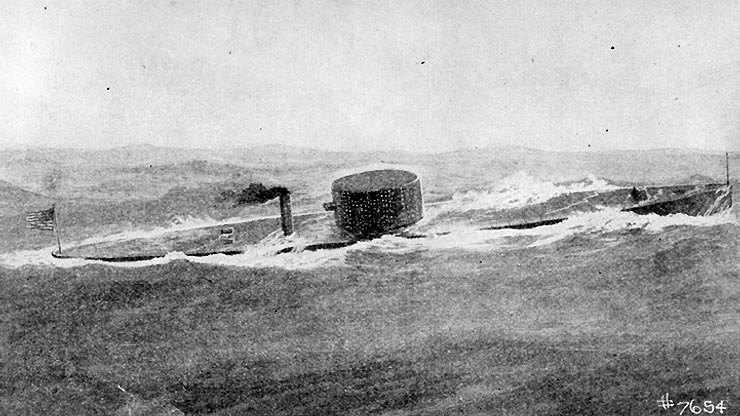
HMS Royal George
still · painting · 1757
age of sail · MDCCLXXXII

HMS Royal George

Spithead, heeled too far, at anchor

cause
capsized
lost
~800-900
depth
20 m

Royal Navy first rate, 100 guns, Admiral Kempenfelt's flagship. Heeled intentionally at Spithead on 29 August 1782 to repair a leak below her waterline; the heel was carried too far, water entered the open gun ports, and she capsized at her anchor. Between 800 and 900 dead, including the admiral and several hundred wives, children, and merchants visiting the ship in harbour. Cowper's poem 'Loss of the Royal George' preserved the catastrophe in English literature.

read the folio →
HMS Queen Charlotte
still · painting · 1794
age of sail · MDCCC

HMS Queen Charlotte

Livorno, hay on a match tub, the magazine

cause
fire · magazine explosion
lost
673
fate
destroyed

Royal Navy first rate, 100 guns, Lord Keith's Mediterranean flagship (her admiral ashore). At anchor off Livorno on the morning of 17 March 1800, loose hay caught on a lit match tub in the cable tier and ignited; the crew could not contain it. She burned four hours before the magazine went up at eleven. 673 dead, nearly every man aboard. The flag captain, Andrew Todd, died with the ship.

read the folio →
HMS Erebus & Terror
still · painting · 1846
age of sail · MDCCCXLV

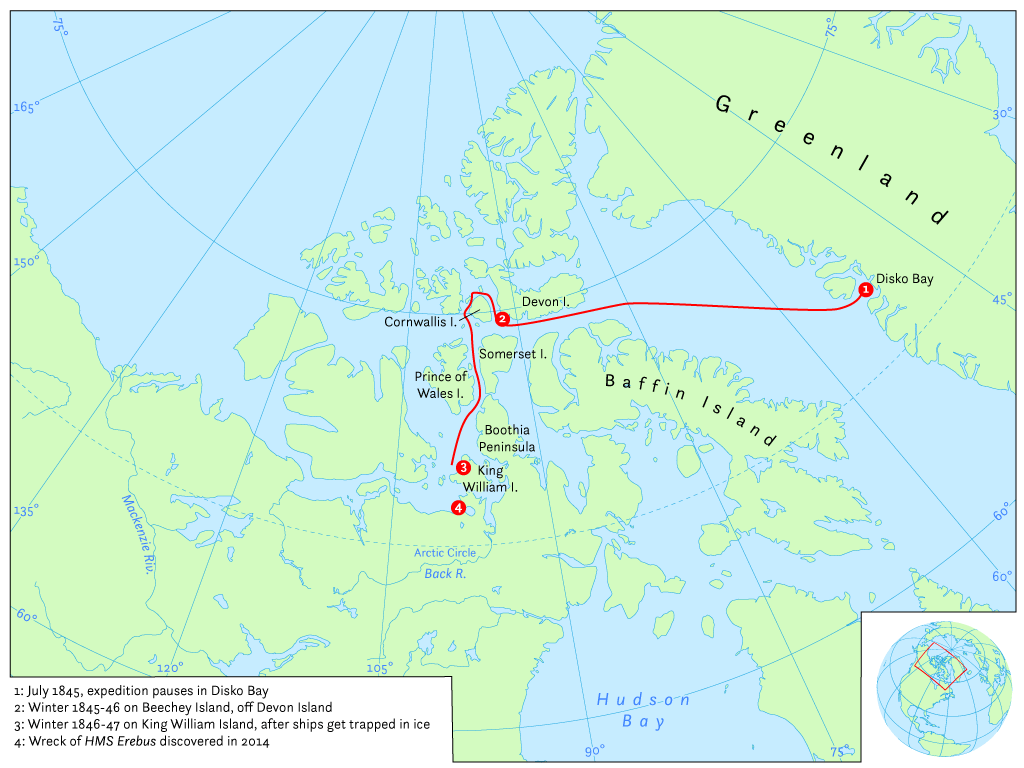
HMS Erebus & Terror

The Franklin Expedition, swallowed by the Arctic

cause
ice · starvation
lost
129
depth
11 m (Erebus) · 24 m (Terror)

Sir John Franklin's expedition to find the Northwest Passage vanished with all hands. Inuit testimony of cannibalism among the final survivors was dismissed by Victorian society and vindicated by 20th-century forensic archaeology. The ships themselves were not found until the 2010s, exactly where the Inuit had always said they were.

read the folio →
HMS Birkenhead
still · painting
age of sail · MDCCCLII

HMS Birkenhead

Danger Point, the Birkenhead drill

cause
grounding
lost
~450
depth
30 m

British troopship, one of the first iron-hulled naval vessels, ferrying reinforcements for the Cape Frontier War. Struck an uncharted rock off Danger Point at two in the morning on 26 February 1852. The senior officer, Lieutenant-Colonel Seton, ordered his soldiers to stand fast on deck so the three boats could take the women and children first. Of 445 aboard, 193 survived. The protocol she accidentally invented, the 'Birkenhead drill', became custom through the age of steam.

read the folio →
USS Cumberland
still · Currier & Ives
age of sail · MDCCCLXII

USS Cumberland

Hampton Roads, the ironclad, the ram

cause
naval ramming
lost
121
depth
18 m

Union Navy sloop, flagship of the Hampton Roads blockade squadron. Rammed and sunk by the Confederate ironclad CSS Virginia on 8 March 1862, one day before USS Monitor arrived. 121 dead; her flag stayed flying as she went down. Her destruction proved that wooden-hulled warships could no longer survive the age of steam and armor, and sent the Union's untested Monitor hurrying south overnight to meet the same adversary.

read the folio →
USS Monitor
still · photograph · 1862
age of sail · MDCCCLXII

USS Monitor

Cape Hatteras, the ironclad that ended sail

cause
storm · foundered
lost
16
depth
70 m

Union Navy ironclad, revolutionary low-freeboard turret ship (a cheesebox on a raft, as her detractors called her). Fought CSS Virginia to a draw at Hampton Roads in March 1862 and ended the age of wooden-hulled naval warfare in a single afternoon. Foundered in a storm off Cape Hatteras on New Year's Eve 1862: 16 dead, 47 rescued by USS Rhode Island. Discovered in 1973 and her turret raised in 2002, now on display at the Mariners' Museum in Virginia.

read the folio →
CSS Alabama
still · illustration
age of sail · MDCCCLXIV

CSS Alabama

Cherbourg, Kearsarge, the Manet painting

cause
naval gunfire
lost
9
depth
58 m

Confederate commerce raider, built clandestinely in Liverpool. Took or destroyed 65 Union merchant ships across two oceans in two years. Brought to battle by USS Kearsarge off Cherbourg on 19 June 1864 and sunk in an hour in the only major Civil War engagement fought in European waters. Édouard Manet painted the duel two weeks later from sketches made at the scene; the wreck was located by the French Navy in 1984.

read the folio →
HMS Captain
still · W.F. Mitchell
age of sail · MDCCCLXX

HMS Captain

Biscay squall, the designer aboard, five minutes

cause
capsized · design flaw
lost
482
depth
600 m (approximate)

Royal Navy experimental turret ship, designed by Captain Cowper Coles against the warnings of the Admiralty's constructors; her freeboard was too low and her top-hamper too heavy. In a Biscay squall on 7 September 1870 she capsized in under five minutes. 482 dead, including Coles himself. The scandal reshaped how the Royal Navy reviewed warship design for a generation.

read the folio →
Cospatrick
still · photograph
age of sail · MDCCCLXXIV

Cospatrick

South Atlantic, the emigrant ship, cannibalism

cause
fire
lost
~470
fate
destroyed

British emigrant clipper, London to Auckland with 429 settlers and their provisions. Fire broke out in the forward hold in the early hours of 17 November 1874 in the South Atlantic. Two lifeboats got away with 62 of the 477 aboard; nine days later, three men were still alive, kept so by the flesh of their dead shipmates. Three survived of 477, and every British emigrant ship thereafter sailed with full lifeboat capacity.

read the folio →
HMS Eurydice
still · painting
age of sail · MDCCCLXXVIII

HMS Eurydice

Isle of Wight, snow squall, two minutes

cause
capsized · storm
lost
317
depth
22 m

Royal Navy training frigate, returning from the West Indies with a crew of young seamen. Caught in a sudden snow squall off the Isle of Wight on the afternoon of 24 March 1878: she heeled with gun ports open and was on her beam ends inside two minutes. 317 dead, two survivors. Raised four months later and then broken up, the Eurydice became the textbook case against sail-era training ships that should have been steam-powered by the time she went down.

read the folio →
RMS Tayleur
still · illustration
age of steam · MDCCCLIV

RMS Tayleur

Iron clipper, compasses wrong, maiden voyage

cause
grounding
lost
~380
depth
18 m

Iron-hulled emigrant clipper, Liverpool to Melbourne on her maiden voyage. Struck Lambay Island off the Dublin coast on 21 January 1854 in thick weather. Her compasses had been thrown off by the iron in her own hull; the crew were inexperienced and understrength for the conditions. 380 of 652 died, the first great iron-hulled disaster and in some tellings the Titanic of the gold-rush era.

read the folio →
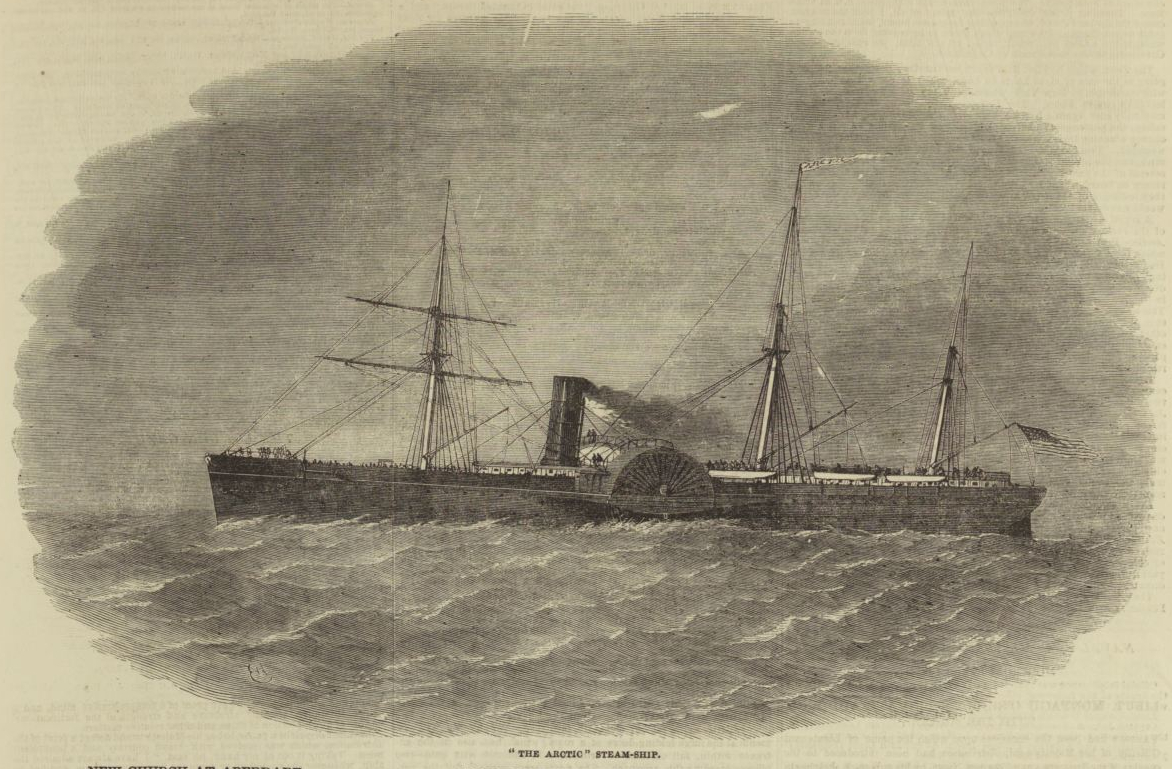
SS Arctic
still · ILN · 1854
age of steam · MDCCCLIV

SS Arctic

Collins Line, no woman survived

cause
collision
lost
~300
depth
4,200 m

Flagship of the American Collins Line, transatlantic paddle steamer. Rammed by the French steamer SS Vesta in fog off the Grand Banks on 27 September 1854, she sank slowly over five hours. The crew seized the lifeboats first; not a single woman or child among the passengers survived, including Captain Luce's twelve-year-old son. The scandal ruined Collins Line within five years.

read the folio →
SS Central America
still · engraving
age of steam · MDCCCLVII

SS Central America

Ship of Gold, the Panic of 1857

cause
hurricane
lost
425
depth
2,200 m

American paddle steamer, Havana to New York with three tons of California gold in her hold. Caught in a hurricane off the Carolinas on 9 September 1857, she foundered on the night of the 12th. 425 dead, 153 rescued. The loss of her gold contributed directly to the Panic of 1857, the first worldwide financial crisis; recovered in 1988 by Tommy Thompson, who later went to federal prison for refusing to disclose the whereabouts of the missing coins.

read the folio →
SS Austria
still · lithograph · 1857
age of steam · MDCCCLVIII

SS Austria

Boiling pitch, mid-Atlantic, ten minutes

cause
fire
lost
449
depth
abyssal · not located

Hamburg America emigrant steamer, Hamburg to New York with German and Slavic passengers in steerage. On 13 September 1858 a crewman fumigating the lower decks with boiling pitch dropped his pot; the tar ignited the deck and the fire raced through the ship in under ten minutes. 449 dead of 538. Ninety men were picked up by a passing Norwegian barque; most of the rest burned or drowned.

read the folio →
PS Lady Elgin
still · lithograph
age of steam · MDCCCLX

PS Lady Elgin

Great Lakes, the schooner Augusta

cause
collision
lost
~300
depth
18 m

Great Lakes paddle steamer, Milwaukee to Chicago with an excursion of Irish-American militia and their families. Struck by the lumber schooner Augusta in a Lake Michigan squall at 02:30 on 8 September 1860, she broke in half and went down in twenty minutes. About 300 died, the deadliest open-water disaster in Great Lakes history. The loss led directly to the requirement that Great Lakes passenger vessels carry life preservers for every person aboard.

read the folio →
CSS H.L. Hunley
still · Chapman · 1863
age of steam · MDCCCLXIV

CSS H.L. Hunley

Charleston, the first combat submarine, the spar torpedo

cause
unknown · post-attack loss
lost
8
depth
8 m

Confederate submarine, hand-cranked by a crew of eight, armed with a spar torpedo on a ten-metre pole. On the night of 17 February 1864 off Charleston, she became the first submarine in history to sink an enemy warship, putting her torpedo into the Union sloop USS Housatonic. She never returned. Recovered in 2000 and conserved for twenty years; analysis suggests the crew were stunned unconscious by the shock of their own torpedo transmitted through the water and drowned at their stations.

read the folio →
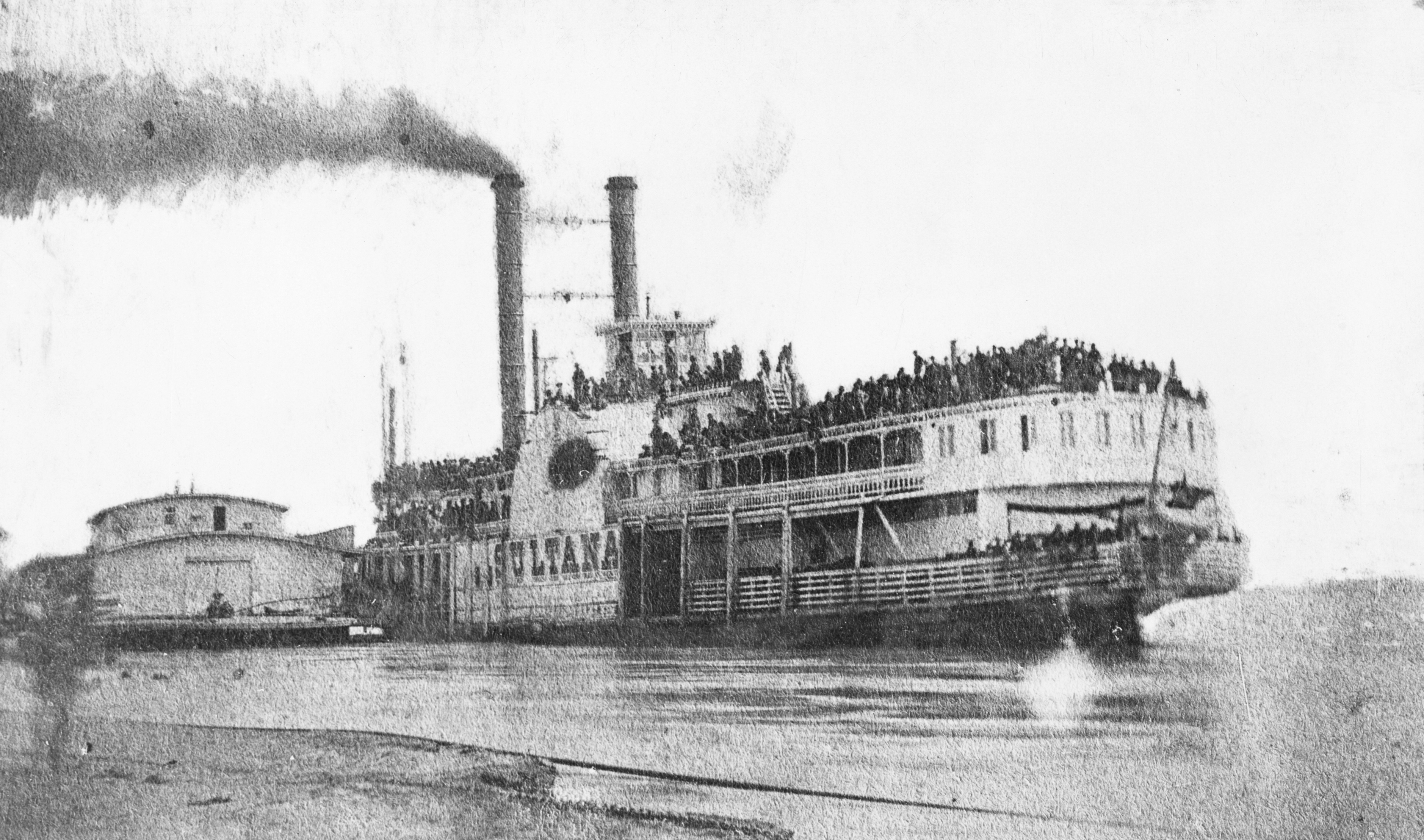
SS Sultana
still · photograph · 1865
age of steam · MDCCCLXV

SS Sultana

The forgotten American maritime disaster

cause
boiler explosion
lost
~1,167
fate
destroyed

Mississippi steamboat carrying Union POWs home from Confederate prison camps. Designed to carry 376; 2,100 were aboard. Three of four boilers exploded at 2 a.m. north of Memphis. More Americans died than on the Titanic. Lost beneath news of John Wilkes Booth's death the same week.

read the folio →
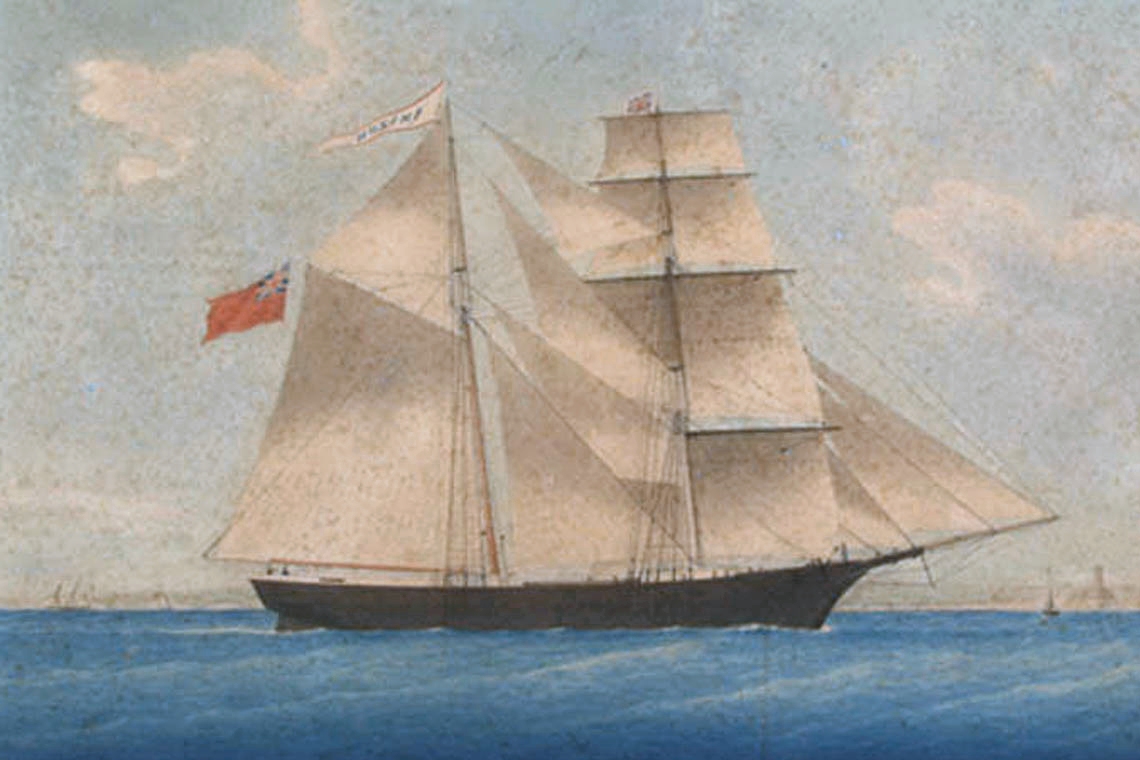
Mary Celeste
still · as Amazon · 1861
age of steam · MDCCCLXXII

Mary Celeste

The ghost ship of the Atlantic

cause
abandoned at sea
lost
~10 (vanished)
depth
never wrecked on this voyage

American brigantine, Staten Island to Genoa with 1,701 barrels of denatured alcohol. Discovered 600 miles west of Portugal on 4 December 1872, sailing under reduced canvas with nobody aboard. The captain, his wife, their two-year-old daughter, and seven crew had vanished from the ship with her boat; no trace of them was ever found. The most durable theory is a feared alcohol-vapour explosion that drove them into the lifeboat, which was then lost in tow.

read the folio →
SS Atlantic
still · sister ship Oceanic
age of steam · MDCCCLXXIII

SS Atlantic

Nova Scotia, coal running low, no women saved

cause
grounding
lost
~560
depth
15 m

White Star Line transatlantic liner, Liverpool to New York, diverted to Halifax for coal when a winter storm slowed her passage. Struck Marr's Rock off Meagher's Island, Nova Scotia, at 03:15 on 1 April 1873 and broke up in heavy seas. Between 535 and 562 died, the worst transatlantic maritime disaster until the same company's Titanic went down 39 years later. Every woman and all but one child aboard were lost.

read the folio →
SS Pacific
still · photograph
age of steam · MDCCCLXXV

SS Pacific

Cape Flattery, rotten frames, two survived

cause
collision
lost
~300
depth
unknown

American sidewheel steamer, Victoria to San Francisco. Collided with the sailing barque SS Orpheus off Cape Flattery at 21:30 on 4 November 1875; she had been reported rotten in her frames before departure and was overloaded with passengers returning from the Cassiar gold rush. Two survived of roughly 300 aboard. The worst maritime disaster on the American West Coast to that date.

read the folio →
PS Princess Alice
still · Bywell Castle, Deptford
age of steam · MDCCCLXXVIII

PS Princess Alice

Thames, sewage in the water, four minutes

cause
collision
lost
~645
depth
10 m

London Steamboat Company paddle steamer, returning to North Woolwich from a day excursion to Sheerness. Struck on the starboard bow by the collier Bywell Castle in the Thames at Gallions Reach at 19:40 on 3 September 1878. Sank in under four minutes, 600 to 700 drowned or poisoned. The sewage outfalls at Crossness and Barking had been discharging for an hour before the collision; survivors pulled from the river died of the water in their lungs in the days after.

read the folio →
USS Jeannette
still · NH-52199
age of steam · MDCCCLXXXI

USS Jeannette

Arctic ice, De Long, wreckage across the pole

cause
ice
lost
20
depth
abyssal · not recovered

Naval steam yacht of the U.S. Navy, purchased by the New York Herald for Lieutenant George De Long's 1879 expedition to reach the North Pole via the Bering Strait. Trapped in pack ice north of the New Siberian Islands for twenty-one months before the floes finally crushed her hull. She sank through the ice on 12 June 1881; the survivors walked for months across the Arctic, De Long and thirteen others dying of starvation in the Lena delta. Wreckage from the Jeannette drifted across the pole and washed up on Greenland three years later, the proof Fridtjof Nansen needed for the theory that would produce his Fram expedition.

read the folio →
SS Utopia
still · engraving · 1891
age of steam · MDCCCXCI

SS Utopia

Gibraltar, the ram of HMS Anson, twenty minutes

cause
collision
lost
562
depth
17 m

Anchor Line Italian emigrant steamer, Trieste to New York with 813 passengers. In a March gale in Gibraltar Bay on the night of 17 March 1891, her captain misjudged the distance to the moored British battleship HMS Anson; the Anson's ram bow tore a hole in her port side below the waterline. 562 dead of around 880 aboard. Twenty minutes from collision to sinking.

read the folio →
HMS Victoria
still · W.F. Mitchell
age of steam · MDCCCXCIII

HMS Victoria

Tripoli, the admiral's own order

cause
collision
lost
358
depth
140 m

Royal Navy battleship, flagship of the Mediterranean Fleet under Vice-Admiral Sir George Tryon. On 22 June 1893 off Tripoli in Lebanon, Tryon ordered two columns of battleships to turn inward toward each other; HMS Camperdown's ram struck her starboard bow, and she rolled over and sank in fifteen minutes. 358 dead, including Tryon, who reportedly said 'It was entirely my fault' as the deck tilted beneath them. A court martial cleared the surviving officers: the admiral's order had been so obviously wrong that no one had been brave enough to disobey it.

read the folio →
USS Maine
still · photograph · 1898
age of steam · MDCCCXCVIII

USS Maine

Havana harbor, remember the Maine

cause
explosion · disputed
lost
266
depth
11 m (raised 1911)

U.S. Navy armored cruiser, sent to Havana to protect American interests during the Cuban War of Independence. Exploded at her anchor at 21:40 on 15 February 1898; her forward third was torn open and she sank in shallow water. 266 dead, two-thirds of her crew. 'Remember the Maine' became the war cry that pushed the United States into conflict with Spain two months later, though modern analysis suggests the explosion was almost certainly a spontaneous coal bunker fire rather than a Spanish mine.

read the folio →
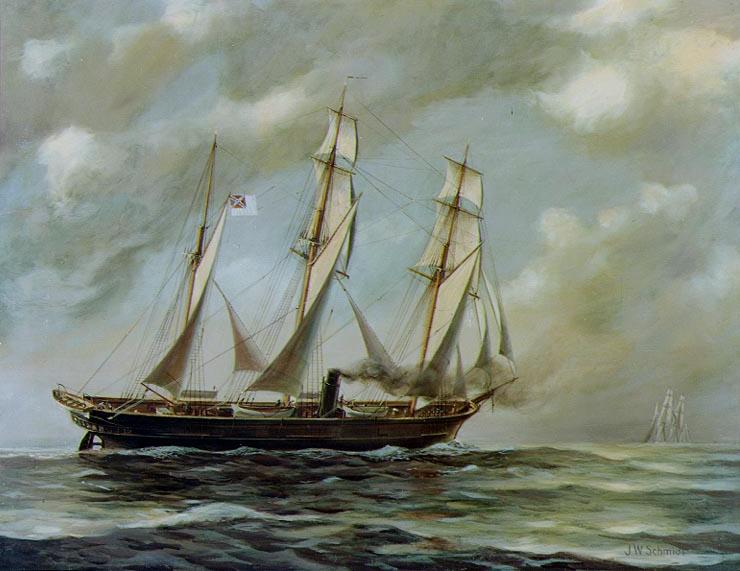
SS La Bourgogne
still · photograph · c.1895
age of steam · MDCCCXCVIII

SS La Bourgogne

Sable Island fog, crew with the oars

cause
collision
lost
549
depth
30 m

French Line transatlantic liner, New York to Le Havre. Rammed in dense fog by the British sailing ship Cromartyshire off Sable Island on 4 July 1898 and sank in thirty minutes. 549 dead, including every child and all but one woman aboard; the French crew seized the lifeboats, beating passengers back with oars, and were widely reviled in the press of two continents. The disaster was a scar on the French merchant marine for decades.

read the folio →
PS General Slocum
still · photograph
age of steam · MCMIV

PS General Slocum

East River, church excursion, rotten vests

cause
fire
lost
1,021
fate
destroyed

Sidewheel paddle steamer chartered by a German-Lutheran Sunday school on the Lower East Side for their annual summer outing. Fire broke out in a forward locker at 10:00 on 15 June 1904; the captain ran for shore instead of beaching, feeding the flames. Life preservers rotten, fire hoses perished, crew never drilled. 1,021 dead, overwhelmingly women and children: the worst disaster New York City would know until September 2001.

read the folio →
SS Norge
still · photograph
age of steam · MCMIV

SS Norge

Rockall, the deadliest before Titanic

cause
grounding
lost
~635
depth
70 m

Danish emigrant liner, Copenhagen to New York with Scandinavian and Russian passengers in steerage. Struck the uncharted Hasselwood Rock in the North Atlantic off Rockall at 07:45 on 28 June 1904 and sank in twenty minutes. 635 of 794 aboard died, the deadliest civilian loss on the North Atlantic until the Titanic eight years later. Remembered in Scandinavia, almost forgotten elsewhere.

read the folio →
Petropavlovsk
still · postcard
age of steam · MCMIV

Petropavlovsk

Port Arthur, the mine, Makarov and Vereshchagin

cause
mine
lost
~635
depth
35 m

Russian pre-dreadnought battleship, flagship of the Pacific Squadron at Port Arthur. Struck Japanese mines off the harbour entrance on 13 April 1904; the forward magazine ignited and she went over in under two minutes. 635 dead, 80 rescued, including Vice-Admiral Stepan Makarov (the most respected officer in the Imperial Russian Navy) and the war artist Vasily Vereshchagin, painting the harbour from the afterdeck as she capsized. The Russian Pacific Fleet never recovered; eighteen months later the Baltic Fleet was annihilated at Tsushima.

read the folio →
SS Valencia
still · photograph
age of steam · MCMVI

SS Valencia

Graveyard of the Pacific, two days within sight of shore

cause
grounding
lost
136
depth
destroyed on reef

American coastal liner, San Francisco to Seattle. In thick weather off Vancouver Island on 22 January 1906, she ran past the Cape Beale light and struck the rocks of Pachena Point, where the seas destroyed her over two days within sight of shore. 136 of roughly 180 aboard died. The catastrophe pushed the Canadian government to build the Pachena Lighthouse, construct what became the West Coast Trail, and charter a permanent lifesaving service along the 'Graveyard of the Pacific'.

read the folio →
RMS Republic
still · photograph
age of steam · MCMIX

RMS Republic

Nantucket, the first CQD

cause
collision
lost
6
depth
75 m

White Star Line transatlantic liner, New York to Mediterranean, rammed in fog off Nantucket by the Italian liner Florida at 05:40 on 23 January 1909. Wireless operator Jack Binns tapped out the first CQD distress call ever sent at sea; the signal was received at Siasconset and relayed to rescue ships hours before the Republic finally went down. Six dead. The incident turned the wireless into the indispensable safety instrument of the twentieth century.

read the folio →
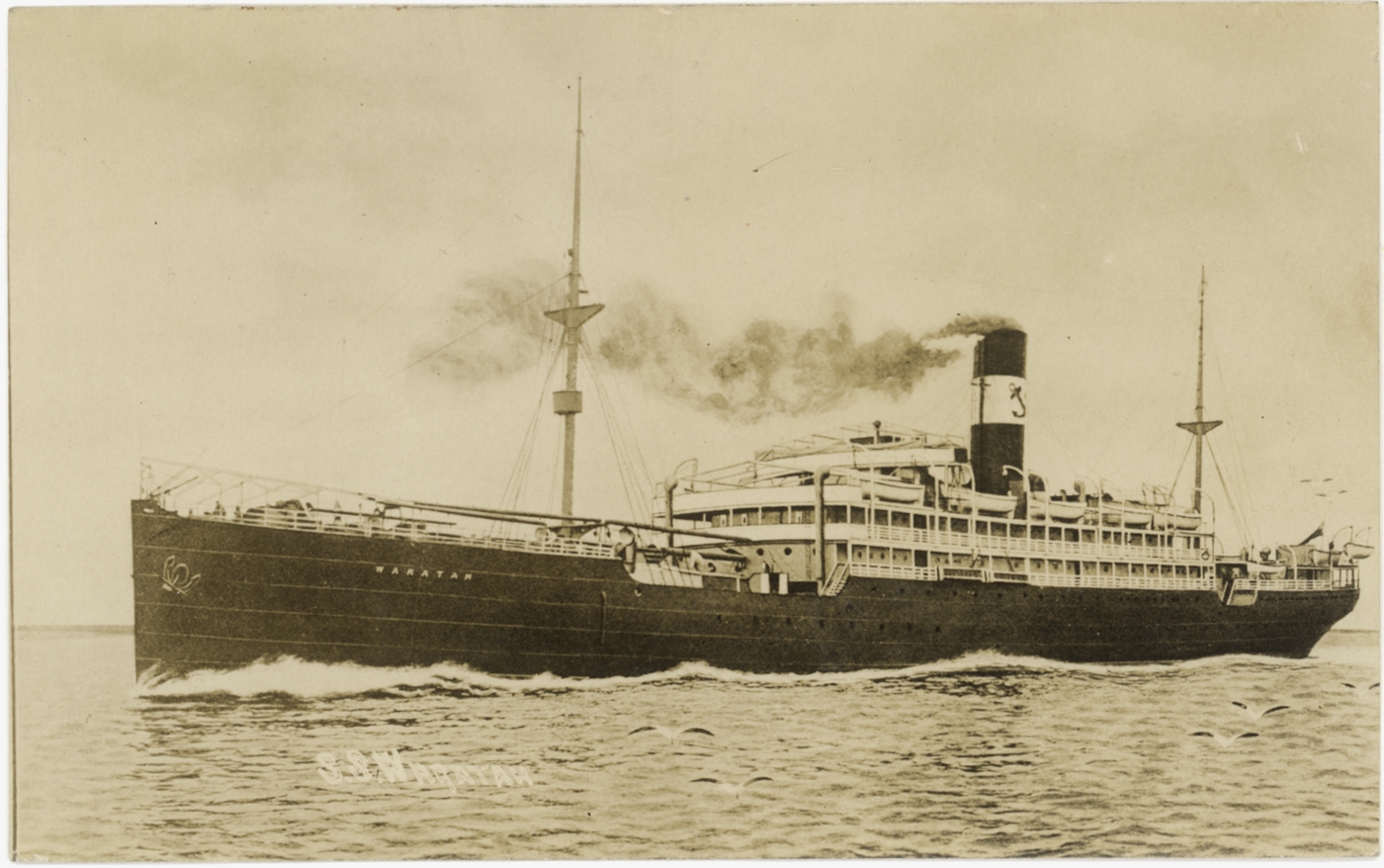
SS Waratah
still · photograph
age of steam · MCMIX

SS Waratah

The Wild Coast, never found, Australia's Titanic

cause
unknown
lost
211
depth
never found

Blue Anchor Line passenger-cargo ship, Durban to Cape Town. Sailed into heavy weather on the night of 27 July 1909 and was never seen again. 211 aboard vanished without trace. Suspicion has centred on a top-heavy design and excessive metacentric height, but no wreck has ever been confirmed; known in Australia as 'Australia's Titanic', the disappearance remains one of the great unsolved maritime mysteries of the twentieth century.

read the folio →
video · WHOI 1986
age of steam · MCMXII

RMS Titanic

The unsinkable, at 41°43'N 49°56'W

cause
iceberg
lost
~1,517
depth
3,800 m

Struck starboard side at 23:40 on 14 April 1912. Sank in two hours and forty minutes. The deadliest peacetime maritime disaster of the 20th century to that date. Led directly to SOLAS (1914), the first international convention for safety at sea. Found by Ballard in 1985.

read the folio →
SS Charles S. Price
still · photograph
age of steam · MCMXIII

SS Charles S. Price

Lake Huron, the White Hurricane, turtled

cause
storm
lost
28
depth
61 m

Great Lakes bulk freighter, 524 feet, steel hull, coal cargo. Vanished in the Great Lakes Storm of November 1913, the 'White Hurricane' that killed more than 250 mariners across the lakes in sixteen hours. Found two days later floating upside down like a dead whale, her propeller turning slowly in the air. All 28 crew lost; the only body identified was the cook, washed ashore still wearing his white apron.

read the folio →
RMS Empress of Ireland
still · colourised
age of steam · MCMXIV

RMS Empress of Ireland

St. Lawrence, dense fog, fourteen minutes

cause
collision
lost
1,012
depth
40 m

Canadian Pacific liner, outbound from Quebec City for Liverpool. Rammed in fog on the St. Lawrence by the Norwegian collier Storstad at 01:55 on 29 May 1914, she sank in fourteen minutes with most passengers trapped in their cabins. 1,012 dead; more paying passengers were lost than on the Titanic. The Great War began two months later and the wreck was forgotten outside Canada.

read the folio →
HMS Bulwark
still · photograph
age of steam · MCMXIV

HMS Bulwark

Sheerness, the cordite overheated, seconds

cause
magazine explosion
lost
736
depth
11 m

Royal Navy pre-dreadnought battleship, moored in the Medway estuary at Sheerness. At 07:53 on 26 November 1914, during routine work, her forward cordite magazine detonated spontaneously and she disintegrated in seconds. 736 dead of around 750 aboard; fourteen survivors, all blown clear into the water. Investigation blamed cordite stored against a boiler-room bulkhead and overheated over months of service.

read the folio →
Karluk
still · photograph
age of steam · MCMXIV

Karluk

Chukchi pack, Stefansson's hunt, Bartlett's walk

cause
ice
lost
11
depth
crushed through ice

Canadian Arctic Expedition flagship, a former whaler under Vilhjalmur Stefansson. Trapped in Chukchi Sea pack ice in August 1913; Stefansson left the ship two months later on what he called a hunting trip and never returned, and the ice crushed her on 11 January 1914. Captain Bob Bartlett marched the survivors south across the ice to Wrangel Island, then continued alone by sledge to Siberia to find a rescue. Of 25 aboard when she left the ice, 11 died before rescue arrived; Stefansson was reprimanded but never prosecuted.

read the folio →
HMHS Britannic
still · photograph
age of steam · MCMXVI

HMHS Britannic

Titanic's sister, the hospital ship, the Aegean

cause
mine
lost
30
depth
122 m

The third Olympic-class liner, converted to a hospital ship. Struck a German mine off the Greek island of Kea. Sank in 55 minutes (Titanic took 160) because she was built with the lessons learned. The largest passenger ship lost in WWI. Survived by Violet Jessop, who had also survived the Titanic and an earlier Olympic collision.

read the folio →
SMS Zenta
still · NH-87365
world wars · MCMXIV

SMS Zenta

The first naval loss of the Great War

cause
naval gunfire
lost
173
depth
70 m

Austro-Hungarian protected cruiser, patrolling the Adriatic at the opening of the war. Cornered by the combined French and British Mediterranean fleet at the Battle of Antivari off Bar, Montenegro, on 16 August 1914; outnumbered and outgunned, her captain refused to strike his colours. The first naval loss of the First World War. 173 dead; around 130 picked up by Montenegrin fishermen.

read the folio →
HMS Aboukir, Hogue & Cressy
still · HMS Aboukir at Malta
world wars · MCMXIV

HMS Aboukir, Hogue & Cressy

U-9, Weddigen, seventy-five minutes

cause
submarine torpedo
lost
~1,459
depth
30 m

Three Cressy-class armoured cruisers of the Royal Navy, patrolling the southern North Sea off the Dutch coast on the morning of 22 September 1914. Torpedoed inside 75 minutes by U-9 under Kapitänleutnant Otto Weddigen, who hit the Aboukir, waited for Hogue and Cressy to stop for rescue, and torpedoed them too. 1,459 dead across three hulls. The catastrophe taught the Admiralty that stopping to rescue survivors in a submarine war would kill you.

read the folio →
HMS Good Hope
still · photograph
world wars · MCMXIV

HMS Good Hope

Coronel, von Spee, no survivors

cause
naval gunfire
lost
~900
depth
abyssal · not located

Drake-class armoured cruiser, flagship of Rear-Admiral Sir Christopher Cradock's South Atlantic squadron. Engaged by Vice-Admiral Graf Maximilian von Spee's German East Asia Squadron off Coronel on the Chilean coast at 19:50 on 1 November 1914. No survivors, Cradock included. The first British naval defeat since the American Revolution; the Royal Navy's response, six weeks later off the Falklands, destroyed von Spee's entire force.

read the folio →
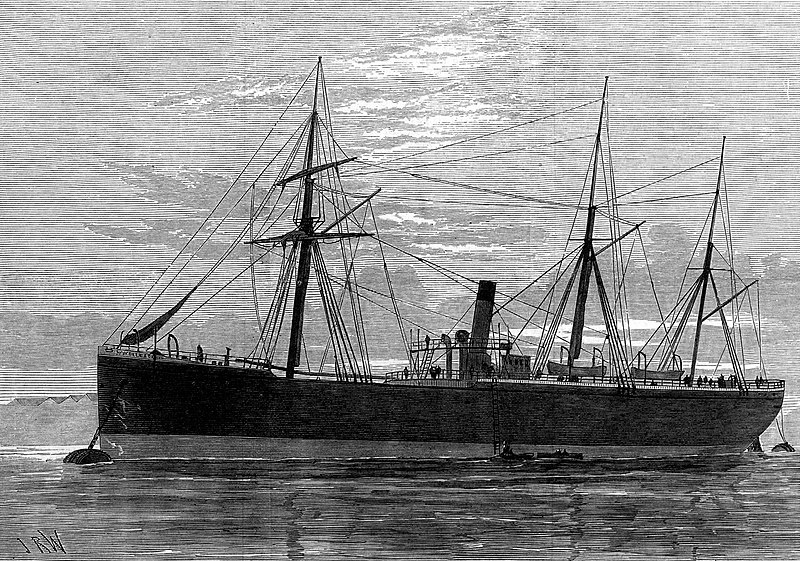
HMS Audacious
still · IWM Q-75212
world wars · MCMXIV

HMS Audacious

Lough Swilly mine, the Olympic stood by

cause
mine
lost
1
depth
67 m

Royal Navy super-dreadnought, commissioned less than a year when she struck a German mine off Lough Swilly, Ireland, on 27 October 1914. The fire crept toward her magazine over twelve hours; Cunard's Olympic, sister of the Titanic, tried to take her in tow in vain. The only casualty was a petty officer aboard HMS Liverpool hit by a fragment from the final magazine explosion. The Admiralty kept the news secret until after the 1918 Armistice for reasons of naval morale.

read the folio →
SMS Scharnhorst
still · Arthur Renard
world wars · MCMXIV

SMS Scharnhorst

Falklands, von Spee avenged six weeks late

cause
naval gunfire
lost
~860
depth
1,610 m

Flagship of Vice-Admiral Graf Maximilian von Spee and victor of the Battle of Coronel on 1 November 1914. Five weeks later at the Battle of the Falklands on 8 December, caught by the British battlecruisers Invincible and Inflexible with their superior heavy guns. ~860 dead, no survivors, including von Spee and his two sons. Located by Mensun Bound in 2019 at a depth of 1,610 metres.

read the folio →
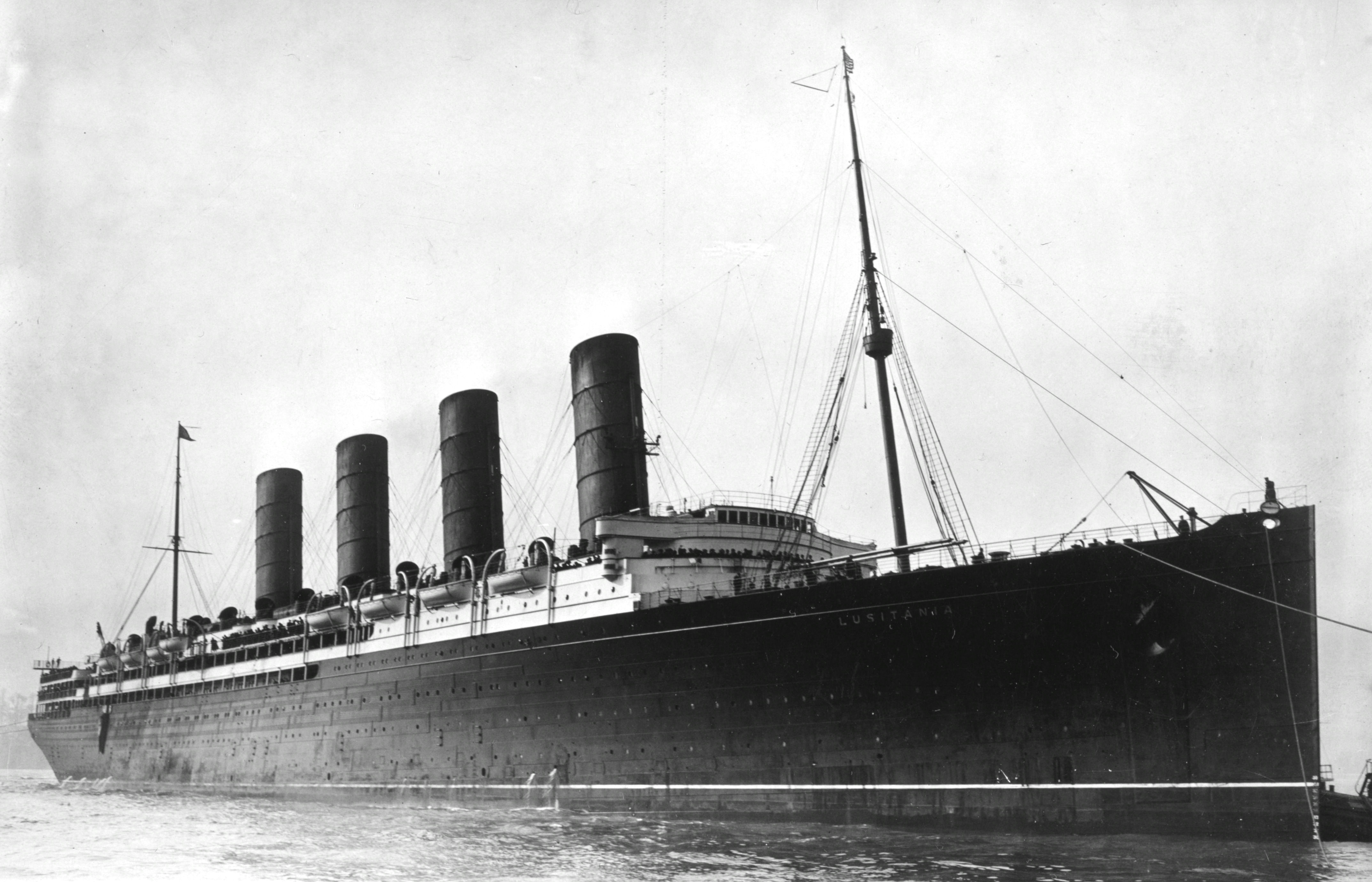
RMS Lusitania
still · photograph · 1907
world wars · MCMXV

RMS Lusitania

The torpedo that rewrote the Great War

cause
u-boat torpedo
lost
1,198
depth
93 m

Torpedoed by U-20 off the Old Head of Kinsale. A secondary explosion sank her in 18 minutes. 128 of the dead were American civilians. The sinking hardened U.S. opinion against Germany and pushed Washington toward intervention two years later. The secondary-explosion cause remains disputed to this day.

read the folio →
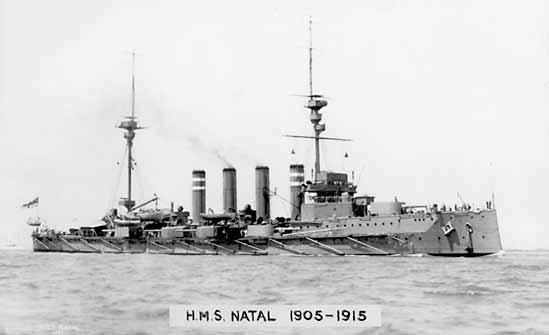
HMS Natal
still · photograph
world wars · MCMXV

HMS Natal

Cromarty, the children's film, the magazine

cause
magazine explosion
lost
421
depth
20 m

Royal Navy armoured cruiser, anchored at Cromarty Firth for the Christmas holiday in 1915. At 15:30 on 30 December, her after magazine detonated spontaneously during a film screening arranged for the crew's children. 421 dead, including the captain's wife and several civilian guests aboard for the afternoon. The cause was traced to deteriorated cordite propellant stored too close to the boiler room bulkheads, the same defect that had destroyed HMS Bulwark thirteen months earlier.

read the folio →
SMS Blücher
still · bundesarchiv
world wars · MCMXV

SMS Blücher

Dogger Bank, capsized under cheering gunners

cause
naval gunfire
lost
792
depth
40 m

German armoured cruiser, the fastest of her class, caught by the British battlecruiser force at the Battle of Dogger Bank on 24 January 1915. Struck by over seventy British shells across three hours, she listed progressively, burning, but kept firing. She capsized at 12:07 while still shooting; the photograph of her rolling belly-up with her crew scrambling along her keel became the iconic image of naval firepower in the Great War. 792 dead; the British rescue effort was abandoned when a Zeppelin was mis-identified as a bombing attack.

read the folio →
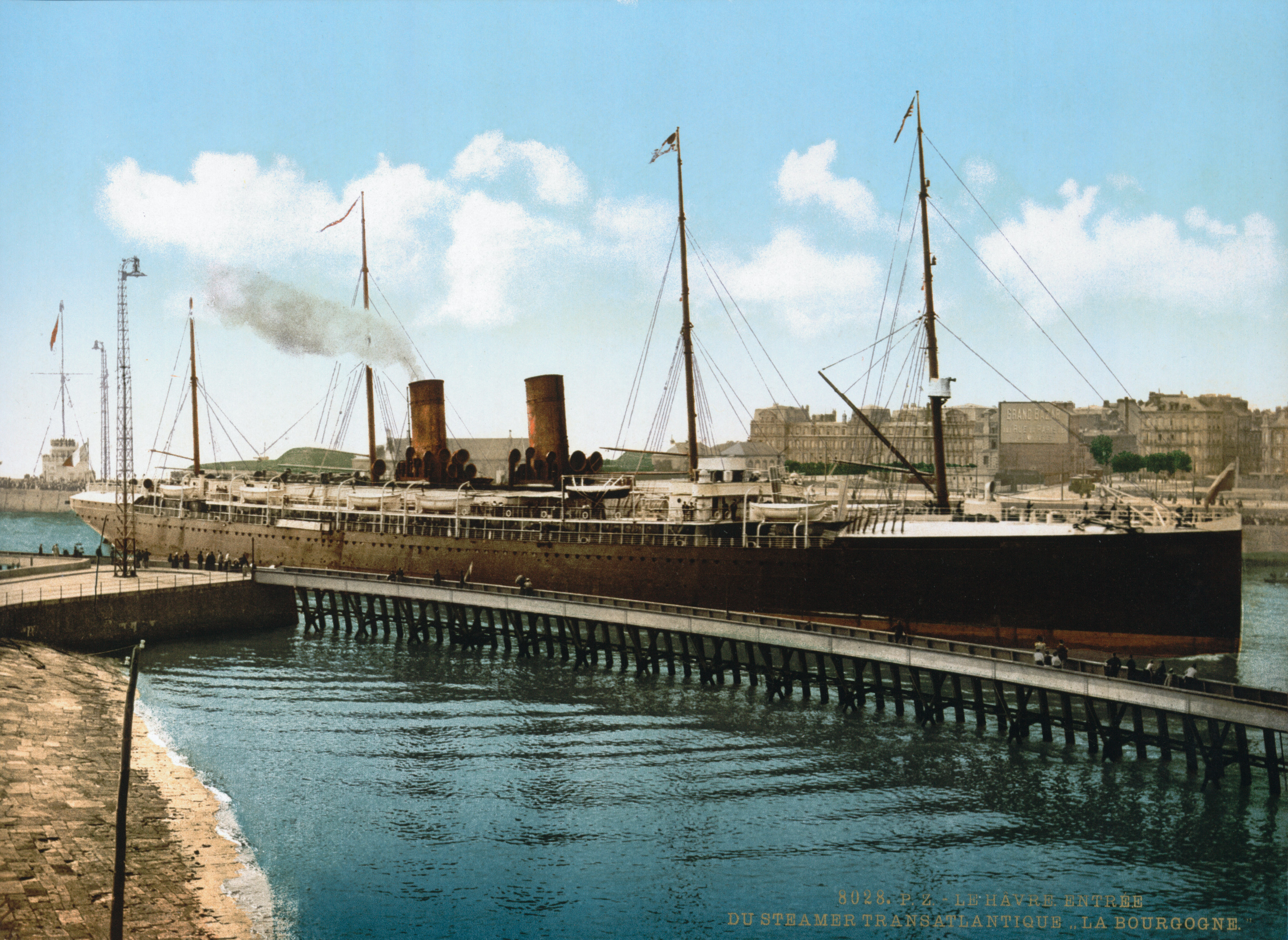
HMS Hampshire
still · photograph · 1903
world wars · MCMXVI

HMS Hampshire

Marwick Head, Kitchener aboard, twelve survived

cause
mine
lost
737
depth
65 m

Royal Navy armoured cruiser, carrying Lord Kitchener, Secretary of State for War and the face of the recruiting poster, on a diplomatic mission to Russia. Struck a mine laid by U-75 off Marwick Head, Orkney, at 19:40 on 5 June 1916 in a force-nine gale, and sank in fifteen minutes. 737 dead of 749, including Kitchener; twelve men made it ashore on a coast where the Admiralty had turned local rescuers back until morning. The loss became the centrepiece of British conspiracy theories about the war for a generation.

read the folio →
HMS Queen Mary
still · photograph
world wars · MCMXVI

HMS Queen Mary

Jutland, the Derfflinger salvo, ninety seconds

cause
naval gunfire · magazine explosion
lost
1,266
depth
60 m

Royal Navy battlecruiser at the Battle of Jutland. Struck by two quick German salvoes on the afternoon of 31 May 1916; her forward and after magazines went up together and she blew apart in ninety seconds. 1,266 dead, nine survivors. Vice-Admiral Beatty, watching from HMS Lion, said to his flag captain, 'There seems to be something wrong with our bloody ships today.' Three British battlecruisers died the same way that afternoon.

read the folio →
HMS Invincible
still · photograph
world wars · MCMXVI

HMS Invincible

Jutland, the first battlecruiser, Q turret

cause
naval gunfire · magazine explosion
lost
1,026
depth
55 m

The first battlecruiser ever built and type-ship of a new class of warship. At the Battle of Jutland on the evening of 31 May 1916 a German salvo from SMS Derfflinger penetrated her Q turret and exploded the adjacent magazine; she broke in half inside ninety seconds. 1,026 dead, six survivors. Rear-Admiral Sir Horace Hood, Nelson's great-great-grandson, died on the bridge.

read the folio →
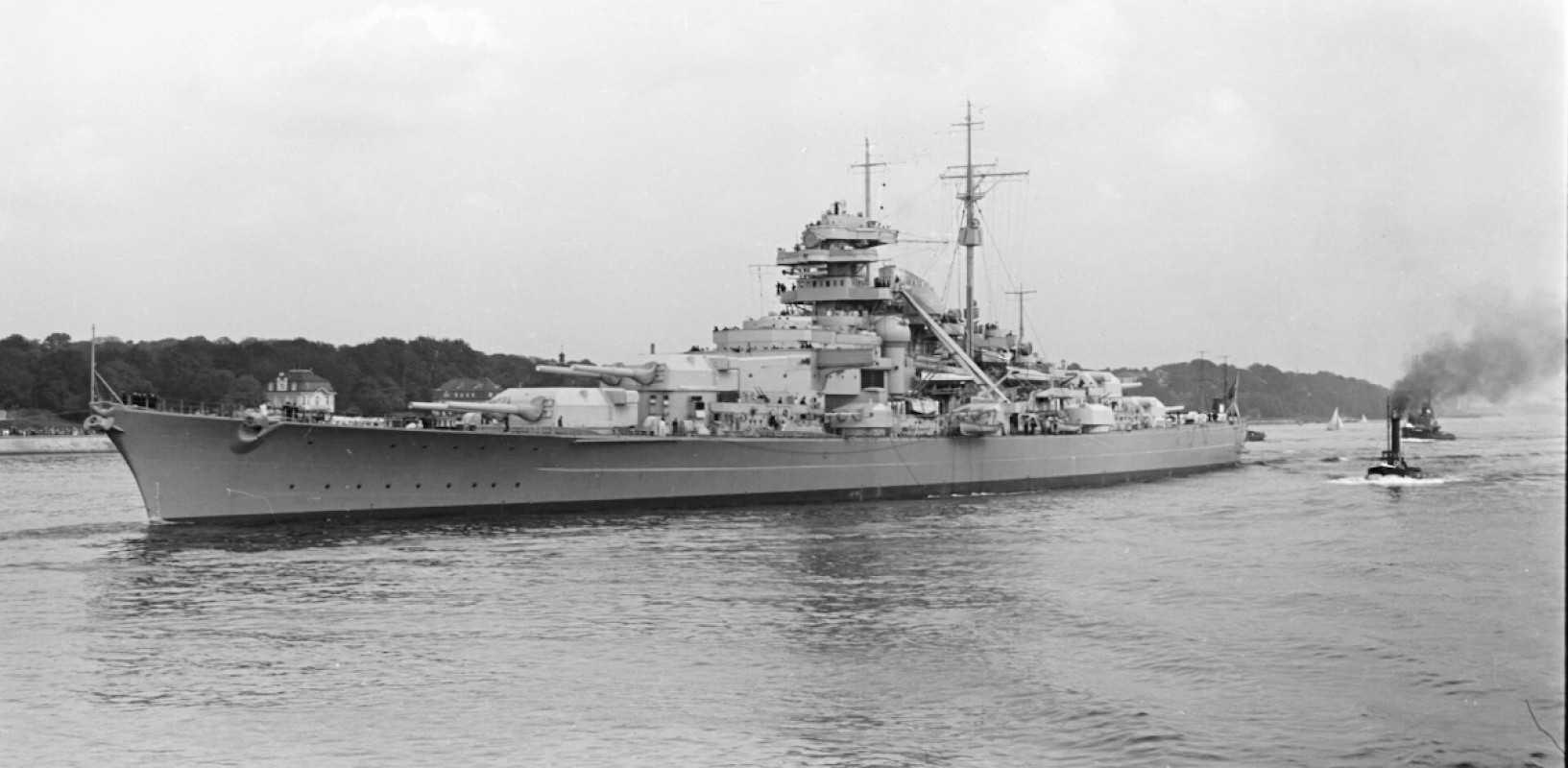
HMS Black Prince
still · IWM Q-75294
world wars · MCMXVI

HMS Black Prince

Jutland, the night engagement, all hands

cause
naval gunfire
lost
857
depth
55 m

Royal Navy armoured cruiser, separated from the 1st Cruiser Squadron during the night phase of the Battle of Jutland. At 00:10 on 1 June 1916 she blundered into the German battle line at point-blank range. Destroyed in fifteen minutes by combined fire from four German dreadnoughts; no survivors of her crew of 857. The worst-ever Royal Navy loss with no survivors; only HMS Hood the following war would exceed the toll in any single engagement.

read the folio →
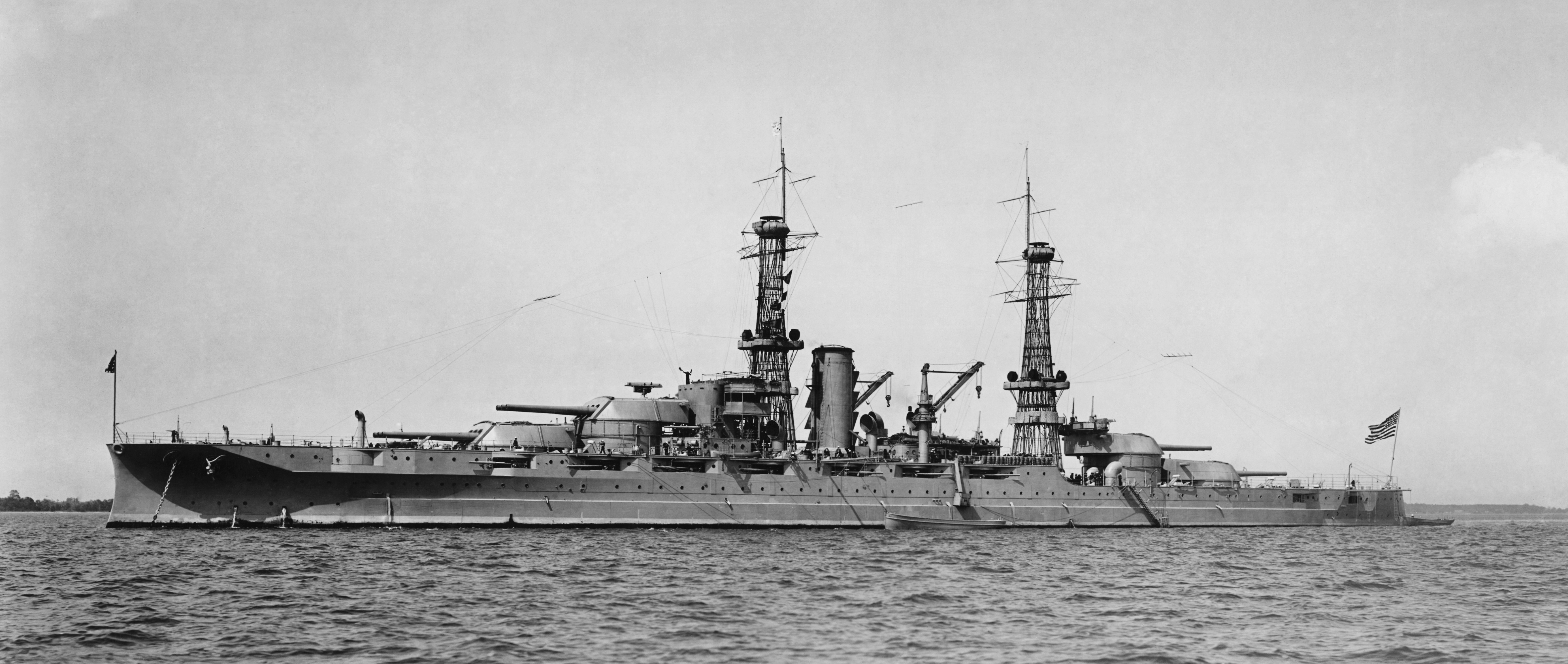
RMS Laconia
still · photograph · 1912
world wars · MCMXVII

RMS Laconia

Fastnet torpedo, the American women

cause
submarine torpedo
lost
12
depth
3,300 m

Cunard passenger liner, Boston to Liverpool. Torpedoed by SM U-50 off the Fastnet Rock at 22:30 on 25 February 1917, five weeks before the United States entered the Great War. Twelve dead, including two American women lost in the sea that night, Mary E. Hoy and her daughter Elizabeth of Chicago. The specific circumstances of their deaths, reported in the American press with calculated detail, were among the events that pushed the Wilson administration into the war six weeks later.

read the folio →
SS Mendi
still · photograph
world wars · MCMXVII

SS Mendi

Isle of Wight fog, the Darro did not stop

cause
collision
lost
646
depth
42 m

British troop transport, carrying the South African Native Labour Corps, 616 black South Africans bound for the Western Front. Rammed in fog in the English Channel by the Royal Mail Line's Darro on the morning of 21 February 1917. 646 dead, mostly men from the Xhosa, Mpondo, Basotho, and Zulu homelands, and the Darro did not stop to rescue. Suppressed by white South Africa for eighty years; today her memorial at Hollybrook Cemetery is the centrepiece of the South African state's war-dead commemoration.

read the folio →
SS Tuscania
still · photograph
world wars · MCMXVIII

SS Tuscania

North Channel, the first American troopship

cause
submarine torpedo
lost
210
depth
123 m

Anchor Line transatlantic liner converted to a troop transport, carrying American Expeditionary Force reinforcements to France. Torpedoed by UB-77 in the North Channel off Rathlin Island at 17:40 on 5 February 1918. The first American troopship torpedoed in the war. 210 dead, including 166 American soldiers, and the Islay crofters who buried the bodies of the American dead became local heroes.

read the folio →
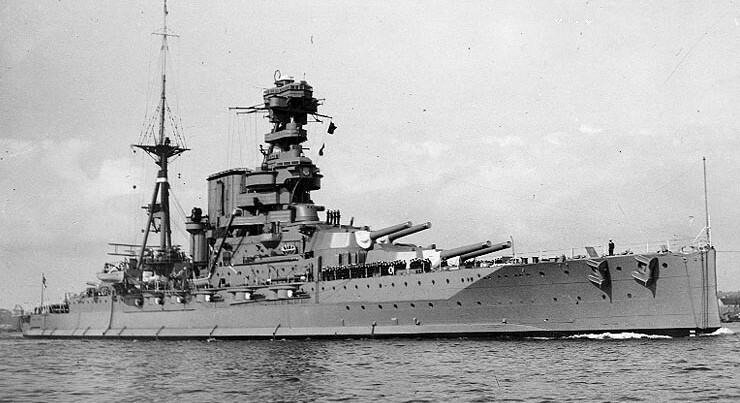
HMHS Llandovery Castle
still · postcard
world wars · MCMXVIII

HMHS Llandovery Castle

Hospital ship, the machine guns on the boats

cause
submarine torpedo · war crime
lost
234
depth
abyssal · not located

Canadian hospital ship, returning from Halifax with medical personnel. Torpedoed by U-86 off southern Ireland on the night of 27 June 1918 despite her unmistakable markings; Kapitänleutnant Helmut Patzig then surfaced and opened machine-gun fire on the lifeboats to eliminate witnesses. 234 of 258 dead. Patzig was named at the Leipzig war crimes trials in 1921 but evaded prosecution by escaping to Danzig.

read the folio →
RMS Leinster
still · photograph · 1897
world wars · MCMXVIII

RMS Leinster

Irish Sea, four weeks from armistice

cause
submarine torpedo
lost
564
depth
35 m

City of Dublin Steam Packet Company mail boat, Dublin to Holyhead. Torpedoed twice by UB-123 off the Kish Lightship at 09:50 on 10 October 1918, in the final month of the war. 564 dead of 771 aboard, including mothers and children returning from visiting soldiers in British hospitals. The worst disaster in the history of the Irish Sea; the Armistice came four weeks later.

read the folio →
SMS Szent István
still · photograph
world wars · MCMXVIII

SMS Szent István

Premuda, MAS-15, the sinking on film

cause
motor torpedo boat
lost
89
depth
66 m

Austro-Hungarian Tegetthoff-class dreadnought, sailing south to attack the Otranto Barrage. Ambushed by Luigi Rizzo's Italian motor torpedo boat MAS-15 off the island of Premuda at 03:20 on 10 June 1918. She capsized over three hours on a calm Adriatic morning, filmed in full from her sister ship Tegetthoff: the only sinking of a dreadnought ever recorded on motion picture. 89 dead of 1,094.

read the folio →
SS Vestris
still · postcard
world wars · MCMXXVIII

SS Vestris

Coal shifted, the lifeboats capsized

cause
foundered
lost
~125
depth
abyssal · not located

British Lamport & Holt liner, New York to the River Plate. Caught in a gale 200 miles off Virginia on 11 November 1928 with an overloaded coal cargo that shifted to starboard; Captain Carey delayed the SOS by eighteen hours trying to correct the list. Of about 125 lost, all but eleven were women and children; the lifeboats reserved for them capsized under the list as they were launched. The inquiry rewrote American stability and lifeboat regulations.

read the folio →
SS Morro Castle
still · photograph
world wars · MCMXXXIV

SS Morro Castle

Asbury Park, the captain already dead

cause
fire
lost
137
depth
grounded · scrapped

American Ward Line cruise ship, Havana to New York with Labor Day holiday passengers. Captain Robert Willmott died of a sudden heart attack on the evening of 7 September 1934; hours later a fire broke out in a storage locker off the Jersey coast. 137 dead of 549 aboard. The burning hulk drifted onto the beach directly in front of the Asbury Park Convention Hall, where it drew crowds for months and drove the first meaningful American shipboard fire regulations.

read the folio →
USS Squalus
still · after raising (as Sailfish)
world wars · MCMXXXIX

USS Squalus

The first deep-sea submarine rescue

cause
valve failure
lost
26
depth
73 m (raised)

American Porpoise-class submarine on her fourteenth trial dive off the Isles of Shoals on 23 May 1939. A main induction valve failed to close; water flooded the aft compartments in seconds. Twenty-six drowned; 33 trapped alive at 73 metres were lifted out by the first successful deep-sea submarine rescue in history. Raised in September and recommissioned as USS Sailfish, she sank a Japanese aircraft carrier in 1943.

read the folio →
HMS Thetis
still · after raising (as Thunderbolt)
world wars · MCMXXXIX

HMS Thetis

Liverpool Bay, the tail above the surface

cause
flooded · valve error
lost
99
depth
49 m (raised)

British T-class submarine, her first dive trials in Liverpool Bay on 1 June 1939. A torpedo tube left flooded during maintenance let the sea into the fore-ends when opened; she settled stern-up at 49 metres with her tail visible above the surface. 99 of 103 aboard died while rescue ships watched the tail above the waterline; the hull-cutting torches took too long. Raised four months later, recommissioned as HMS Thunderbolt, and lost in the Mediterranean in 1943.

read the folio →
SS Athenia
still · photograph
world wars · MCMXXXIX

SS Athenia

Nine hours after war, the first merchant sunk

cause
submarine torpedo
lost
117
depth
250 m

Donaldson Atlantic Line passenger liner, Glasgow to Montreal, crowded with refugees and tourists caught in the war's opening days. Torpedoed by U-30 west of Rockall at 19:40 on 3 September 1939, nine hours after Chamberlain's declaration of war. The first British merchant vessel sunk in the Second World War. 117 dead of 1,418 aboard, including 28 Americans; Germany denied responsibility until 1946.

read the folio →
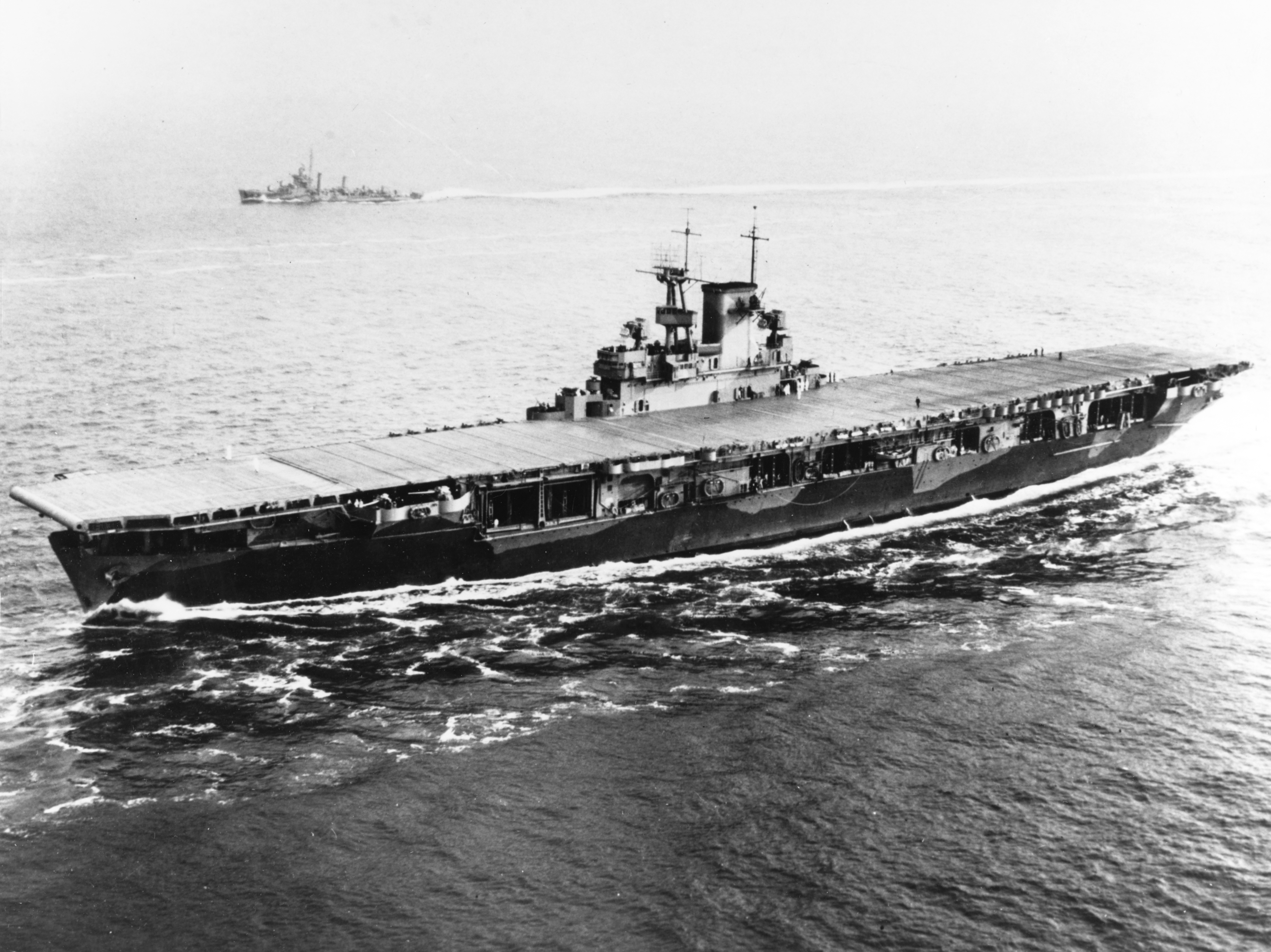
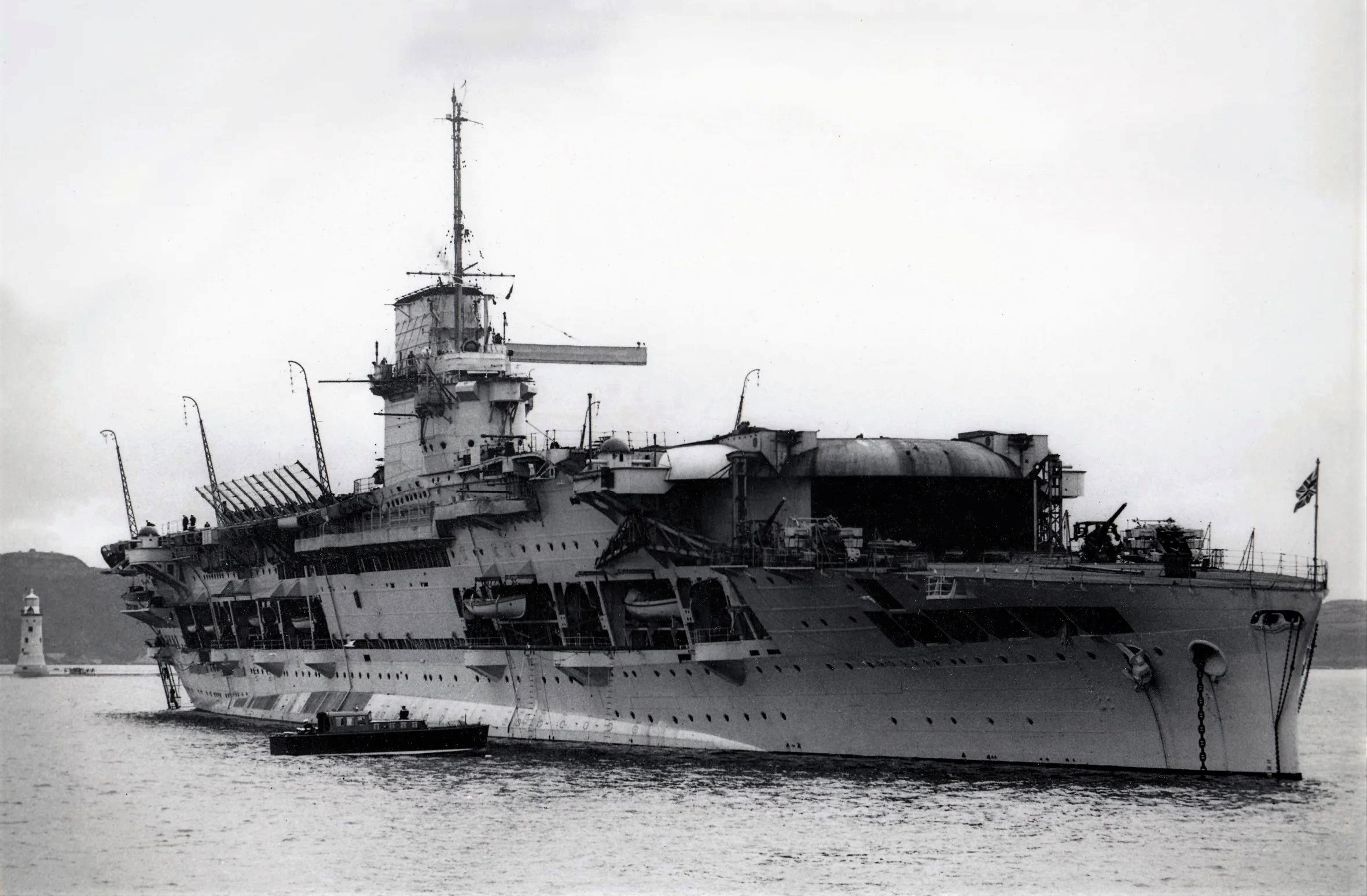
HMS Courageous
still · photograph
world wars · MCMXXXIX

HMS Courageous

U-29, fifteen minutes, the first RN carrier

cause
submarine torpedo
lost
519
depth
140 m

Royal Navy aircraft carrier, converted from a Great War battlecruiser. Torpedoed by U-29 southwest of Ireland at 19:50 on 17 September 1939, two weeks after the war began; she sank in fifteen minutes. 519 dead of 1,216 aboard, the first major Royal Navy loss of the Second World War. The pattern confirmed what the Admiralty feared: the aircraft carrier, without destroyer screens, was a torpedo's natural prey.

read the folio →
HMS Royal Oak
still · photograph
world wars · MCMXXXIX

HMS Royal Oak

Scapa Flow, Günther Prien, thirteen minutes

cause
submarine torpedo
lost
834
depth
30 m

Royal Navy Revenge-class battleship, at anchor in Scapa Flow on the night of 14 October 1939. German submarine U-47 under Günther Prien threaded the blockship barriers at Kirk Sound and fired seven torpedoes; four struck, and she rolled over in thirteen minutes. 834 dead of 1,234 aboard, including 134 boy seamen. Prien returned to Berlin a national hero; the defences at Scapa were rebuilt as the Churchill Barriers.

read the folio →
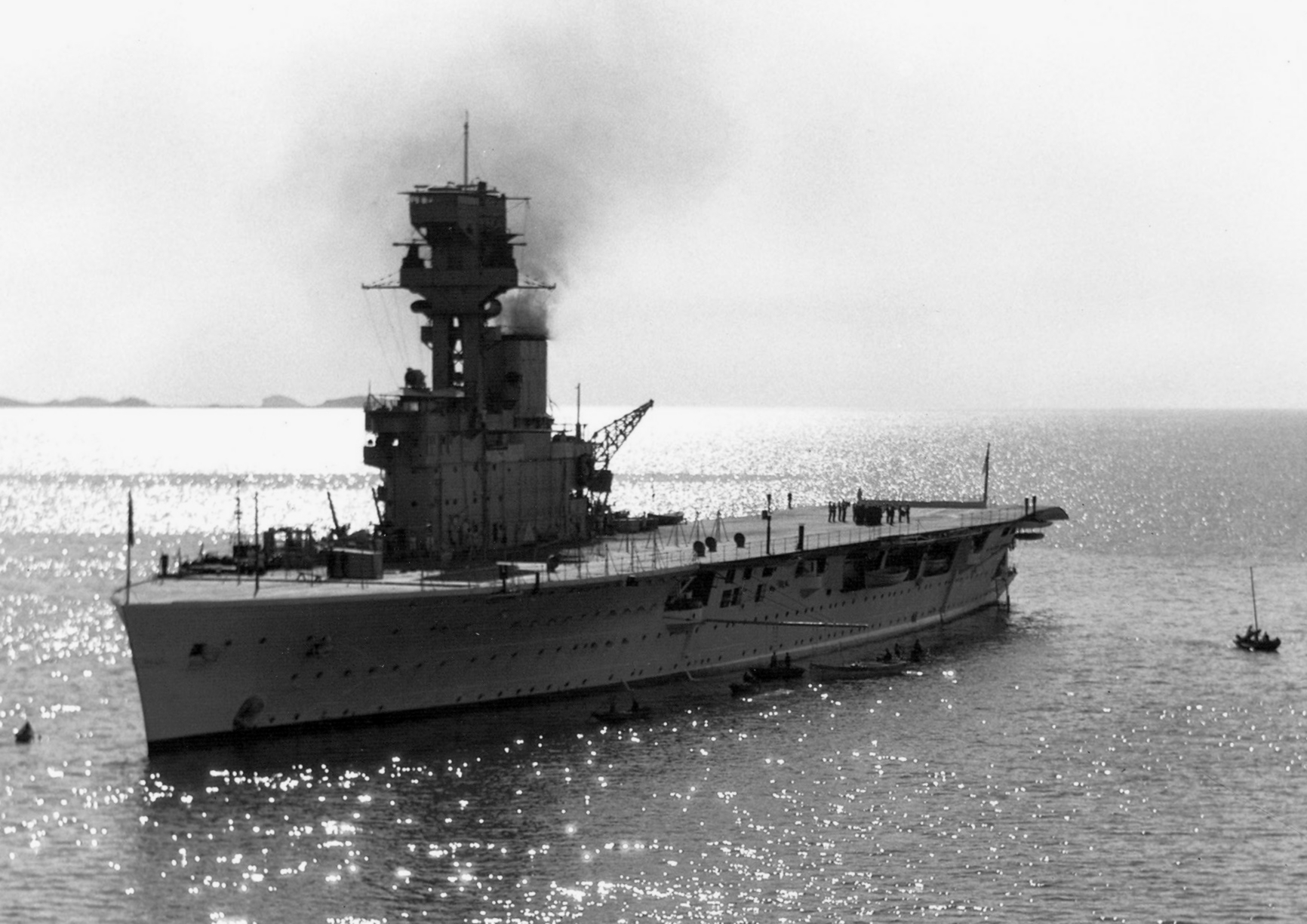
HMS Rawalpindi
still · photograph
world wars · MCMXXXIX

HMS Rawalpindi

Iceland Strait, a liner against two battleships

cause
naval gunfire
lost
275
depth
abyssal · not located

Armed merchant cruiser of the Northern Patrol, a P&O liner requisitioned and fitted with eight 6-inch guns of Great War vintage. Intercepted in the Iceland-Faroes Gap on the evening of 23 November 1939 by the German battleships Scharnhorst and Gneisenau. Captain Kennedy's response was to open fire and broadcast the enemy's position on W/T before his ship was destroyed. 275 dead in forty minutes; 38 men were taken off by the Germans before a British cruiser squadron closed the range. The disparity of force made her loss one of the iconic 'last stands' of the Royal Navy.

read the folio →
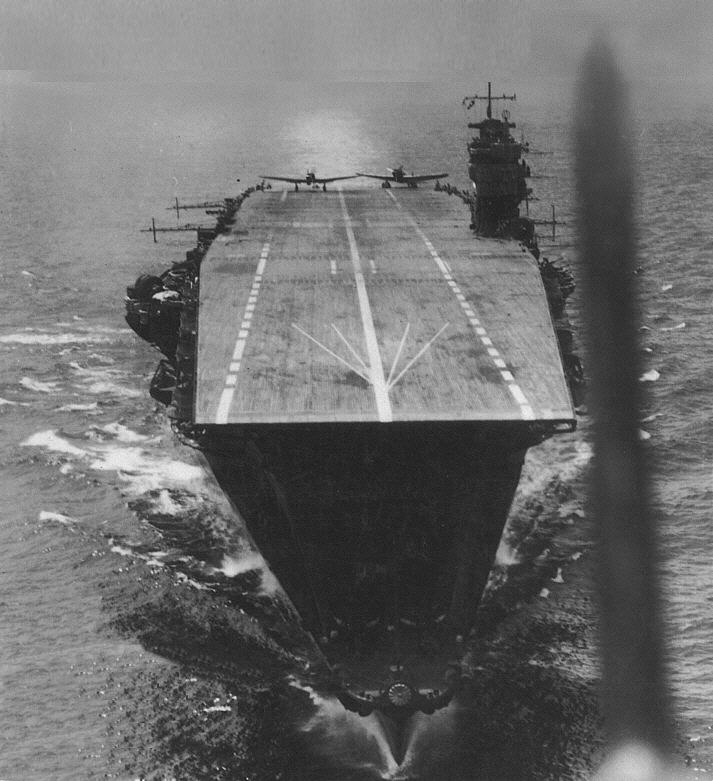
HMS Glorious
still · IWM FL-22991
world wars · MCMXL

HMS Glorious

Norway, Scharnhorst's 11-inch guns, Ardent and Acasta charging

cause
naval gunfire
lost
1,519
depth
460 m

Royal Navy aircraft carrier, returning from the Norwegian campaign with a deck of Hurricane fighters. Intercepted off northern Norway on 8 June 1940 by the German battleships Scharnhorst and Gneisenau in clear weather; her two destroyer escorts charged the battleships to lay smoke but were destroyed, and Scharnhorst's 11-inch shells reached the Glorious from 24,000 metres. 1,519 dead of 1,561 aboard. The last engagement in naval history in which a battleship sank an aircraft carrier by gunfire.

read the folio →
RMS Lancastria
still · photograph
world wars · MCMXL

RMS Lancastria

Saint-Nazaire, four thousand dead, Churchill buried it

cause
aerial attack
lost
~4,000-6,000
depth
25 m

Cunard transatlantic liner, requisitioned as a troopship, evacuating British soldiers and civilians from Saint-Nazaire at the collapse of France. Bombed by a Luftwaffe Ju 88 at 15:50 on 17 June 1940; four bombs struck, one down a funnel into the engine room, and she sank in twenty minutes with thousands still aboard. Between 4,000 and 6,000 dead, the worst maritime disaster in British history. Churchill ordered the news suppressed; most Britons did not hear the story until the 1970s.

read the folio →
HMS Glowworm
still · photograph
world wars · MCMXL

HMS Glowworm

Norwegian Sea, rammed the Hipper, Roope's VC

cause
naval gunfire · ramming
lost
109
depth
abyssal · not located

Royal Navy G-class destroyer, screening the British fleet moving north to intercept the German invasion of Norway. Ran into the heavy cruiser Admiral Hipper in heavy weather on the morning of 8 April 1940; outgunned by a factor of ten. Her commanding officer, Lieutenant-Commander Gerard Roope, laid smoke, closed, and rammed the Hipper amidships before his ship was destroyed by gunfire. 109 dead, 31 survived. Roope received a posthumous Victoria Cross, the recommendation written by the German captain he had rammed.

read the folio →
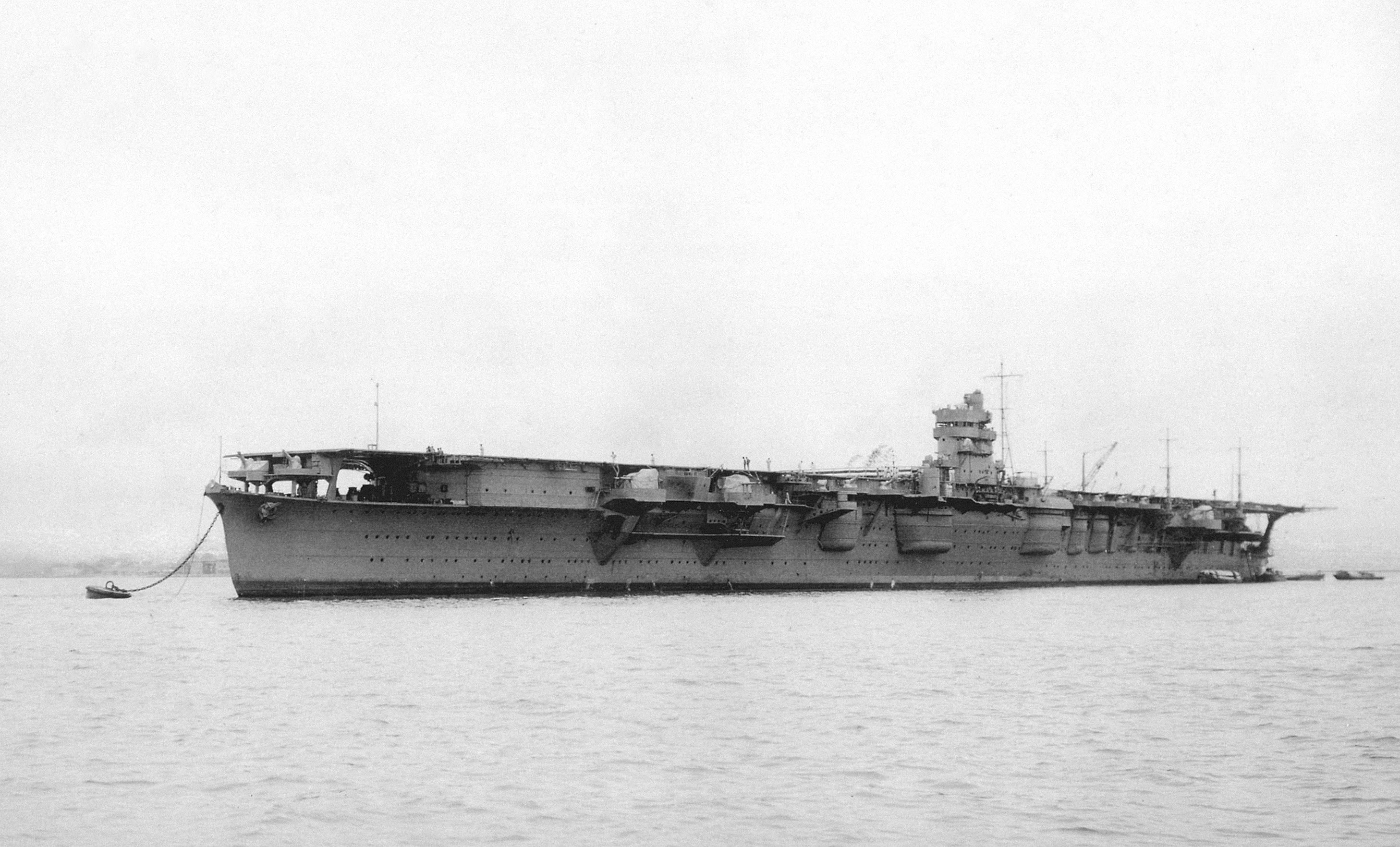
HMS Hood
still · photograph · 1924
world wars · MCMXLI

HMS Hood

Pride of the Royal Navy, three minutes, three survivors

cause
naval gunfire · magazine explosion
lost
1,415
depth
2,800 m

Pride of the Royal Navy for two decades, the largest warship in the world when she commissioned in 1920. In the Denmark Strait on the morning of 24 May 1941, a shell from Bismarck found her aft magazine; she broke in half and sank in under three minutes. 1,415 dead, three survivors, no time to launch a boat. The shock to British morale was the single greatest naval loss of the war.

read the folio →
Bismarck
still · bundesarchiv
world wars · MCMXLI

Bismarck

Germany's largest, three days after Hood

cause
naval gunfire · torpedo
lost
~2,100
depth
4,790 m

Germany's largest warship, flagship of the Kriegsmarine. Sank HMS Hood on 24 May 1941 in the Denmark Strait; three days later, crippled by a Fairey Swordfish torpedo to her rudder, she was pounded into scrap by the Royal Navy. ~2,100 dead, 114 rescued. Found by Robert Ballard in 1989, four and a half kilometres down, upright on the abyssal plain.

read the folio →
USS Arizona
still · NARA · 1930
world wars · MCMXLI

USS Arizona

Ford Island, 08:06, the magazine

cause
aerial attack
lost
1,177
depth
12 m

Pennsylvania-class battleship, moored on Battleship Row alongside Ford Island. A Japanese armor-piercing bomb detonated her forward magazine at 08:06 on 7 December 1941; she sank in under nine minutes. 1,177 dead, nearly half the American casualties of the day. Still seeping oil into the harbor eight decades on, beneath the white memorial that spans her submerged hull.

read the folio →
SS Gairsoppa
still · 2012 salvage
world wars · MCMXLI

SS Gairsoppa

2,817 silver bars, the deepest recovery ever

cause
submarine torpedo
lost
85
depth
4,700 m

British Hain Steamship cargo ship, India to Galway with 2,817 silver bars in her holds. Ran low on coal and broke away from her convoy on 14 February 1941; torpedoed three days later by U-101 southwest of Ireland. 85 dead of 86 aboard; Second Officer Richard Ayres reached the Cornish coast in a lifeboat two weeks later. In 2012-13 Odyssey Marine recovered the silver from 4,700 metres, the deepest recovery of precious metals ever attempted.

read the folio →
HMS Ark Royal
still · H-79167
world wars · MCMXLI

HMS Ark Royal

Gibraltar, fourteen hours to sink, damage control blamed

cause
submarine torpedo
lost
1
depth
1,000 m

Royal Navy aircraft carrier, veteran of the hunt for Bismarck six months earlier. Torpedoed by U-81 thirty miles east of Gibraltar at 15:41 on 13 November 1941. She took 14 hours to sink, long enough for all but one of her 1,488 crew to be taken off. The Admiralty blamed inadequate damage control rather than the torpedo itself; the wreck was found in 2002 at 1,000 metres.

read the folio →
HMS Barham
still · photograph
world wars · MCMXLI

HMS Barham

Sidi Barrani, the magazine, the Valiant's camera

cause
submarine torpedo · magazine explosion
lost
862
depth
148 m

Royal Navy Queen Elizabeth-class battleship, operating off Sidi Barrani with the Mediterranean Fleet. Torpedoed by U-331 at 16:25 on 25 November 1941; three torpedoes found her port side, her magazines ignited, and she capsized and exploded in under five minutes. 862 dead of 1,184 aboard. The entire sinking was filmed from HMS Valiant; the Admiralty suppressed the footage for three months to prevent German confirmation of the kill.

read the folio →
USS Utah
still · photograph
world wars · MCMXLI

USS Utah

Ford Island west side, misidentified as a carrier

cause
aerial attack
lost
58
depth
11 m

American battleship of 1909, by 1941 a radio-controlled target ship. Mis-identified by Japanese pilots as an active aircraft carrier on the morning of 7 December 1941 and hit by two torpedoes; she capsized in eleven minutes. 58 dead, four Medal of Honor citations awarded for men who refused to abandon trapped shipmates. The wreck was never raised, and the Utah Memorial on Ford Island is the quieter twin of Arizona's marble rectangle.

read the folio →
USS Oklahoma
still · photograph
world wars · MCMXLI

USS Oklahoma

Pearl Harbor, rolled 135 degrees, twelve minutes

cause
aerial attack
lost
429
depth
12 m (raised)

Nevada-class battleship, moored on Battleship Row alongside USS Maryland on 7 December 1941. Struck by between five and nine Japanese aerial torpedoes in the opening minutes of the Pearl Harbor attack. She capsized in twelve minutes, rolling 135 degrees until her masts hit the harbor floor. 429 dead, trapped below as the compartments flooded and inverted; raised in 1943 at record expense and scrapped in 1947.

read the folio →
HMS Prince of Wales
still · Singapore · December 1941
world wars · MCMXLI

HMS Prince of Wales

South China Sea, Japanese torpedo bombers, Force Z

cause
aerial torpedo
lost
327
depth
68 m

Royal Navy King George V-class battleship, flagship of Force Z, sent to Singapore to deter a Japanese advance on Malaya. Sunk together with the battlecruiser HMS Repulse by Japanese aircraft off Kuantan on 10 December 1941. The first battleship in history sunk at sea by aircraft alone, three days after the entry of Japan into the war. 327 dead including Admiral Tom Phillips, who had been warned but had not believed that capital ships could be destroyed by bombers. The loss of her and Repulse ended forever the assumption that the battleship was the backbone of sea power.

read the folio →
HMS Repulse
still · sister ship Renown
world wars · MCMXLI

HMS Repulse

South China Sea, alongside Prince of Wales

cause
aerial torpedo
lost
508
depth
58 m

Royal Navy battlecruiser of Great War vintage, partnered with HMS Prince of Wales in Force Z. Attacked together with her flagship by Japanese land-based torpedo bombers off Kuantan, Malaya, on the afternoon of 10 December 1941. Five torpedoes struck in quick succession; her twenty-five-year-old hull folded in under twenty minutes, capsizing at 12:33. 508 dead of 1,304. Admiral Phillips's stubborn refusal to call for fighter cover from Singapore remains a disputed command decision in Royal Navy historiography.

read the folio →
HMAS Sydney
still · photograph · 1936
world wars · MCMXLI

HMAS Sydney

Indian Ocean, Kormoran's disguise, no survivors

cause
naval gunfire · torpedo
lost
645
depth
2,468 m

Royal Australian Navy light cruiser, intercepting what she took to be a Dutch merchantman off Western Australia on the afternoon of 19 November 1941. The 'merchantman' was the disguised German auxiliary cruiser Kormoran. Both ships opened fire at close range; Sydney's bridge and turret magazines were destroyed in seconds. Both ships were mortally damaged; Sydney was not seen again, lost with all 645 aboard. Her wreck was located in 2008 by David Mearns at 2,468 metres, 22 kilometres from the Kormoran.

read the folio →
USS Lexington
still · NARA 80-G-416362
world wars · MCMXLII

USS Lexington

Coral Sea, the fuel vapours, Phelps's scuttling

cause
aerial attack · secondary explosion
lost
216
depth
3,000 m

American Lexington-class aircraft carrier, 'Lady Lex'. At the Battle of the Coral Sea on 8 May 1942, struck by two Japanese aerial torpedoes and two bombs; damage control seemed to have saved her until vapour from ruptured aviation fuel lines ignited and secondary explosions gutted her. 216 dead, scuttled by USS Phelps. Found intact in 2018 by Paul Allen's team at 3,000 metres with her fighter aircraft still on deck.

read the folio →
USS Yorktown
still · photograph · 1937
world wars · MCMXLII

USS Yorktown

Midway, the hinge, Ballard's discovery

cause
aerial attack · submarine torpedo
lost
141
depth
5,070 m

American Yorktown-class carrier, 'The Fighting Lady', patched in 72 hours at Pearl Harbor after Coral Sea and on station at Midway on the morning of 4 June 1942. Bombed in two waves by Japanese carrier aircraft and torpedoed two days later by the submarine I-168. She sank on 7 June, the day the battle that reversed the Pacific War ended. Found in 1998 by Robert Ballard at over 5,000 metres, bombers still chained to her deck.

read the folio →
USS Wasp
still · photograph · 1942
world wars · MCMXLII

USS Wasp

Solomon Sea, I-19, the six-torpedo salvo

cause
submarine torpedo
lost
193
depth
4,500 m

American Wasp-class aircraft carrier, covering the Guadalcanal reinforcement convoy. Struck by three torpedoes from the Japanese submarine I-19 at 14:44 on 15 September 1942: part of the most damaging single salvo of torpedoes in submarine history, three of six also hit USS O'Brien and USS North Carolina. 193 dead. Aviation fuel lines ruptured and damage-control pumps failed; scuttled by USS Lansdowne that evening. Found in 2019 by Paul Allen's team in 4,500 metres.

read the folio →
USS Hornet
still · NH-81313
world wars · MCMXLII

USS Hornet

Doolittle's launch, Santa Cruz, the Japanese torpedoes

cause
aerial attack · naval torpedo
lost
140
depth
5,400 m

American Yorktown-class carrier, launched the Doolittle Raid against Tokyo in April 1942. At the Battle of the Santa Cruz Islands on 26 October 1942 she was bombed and torpedoed repeatedly by Japanese carrier aircraft until her crew was ordered off; American scuttling torpedoes failed to sink her and the Japanese destroyers Makigumo and Akigumo finished her in the small hours of the 27th. 140 dead. Located by Paul Allen's team in 2019 at 5,400 metres, upright and apparently intact.

read the folio →
HMS Hermes
still · photograph · c.1931
world wars · MCMXLII

HMS Hermes

Ceylon, Nagumo's raid, the first purpose-built carrier

cause
aerial attack
lost
307
depth
54 m

The first purpose-built aircraft carrier in history, commissioned in 1924. Intercepted south of Trincomalee on the morning of 9 April 1942 by 85 Japanese carrier aircraft during Admiral Nagumo's Indian Ocean raid: no fighter cover, forty bombs in ten minutes. Sank in twenty minutes, 307 dead. The first aircraft carrier ever sunk by enemy carrier aircraft.

read the folio →
Akagi
still · photograph · April 1942
world wars · MCMXLII

Akagi

Midway, one bomb, the flagship of Pearl

cause
aerial attack
lost
267
depth
5,490 m

Flagship of the Kidō Butai, the Japanese fast carrier strike force that attacked Pearl Harbor. At the Battle of Midway on the morning of 4 June 1942, a single American Dauntless dive bomber planted a 1,000-pound bomb among her fuelled and armed aircraft; she burned all day and was scuttled the next morning. 267 dead; 1,630 survived. Located in 2019 by Paul Allen's RV Petrel at 5,490 metres.

read the folio →
Kaga
still · photograph
world wars · MCMXLII

Kaga

Midway, four bombs, the hangar oven

cause
aerial attack
lost
811
depth
5,400 m

Converted from the incomplete Tosa-class battleship, veteran of the Pearl Harbor attack. At Midway on 4 June 1942, struck by four bombs from USS Enterprise's VB-6 in rapid succession; the ruptured aviation fuel lines turned her hangar deck into an oven. 811 dead, the heaviest Japanese carrier loss of the battle. Located in 2019 at 5,400 metres, split in three and upside down.

read the folio →
Sōryū
still · photograph · 1938
world wars · MCMXLII

Sōryū

Midway, three bombs in three minutes

cause
aerial attack
lost
711
depth
5,400 m

Fast fleet carrier of the Kidō Butai, veteran of Pearl Harbor and the Indian Ocean raid. At Midway on 4 June 1942, struck by three bombs from USS Yorktown's VB-3 in three minutes. Abandoned within the hour; USS Nautilus put a final torpedo into her and she sank that evening. 711 dead, 392 survived.

read the folio →
Hiryū
still · photograph · 1939
world wars · MCMXLII

Hiryū

Midway, the afternoon survivor, Yamaguchi

cause
aerial attack
lost
389
depth
4,650 m

Fast fleet carrier, the only Japanese carrier to survive the American morning attack at Midway on 4 June 1942; she launched the retaliatory strike that crippled USS Yorktown. Caught that same afternoon by aircraft from USS Enterprise; four bombs struck and she burned through the night, scuttled before dawn on 5 June. 389 dead, 797 survived. Rear-Admiral Tamon Yamaguchi, one of Japan's most capable carrier commanders, chose to go down with his ship.

read the folio →
SS Laconia
still · photograph
world wars · MCMXLII

SS Laconia

Hartenstein's rescue, the American bomber, the Laconia Order

cause
submarine torpedo
lost
~1,658
depth
4,850 m

Former Cunard liner, by 1942 a British troopship. Torpedoed by U-156 under Werner Hartenstein west of Ascension Island on the night of 12 September 1942. When Hartenstein discovered she was carrying 1,800 Italian POWs alongside British troops and civilians, he surfaced, tied lifeboats to his U-boat, and broadcast in English that he would not fire on rescuers; an American B-24 then bombed the U-boat mid-rescue. The Laconia Order that followed prohibited U-boats from rescuing survivors for the rest of the war. 1,658 dead of about 2,725 aboard.

read the folio →
USS Juneau
still · 19-N-28143
world wars · MCMXLII

USS Juneau

The five Sullivan brothers, forty-two seconds

cause
submarine torpedo
lost
687
depth
4,200 m

American Atlanta-class light cruiser, at the Naval Battle of Guadalcanal. Damaged by a Japanese torpedo on the night of 13 November 1942 and steaming away for repairs when I-26 put a second torpedo into her magazine the next morning; she exploded and sank in forty-two seconds. 687 dead, among them the five Sullivan brothers of Waterloo, Iowa, whose loss drove the U.S. Navy's Sole Survivor Policy. Only six of the initial ten survivors lived through eight days in shark-infested water before rescue.

read the folio →
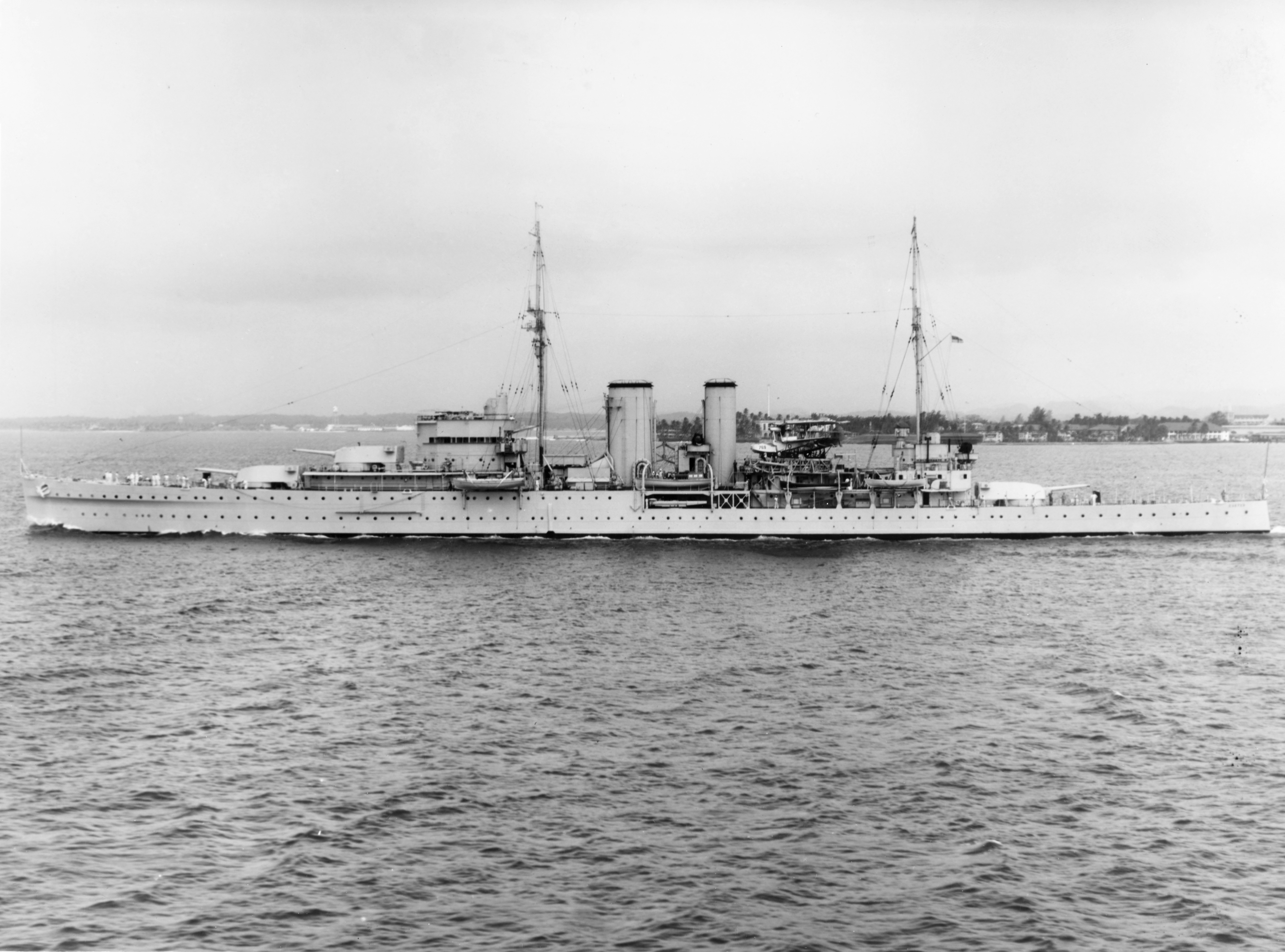
HMS Exeter
still · photograph · c.1939
world wars · MCMXLII

HMS Exeter

Java Sea, the second engagement, Nachi and Haguro

cause
naval gunfire · torpedo
lost
54
depth
60 m

Royal Navy York-class heavy cruiser, veteran of the 1939 Battle of the River Plate where she had helped run the Graf Spee to ground. Intercepted by four Japanese heavy cruisers on 1 March 1942 at the Second Battle of the Java Sea while attempting to escape to Ceylon. Struck in the engine room by a 20.3 cm shell; scuttled by her crew after sustained torpedo and gunfire attack. 54 dead. Her wreck was located in 2007 and then, shockingly, illegally salvaged for scrap metal in 2016 by Indonesian scrap divers, along with HMS Electra and HMS Encounter.

read the folio →
USS Houston
still · San Diego · 1935
world wars · MCMXLII

USS Houston

Sunda Strait, the Ghost of the Java Coast

cause
naval gunfire · torpedo
lost
693
depth
40 m

American Northampton-class heavy cruiser, nicknamed 'The Ghost of the Java Coast' by the Japanese who kept reporting her sunk. Caught with HMAS Perth at the Sunda Strait on the night of 28 February-1 March 1942 blundering into a Japanese amphibious force. 693 dead of 1,061 aboard; Captain Albert Rooks was awarded a posthumous Medal of Honor. 368 of the survivors were captured and 266 of those died as prisoners of war, many on the Sumatra railway.

read the folio →
HMAS Canberra
still · Wellington · 22 July 1942
world wars · MCMXLII

HMAS Canberra

Savo Island, Mikawa's night attack

cause
naval gunfire · torpedo
lost
85
depth
700 m

Royal Australian Navy heavy cruiser, screening the American transports at Guadalcanal. Surprised at 01:38 on 9 August 1942 by Vice-Admiral Mikawa's Japanese cruiser force at the Battle of Savo Island. Hit by more than twenty 8-inch shells in two minutes; her captain and 85 crew were killed instantly. Scuttled by USS Ellet the following morning. One of four Allied heavy cruisers lost in a single 32-minute engagement, the worst Allied surface defeat of the Pacific War.

read the folio →
USS Liscome Bay
still · US Navy
world wars · MCMXLIII

USS Liscome Bay

Makin, I-175, the deadliest US carrier loss

cause
submarine torpedo · magazine explosion
lost
644
depth
1,460 m

American Casablanca-class escort carrier, supporting the Gilbert Islands campaign off Makin. Torpedoed at 05:13 on 24 November 1943 by the Japanese submarine I-175; the torpedo found her after aircraft-bomb magazine. She disintegrated in a single blast that sent debris seven hundred metres into the air. 644 dead, the heaviest American aircraft carrier loss of the Pacific War, despite Liscome Bay being one of the smallest flat-tops afloat. Admiral Henry M. Mullinnix died on the bridge.

read the folio →
Junyō Maru
still · photograph
world wars · MCMXLIV

Junyō Maru

Sumatra, Javanese rōmusha, the Allied submarine

cause
submarine torpedo
lost
5,620
depth
abyssal · not located

Japanese merchant ship converted to transport, carrying 2,200 Javanese rōmusha forced labourers, 1,700 Allied POWs, and a few hundred Japanese guards from Batavia to Padang. Torpedoed by the British submarine HMS Tradewind off the west coast of Sumatra on 18 September 1944. 5,620 dead, a casualty toll exceeded only by the Wilhelm Gustloff, the Goya, and the Doña Paz. Few of the Javanese forced labourers, conscripted to build the Sumatra Death Railway, are listed by name anywhere.

read the folio →
Ōryoku Maru
still · pre-war photograph
world wars · MCMXLIV

Ōryoku Maru

The worst American POW atrocity at sea

cause
aerial attack
lost
~1,280 (across three ships)
depth
20 m

Japanese cargo ship converted to prisoner transport, sailing from Manila with 1,620 American POWs in her holds. Attacked by U.S. Navy aircraft over four days from 14 December 1944; POWs suffocated in the holds between bombings, packed without water in temperatures that drove men mad. Survivors transferred to Enoura Maru and Brazil Maru, both of which were also attacked. Of 1,620 POWs aboard at Manila, fewer than 400 survived to liberation; the worst American POW atrocity of the Pacific War.

read the folio →
Shinano
still · photograph
world wars · MCMXLIV

Shinano

Maiden voyage, seven hours, USS Archerfish

cause
submarine torpedo
lost
1,435
depth
4,000 m

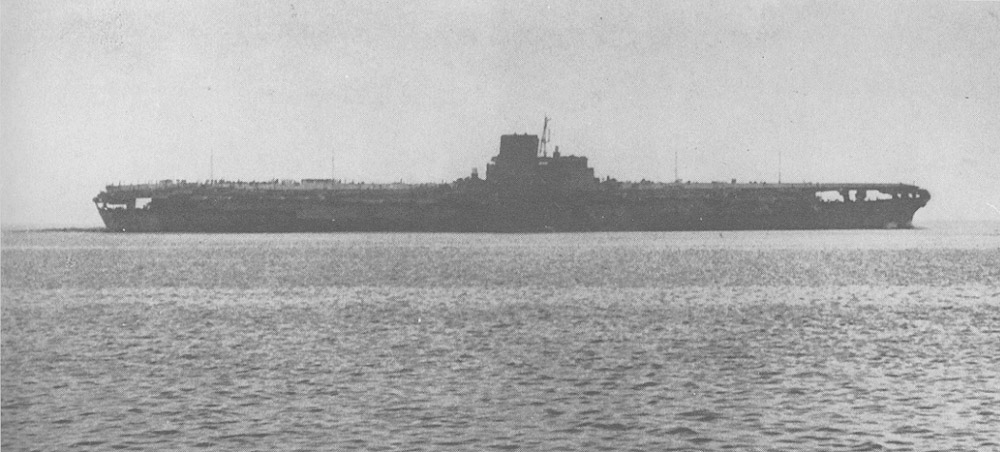
Originally laid down as the third Yamato-class battleship, converted mid-build to an armoured aircraft carrier, the largest warship ever built at the time. Sailed from Yokosuka on her maiden voyage only seventeen days commissioned; torpedoed four times by USS Archerfish on the morning of 29 November 1944. Poor damage control and unfinished watertight bulkheads doomed her. Sank seven hours after her first torpedo, on her first voyage. 1,435 dead.

read the folio →
Musashi
still · NH-63473
world wars · MCMXLIV

Musashi

Sibuyan Sea, nineteen torpedoes, Kurita's flagship

cause
aerial attack
lost
~1,023
depth
1,000 m

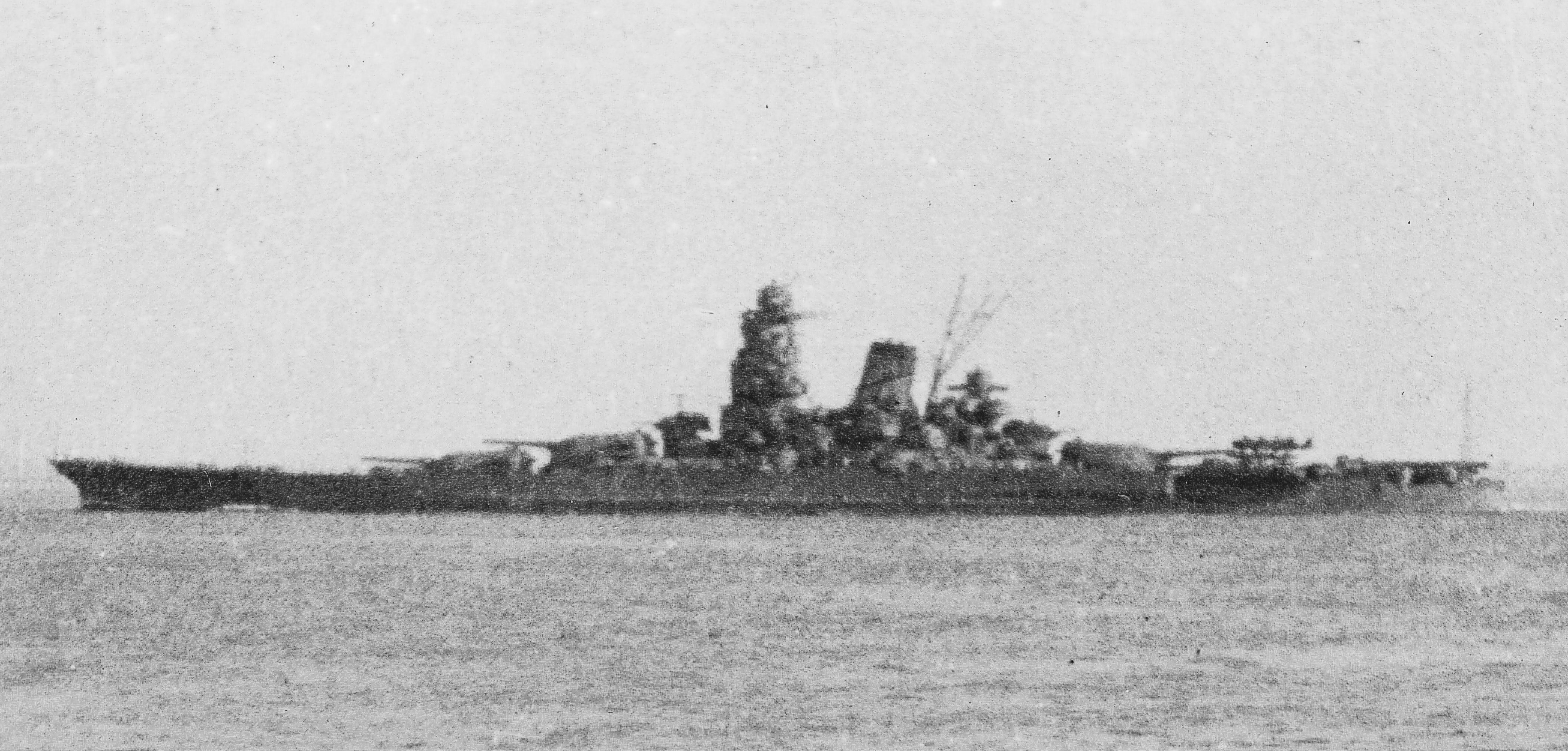
Second and last Yamato-class battleship, flagship of the 2nd Fleet under Admiral Takeo Kurita. Attacked repeatedly by American carrier aircraft of Task Force 38 at the Battle of Leyte Gulf on 24 October 1944 as she advanced through the Sibuyan Sea. Absorbed 19 torpedoes and 17 bombs before capsizing. ~1,023 dead; her loss ended the credible Japanese surface threat in the Pacific. Found in 2015 by Paul Allen at 1,000 metres.

read the folio →
USS Johnston
still · NH-63495
world wars · MCMXLIV

USS Johnston

Samar, charged Kurita's battleships, 6,469 m

cause
naval gunfire
lost
186
depth
6,469 m

American Fletcher-class destroyer, commanded by Ernest E. Evans, part of Taffy 3's escort screen at the Battle off Samar. On the morning of 25 October 1944 she led the counterattack against Admiral Kurita's Centre Force, charging alone into a battle line that included the battleship Yamato. Fired every torpedo, expended every 5-inch round, and kept going until she was destroyed by the combined gunfire of four Japanese battleships and cruisers. 186 dead including Evans, who received a posthumous Medal of Honor. Located in 2019 at 6,469 metres, the deepest wreck of any ship then on record.

read the folio →
Wilhelm Gustloff
still · bundesarchiv
world wars · MCMXLV

Wilhelm Gustloff

The largest loss of life on a single ship in history

cause
submarine torpedo
lost
~9,400
depth
44 m

Sunk by Soviet submarine S-13 in the Baltic on 30 January 1945, during the evacuation of East Prussia. The dead were mostly civilian refugees and wounded soldiers, including thousands of children. Six times the Titanic's casualties. Suppressed for decades on both sides of the Cold War; most of the world has still never heard of it.

read the folio →
USS Indianapolis
still · US Navy · 1939
world wars · MCMXLV

USS Indianapolis

Delivered the bomb, then the sharks

cause
submarine torpedo
lost
~880
depth
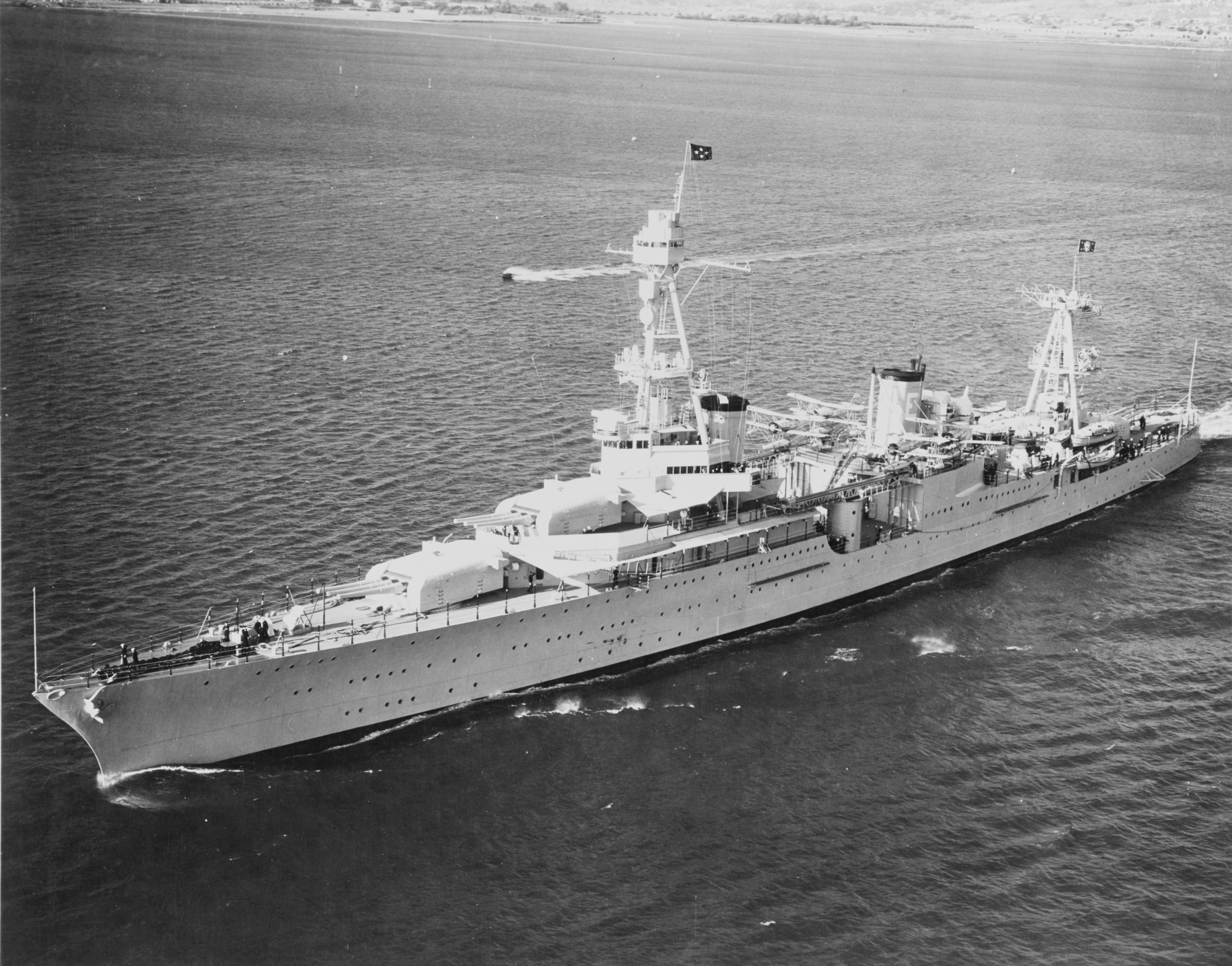
5,500 m

Heavy cruiser. Delivered components of the Hiroshima bomb to Tinian, then torpedoed four days later by Japanese submarine I-58 in the Philippine Sea on 30 July 1945. Of 890 men who went into the water, only 316 were alive four days later when the silence was finally noticed; the sharks had taken an estimated 150 to 300 of the rest. Captain Charles McVay became the only U.S. commander court-martialed for losing his ship in combat, and Congress exonerated him posthumously in 2000.

read the folio →
General von Steuben
still · Bundesarchiv
world wars · MCMXLV

General von Steuben

Baltic, Marinesko again, four thousand lost

cause
submarine torpedo
lost
~4,200
depth
70 m

Former North German Lloyd liner, by 1945 a refugee transport in Operation Hannibal. Torpedoed by the Soviet submarine S-13 (Alexander Marinesko, commanding) off Stolpmünde in the Baltic at 00:55 on 10 February 1945, eleven days after Marinesko had sunk the Wilhelm Gustloff. Approximately 4,200 dead of ~4,500 aboard. Along with Goya and Wilhelm Gustloff, she is one of the three German refugee ships Marinesko's boats destroyed in a single winter.

read the folio →
Goya
still · photograph
world wars · MCMXLV

Goya

Pomeranian coast, four minutes, six thousand dead

cause
submarine torpedo
lost
~6,700
depth
76 m

German transport, evacuating refugees from East Prussia in Operation Hannibal. Torpedoed by the Soviet submarine L-3 off the Pomeranian coast at 23:52 on 16 April 1945; two torpedoes struck and she broke in half in four minutes. ~6,700 dead, 183 rescued. The second-deadliest single-ship loss of life in history, after her fleet-mate Wilhelm Gustloff.

read the folio →
Yamato
still · photograph · 1941
world wars · MCMXLV

Yamato

Operation Ten-Go, the one-way voyage

cause
aerial attack · magazine explosion
lost
3,055
depth
340 m

Flagship of the Imperial Japanese Navy, the largest battleship ever built alongside her sister Musashi. Sent on a one-way mission to Okinawa in Operation Ten-Go on 6 April 1945 with fuel for only half the voyage, intercepted by 386 American carrier aircraft the next afternoon. Her forward magazine detonated after ten torpedoes and nine bombs; the mushroom cloud was visible from Kyushu, 200 kilometres away. 3,055 dead of 3,332 aboard; the Imperial Japanese Navy never sortied again.

read the folio →
Cap Arcona
still · photograph
world wars · MCMXLV

Cap Arcona

Lübeck Bay, Neuengamme prisoners, the RAF Typhoons

cause
aerial attack
lost
~5,000
depth
25 m

Former North German Lloyd liner, by May 1945 a floating prison for concentration camp inmates in the Bay of Lübeck. Bombed and strafed by RAF Typhoons of 83 Group on the afternoon of 3 May 1945, six days before the German surrender. Swedish Red Cross intelligence that the ship was carrying KZ prisoners had reached the RAF but not the squadrons in time. Approximately 5,000 dead, most of them Neuengamme inmates, many killed as they swam toward shore.

read the folio →
SS Noronic
still · photograph · c.1939
postwar · MCMXLIX

SS Noronic

Toronto harbour, wooden liner, one hundred and thirty-nine

cause
fire
lost
139
depth
destroyed at dockside

Canada Steamship Lines Great Lakes cruise ship, calling Toronto in the middle of an Ontario-New York vacation circuit. Fire broke out in a linen locker at 02:30 on 17 September 1949 while docked overnight. Wooden panelling, an unattended fire watch, and non-functioning hoses let the flames consume her in under an hour. 139 dead, almost all of them American passengers asleep below. The disaster rewrote Canadian fire regulations and effectively ended wooden-superstructure passenger service on the Great Lakes.

read the folio →
HMS Affray
still · photograph
postwar · MCMLI

HMS Affray

English Channel, the snort mast, seventy-five

cause
flooded · mechanical failure
lost
75
depth
85 m

Royal Navy A-class submarine, on a training exercise out of Portsmouth. Failed to surface from a dive on the night of 16 April 1951 somewhere between Start Point and the Channel Islands. Seventy-five dead, no survivors. Located two months later on the continental shelf at 85 metres; the probable cause was a structural failure of the snort mast that flooded her while submerged.

read the folio →
Tōya Maru
still · photograph
postwar · MCMLIV

Tōya Maru

Typhoon 15, the Hokkaido ferry

cause
typhoon
lost
~1,155
depth
60 m

Japanese National Railways ferry between Honshū and Hokkaidō, the main link across the Tsugaru Strait. Capsized in Typhoon Marie on the evening of 26 September 1954 after her captain mistook the eye of the storm for its end and sailed from harbour. 1,155 dead, the deadliest civilian maritime disaster in Japanese history. The catastrophe was the direct spur to the 54-kilometre Seikan Tunnel, the world's longest undersea rail tunnel, completed in 1988.

read the folio →
SS Andrea Doria
still · photograph
postwar · MCMLVI

SS Andrea Doria

Italian flagship, Stockholm's bow, summer fog

cause
collision
lost
46
depth
75 m

Italian Line flagship, Genoa to New York, the most elegant liner of her generation. Rammed starboard in Nantucket fog by the Swedish liner Stockholm on the night of 25 July 1956. 46 died in the collision itself; the remaining 1,660 were lifted off through the night in one of the largest civilian sea rescues ever mounted. The last great transatlantic disaster before the jet age erased them.

read the folio →
Pamir
still · photograph
postwar · MCMLVII

Pamir

Hurricane Carrie, the last commercial sail

cause
hurricane
lost
80
depth
abyssal · not located

German four-masted barque, the last commercial sailing ship to round Cape Horn (1949). Caught by Hurricane Carrie in mid-Atlantic on 21 September 1957 with 52 cadets aboard on a training voyage. An improperly trimmed barley cargo shifted; she heeled and could not right. 80 dead, six survivors. The catastrophe ended the German sail-training program for a generation and effectively closed the era of commercial sail at sea.

read the folio →
USS Stickleback
still · US Navy
postwar · MCMLVIII

USS Stickleback

Oahu exercise, rammed amidships, no casualties

cause
collision
lost
0
depth
5,400 m

American Balao-class submarine, on a Cold War training exercise off Pearl Harbor. Made an inadvertent broach during an emergency surface and was rammed amidships by the destroyer escort USS Silverstein at 18:16 on 28 May 1958. All 82 crew taken off before she sank six hours later. No casualties, a near-miss in the long post-war record of submarine training losses.

read the folio →
USS Thresher
still · US Navy
postwar · MCMLXIII

USS Thresher

Cape Cod, test depth, the implosion

cause
implosion
lost
129
depth
2,590 m

American Permit-class nuclear attack submarine, the lead ship of a revolutionary class. On post-overhaul trials off Cape Cod on the morning of 10 April 1963, a probable silver-brazed seawater-joint failure at test depth led to flooding, reactor scram, and loss of propulsion. 129 dead, the worst American submarine loss ever. The investigation produced the SUBSAFE quality-control program, which has overseen the construction of every U.S. Navy submarine since.

read the folio →
HMAS Voyager
still · AWM 301014
postwar · MCMLXIV

HMAS Voyager

Jervis Bay, HMAS Melbourne, eighty-two

cause
collision
lost
82
depth
120 m

Royal Australian Navy destroyer, on plane-guard duty for the aircraft carrier HMAS Melbourne during night exercises in the Tasman Sea. Cut cleanly in half at 20:56 on 10 February 1964 when the two bridges both misjudged a turn. The forward section went down in ten minutes. 82 dead, including the captain and most of the wardroom. The first of two Melbourne night-collisions; five years later USS Frank E. Evans was cut in half the same way in the South China Sea.

read the folio →
SS Cedarville
still · photograph
postwar · MCMLXV

SS Cedarville

Mackinac, fog, the Norwegian bow

cause
collision
lost
10
depth
32 m

US Steel Great Lakes bulk freighter, carrying limestone from Calcite to Gary, Indiana. Rammed in dense fog by the Norwegian motor vessel Topdalsfjord in the Straits of Mackinac at 09:45 on 7 May 1965; her captain attempted to beach her on Mackinaw City before she rolled. 10 of 35 aboard died. She lies upside down at 32 metres, one of the most visited freshwater wreck dives in North America.

read the folio →
USS Liberty
still · USN 1123118
postwar · MCMLXVII

USS Liberty

Six-Day War, Israeli aircraft and torpedo boats

cause
aerial and torpedo attack
lost
34
depth
survived · later scrapped

American technical research ship (a converted Liberty cargo ship), intercepting signals in international waters off the northern Sinai during the Six-Day War. Attacked by Israeli aircraft and torpedo boats for approximately 75 minutes on 8 June 1967 despite a clearly displayed American flag and distinctive hull markings. 34 dead, 171 wounded, the largest single-day loss of U.S. Navy life to hostile action since 1945. Israel claimed mistaken identity and paid compensation; survivors and researchers have disputed that explanation ever since.

read the folio →
SS Torrey Canyon
still · no photograph available
postwar · MCMLXVII

SS Torrey Canyon

Seven Stones, the RAF's burning oil

cause
grounding
lost
0
depth
30 m (broken on reef)

Liberian-flagged supertanker, one of the largest of her generation, running from the Persian Gulf to Milford Haven. Struck Pollard's Rock on the Seven Stones reef at 08:48 on 18 March 1967. 119,000 tonnes of Kuwaiti crude spilled into the English Channel, the first major supertanker oil disaster. The RAF and Fleet Air Arm bombed and napalmed the wreck for ten days in a failed attempt to burn off the cargo; the spill contaminated the coasts of Cornwall, Brittany, Guernsey, and Jersey and directly produced the 1969 Intervention Convention.

read the folio →
USS Scorpion
still · NH-97214
postwar · MCMLXVIII

USS Scorpion

SW of Azores, the torpedo theory, unresolved

cause
unknown · possible torpedo malfunction
lost
99
depth
3,050 m

American Skipjack-class nuclear attack submarine, returning to Norfolk from the Mediterranean. Vanished somewhere southwest of the Azores on 22 May 1968. 99 dead; the wreck was located five months later at 3,050 metres. The most supported theory is that one of her own Mk 37 torpedoes activated inside the tube and detonated against the inner door, though alternative explanations involving Soviet retaliation for the March loss of K-129 have never fully faded.

read the folio →
Soviet submarine K-129
still · photograph
postwar · MCMLXVIII

Soviet submarine K-129

Hawaii, Project Azorian, the Glomar Explorer

cause
unknown
lost
98
depth
4,900 m

Soviet Golf II-class diesel-electric ballistic missile submarine, carrying three nuclear warheads on Pacific patrol. Vanished on 8 March 1968; cause never determined, the Soviets unable to locate her. The U.S. Navy did, however, and in 1974 the CIA raised part of the bow using Howard Hughes's purpose-built ship Hughes Glomar Explorer in Project Azorian, the most expensive covert operation ever mounted. The phrase 'we can neither confirm nor deny' entered the lexicon from the cover story.

read the folio →
TEV Wahine
still · photograph
postwar · MCMLXVIII

TEV Wahine

Wellington Harbour, Cyclone Giselle, Barrett Reef

cause
storm · grounding
lost
53
depth
12 m

New Zealand inter-island ferry, Lyttelton to Wellington. Caught by the remnants of Cyclone Giselle at the entrance to Wellington Harbour on the morning of 10 April 1968, with 160-knot gusts through the Cook Strait. Driven onto Barrett Reef, lost steering, carried the length of the harbour by wind and tide, and capsized in Seatoun shortly after abandonment. 53 dead of 734 aboard. New Zealand's worst modern maritime disaster; the 53 names still headline the plaque at the Wellington waterfront.

read the folio →
USS Frank E. Evans
still · 19-N-78354
postwar · MCMLXIX

USS Frank E. Evans

South China Sea, HMAS Melbourne, the bow section

cause
collision
lost
74
depth
3,000 m (bow section)

American Allen M. Sumner-class destroyer, screening HMAS Melbourne during overnight exercises in the South China Sea. At 03:15 on 3 June 1969 her watch officers turned the wrong way in response to a course-change signal and put her directly into the Melbourne's bow. Cut cleanly in half; the forward section sank in three minutes with most of the sleeping crew aboard. 74 dead, including three brothers from Niobrara, Nebraska. The Melbourne's commanding officer was exonerated at the joint inquiry; the destroyer's two duty officers were court-martialled.

read the folio →
Seawise University
still · Queen Elizabeth · Southampton 1967
postwar · MCMLXXII

Seawise University

Hong Kong harbour, arson suspected, RMS Queen Elizabeth

cause
fire · possible arson
lost
1
depth
14 m (scrapped)

Formerly RMS Queen Elizabeth, Cunard's 83,000-ton flagship and for twenty-seven years the largest ocean liner in the world. Sold in 1970 to C.Y. Tung, renamed Seawise University, and converted in Hong Kong to a floating university. Fires broke out at five separate points on 9 January 1972 while she sat at anchor in Victoria Harbour. The pattern indicated arson; she burned through the night, capsized the next morning, and was scrapped where she lay over the following two years. One crew member died fighting the fire.

read the folio →
FV Gaul
gradient · no image in Commons
postwar · MCMLXXIV

FV Gaul

Barents Sea, thirty-six men, Cold War questions

cause
flooded · capsized
lost
36
depth
273 m

British factory freezer trawler, fishing in the Barents Sea off the North Cape. Vanished on 8 February 1974 with 36 crew; no distress, no debris recovered. Twenty-three years of conspiracy theories centred on the Cold War and alleged espionage, with the Soviet navy a permanent suspect. The 1997 discovery by a Hull-commissioned survey found her at 273 metres and confirmed a mundane but terrible explanation: flooding through duff-chute doors left open in a rising gale.

read the folio →
SS Edmund Fitzgerald
still · photograph · 1971
postwar · MCMLXXV

SS Edmund Fitzgerald

When the gales of November came early

cause
storm · disputed
lost
29
depth
160 m

The largest ship ever lost on the Great Lakes. Went down in a Lake Superior gale 17 miles from Whitefish Bay with no distress signal and no survivors. The wreck broke in two. Immortalized by Gordon Lightfoot's 1976 ballad, which did more to sustain the memory than any maritime commission. Exact cause of sinking remains contested fifty years on.

read the folio →
Amoco Cadiz
still · aerial · 1978
postwar · MCMLXXVIII

Amoco Cadiz

Portsall, steering failure, 227,000 tonnes

cause
grounding · steering failure
lost
0
depth
30 m (broken)

Liberian-flagged Very Large Crude Carrier, returning 220,000 tonnes of Iranian light from the Persian Gulf to Rotterdam. Her rudder failed off Ushant in a March gale on the morning of 16 March 1978; a West German tug refused to take her in tow without an agreed fee, and by the time negotiations ended the tide had driven her onto Portsall Rocks. She broke in half and spilled 227,000 tonnes of crude across 300 kilometres of Breton coast. The largest oil spill of its kind to that date; the subsequent French civil suit ran for 14 years and produced the most detailed environmental-damage judgement in European legal history.

read the folio →
MS München
gradient · no image in Commons
postwar · MCMLXXVIII

MS München

North Atlantic, rogue wave, LASH carrier

cause
rogue wave · foundered
lost
28
depth
abyssal · not located

West German LASH carrier (Lighter Aboard Ship), Bremerhaven to Savannah with containerised barges in her holds. Vanished in mid-Atlantic on the night of 13 December 1978 after a garbled Mayday. The sole recovered lifeboat, her starboard, had been torn from its davits twenty metres above the waterline by a wave of unimaginable height. The first documented case in maritime history of a rogue wave striking a modern merchant ship from the side, and the spur to the European MAXWAVE programme that confirmed the phenomenon.

read the folio →
Alexander L. Kielland
still · Norsk Oljemuseum
postwar · MCMLXXX

Alexander L. Kielland

Ekofisk field, the fatigue crack, one hundred and twenty-three

cause
structural failure · capsize
lost
123
depth
74 m

Norwegian semi-submersible accommodation platform in the Ekofisk oilfield. On the evening of 27 March 1980, a fatigue crack in a weld around a hydrophone flange severed one of her five support columns. She heeled 35 degrees and capsized in twenty minutes. 123 dead of 212 aboard. Norway's worst peacetime maritime disaster and the spur to an overhaul of North Sea platform certification.

read the folio →
SS Poet
still · as USS Omar Bundy, 1945
postwar · MCMLXXX

SS Poet

North Atlantic, grain cargo, no trace

cause
unknown · vanished
lost
34
depth
never found

American bulk carrier, Philadelphia to Port Said with 13,500 tonnes of corn for Egypt. Cleared the Delaware Capes on the morning of 24 October 1980 and was never seen again. Thirty-four crew vanished without any trace of ship or boats ever being recovered. The subsequent Coast Guard investigation concluded she had likely been caught by a rogue wave or a rapid shifting of her grain cargo in the storm that crossed the mid-Atlantic that week.

read the folio →
MV Derbyshire
still · model of sister ship
postwar · MCMLXXX

MV Derbyshire

Typhoon Orchid, OBO carrier, hatch cover failure

cause
typhoon · structural failure
lost
44
depth
4,200 m

British OBO carrier (ore/bulk/oil), Seven Islands, Quebec to Kawasaki, Japan, with 157,000 tonnes of iron ore. Caught by Typhoon Orchid in the East China Sea on 9 September 1980. Lost without a distress call. The largest British-flagged ship ever lost; the families' 14-year campaign eventually forced a 1994 survey that found her at 4,200 metres and identified a design weakness in number-one hold hatch covers shared across the OBO class.

read the folio →
Ocean Ranger
still · photograph
postwar · MCMLXXXII

Ocean Ranger

Grand Banks, the ballast console, eighty-four

cause
storm · flooded
lost
84
depth
80 m

Semi-submersible drilling rig, the largest in the world when she commissioned, under charter to Mobil Oil off Newfoundland. Caught in a severe storm on the night of 14 February 1982 when a rogue wave broke a porthole in the ballast control room; the shorted panel opened ballast valves at random. She lost stability and capsized in a few hours. 84 dead, no survivors. The Royal Commission report produced the overhaul of Canadian offshore training and the creation of the Canada-Newfoundland Offshore Petroleum Board.

read the folio →
ARA General Belgrano
still · photograph
postwar · MCMLXXXII

ARA General Belgrano

South Atlantic, HMS Conqueror's torpedoes, 323 dead

cause
submarine torpedo
lost
323
depth
4,000 m

Argentine light cruiser, formerly USS Phoenix, a Pearl Harbor survivor. Torpedoed by HMS Conqueror on 2 May 1982 during the Falklands War, 35 nautical miles outside the British Total Exclusion Zone. Two Mark 8 torpedoes struck her port side and she sank in under an hour in freezing water. 323 dead, over half the Argentine military casualties of the entire war. The legality of the attack became the defining controversy of the Thatcher government's conduct of the war.

read the folio →
HMS Sheffield
still · photograph
postwar · MCMLXXXII

HMS Sheffield

Falklands, an Exocet, aluminium burned

cause
anti-ship missile
lost
20
depth
100 m

Royal Navy Type 42 destroyer, on radar picket duty for the British carrier task group off the Falklands. Struck amidships by an AM-39 Exocet from an Argentine Super Étendard at 14:03 on 4 May 1982. The warhead did not detonate but the aluminium superstructure caught fire from the residual rocket fuel and could not be contained. 20 dead, the first British warship lost to enemy action since 1945. Her loss exposed a critical flaw in the aluminium superstructures of Royal Navy frigates and destroyers.

read the folio →
HMS Ardent
gradient · limited photography
postwar · MCMLXXXII

HMS Ardent

San Carlos, Argentine Skyhawks, bomb in the hangar

cause
aerial attack
lost
22
depth
30 m

Royal Navy Type 21 frigate, providing naval gunfire support for the British landings at San Carlos Water. Bombed nine times by Argentine A-4 Skyhawks through the afternoon of 21 May 1982; three bombs failed to explode, but those that detonated gutted the aft magazine. 22 dead, the first Royal Navy frigate lost to enemy action since 1945. She burned through the night in the shallows of Falkland Sound and sank the next morning.

read the folio →
HMS Antelope
still · photograph · 1982
postwar · MCMLXXXII

HMS Antelope

San Carlos, the unexploded bomb, the photograph

cause
aerial attack · delayed bomb detonation
lost
1
depth
50 m

Royal Navy Type 21 frigate, on picket duty in San Carlos Water during the Falklands landings. Bombed by Argentine A-4 Skyhawks on the afternoon of 23 May 1982; two 1,000-pound bombs lodged unexploded in her hull. During the evening defusing attempt, one detonated and cut her in half. She burned through the night and went up in a single fireball on the morning of the 24th, producing the most widely reproduced British naval photograph of the war.

read the folio →
HMS Coventry
still · photograph · 1981
postwar · MCMLXXXII

HMS Coventry

Pebble Island, the Skyhawks, capsized in twenty

cause
aerial attack
lost
19
depth
100 m

Royal Navy Type 42 destroyer, on radar picket duty north of Pebble Island. Bombed by two Argentine A-4 Skyhawks on the afternoon of 25 May 1982; three 1,000-pound bombs hit home in under a minute. She capsized in under twenty minutes. 19 dead, the same day as the Atlantic Conveyor. The Argentinians called 25 May 'the day of the two ships'; the Royal Navy later commissioned a new Coventry six years later.

read the folio →
SS Atlantic Conveyor
still · photograph
postwar · MCMLXXXII

SS Atlantic Conveyor

Falklands, two Exocets, the helicopters lost

cause
anti-ship missile
lost
12
depth
200 m

Cunard roll-on container ship, requisitioned as a STUFT (Ship Taken Up From Trade) to carry the British task force's heavy-lift helicopters to the Falklands. Struck by two AM-39 Exocets off the Falklands on the evening of 25 May 1982, the same day HMS Coventry was bombed. Her cargo of Wessex, Chinooks, and Lynx helicopters burned on her decks. The loss of the heavy-lift aircraft forced 3 Commando Brigade to march overland across East Falkland, the 'yomp' that entered British military mythology. 12 dead, including Captain Ian North, Merchant Navy.

read the folio →
RFA Sir Galahad
still · photograph
postwar · MCMLXXXII

RFA Sir Galahad

Bluff Cove, Welsh Guards, forty-eight

cause
aerial attack
lost
48
depth
90 m

Royal Fleet Auxiliary landing ship, disembarking Welsh Guards and medical staff at Bluff Cove on the final push to Port Stanley. Bombed by Argentine A-4 Skyhawks at 13:10 on 8 June 1982. Her fuel and ammunition holds ignited; men were blown out of the landing craft alongside. 48 dead, mostly Welsh Guards, the single worst British loss of the war. Scuttled in deep water ten days later as an official war grave.

read the folio →
SS Marine Electric
still · photograph
postwar · MCMLXXXIII

SS Marine Electric

Virginia coast, perished hatch covers, three survived

cause
foundered · structural
lost
31
depth
37 m

American coastal collier, returning empty from a delivery to the Brayton Point power station. Foundered off the Virginia coast at 04:15 on 12 February 1983 in a winter storm after her corroded hatch covers failed. 31 of 34 aboard died, mostly from exposure in 4-degree Celsius water. Chief mate Bob Cusick's testimony drove the subsequent overhaul of American merchant marine safety regulations, the creation of exposure suits as mandatory equipment, and the establishment of the Coast Guard's Helicopter Interdiction Squadron.

read the folio →
Soviet submarine K-219
still · US Navy surveillance
postwar · MCMLXXXVI

Soviet submarine K-219

Bermuda, the missile tube, Preminin's reactor

cause
missile propellant leak · fire
lost
4
depth
5,500 m

Soviet Yankee I-class ballistic missile submarine, on patrol northeast of Bermuda. Developed a seawater leak into a missile tube on 3 October 1986; the nitric acid oxidizer and hydrazine fuel reacted and exploded, rupturing the silo and starting a fire. The crew scrammed the reactors manually; twenty-year-old Seaman Sergei Preminin entered the compartment to shut the second reactor down and did not come out alive. She was taken in tow and sank four days later, taking two nuclear reactors and sixteen R-27U missiles with her.

read the folio →
MS Mikhail Lermontov
still · photograph
postwar · MCMLXXXVI

MS Mikhail Lermontov

Marlborough Sounds, the harbour master's command

cause
grounding
lost
1
depth
36 m

Soviet passenger liner, cruising the New Zealand coast with 408 passengers, mostly Australian and American tourists. Ran onto the rocks at Cape Jackson in the Marlborough Sounds at 17:37 on 16 February 1986 during a close-pass manoeuvre ordered by the New Zealand harbourmaster, Don Jamison. She was beached at Port Gore to save her, then slipped off the bank and sank overnight. One dead, a refrigeration engineer; all 738 aboard were taken off by fishing boats and the New Zealand Navy. A Cold War curiosity: a Soviet ship lost on a New Zealand pilot's command.

read the folio →
MV Doña Paz
still · operator fleet
postwar · MCMLXXXVII

MV Doña Paz

The worst peacetime maritime disaster ever

cause
collision · fire
lost
4,386
depth
545 m

Philippine ferry, certified for 1,518, carrying at least 4,400 passengers home for Christmas. Collided with the oil tanker MT Vector in the Tablas Strait on 20 December 1987. Both vessels burst into flames. 24 survivors. Three times the Titanic's death toll, almost entirely unknown in the West. Most of the dead were never counted by name.

read the folio →
MS Herald of Free Enterprise
still · photograph · 1984
postwar · MCMLXXXVII

MS Herald of Free Enterprise

Zeebrugge, bow doors open, ninety seconds

cause
flooded · capsized
lost
193
depth
10 m (half-submerged)

Ro-ro ferry, Zeebrugge to Dover, 6 March 1987. Sailed with both bow doors still open; the assistant bosun responsible for closing them was asleep in his cabin. Water poured onto the vehicle deck as she accelerated into the harbor mouth, and she capsized in under ninety seconds. 193 dead; the inquest coined the phrase 'corporate manslaughter' and rewrote international ro-ro ferry safety.

read the folio →
USS Stark
still · US Navy
postwar · MCMLXXXVII

USS Stark

Persian Gulf, two Iraqi Exocets

cause
anti-ship missile
lost
37
depth
survived · later decommissioned

American Oliver Hazard Perry-class frigate, on Persian Gulf escort duty during the Iran-Iraq tanker war. Struck by two Exocet missiles fired by an Iraqi Mirage F-1 on the evening of 17 May 1987 in international waters. 37 dead — the first missile spread burning fuel through the berthing spaces, the second detonated inside the Combat Information Center. Iraq apologised and paid indemnity; Saddam Hussein personally called the incident an accident, an explanation that has held up through every subsequent review.

read the folio →
Piper Alpha
still · the fire
postwar · MCMLXXXVIII

Piper Alpha

North Sea, a missing blind flange, one hundred and sixty-seven

cause
explosion · gas leak · fire
lost
167
depth
144 m (base)

North Sea oil production platform operated by Occidental Petroleum. On the evening of 6 July 1988, a condensate pump was restarted with a blind flange missing from a valve removed for maintenance. The leak ignited; the main gas riser from adjacent platforms ruptured twenty-two minutes later, producing a fireball twice the platform's height. 167 dead of 229 aboard. The worst offshore oil disaster in history, and the direct cause of the 1990 Cullen Inquiry that rewrote the safety regulations for every platform in the North Sea.

read the folio →
Exxon Valdez
still · aerial · 1989
postwar · MCMLXXXIX

Exxon Valdez

Bligh Reef, 11 million gallons, OPA '90

cause
grounding
lost
0
depth
grounded · refloated

Single-hulled oil tanker, running Valdez to Long Beach. Ran aground on Bligh Reef in Prince William Sound at 00:04 on 24 March 1989 after leaving the charted lane to avoid ice; Captain Hazelwood was not on the bridge. 11 million gallons of Prudhoe Bay crude spilled across 2,100 kilometres of Alaskan coastline. No crew died; the otters, orcas, and herring fisheries did, and the Oil Pollution Act of 1990 mandated double hulls on every tanker entering U.S. waters.

read the folio →
Soviet submarine K-278 Komsomolets
still · DN-SN-87-07042
postwar · MCMLXXXIX

Soviet submarine K-278 Komsomolets

Bear Island, a titanium hull, the plutonium at 1,680 m

cause
fire
lost
42
depth
1,680 m

Soviet Mike-class experimental submarine, the only titanium-hulled attack submarine ever built, capable of diving beyond 1,000 metres. Fire in the aft engineering compartment on the morning of 7 April 1989 off Bear Island; surfaced but the fire spread through cable runs and she sank five hours later. 42 dead, mostly from exposure in the Barents Sea. Two plutonium-tipped torpedoes remain sealed inside the wreck at 1,680 metres; ongoing Russian surveys have detected no leakage so far.

read the folio →
MS Scandinavian Star
still · photograph
postwar · MCMXC

MS Scandinavian Star

Oslo to Frederikshavn, arson still unsolved

cause
fire · suspected arson
lost
159
depth
salvaged · scrapped 2004

Passenger ferry, Oslo to Frederikshavn, 7 April 1990. Two fires broke out simultaneously in separate corridors at 01:59. Accelerant was found at both sites; the pattern was unmistakably arson. 159 dead of 482 aboard. The investigation has continued for more than thirty years across three countries without a conviction; the Danish prosecutor formally reopened the case in 2014 and again in 2021.

read the folio →
MTS Oceanos
still · Piraeus · 1986
postwar · MCMXCI

MTS Oceanos

Transkei, the captain first off, Moss Hills on Mayday

cause
flooded · valve failure
lost
0
depth
92 m

Greek Epirotiki Line cruise ship, on a routine run up the South African coast. Took on water through a faulty engine-room valve in a Wild Coast storm on the night of 3 August 1991. Captain Avranas and most of the crew abandoned ship before the passengers were organised; guitarist Moss Hills and the ship's entertainers took over the bridge, broadcast the Mayday, and ran the evacuation. All 571 aboard survived; the South African Navy airlifted every passenger and crew off by helicopter the next day. A cruise-line disaster with no deaths but permanent reputational damage to the profession of sea captain.

read the folio →
MV Salem Express
still · as Scamaroni, 1966
postwar · MCMXCI

MV Salem Express

Red Sea, returning hajj pilgrims, four hundred and seventy

cause
grounding · storm
lost
~470
depth
30 m

Egyptian ro-ro ferry, returning hajj pilgrims from Jeddah to Safaga. Struck Hyndman Reef in a storm at 23:13 on 15 December 1991; the bow visor collapsed, water flooded the vehicle deck, and she capsized in twenty minutes. The official toll of 470 dead is widely believed to understate the true figure, since many of the aboard were undocumented returning pilgrims. The wreck is now a protected grave, diveable but with no human remains to be disturbed.

read the folio →
Moby Prince
still · photograph
postwar · MCMXCI

Moby Prince

Livorno, the fog, the oil tanker

cause
collision · fire
lost
140
depth
towed · scrapped

Italian roll-on ferry, Livorno to Olbia, running out of harbour in thick fog. Struck the anchored oil tanker Agip Abruzzo at 22:25 on 10 April 1991; the tanker's crude oil spilled onto her deck and ignited. The port authority spent hours searching in the wrong sector. 140 of 141 aboard died, mostly of asphyxiation in the aft salon where they had gathered. Italy's worst peacetime maritime disaster since the war; the independent inquiry of 2018 produced a final judgement of criminal negligence on the part of the port's emergency services.

read the folio →
MS Jan Heweliusz
still · photograph · 1986
postwar · MCMXCIII

MS Jan Heweliusz

Baltic, unsecured trucks, top-heavy

cause
capsized · cargo shift
lost
55
depth
20 m

Polish ro-ro ferry, Świnoujście to Ystad, the night of 14 January 1993. Unsecured trucks on her vehicle deck shifted to port in a Baltic storm; she was already marginally stable, built top-heavy. 55 of 64 aboard died. The Polish inquiry blamed inadequate cargo lashing procedures and ferry-class stability standards; EU ro-ro rules were tightened across the Baltic in its wake.

read the folio →
MS Estonia
still · photograph · 1993
postwar · MCMXCIV

MS Estonia

Baltic, bow visor failure, 852 dead

cause
bow visor failure
lost
852
depth
80 m

Baltic car ferry, Tallinn to Stockholm, the night of 28 September 1994. Her bow visor locking mechanism failed in heavy seas; water poured onto the vehicle deck and the ship listed past righting within thirty minutes. 852 dead, the deadliest peacetime European maritime disaster since the Titanic. The wreck is protected as a grave by treaty between Estonia, Sweden, and Finland, and the official cause remains contested by survivor groups and independent investigators three decades on.

read the folio →
MV Bukoba
still · photograph · 1995
postwar · MCMXCVI

MV Bukoba

Lake Victoria, overloaded, nearly nine hundred lost

cause
capsized · overloading
lost
~894
depth
25 m

Tanzanian passenger ferry, regular Mwanza-Bukoba overnight run on Lake Victoria. Capsized on the morning of 21 May 1996 after a steady list through the night, approximately 30 miles from Mwanza. Certified for 430 passengers; carrying around 800, with fuel drums and cargo stacked on the upper deck. ~894 dead, one of the deadliest African maritime disasters of the twentieth century. The wreck was left on the lake bed except for a single compartment cut open in 1997 to remove a cholera outbreak of decomposing bodies.

read the folio →
MV Princess of the Orient
still · as Sunflower 11, Japan
postwar · MCMXCVIII

MV Princess of the Orient

Sulpicio Lines again, Typhoon Vicki

cause
typhoon · capsize
lost
150
depth
122 m

Sulpicio Lines passenger ferry, Manila to Cebu, 18 September 1998. Capsized in Typhoon Vicki at 19:55 off Cavite, eleven years after the Doña Paz, eight years after the Doña Marilyn. 150 dead of 488 aboard. The Philippine Senate concluded that Sulpicio had a corporate culture of ignoring storm warnings to maintain schedules; the line was eventually stripped of its passenger licence in 2011.

read the folio →
MV Erika
still · as Intermar Prosperity, 1979
postwar · MCMXCIX

MV Erika

Bay of Biscay, broken in half, 20,000 tonnes

cause
structural failure · storm
lost
0
depth
120 m

Maltese-flagged oil tanker, chartered to Total Fina, Dunkirk to Livorno with 31,000 tonnes of heavy fuel oil. Broke in half in a Bay of Biscay storm at 06:00 on 12 December 1999 due to internal corrosion that classification surveys had missed. 19,800 tonnes of fuel oil contaminated 400 kilometres of Brittany and Vendée coast. No crew died. The subsequent French prosecution convicted Total of environmental damage, the first time an oil major had been held criminally liable for a spill.

read the folio →
USS Cole
still · US Navy
modern · MM

USS Cole

Aden, the skiff, al-Qaeda

cause
terrorist attack · shaped charge
lost
17
depth
survived · repaired

American Arleigh Burke-class destroyer, refuelling in the port of Aden, Yemen. At 11:18 on 12 October 2000, a small fiberglass skiff carrying two al-Qaeda suicide bombers and 500 pounds of shaped explosive detonated alongside her port side. 17 dead, 37 wounded, a 12-by-18-metre hole below the waterline. One of the last warnings before 11 September; Osama bin Laden claimed responsibility two months later in a recruiting video. She was towed home, repaired, and returned to service in 2002.

read the folio →
Kursk
still · Roslyakovo dock
modern · MM

Kursk

Barents Sea, the torpedo, the tapping stopped

cause
torpedo malfunction · explosion
lost
118
depth
108 m (raised)

Russian Oscar II-class nuclear-powered submarine, on a naval exercise in the Barents Sea. A hydrogen peroxide leak in a practice torpedo ignited at 11:28 on 12 August 2000; two minutes later the detonation breached the forward magazine and a larger blast destroyed the bow. Twenty-three men survived in the stern and lived for hours, tapping on the hull. The Russian Navy refused foreign rescue help for 36 hours while Putin remained on his Black Sea holiday. 118 dead, the defining political failure of the early Putin government.

read the folio →
MV Prestige
still · photograph
modern · MMII

MV Prestige

Galicia, turned away by three countries, the broken spine

cause
structural failure · storm
lost
0
depth
3,500 m

Bahamas-flagged single-hulled oil tanker, carrying 77,000 tonnes of heavy fuel oil from Latvia to Singapore. Developed a fuel-tank rupture in a Biscay storm on 13 November 2002; Spain, Portugal, and France each refused her a port of refuge. Towed ever further out to sea, she broke in half six days later. 63,000 tonnes of bunker fuel reached 2,900 kilometres of Iberian and French coast. The European Union's ERIKA-III legislation phased out single-hulled tankers from EU waters.

read the folio →
MV Le Joola
still · Ziguinchor · 1991
modern · MMII

MV Le Joola

The Gambia, overloaded for Senegal, nearly two thousand

cause
capsized · overloading
lost
~1,863
depth
22 m

Senegalese state passenger ferry, Ziguinchor in the Casamance to Dakar. Capsized in a squall off The Gambia at 23:00 on 26 September 2002 while carrying more than three times her licensed capacity. 1,863 dead of around 1,927 aboard: the second-deadliest peacetime civilian maritime disaster in history after the Doña Paz. The fact that the passenger manifest was incomplete means no authoritative toll will ever exist.

read the folio →
MV Tricolor
still · sister ship Nosac Sun
modern · MMII

MV Tricolor

Strait of Dover, car carrier, collision cascade

cause
collision
lost
0
depth
30 m (part broke surface)

Norwegian pure car carrier, Zeebrugge to Southampton with 2,862 luxury European cars in her holds. Rammed in fog in the Strait of Dover by the Bahamian freighter Kariba at 02:25 on 14 December 2002. Capsized in eight minutes. No crew died. She was struck by two more passing ships in the following ten days before her wreck was properly buoyed, producing new rules on wreck marking in the Dover Strait.

read the folio →
Al-Salam Boccaccio 98
still · Genoa · 2001
modern · MMVI

Al-Salam Boccaccio 98

Red Sea, fire below, a thousand and thirty-one

cause
fire · capsize
lost
1,031
depth
960 m

Egyptian passenger ferry, Duba to Safaga, carrying Egyptian workers home from Saudi Arabia. Fire broke out on the vehicle deck shortly after departure; the captain reversed course rather than stopping and the accumulated firefighting water built a list that could not be recovered. 1,031 dead of 1,419 aboard. No distress call reached shore. The corruption trial of the ship's owner Mamdouh Ismail produced a seven-year sentence in absentia.

read the folio →
MV Pasha Bulker
still · Newcastle · 2007
modern · MMVII

MV Pasha Bulker

Newcastle beach, 76,000 tonnes grounded in public

cause
grounding
lost
0
depth
3 m (beached)

Panamanian-flagged bulk carrier, at anchor off Newcastle with eight other bulkers awaiting coal loading berths. Ignored warnings of an approaching east coast low and was driven ashore on the morning of 8 June 2007 within thirty metres of the city's main beach in front of live television. Salvage took three weeks and a cyclone-scale operation. The event gave Australian common usage the phrase 'to do a Pasha Bulker' for spectacular public failure.

read the folio →
MS Explorer
still · photograph · 2005
modern · MMVII

MS Explorer

Antarctic Peninsula, ice, no lives lost

cause
ice · grounding
lost
0
depth
1,130 m

Ice-strengthened cruise ship, pioneering Antarctic tourism vessel, lost to ice in the Bransfield Strait on 23 November 2007. Holed below the waterline in multiple compartments by hard glacial ice. Abandoned in two hours; 154 passengers and crew taken off by the Norwegian cruise ship Nordnorge in a textbook open-boat rescue. No lives lost. The first and so far only loss of a passenger ship in Antarctic waters; the wreck is now the deepest protected Antarctic archaeological site.

read the folio →
MV Princess of the Stars
still · photograph · 2006
modern · MMVIII

MV Princess of the Stars

Typhoon Fengshen, Sibuyan, Sulpicio again

cause
typhoon · capsize
lost
~820
depth
35 m

Sulpicio Lines ferry, Manila to Cebu, sailed into Typhoon Fengshen with the Philippine Coast Guard's permission despite red-flag warnings already flying. Capsized in the Sibuyan Sea on the morning of 21 June 2008 and settled on her starboard side. ~820 dead. Sulpicio was finally stripped of its passenger licence in the aftermath, 21 years after the Doña Paz.

read the folio →
Deepwater Horizon
still · the fire · 2010
modern · MMX

Deepwater Horizon

Macondo Prospect, the blowout, the largest spill

cause
blowout · fire
lost
11
depth
1,500 m (rig) · 4,000 m (well)

Transocean semi-submersible drilling rig, contracted to BP, drilling the Macondo Prospect well 66 kilometres off the Louisiana coast. The well blew out on the evening of 20 April 2010; gas rose up the drill string and ignited on deck at 21:49. The rig burned for 36 hours before sinking. 11 dead. The largest marine oil spill in history poured for 87 days until the well was finally capped: 4.9 million barrels of crude into the Gulf of Mexico.

read the folio →
MV Rena
still · NZ Defence Force
modern · MMXI

MV Rena

Astrolabe Reef, Bay of Plenty, clear chart

cause
grounding
lost
0
depth
25 m (broken)

Liberian-flagged container ship, bound for the Port of Tauranga with 1,368 containers on deck. Struck the charted Astrolabe Reef in the Bay of Plenty at 17 knots on a clear night on 5 October 2011. Broke in two over the following months; 350 tonnes of bunker fuel and 2,000 containers ended up on the Bay of Plenty's beaches. The worst maritime environmental disaster in New Zealand history. Master and second officer served jail time.

read the folio →
Costa Concordia
still · photograph · 2008
modern · MMXII

Costa Concordia

Giglio, vada a bordo, the largest parbuckling

cause
grounding
lost
32
depth
18 m (as grounded)

Italian cruise ship, 114,000 tons. On 13 January 2012 her captain, Francesco Schettino, steered a 'salute' too close to the island of Giglio and struck a submerged rock. 32 dead; Schettino abandoned ship before passengers were off, prompting the coast guard's famous order, vada a bordo, cazzo. Parbuckled upright in 2014 in the largest salvage operation ever attempted, scrapped in 2017.

read the folio →
MV Baltic Ace
still · photograph · 2007
modern · MMXII

MV Baltic Ace

North Sea, car carrier, fifteen minutes

cause
collision
lost
11
depth
35 m

Bahamas-flagged pure car and truck carrier, Zeebrugge to Kotka with 1,417 Mitsubishi vehicles aboard. Struck amidships by the Cypriot container ship Corvus J in the North Sea at 19:15 on 5 December 2012 despite having each other on radar for twenty minutes. Capsized and sank in fifteen minutes. 11 dead, 13 survived before the North Sea could kill them in 4-degree Celsius water.

read the folio →
MV Lyubov Orlova
still · Petermann Island
modern · MMXIII

MV Lyubov Orlova

The ghost ship, the North Atlantic, the rats

cause
abandoned · drifted · sank
lost
0
depth
never located

Soviet-built Antarctic cruise liner, unmanned and under tow from Newfoundland to the Dominican Republic for scrapping in January 2013. Broke free from her tow in a North Atlantic storm; no attempt was made to reclaim her because the tow crew declined to endanger their vessel. Drifted across the Atlantic for sixteen months, tracked intermittently from the air, famously reported to contain a population of rats surviving on each other. Her life raft beacons activated in the Irish Approaches in March 2014; she was not seen again and is presumed to have foundered.

read the folio →
MOL Comfort
still · sister ship APL Poland
modern · MMXIII

MOL Comfort

Arabian Sea, broke in half, design flaw

cause
structural failure
lost
0
depth
4,000 m

Bahamas-flagged post-Panamax container ship operated by Mitsui O.S.K., Singapore to Jeddah with 4,293 containers. Broke in half in the Arabian Sea on the morning of 17 June 2013 during routine passage in moderate weather. No crew injured; both halves drifted independently for weeks before sinking. Subsequent review identified inadequate longitudinal bending strength across a class of post-Panamax container ships; the design's bottom plating was reinforced across the fleet.

read the folio →
MV Rhosus
still · 2011 photograph
modern · MMXIII

MV Rhosus

Beirut, 2,750 tonnes ammonium nitrate, seven years

cause
abandoned · cargo detonated 2020
lost
218
depth
scuttled in harbour 2018

Moldovan-flagged cargo ship, hauling 2,750 tonnes of ammonium nitrate from Batumi to Beira. Put into Beirut in November 2013 for a forbidden cargo top-up; her owner declared insolvency. The cargo was unloaded into Port of Beirut Hangar 12 by court order; the ship herself sank in the harbour in 2018. The ammonium nitrate detonated on 4 August 2020 in the third-largest non-nuclear explosion ever recorded, killing 218 in the port-side districts of Beirut.

read the folio →
MV Sewol
still · Korea Coast Guard
modern · MMXIV

MV Sewol

Field trip, fatal turn, the captain fled

cause
capsized
lost
304
depth
44 m

South Korean ro-ro ferry, Incheon to Jeju, 16 April 2014. Overloaded and improperly ballasted, she heeled in a routine turn and could not recover; the captain and crew abandoned ship while ordering passengers to stay in their cabins. Of the 304 dead, 250 were high school students on a field trip. Broadcast live on national television for hours, the disaster became a political rupture that eventually reached the presidency and ended it.

read the folio →
Norman Atlantic
still · Port of Bari · 2015
modern · MMXIV

Norman Atlantic

Adriatic, Greek-to-Italian, fire in the hold

cause
fire
lost
~31
depth
towed · scrapped

Italian roll-on ferry, Patras to Ancona via Igoumenitsa. Fire broke out on the vehicle deck at 04:30 on 28 December 2014 in the southern Adriatic. Firefighting water created a list; rescue by Italian, Albanian, and Greek helicopters took 36 hours under freezing conditions. At least 31 dead, many from exposure on deck before rescue arrived. The Italian Public Prosecutor opened multiple manslaughter charges against the master and Anek Line management.

read the folio →
SS El Faro
still · TOTE Maritime
modern · MMXV

SS El Faro

Hurricane Joaquin, the 4,500-metre recording

cause
hurricane · foundered
lost
33
depth
4,500 m

American roll-on container ship, Jacksonville to San Juan. Sailed into Hurricane Joaquin on 1 October 2015 believing she could outrun it; she could not, and was lost with all hands off Crooked Island, Bahamas. Her Voyage Data Recorder was recovered from 4,500 metres, the deepest such recovery in maritime history. The 26-hour bridge transcript became the single most influential document in modern bridge-resource training.

read the folio →
MV Stellar Daisy
gradient · no image available
modern · MMXVII

MV Stellar Daisy

South Atlantic, ore carrier, two survived

cause
structural failure
lost
22
depth
3,500 m

South Korean-operated very large ore carrier, converted from a 1993-built VLCC tanker. Carrying 260,000 tonnes of iron ore from Brazil to China when she reported a tank breach on the night of 31 March 2017. Sank in three minutes. Twenty-two dead, two survivors plucked from the water by the MV Elpida. The South Korean prosecution established that converted VLCCs had inherent structural vulnerabilities when loaded as ore carriers; the class was withdrawn.

read the folio →
ARA San Juan
still · photograph
modern · MMXVII

ARA San Juan

South Atlantic, hydrogen flash, forty-four

cause
battery compartment flood · implosion
lost
44
depth
907 m

Argentine TR-1700-class diesel-electric submarine, on patrol off the Patagonian coast. Reported a seawater leak into her forward battery compartment at 07:30 on 15 November 2017; an acoustic event consistent with hydrogen explosion or implosion followed hours later. 44 dead. Located 907 metres down by Ocean Infinity on 17 November 2018, a year to the day after her loss, after a crowdfunded family campaign forced the Argentine Navy's hand.

read the folio →
USS Fitzgerald
still · US Navy
modern · MMXVII

USS Fitzgerald

Shimoda, the container ship, seven sailors

cause
collision
lost
7
depth
survived · repaired

American Arleigh Burke-class destroyer, attached to the 7th Fleet out of Yokosuka. Struck the Philippine container ship ACX Crystal in the Philippine Sea at 01:30 on 17 June 2017 after a series of bridge-watch failures. Seven sailors drowned in their racks as Berthing Compartment 2 flooded. Two months later USS John S. McCain repeated the pattern in the Singapore Strait.

read the folio →
USS John S. McCain
still · US Navy
modern · MMXVII

USS John S. McCain

Singapore Strait, throttle error, ten dead

cause
collision
lost
10
depth
survived · repaired

American Arleigh Burke-class destroyer, attached to the 7th Fleet, two months after the USS Fitzgerald collision. Collided with the Liberian tanker Alnic MC in the Singapore Strait at 05:24 on 21 August 2017 after a confused bridge-watch throttle transfer. Ten sailors drowned in Berthing Compartment 5. The second catastrophic 7th Fleet collision in two months produced the Comprehensive Review ordered by the Chief of Naval Operations.

read the folio →
MV Sanchi
gradient · no image available
modern · MMXVIII

MV Sanchi

East China Sea, condensate tanker, all hands

cause
collision · fire
lost
32
depth
115 m

Panamanian-flagged Suezmax condensate tanker, on charter to the National Iranian Tanker Company with 136,000 tonnes of natural gas condensate. Rammed by the bulk carrier CF Crystal in the East China Sea on 6 January 2018. The cargo ignited immediately; she burned for eight days at over a thousand degrees Celsius before sinking on 14 January. All 32 aboard lost, a cargo too toxic for salvage divers to enter. The condensate spill contaminated 100 square kilometres of the East China Sea.

read the folio →
MV Conception
still · dawn · 2 Sep 2019
modern · MMXIX

MV Conception

Santa Cruz Island, overnight dive, thirty-four

cause
fire
lost
34
depth
18 m

American dive-charter boat, on an overnight trip to Santa Cruz Island for a group of 33 divers. Fire broke out at 03:14 on 2 September 2019 with the passengers asleep below. The only escape paths were blocked by fire; no watchman was awake, a violation of Coast Guard regulations the operator had routinely ignored. 34 dead. Captain Jerry Boylan was convicted of seaman's manslaughter in 2023, the first such conviction in a U.S. federal court since the Edmund Fitzgerald era.

read the folio →
MV Viking Sky
still · photograph
modern · MMXIX

MV Viking Sky

Norwegian coast, engine failure, the helicopter hoist

cause
engine failure · near-miss
lost
0
depth
survived · continued service

Norwegian cruise ship, on the passage from Tromsø to Stavanger with 915 passengers. All four engines lost power in succession off Hustadvika on the afternoon of 23 March 2019 in a severe storm. She drifted toward the rocky coast as her anchors dragged. 479 passengers were airlifted off by five SAR helicopters before the engines were restarted. No deaths; the cause was traced to low lubricating oil levels that had tripped automatic shutdowns.

read the folio →
MV Golden Ray
still · photograph
modern · MMXIX

MV Golden Ray

St Simons Sound, ballast miscalculation, the longest salvage

cause
capsized · ballast miscalculation
lost
0
depth
15 m (on her side)

South Korean-operated car carrier, loaded with 4,161 vehicles in Brunswick, Georgia. Capsized at 01:39 on 8 September 2019 in the St Simons Sound shipping channel after the chief officer miscalculated her ballast. No deaths, though the engine room crew were trapped for nearly a day. The salvage took two and a half years and involved cutting her into eight pieces in place, the most expensive wreck-removal operation in American waters.

read the folio →
MV Wakashio
still · IMO response
modern · MMXX

MV Wakashio

Mauritius, Wi-Fi signal, 1,000 tonnes of bunker

cause
grounding
lost
0
depth
10 m (broken)

Panamanian-flagged Japanese-operated bulk carrier in ballast, ran onto a coral reef off Mauritius on 25 July 2020. Her crew had steered toward shore to find mobile phone signal for a birthday celebration, an explanation confirmed by the Mauritian court. Broke in two three weeks later; 1,000 tonnes of bunker fuel saturated a UNESCO biosphere reserve. The captain and chief officer were convicted of endangering safe navigation; Mauritius received a $9 million settlement.

read the folio →
KRI Nanggala
gradient · limited photography
modern · MMXXI

KRI Nanggala

Bali Sea, imploded at 850 m, fifty-three

cause
implosion
lost
53
depth
850 m

Indonesian Cakra-class (Type 209) submarine, on torpedo exercises north of Bali. Lost contact on the morning of 21 April 2021. She imploded at approximately 850 metres, more than three times her test depth. 53 dead. Indonesia had been warning for years that its submarine force needed replacement; the loss of Nanggala accelerated procurement of new Scorpène-class boats from France.

read the folio →
MV Ever Given
still · photograph
modern · MMXXI

MV Ever Given

Suez Canal, six days, 450 ships waiting

cause
grounding · sandstorm
lost
0
depth
grounded · refloated

Panamanian-flagged container ship of Evergreen Marine, Yantian to Rotterdam with 18,300 containers. Ran aground at 07:40 on 23 March 2021 in a Suez Canal sandstorm and wedged the 400-metre hull diagonally across the 200-metre channel. The canal was blocked for six days; 422 ships waited in the Red Sea and the Mediterranean approaches, re-routing cost an estimated $400 million a day. Refloated on 29 March after a spring tide and the extraction of 27,000 cubic metres of sand.

read the folio →
video · oceangate 2022
modern · MMXXIII

OceanGate Titan

Imploded at the Titanic wreck, closing the loop

cause
implosion
lost
5
depth
3,300 m (implosion)

Experimental carbon-fiber submersible operated by OceanGate Expeditions, lost on a tourist dive to the Titanic wreck on 18 June 2023. Catastrophic implosion at roughly 3,300 meters. The world watched the search for four days before the U.S. Coast Guard confirmed the debris field. The ship that sought out Rome's most famous wreck became part of the same archive.

read the folio →
Bayesian
still · photograph · 2024
modern · MMXXIV

Bayesian

Sicily, a waterspout, seven dead

cause
waterspout · capsized
lost
7
depth
50 m

Luxury sailing yacht, 56 metres, owned by the British software entrepreneur Mike Lynch, who had been acquitted of fraud charges in a years-long U.S. trial weeks earlier. Capsized in a violent waterspout off Porticello, Sicily, before dawn on 19 August 2024. 7 dead, including Lynch and his 18-year-old daughter. Investigators are still working out how a modern superyacht, built to survive severe weather, went down in minutes.

read the folio →
MV Dali
still · photograph
modern · MMXXIV

MV Dali

Baltimore, the Francis Scott Key Bridge

cause
power failure · allision
lost
6
depth
survived · bridge collapsed

Singapore-flagged Neo-Panamax container ship, outbound from Baltimore at 01:27 on 26 March 2024. Lost electrical power twice in ninety seconds as she approached the Francis Scott Key Bridge; without power, neither anchors nor reverse thrust could stop her. She struck the southwestern pier at 8 knots at 01:29. The bridge collapsed into the Patapsco River in ten seconds, killing six road-crew workers who had been filling potholes at the moment of impact. The largest American maritime infrastructure failure of the twenty-first century.

read the folio →
about this archive

Naufragia

a chronicle of two hundred historic shipwrecks

Naufragia is a folio of the Codex Vloriensis, a private scriptorium of cultural archives. It records two hundred shipwrecks from the Mary Rose in 1545 to the MV Dali in 2024: the vessels, the voyages, the disasters, and the legacies the sea left behind.

The RAD methodology

Each site in the RAD system is developed using the same two-phase pipeline.

Phase I · Canon Formation

A complete, normalized corpus is established for the domain. Entities are structured into consistent records, timelines are resolved, and foundational relationships are defined.

Phase II · Enrichment & Analysis

The corpus is expanded with contextual intelligence: stylistic traits, influence networks, narrative arcs, and cross-linked relationships, enabling deeper exploration and query beyond traditional archives.

Rather than a static database, this project functions as a research system: designed to surface patterns, structure knowledge, and support ongoing interpretation.

This is one of several domains built using the RAD methodology, including cultural media, historical power systems, global events, and more.

RAD · Research, Analysis, Documentation
oracle

Ask me about the ships the sea has taken

I know the wrecks from the Mary Rose in the Solent to the Titan in the abyssal plain. Ask me about a ship, a cause, a captain, a depth. Ask me where the dead are still counted and where they never were.

wrecks of the Aegean
ships that vanished without trace
the deadliest peacetime disasters
wrecks raised from the deep
what sank the Lusitania, really