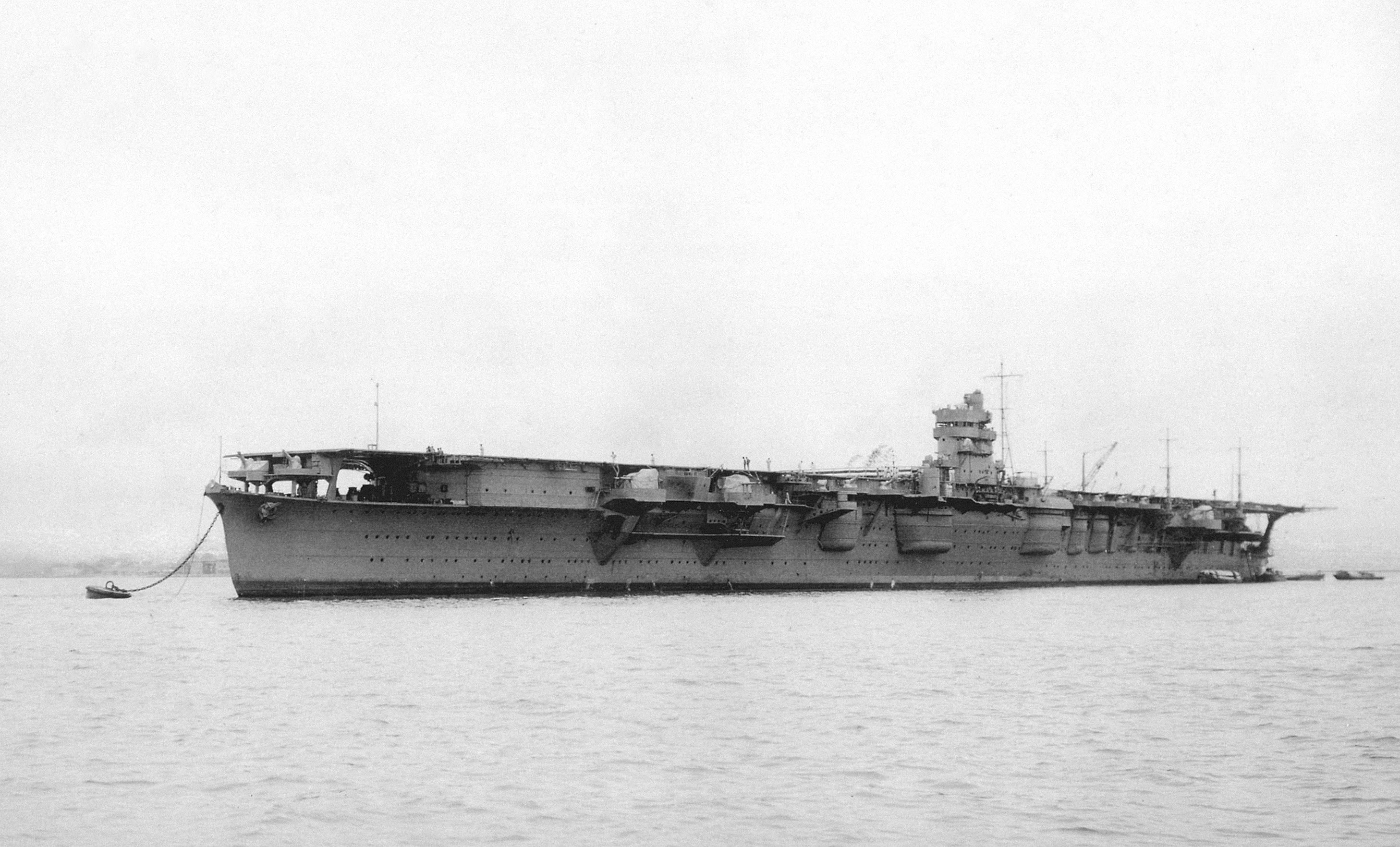
The Record
Fast fleet carrier, the only Japanese carrier to survive the American morning attack at Midway on 4 June 1942; she launched the retaliatory strike that crippled USS Yorktown. Caught that same afternoon by aircraft from USS Enterprise; four bombs struck and she burned through the night, scuttled before dawn on 5 June. 389 dead, 797 survived. Rear-Admiral Tamon Yamaguchi, one of Japan's most capable carrier commanders, chose to go down with his ship.
The Vessel
The Imperial Japanese Navy aircraft carrier Hiryū ("Flying Dragon") was the sister ship of Sōryū, commissioned at the Yokosuka Naval Arsenal on 5 July 1939. She was 228 metres long, 17,300 tons standard displacement, and carried the same air group composition as Sōryū (63 aircraft). Her one distinctive feature among Japanese carriers was the port-side island structure rather than the starboard-side arrangement standard on Akagi, Kaga, Sōryū, and subsequent Japanese carriers.
Her operational service from 1939 paralleled Sōryū's through the early Pacific War. Her captain from September 1941 was Captain Tomeo Kaku, a career naval aviator, and her air group was commanded by Lieutenant-Commander Joichi Tomonaga, one of the most distinguished Japanese aviators of the early war.
At Midway on 4 June 1942, Hiryū alone among the four Japanese fleet carriers survived the American dive-bombing attacks of 10:22-10:26. Her position in the starboard column, slightly to the rear of Sōryū, had placed her out of the immediate strike path of VB-3 and she had suffered no damage in the morning attack.
The Voyage
Through the middle of the morning of 4 June 1942, Hiryū emerged as the last operational Japanese carrier in the Pacific. Rear-Admiral Tamon Yamaguchi, the commander of the 2nd Carrier Division aboard Hiryū, assumed operational command of what remained of the Kidō Butai. At approximately 10:45 Yamaguchi ordered an immediate counter-strike against the American carriers, whose position had been reported by Japanese scout aircraft.
Hiryū's first counter-strike was launched at 10:58 on 4 June 1942. The strike comprised 18 Aichi D3A Val dive bombers and 6 Mitsubishi A6M Zero fighters under the command of Lieutenant Michio Kobayashi. The strike reached USS Yorktown at 12:05 and delivered three bomb hits on her flight deck, stopping her engines and causing significant fires. Yorktown appeared to be crippled but was able to restore power and speed over the following 90 minutes; the appearance of her flight deck being operational in subsequent Japanese reconnaissance contributed to Japanese misidentification of the second Yorktown attack as an attack on a different American carrier.
Hiryū's second counter-strike was launched at 13:31 on 4 June 1942. The strike comprised 10 Nakajima B5N Kate torpedo bombers and 6 A6M Zero fighters under Tomonaga's personal command. Tomonaga, whose aircraft had been damaged in the morning Midway strike, insisted on leading the counter-strike despite the damaged fuel tanks that precluded his return to Hiryū. The strike reached Yorktown at 14:30 and delivered two torpedo hits; Yorktown was doomed from this moment. Tomonaga's aircraft was shot down in the attack; his name is recorded with particular honour in Japanese naval history as the senior officer aboard a Japanese carrier to have led a mission from which he had no possibility of return.
The Disaster
While Hiryū's second strike was attacking Yorktown, the American forces had identified her as the surviving Japanese carrier and had launched a strike of their own. At approximately 17:00 on 4 June 1942 the dive bombers of USS Enterprise's VB-6 and a scratch contingent from Yorktown's VB-3 (whose pilots had landed on Enterprise after Yorktown had been damaged) reached the Kidō Butai's position. The combined strike of 24 Dauntless dive bombers found Hiryū at 17:03.
Four American 1,000-pound bombs struck Hiryū between 17:04 and 17:05. The first three struck her forward flight deck and forward hangar; the fourth struck her island structure. The damage pattern was similar to the other Midway carrier losses: burning aviation fuel from ruptured lines, exploding armaments on the hangar deck, progressive structural failure as the fires burned through internal bulkheads.
Captain Kaku was wounded on the bridge but remained in command. Rear-Admiral Yamaguchi, as commander of the 2nd Carrier Division, decided to remain aboard the burning ship. The pattern of Japanese carrier command culture in 1942 placed strong emphasis on the senior officer going down with his ship when the ship was lost; Yamaguchi's decision was received by the surviving Japanese officers as the expected and honourable course. He refused evacuation; his last message to the fleet, transmitted by blinker signal to the destroyer Kazagumo at approximately 02:00 on 5 June 1942, was a request that the Japanese Emperor be informed of the circumstances of his death.
The destroyer Makigumo was ordered to scuttle Hiryū with torpedoes at approximately 05:00 on 5 June 1942. Makigumo fired two Type 93 Long Lance torpedoes from 900 metres; both struck Hiryū's starboard side. Hiryū sank at 09:12 on 5 June 1942 at approximately 31°27′N 179°23′W in approximately 4,650 metres of water. Yamaguchi, Kaku, and approximately 390 of her 1,200 crew died. The surviving crew, approximately 797 men, were rescued by the destroyers Kazagumo and Yūgumo.
The Legacy
Rear-Admiral Tamon Yamaguchi has come to occupy, in post-war Japanese naval historiography, the position of the single most accomplished Japanese carrier admiral whose career was cut short by the defeat at Midway. Before the war, in 1937, he had served as the Japanese naval attaché in Washington D.C., where he had studied American carrier doctrine and personalities directly. His assessment of American capabilities, documented in the Imperial Japanese Navy General Staff archives, was consistently more realistic than that of other senior Japanese officers. Had he survived Midway, he would almost certainly have become Combined Fleet commander-in-chief; his loss with Hiryū meant that the more cautious Admirals Jisaburō Ozawa and Takeo Kurita, both of whom had advised against the Midway operation, took over the Japanese carrier command.
Hiryū's position as the last Japanese carrier to operate at Midway, and her role in sinking USS Yorktown in a counter-strike after the destruction of Akagi, Kaga, and Sōryū, made her the single Japanese carrier whose combat effectiveness has been most extensively studied. The Tomonaga second strike of 13:31 on 4 June 1942 is analysed in the American Naval War College curriculum as one of the most effective air strikes ever delivered against a modern aircraft carrier.
The wreck of Hiryū was located in October 2023 by the Petrel expedition's successor survey, at 4,650 metres depth, 24 kilometres north-northwest of Kaga's wreck site. The relative positions of the four Midway carrier wrecks confirm the battle's generally-accepted sequence and locations; Hiryū's isolated position away from the three morning carriers reflects her 90-minute survival after the 10:22-10:26 strike and the subsequent continuation of her operations on 4 June 1942.
All four Midway carriers are now located, surveyed, and protected as foreign military wrecks in United States waters. The Japanese Maritime Self-Defense Force has not named a subsequent ship Hiryū; the name, along with Akagi and Sōryū, remains unassigned in the post-war Japanese navy. The 390 dead of Hiryū are commemorated at the Yasukuni Shrine along with the combined dead of the four Midway carriers. Rear-Admiral Yamaguchi's personal effects, recovered from his cabin aboard Hiryū by salvage efforts in the first days after the battle, are displayed at the Naval History Museum in Etajima. His final photograph, taken on Hiryū's bridge at approximately 04:30 on 5 June 1942, shows him in full uniform with his sword, seated on the bridge chair, awaiting the sinking.