The Record
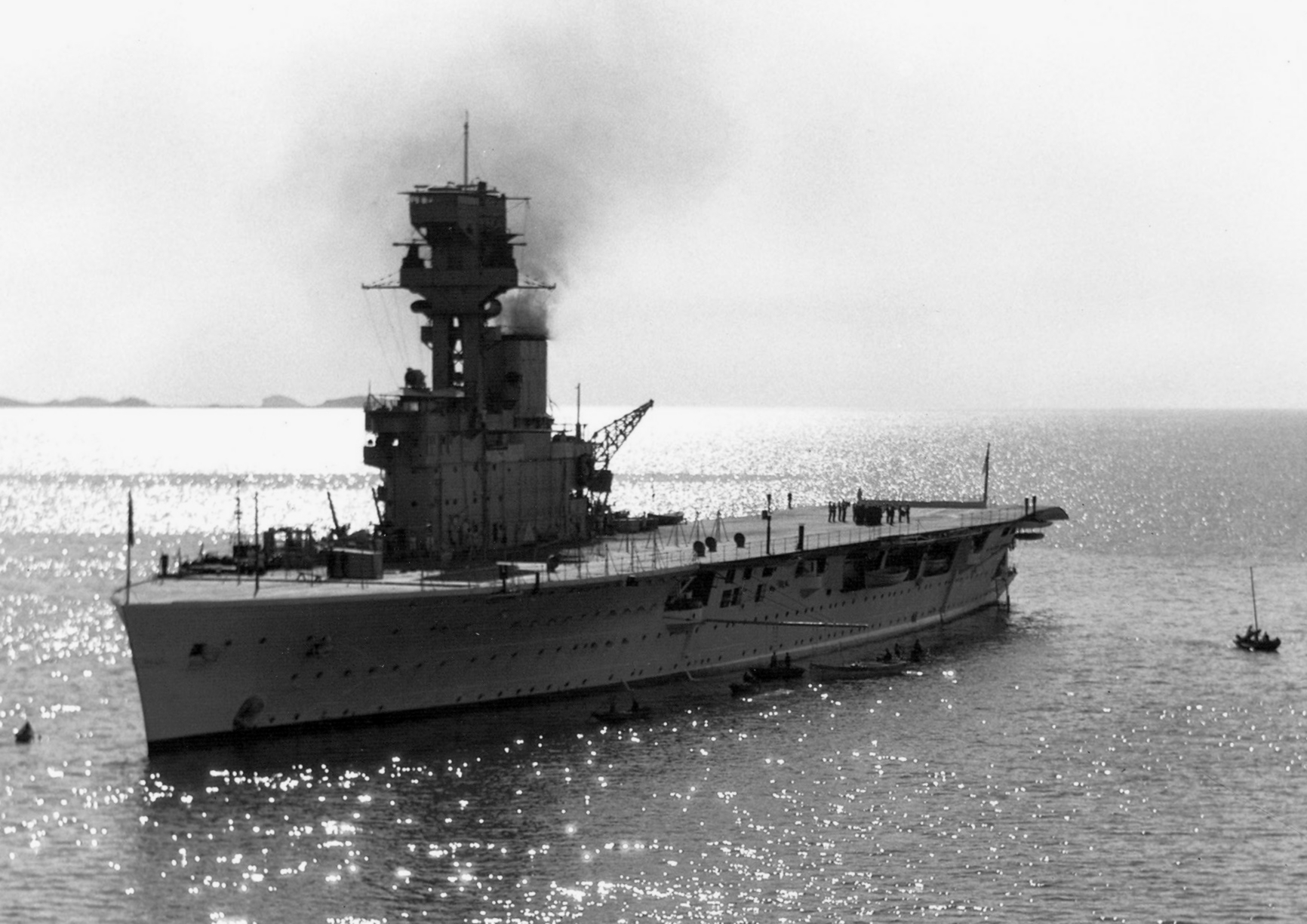
The first purpose-built aircraft carrier in history, commissioned in 1924. Intercepted south of Trincomalee on the morning of 9 April 1942 by 85 Japanese carrier aircraft during Admiral Nagumo's Indian Ocean raid: no fighter cover, forty bombs in ten minutes. Sank in twenty minutes, 307 dead. The first aircraft carrier ever sunk by enemy carrier aircraft.
The Vessel
HMS Hermes was a Royal Navy aircraft carrier, the first warship in the world to be designed and built from the keel as a purpose-built aircraft carrier. She was laid down at Armstrong Whitworth at Elswick in 1918, launched on 11 September 1919, and commissioned on 19 February 1924 after an extended period of interwar delay during which her design features were extensively modified. The long fitting-out period reflected the Royal Navy's continuing uncertainty about carrier design principles.
She was 182 metres long, 10,850 tons, and could operate approximately 20 aircraft. Her design incorporated many of the features that would become standard for subsequent carriers: a single full-length flight deck, a starboard-side island superstructure, and a single enclosed hangar. Her design speed of 25 knots, on single-shaft Parsons turbines, was adequate for the interwar period.
Her interwar service had taken her across the Empire: she served in the Mediterranean Fleet, the China Station, the West Indies Station, and the Atlantic Fleet successively through 1924-1939. She had been the Royal Navy's principal carrier presence in the Far East for much of the 1930s. Her commanding officer in early 1942 was Captain Richard Onslow, 40 years old, a career naval aviator with pre-war carrier experience.
The Voyage
By April 1942 HMS Hermes was operating from Trincomalee, the Royal Navy's principal Far Eastern base in Ceylon (now Sri Lanka). The British Eastern Fleet under Admiral James Somerville had been reconstituted in March 1942 after the loss of Prince of Wales and Repulse in December 1941 and the subsequent Japanese capture of Singapore. Somerville's fleet comprised three aircraft carriers (Indomitable, Formidable, Hermes), five battleships (Warspite, Resolution, Royal Sovereign, Ramillies, Revenge), seven cruisers, and 16 destroyers. By Royal Navy standards the force was impressive; by the standards of the Imperial Japanese Navy's Kidō Butai it was inadequate.
At the beginning of April 1942 Vice-Admiral Nagumo's Kidō Butai conducted a raid into the Indian Ocean: five fleet carriers (Akagi, Hiryū, Sōryū, Shōkaku, Zuikaku), four battleships, two heavy cruisers, and nine destroyers. Nagumo's mission was to destroy the British Eastern Fleet before the Japanese initiation of the Midway operation; British intelligence had identified the approach, and Somerville had withdrawn the bulk of his fleet to Addu Atoll (Maldives) on 1 April 1942 to avoid destruction. Hermes had been detached to Trincomalee for a short refit.
On 9 April 1942, Japanese aircraft from Akagi, Hiryū, and Sōryū attacked Trincomalee harbour. Hermes had been at sea since 08:00 on 9 April, running southeast along the Ceylon coast after receiving warning of the Japanese approach. She was accompanied only by the Australian destroyer HMAS Vampire. Her entire air group had been left ashore at China Bay airfield; the decision reflected the Royal Navy's assessment that carrier aircraft operating with insufficient cover could not survive an engagement with the Japanese.
The Disaster
At 10:30 on 9 April 1942, approximately 100 kilometres south-southeast of Trincomalee, Hermes and Vampire were sighted by Japanese search aircraft. At 10:35 a strike force of 85 Japanese carrier aircraft (Aichi D3A Val dive bombers and escorting A6M Zero fighters) was launched against the British force.
The Japanese strike reached Hermes at 10:50. Approximately 45 dive bombers attacked her in succession over the following ten minutes. The attack was, by the standards of carrier-versus-carrier engagements in 1942, unusually one-sided: Hermes had no fighter cover and no carrier aircraft of her own aloft. Her anti-aircraft armament (six 5.5-inch guns and three 4-inch anti-aircraft guns) was inadequate against a coordinated 45-aircraft dive-bombing attack.
Hermes was struck by approximately 40 bombs in 10 minutes. Her superstructure was destroyed; her flight deck was ploughed from end to end; her hangar deck caught fire. She listed to starboard; her damage-control teams were overwhelmed. Captain Onslow ordered abandon-ship at 11:00 on 9 April 1942. Hermes rolled onto her starboard side and sank at 11:00 at approximately 7°30′N 81°50′E in approximately 54 metres of water.
HMAS Vampire was also attacked during the engagement; she was hit by four bombs and sank at 11:02. The combined casualty count for Hermes and Vampire was 307 dead: 302 from Hermes, 5 from Vampire. The Japanese air strike suffered the loss of three aircraft.
The Legacy
HMS Hermes was the first aircraft carrier ever sunk by enemy carrier aircraft. The distinction was technical: earlier carrier losses (USS Lexington, USS Yorktown) had been compounded by other factors. HMS Hermes's destruction was by carrier aircraft alone, unambiguously, within a ten-minute window of dive-bombing by aircraft launched from a Japanese carrier. The specific sinking established, for the first time, what subsequent Pacific War engagements would repeatedly confirm: that a carrier without air cover in the presence of an enemy carrier's strike aircraft had essentially no defensive options.
The broader strategic consequence of the Japanese Indian Ocean raid (of which Hermes's destruction was the most significant single Allied loss) was the temporary withdrawal of the British Eastern Fleet to East Africa. The withdrawal left the eastern Indian Ocean under nominal Japanese naval dominance for approximately the next twelve months. The Japanese did not exploit the withdrawal for further offensive operations, because their subsequent attention turned to the planned Midway operation.
The wreck of HMS Hermes was located in 1962 by a Royal Ceylon Navy survey at a depth of 54 metres, approximately 20 kilometres off the east coast of Ceylon. The wreck has been the principal focus of Sri Lankan maritime archaeology since independence, and has been opened for recreational diving under strictly controlled conditions; Sri Lankan divers have reported the hull substantially intact, with the bomb damage visible on her flight deck and her lifeboats still in their davits.
The 302 dead of HMS Hermes are commemorated on the Chatham Naval Memorial. The Sri Lankan government maintains an annual commemorative dive on 9 April at the wreck site, in cooperation with the British High Commission in Colombo. The name HMS Hermes has been carried by eight subsequent Royal Navy ships, most recently by the Centaur-class aircraft carrier HMS Hermes (R12), commissioned in 1959 and sold to India in 1986 as INS Viraat. The name is currently held in reserve for a future Royal Navy vessel.