The Record
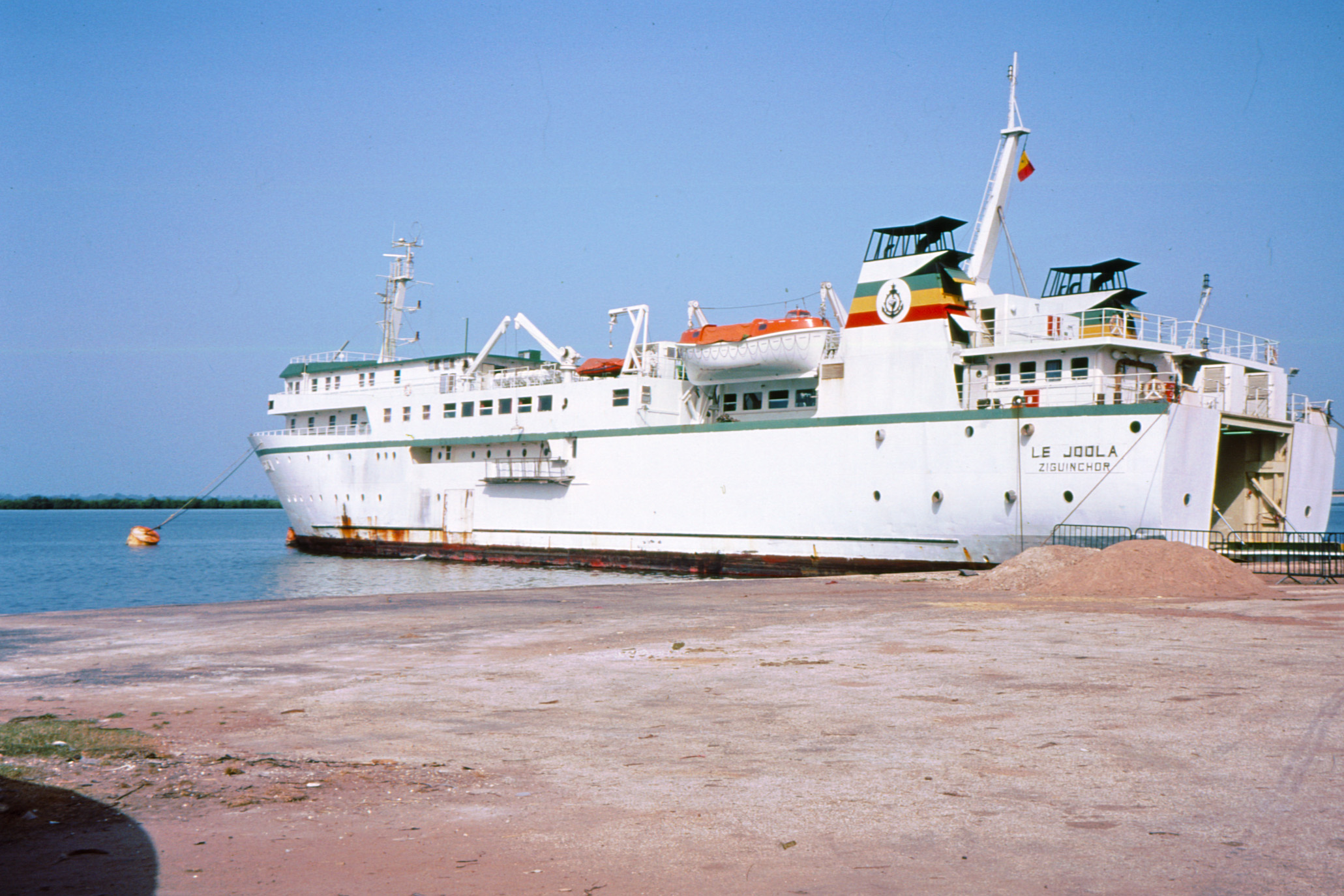
Senegalese state passenger ferry, Ziguinchor in the Casamance to Dakar. Capsized in a squall off The Gambia at 23:00 on 26 September 2002 while carrying more than three times her licensed capacity. 1,863 dead of around 1,927 aboard: the second-deadliest peacetime civilian maritime disaster in history after the Doña Paz. The fact that the passenger manifest was incomplete means no authoritative toll will ever exist.
The Vessel
The MV Le Joola was a Senegalese government-operated passenger-cargo ferry, built at the Germersheim yard of the German Germersheim Shipyards on the River Rhine between 1989 and 1990 and commissioned on 26 April 1990. She was 79 metres long, 2,087 gross tons, and powered by twin diesel engines producing approximately 2,000 horsepower. Her design was a combined passenger-cargo ferry intended for the Senegalese coastal and river ferry service.
Her accommodation was approximately 550 passengers plus approximately 70 vehicles in her lower deck vehicle bay and a crew of approximately 40. The specific design configuration was a two-level passenger vessel with an enclosed lower deck vehicle bay and an upper passenger deck; the configuration was intended for the specific conditions of the Senegalese coastal ferry service.
Her specific operational role was the Senegalese government's ferry service between Dakar (the national capital, on the Atlantic coast) and Ziguinchor (the regional capital of the Casamance region, in southern Senegal). The specific route connected the separate Casamance region (isolated from the rest of Senegal by the surrounding Gambia) with Dakar, providing essential passenger and freight connections.
By September 2002, the Joola had been operating on the Casamance ferry service for 12 years. The specific maintenance and operational condition of the ship had been the subject of several specific concerns; the specific operational budgets of the Senegalese government ferry service had been substantially constrained, affecting the quality and comprehensiveness of ferry maintenance.
Her master on her final voyage was Commander Issa Diarra, 49, a Senegalese Navy officer seconded to the national ferry service. Her complement on 26 September 2002 was substantially overloaded: estimated 1,928 persons (approximately 1,888 passengers plus 40 crew), substantially beyond her design capacity of 550 passengers plus 40 crew.
The Voyage
On 26 September 2002, the MV Le Joola departed Ziguinchor at approximately 13:30 bound for Dakar. The specific voyage was the scheduled weekly ferry service; the planned transit time was approximately 24 hours.
The specific operational issue was the extreme overloading of the ship. The ship's design capacity was 550 passengers; the specific complement of approximately 1,888 passengers represented approximately 243 per cent overloading. The specific overloading had occurred progressively over the preceding months; the specific combination of insufficient ferry capacity on the Dakar-Casamance route and the strong passenger demand for the route had produced the systematic overloading.
The weather conditions on 26 September 2002 were substantially typical of the West African coast during the September transition from the rainy to dry season: moderate wind and wave conditions with occasional squalls. The specific weather was not a principal contributing factor to the subsequent disaster.
At approximately 22:00 on 26 September 2002, Le Joola was approximately 30 kilometres off the Gambia coast, at approximately 13 degrees 30 minutes north, 16 degrees 50 minutes west. The specific navigational conditions were standard; the specific operational issues were internal to the ship.
At approximately 22:30 on 26 September 2002, a specific sudden thunderstorm struck the ship's position. The specific weather event was brief (approximately 15 minutes) but intense: wind velocities reached approximately force 7-8 for the specific duration; sea state increased to approximately 3-4 metre waves; rainfall was substantial.
The specific critical operational issue was the interaction of the extreme overloading with the specific thunderstorm conditions. The combination of: (i) the substantial overloading; (ii) the high centre of gravity due to the upper-deck passenger density; (iii) the specific rolling motion in the thunderstorm conditions; and (iv) the specific inadequate stability margins produced a catastrophic stability loss.
The Disaster
At approximately 22:45 on 26 September 2002, MV Le Joola capsized suddenly in approximately 20 metres of water off the Gambia coast. The specific capsize was extraordinarily rapid: the ship rolled completely inverted within approximately 5 minutes of the initial loss of stability.
The specific evacuation was almost entirely unsuccessful. The specific factors that prevented evacuation included: (i) the extreme rapidity of the capsize; (ii) the substantial overloading that had crowded every available upper-deck space; (iii) the specific below-deck accommodation of approximately 1,000 passengers; (iv) the specific absence of effective emergency warning systems; (v) the specific inadequate lifeboat and life-raft provision; (vi) the specific remote location that delayed rescue-response for many hours.
The specific Senegalese government rescue response was substantially delayed. The specific distress signals from Le Joola reached the Senegalese maritime authorities at approximately 23:00 on 26 September 2002, approximately 15 minutes after the capsize. However, the specific response delay was substantial: the first Senegalese Navy vessel reached the capsize site at approximately 11:00 on 27 September 2002, approximately 12 hours after the capsize.
The specific delayed rescue response substantially compromised the survival rate among those who had initially survived the capsize. Many of those who had reached the surface of the water died of exposure, exhaustion, or dehydration during the extended waiting period for rescue.
Of the approximately 1,928 aboard, approximately 1,863 died: the approximately 1,863 dead included the substantial majority who were trapped below decks in the capsize and the substantial majority who had initially reached the water but died waiting for rescue. Approximately 65 survived: predominantly passengers and crew who had been on the upper decks at the time of the capsize and who were fortunate in the specific circumstances of their exposure.
The specific casualty figure of approximately 1,863 dead made the Le Joola disaster the second-worst peacetime maritime disaster in history, exceeded only by the Philippine Doña Paz disaster of December 1987 (approximately 4,386 dead) and comparable to the Junyō Maru disaster of September 1944 (approximately 5,620 dead).
The Legacy
The MV Le Joola disaster of 26 September 2002 was a catastrophe that exposed systematic failures in Senegalese maritime safety regulation and the broader problems of ferry safety in West Africa. The approximately 1,863 dead devastated the Casamance region and the broader Senegalese population; the specific casualty pattern (predominantly Casamance residents travelling to Dakar for education, commerce, and family purposes) produced substantial national political and social response.
The subsequent Senegalese Commission of Inquiry, conducted through 2002 and 2003, identified a systematic pattern of failures: (i) the specific extreme overloading of the ship; (ii) the specific inadequate maintenance of the ship; (iii) the specific inadequate crew training; (iv) the specific inadequate lifeboat and safety equipment; (v) the specific inadequate rescue-response resources; (vi) the specific systematic failures of Senegalese maritime safety regulation and enforcement. The specific Senegalese Prime Minister Mame Madior Boye was removed from office in November 2002 as a specific political consequence of the disaster.
The specific regulatory response in Senegalese ferry operations was substantial. The Senegalese government established a specific independent maritime safety authority; enhanced ferry safety regulations; acquired modern replacement ferry vessels (the subsequent MV Willis and MV Aline Sitoe Diatta have operated the Casamance route more safely). However, the specific implementation of comprehensive safety reforms has been limited by continuing economic constraints on Senegalese maritime operations.
The specific international response included significant technical assistance from the International Maritime Organization, the World Bank, and various bilateral donors. The specific Le Joola case became a principal reference point in subsequent international ferry-safety initiatives for developing-country maritime operations.
The specific cultural and social impact in Senegal was profound. The disaster became a foundational event in Senegalese national memory comparable to other major national disasters; the specific Le Joola Memorial Day (annually on 26 September) is a national day of remembrance in Senegal. The specific Le Joola Museum at Ziguinchor (opened 2012) documents the disaster; multiple Senegalese literary, musical, and cinematic works have commemorated the tragedy.
The wreck of MV Le Joola lies at approximately 20 metres depth off the Gambia coast. The specific wreck was substantially salvaged through 2002-2003 for the recovery of approximately 552 bodies trapped in the wreck. The specific remaining wreckage is protected under Senegalese and Gambian cultural heritage legislation. The approximately 1,863 dead are commemorated by the Le Joola Memorial at Dakar (dedicated 2004); by the Le Joola Memorial at Ziguinchor (dedicated 2005); by individual memorials at the dead passengers' home communities across the Casamance region; and by the annual 26 September National Memorial Day.