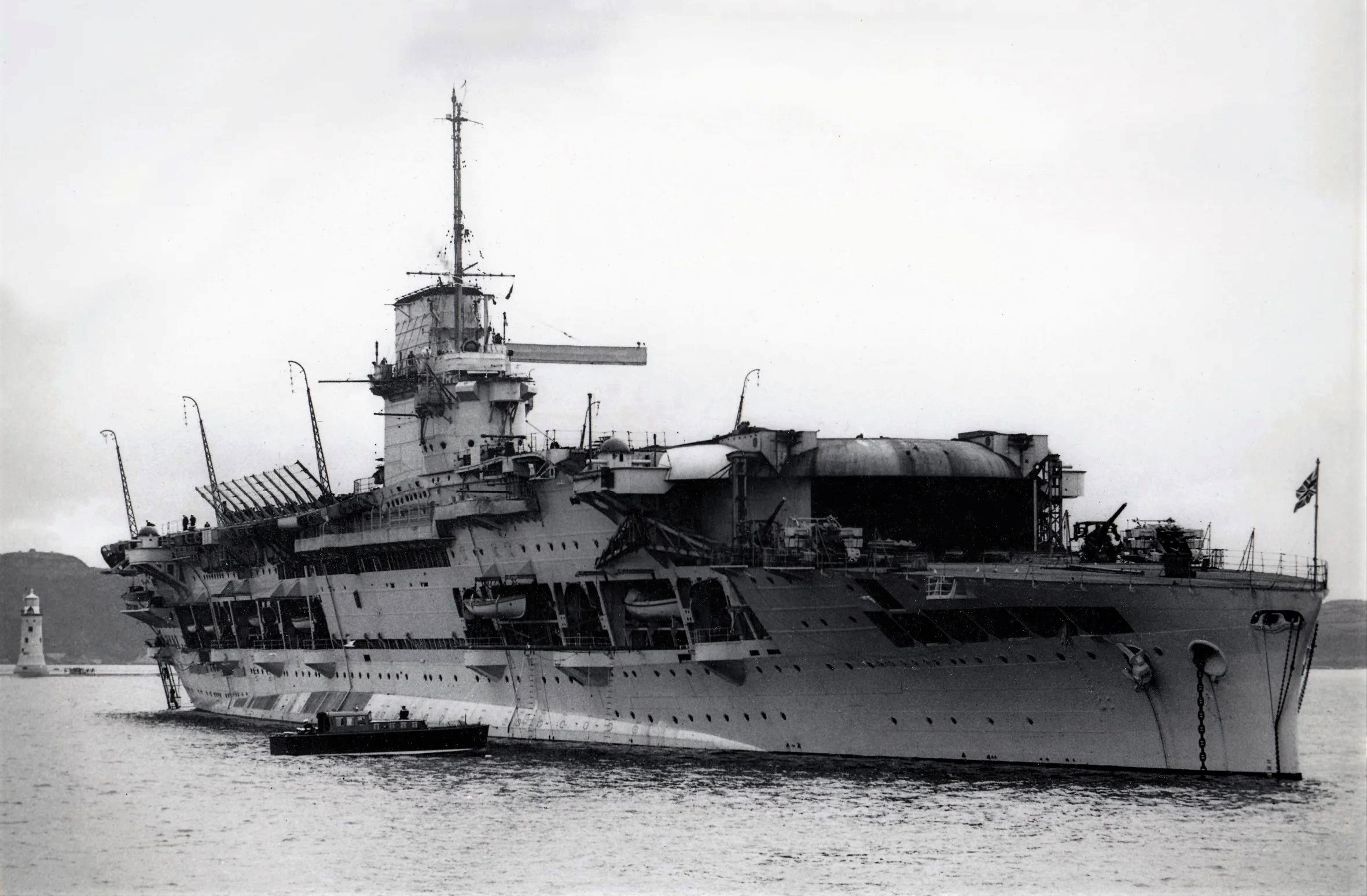
The Record
Royal Navy aircraft carrier, returning from the Norwegian campaign with a deck of Hurricane fighters. Intercepted off northern Norway on 8 June 1940 by the German battleships Scharnhorst and Gneisenau in clear weather; her two destroyer escorts charged the battleships to lay smoke but were destroyed, and Scharnhorst's 11-inch shells reached the Glorious from 24,000 metres. 1,519 dead of 1,561 aboard. The last engagement in naval history in which a battleship sank an aircraft carrier by gunfire.
The Vessel
HMS Glorious was originally a Courageous-class "large light cruiser" of the Royal Navy, laid down at Harland and Wolff in Belfast on 1 May 1915 as part of Admiral Jacky Fisher's late-war "Baltic Project" of ships designed to force the Danish Straits. The Baltic Project never happened; Fisher was replaced; the ships were completed with little operational function. Glorious and her sisters Courageous and Furious were rebuilt as aircraft carriers during the interwar period as the Royal Navy experimented with naval aviation. Glorious's conversion was carried out at Devonport between 1924 and 1930; she emerged as a full-deck aircraft carrier of 22,500 tons, capable of operating 48 aircraft.
She served through the 1930s in the Home and Mediterranean Fleets, participating in the International Naval demonstration at Corfu in 1923 and in the Royal Navy Jubilee Review of 1935. She was the fleet's principal carrier in the Mediterranean in the mid-1930s. By 1939 she was one of seven fleet carriers in Royal Navy service, with an operational record of solid but unremarkable peacetime service.
Her master at the beginning of the war was Captain Guy D'Oyly-Hughes, a former submarine officer who had transferred to the surface fleet in 1925 and had joined Glorious in May 1939. He had no prior aircraft carrier experience. His relationship with his air staff became a source of friction from the outset: he believed carrier flying was excessively cautious, and he dismissed at sea Commander Slessor (Commander Flying) after an argument on 8 April 1940 over the launch conditions for a reconnaissance flight. The dismissal was, by later judgement, a severe professional misjudgement; Slessor's court-martial on reaching England in May was dismissed in minutes.
The Voyage
Glorious arrived at Narvik in northern Norway in late May 1940 as part of the British naval effort supporting the Allied ground campaign against the German invasion. The campaign was failing. On 4 June 1940 the Allied evacuation from Narvik began; ten RAF Gladiator fighters and ten Hurricanes had been landed at the improvised airfield at Bardufoss and were to be flown off to Glorious for return to Britain. The flight-off on the evening of 7 June 1940 was the only carrier landing of RAF Hurricane fighters before the Battle of Britain.
With the Gladiators and Hurricanes aboard, Glorious sailed from Narvik on the evening of 7 June 1940, in company with two destroyer escorts, HMS Ardent and HMS Acasta. Captain D'Oyly-Hughes had requested and received permission from his senior officer at Narvik to detach from the main British force and make an independent return to Scapa, citing the need to court-martial his dismissed Commander Flying. This detachment placed Glorious alone with two Type-A destroyer escorts, without battleship cover, on a passage through waters known to be within the operational range of German surface forces.
She was steaming at a cruising speed of 17 knots. Her boilers had not been raised for high-speed readiness. Her aircraft were ranged on deck, with no fighter airborne and no CAP launched. Her radar was a primitive Type 79Z, still in operational trials, and her radar watch had not reported contacts through the afternoon of 8 June 1940. At 16:00 on that afternoon the lookout on her foretop sighted two ships on the horizon.
The Disaster
The two ships were the German battleships Scharnhorst and Gneisenau, sortieing from Trondheim under Admiral Wilhelm Marschall on Operation Juno, a raiding mission against the Allied evacuation force at Narvik. They had engaged and sunk the British oiler Oil Pioneer and the trawler Juniper earlier in the day. The sighting of Glorious at 17:00 on 8 June 1940 was the moment Marschall had been hoping for: an isolated British carrier at long range, in clear weather.
Scharnhorst opened fire from 24,000 metres at 17:30. Glorious was almost immediately bracketed by 11-inch shells. Captain D'Oyly-Hughes had no fighters airborne, no strike aircraft ready to launch, and no tactical option beyond fleeing under smoke. Ardent and Acasta made an attempt to lay smoke between the German battleships and the carrier; the smoke was blown away faster than it could be generated in the fresh conditions. Ardent was overwhelmed by Scharnhorst's 11-inch fire at 18:00 and sank at 18:25 with 152 of her 160 crew lost.
Glorious was hit in the hangar deck by the fourth German salvo, ignited her aircraft and their fuel, and was burning uncontrollably by 18:30. She was hit successively on the main deck, in the engine room, and in the bridge; the bridge hit killed Captain D'Oyly-Hughes and most of his staff. She settled by the bow and capsized at 19:10.
Acasta, the surviving British destroyer, made a torpedo attack from 15,000 metres as the German battleships were finishing Glorious. Her torpedoes struck Scharnhorst in the engineering spaces, causing substantial damage and forcing Marschall to abandon his raid. The torpedoes were Acasta's only significant achievement; she was then engaged by Gneisenau's secondary armament and sunk with 159 of her 161 crew. One man survived the sinking. 1,519 of the 1,561 British crew of the three ships died in the engagement: 1,207 from Glorious, 152 from Ardent, 160 from Acasta.
The Legacy
The British survivors spent two and a half days in the water. Only 41 reached Norway alive; 39 of them from Glorious, 2 from Acasta. Several died within hours of reaching shore. The single Acasta survivor, Leading Seaman Carter, reported to the Norwegian authorities that his ship had torpedoed Scharnhorst before sinking. His account, passed to the Admiralty on 12 June, was the first intelligence that Scharnhorst had been damaged and confirmed that Operation Juno had been disrupted.
The Admiralty inquiry into the loss of Glorious, conducted in June and July 1940, concluded that Captain D'Oyly-Hughes had been negligent in his decision to detach from the main force without steam-up readiness, fighter cover, or radar watch. The inquiry's findings were classified; they were not released publicly until 1997. The Admiralty's public stance at the time was limited to the announcement of the loss and the names of the dead.
Glorious, along with Ardent and Acasta, lies at approximately 1,600 metres in the Norwegian Sea, 150 kilometres west-northwest of Harstad. The wreck site has not been formally located but has been approximately identified from the Admiralty's reconstruction of her final position. She is protected as a war grave under the Protection of Military Remains Act 1986.
She was the last occasion in naval history in which a battleship destroyed an aircraft carrier by gunfire. The engagement was, more broadly, the last general naval engagement in which surface gunfire between capital ships was the decisive weapon; Jutland had been the equivalent in the First World War and the Battle off Samar in 1944 would be the Second World War's equivalent in Pacific waters. The Glorious disaster is frequently cited in the staff colleges of the English-speaking naval world as the textbook case against the detachment of a carrier from her defensive screen, against the inadequacy of peacetime operational routines under wartime conditions, and against the promotion of officers into command of unfamiliar ship types. The 1,519 dead are commemorated on a joint memorial at the Portsmouth Naval Memorial and at the Clyde Submarine Memorial at Helensburgh.