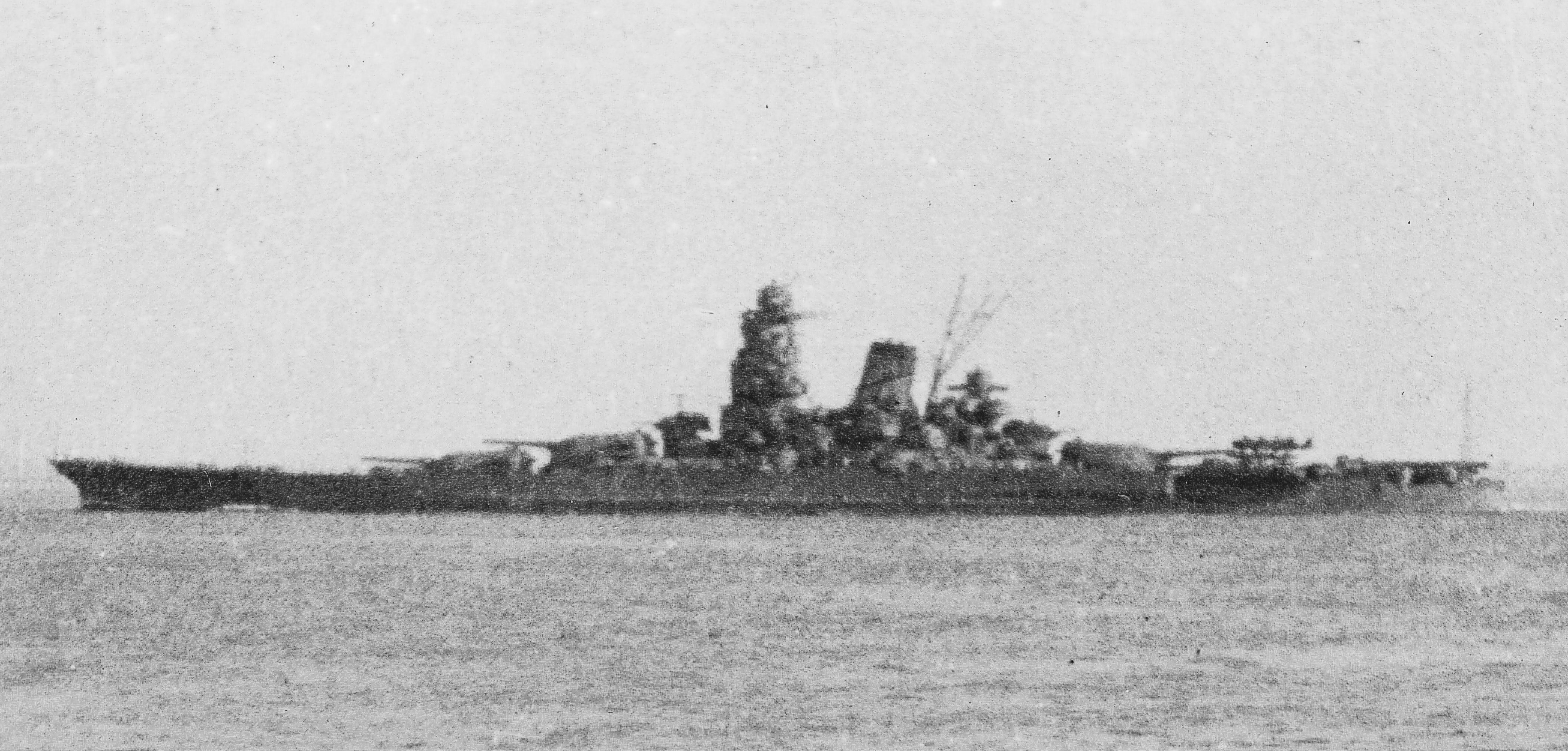
The Record
Second and last Yamato-class battleship, flagship of the 2nd Fleet under Admiral Takeo Kurita. Attacked repeatedly by American carrier aircraft of Task Force 38 at the Battle of Leyte Gulf on 24 October 1944 as she advanced through the Sibuyan Sea. Absorbed 19 torpedoes and 17 bombs before capsizing. ~1,023 dead; her loss ended the credible Japanese surface threat in the Pacific. Found in 2015 by Paul Allen at 1,000 metres.
The Vessel
The Imperial Japanese Navy battleship Musashi was the second of the three Yamato-class battleships, the largest battleships ever built. She was laid down at the Mitsubishi Nagasaki Shipyard on 29 March 1938 and commissioned on 5 August 1942. She was 263 metres long, 72,800 tons at full load, armed with nine 46-cm (18.1-inch) guns in three triple turrets, and carried a crew of approximately 2,400. Like her sister Yamato, she was the product of Japanese naval doctrine of the 1930s that had favoured the construction of a small number of overwhelmingly powerful battleships as the core of the Imperial Japanese Navy.
Her commissioning came nine months after Pearl Harbor, in the war that her class had been designed to fight. The strategic shift from battleship-centred to carrier-centred naval warfare that had been demonstrated by the Pearl Harbor attack (which Musashi's air-group equivalent had conducted) had arrived before Musashi reached operational service. She was, from her first day in commission, a ship whose primary strategic role had already been overtaken by a different weapons system.
She served through 1942-1944 in a training and flagship role, principally at Truk and in the Inland Sea, without engaging Allied forces directly. Her modernised anti-aircraft armament (by late 1944, 24 twin 127-mm guns plus 150 25-mm triple mountings) represented the Imperial Japanese Navy's best attempt to protect a Yamato-class ship against modern carrier aircraft attack. It would prove insufficient.
The Voyage
In October 1944 the American forces began the invasion of the Philippines, landing on Leyte on 20 October. The Imperial Japanese Navy's response, Operation Shō-1, was a desperate three-pronged offensive intended to destroy the American amphibious shipping at Leyte Gulf. Musashi sailed with Vice-Admiral Takeo Kurita's Centre Force, comprising five battleships (including Yamato), twelve cruisers, and fifteen destroyers. The force departed Brunei on 22 October 1944.
Kurita's Centre Force entered the Palawan Passage on 23 October and was attacked by American submarines early on the morning; the cruisers Atago (Kurita's flagship) and Maya were sunk, and Takao severely damaged. Kurita transferred his flag to Yamato. The force continued eastward through the Sulu Sea and the Sibuyan Sea on 24 October 1944.
In the Sibuyan Sea on 24 October 1944, Kurita's force was attacked repeatedly by aircraft of the American Third Fleet. The attacks came in five major waves between 10:26 and 16:48 on 24 October. The specific concentration of American attack aircraft on Musashi, rather than on Yamato (which was Kurita's flagship), has been the subject of considerable historical discussion; it may have reflected Musashi's slightly greater stopping power for inexperienced pilots, or may have reflected the simple tactical fact that she was the easiest target to identify in the confused formation.
The Disaster
The first wave of American attacks at 10:26 on 24 October 1944 struck Musashi with one bomb and one torpedo. The second wave at 12:07 delivered three more torpedoes. The third at 13:31 delivered four torpedoes and four bombs. The fourth at 14:50 delivered four torpedoes and four bombs. The fifth at 15:29 delivered three torpedoes and two bombs. The final wave at 16:48 delivered four torpedoes and four bombs.
Musashi absorbed 19 torpedoes and 17 bombs over approximately six hours. Her design had been calculated to survive 15 torpedo hits before being critically damaged; by the fourth attack wave she had already exceeded this design limit. Her progressive flooding caused her to develop a 15-degree list to port and to lose speed progressively through the afternoon: from 27 knots at the start of the attacks to 12 knots by 14:00, to 6 knots by 16:00, and to 3 knots by 17:00.
Her commanding officer, Rear-Admiral Toshihira Inoguchi, directed damage control efforts that succeeded in keeping the ship afloat far longer than could reasonably have been expected. Her anti-aircraft gunners shot down 18 American aircraft during the six-hour engagement. However, by 17:30 on 24 October her steering had failed, her forward guns were inoperable, and her list had increased to 20 degrees. At 17:30 Inoguchi ordered the ship's company to abandon.
Musashi capsized and sank at 19:36 on 24 October 1944 at approximately 13°07′N 122°32′E in approximately 1,000 metres of water. Inoguchi remained aboard; he committed suicide in his cabin before the sinking. Approximately 1,023 of her 2,399 crew died; the destroyers Asagumo and Hamakaze rescued 1,376 survivors.
The Legacy
The destruction of Musashi on 24 October 1944 in the Sibuyan Sea was one of the most demonstrative single events of the entire Pacific War. The largest battleship ever built, absorbing 19 torpedoes and 17 bombs, had been destroyed by American carrier aircraft in a six-hour engagement without the American fleet ever coming within gunnery range. The demonstration that no battleship, however powerful, could survive sustained attack by massed carrier aviation was the final confirmation of a conclusion that had been gathering since the 1941 sinking of Prince of Wales and Repulse.
The strategic consequence was that Kurita's Centre Force emerged from the Sibuyan Sea with only four battleships (Yamato, Nagato, Kongō, Haruna), having lost the most powerful ship in the force. Kurita's subsequent decision-making on 25 October 1944 (the withdrawal at the Battle off Samar after Taffy 3 had been attacked) has been attributed by some historians to the psychological effect of the Musashi loss on the Japanese command.
The wreck of Musashi was located on 4 March 2015 by a team operating from Paul Allen's research vessel Octopus. She lies at 1,000 metres depth in the Sibuyan Sea, broken into two main sections approximately 600 metres apart. Her forward hull, containing her magazine, is upside down; her stern section is upright. The relatively shallow depth makes her one of the more accessible Pacific War battleship wrecks. The Octopus survey identified her by the 6-inch chrysanthemum seal on her hull plating, the Imperial Japanese Navy's identification mark.
The name Musashi has not been carried by any subsequent Japanese warship. The Japan Maritime Self-Defense Force has a modern Murasame-class destroyer named Musashi (DD-109, commissioned 1999), but she is named for the historical figure Miyamoto Musashi, not for the battleship. The 1,023 dead of Musashi are commemorated at the Yasukuni Shrine along with the combined Japanese naval dead of the Leyte Gulf campaign. Her 46-cm gun barrels, recovered from the wreck in a series of Philippine salvage operations in the 1990s, are displayed at the Yamato Museum in Kure and at the Imperial Japanese Navy Memorial in Yokosuka. She was the largest battleship ever to sink in combat; she sank because the battleship itself had been superseded.