The Record
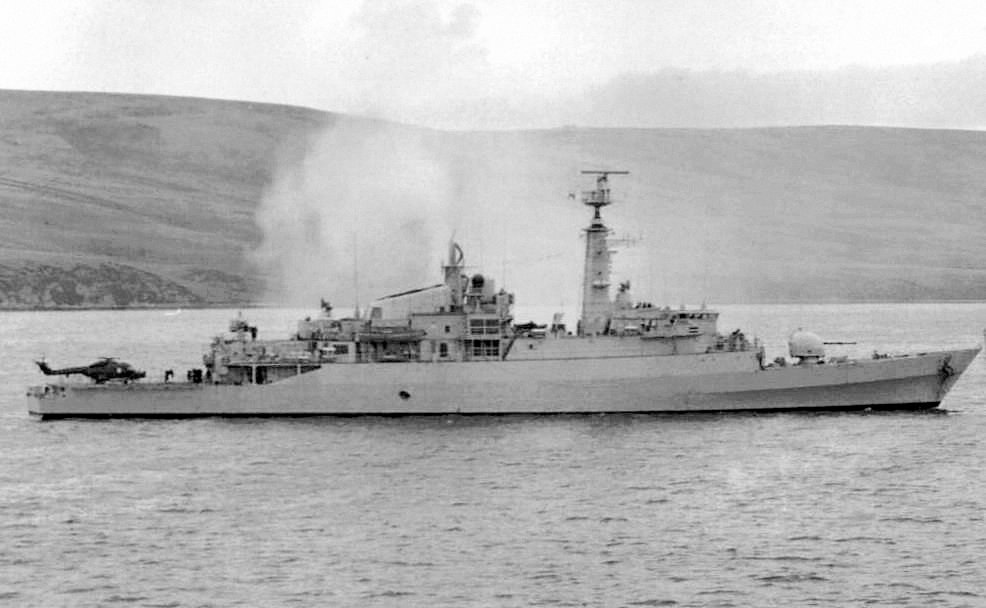
Royal Navy Type 21 frigate, on picket duty in San Carlos Water during the Falklands landings. Bombed by Argentine A-4 Skyhawks on the afternoon of 23 May 1982; two 1,000-pound bombs lodged unexploded in her hull. During the evening defusing attempt, one detonated and cut her in half. She burned through the night and went up in a single fireball on the morning of the 24th, producing the most widely reproduced British naval photograph of the war.
The Vessel
HMS Antelope (F170) was a Type 21 frigate of the Royal Navy, commissioned at Vosper Thornycroft at Woolston, Hampshire, on 19 July 1975. She was 117 metres long, 3,250 tons full load, armed with a single 4.5-inch Mark 8 gun, a Sea Cat surface-to-air missile system, two Exocet MM38 anti-ship missiles, and two triple Mark 32 anti-submarine torpedo tubes. Her designed speed was 32 knots on twin Rolls-Royce Olympus TM3B gas turbines and two Tyne cruise turbines.
The Type 21 class, eight ships built between 1974 and 1979, was the first Royal Navy class to use combined gas turbine (COGOG) propulsion and the first to use commercial-design hulls with naval-combat-systems integration. The class had been controversial within the Royal Navy from its outset: the commercial-design hull (adapted from the Vosper Thornycroft Mk 10 commercial warship design) had been criticised as having inadequate damage-control subdivision, and the aluminium superstructure had raised the same fire-risk concerns as the Type 42 destroyer class. The Type 21 was designed primarily for the General Purpose Frigate role, escorting fleet units and conducting constabulary operations.
Her commanding officer in 1982 was Commander Nick Tobin, 38 years old, a career Royal Navy surface warfare officer. Her crew was 175 officers and ratings.
The Voyage
HMS Antelope was assigned to the Royal Navy Falklands task force and sailed from the United Kingdom with the initial task force in early April 1982. By 21 May 1982 she had been assigned to the inner screen of the British amphibious operation at San Carlos Water, the sheltered bay on the west side of East Falkland where the British amphibious force was conducting the initial ground landing. Her specific mission was close air defence of the amphibious anchorage, operating at very short range from the landing beaches.
The San Carlos Water station was the most tactically difficult of any Royal Navy picket position in the campaign. The amphibious anchorage was constrained in space (a natural harbour approximately 4 kilometres long and 1.5 kilometres wide) and was surrounded by Argentine-held high ground to the north, east, and south. Argentine A-4 Skyhawk and Dagger fighter-bombers could approach the anchorage from any of these directions at low altitude using terrain masking to defeat British radar coverage. The Royal Navy's air defence in the anchorage therefore depended on close-in point defence (Sea Wolf, Sea Cat, small-calibre gunfire, and small-arms fire from Marines ashore) rather than on medium-range Sea Dart coverage.
On 23 May 1982, at approximately 15:30, Argentine Daggers attacked the San Carlos Water anchorage at low altitude. One Argentine 1,000-pound bomb struck HMS Antelope on her starboard side amidships, penetrating her hull and coming to rest unexploded in her forward fuel tank room.
The Disaster
The unexploded bomb inside HMS Antelope created a tactical situation that the Royal Navy's 1982 doctrine had not adequately anticipated. Warrant Officer John Phillips of the Royal Engineers Bomb Disposal and Search Regiment, flown aboard by helicopter, attempted to defuse the bomb during the late afternoon and evening of 23 May 1982. His initial attempt to remove the detonator using a rocket wrench tool was unsuccessful; the detonator was stuck. His second attempt, at approximately 18:30 on 23 May 1982, used a water-displacement technique that had been effective in previous Argentine bomb recoveries.
The bomb detonated at 18:45 on 23 May 1982. The detonation occurred within HMS Antelope's engineering spaces. The resulting fire spread through her ship's centre structure rapidly; her damage-control systems were unable to contain the progressive structural and fire damage. Warrant Officer Phillips was wounded in the detonation but survived. The ship's company was evacuated from the burning wreck over the following two hours.
The progressive fire eventually reached HMS Antelope's main armament magazine. The magazine detonated at approximately 00:05 on 24 May 1982. The explosion was one of the most widely-photographed single events of the Falklands War: her sinking in a single fireball was captured on British press photography and became one of the iconic images of the conflict. The photograph of HMS Antelope breaking in half amidships, with flame rising 30 metres above her superstructure, was published on the front pages of multiple British newspapers on 25 May 1982 and has been reproduced in virtually every subsequent account of the campaign.
HMS Antelope sank at approximately 09:00 on 24 May 1982 at approximately 51°34′S 58°55′W in approximately 35 metres of water in San Carlos Water. Of her 175 crew, 1 died (Steward Mark Stephens, killed in the initial Argentine bomb impact). 174 survived.
The Legacy
The single-casualty loss of HMS Antelope has become the canonical Falklands example of the dual character of the Argentine air campaign: the operational efficiency of the Argentine bombing (which scored repeated hits on British warships at San Carlos despite the British air defences) and the tactical failure of Argentine bomb fusing (which allowed a significant fraction of the Argentine bombs to land unexploded, reducing their actual damage to British ships). The Argentine 1,000-pound bombs had been set for low-altitude release, which required a fuse-delay that the Argentine Daggers, flying at sea level, did not always achieve. Approximately 30 per cent of the Argentine bombs that struck British ships failed to detonate.
Warrant Officer Phillips was awarded the George Medal for his conduct during the defusing attempt. He recovered from his injuries and continued his Royal Engineers career through 1984, after which he retired and took up civilian employment. His account of the defusing (published in the Royal Engineers Journal in 1983) is considered one of the definitive accounts of the Falklands bomb-disposal effort.
The visual record of HMS Antelope's loss, particularly the magazine-detonation photograph of 00:05 on 24 May 1982, has been widely reproduced in civilian and military publications. The photograph was taken by British press photographer Paul Haley, embedded with the British amphibious task force. The image, along with a similar sequence photographed by Andrew Marr during the same event, has become a standard visual reference for subsequent discussions of modern naval warfare, the survivability of aluminium-superstructure warships, and the specific tactical conditions of the 1982 Falklands campaign.
The wreck of HMS Antelope lies in 35 metres of water in San Carlos Water. She is upright on the seabed, her forward and after sections still recognisable despite the structural damage from the magazine detonation and the subsequent sinking. The site is a protected war grave under the UK Protection of Military Remains Act 1986 and is designated a British Dependency heritage site by the government of the Falkland Islands; recreational diving on her is prohibited.
The name HMS Antelope has not been carried by any subsequent Royal Navy warship. As of 2025 the name remains in reserve. Warrant Officer Phillips died in 2014; his family received a formal letter of condolence from the Royal Navy on his death. The Antelope photograph of 00:05 on 24 May 1982 remains one of the most widely-known images of the modern Royal Navy, and one of the most widely-reproduced photographs of a warship loss in the history of naval photography.