The Record
Italian Line flagship, Genoa to New York, the most elegant liner of her generation. Rammed starboard in Nantucket fog by the Swedish liner Stockholm on the night of 25 July 1956. 46 died in the collision itself; the remaining 1,660 were lifted off through the night in one of the largest civilian sea rescues ever mounted. The last great transatlantic disaster before the jet age erased them.
The Vessel
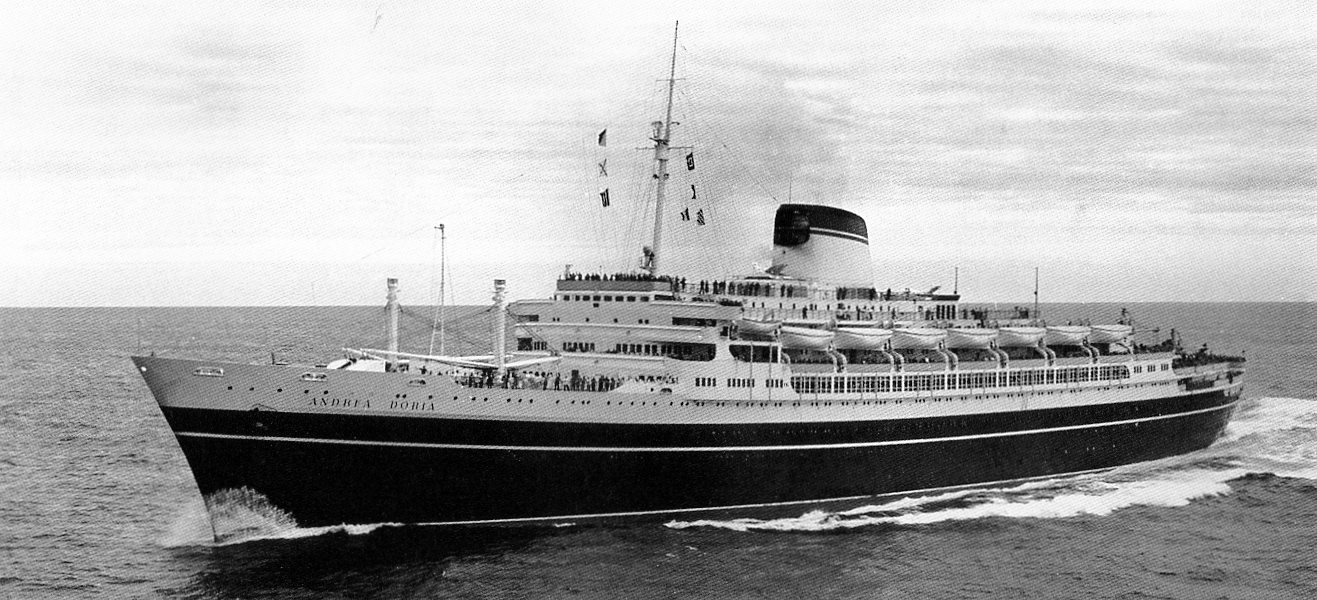
The SS Andrea Doria was the postwar flagship of Italy's reconstituted merchant marine, built at the Ansaldo yard in Genoa and entered into Italian Line service on 14 January 1953. She was 213 metres long, 29,083 tons gross, named for the sixteenth-century Genoese admiral and statesman whose family had financed the yard that built her. At the moment of her launch she was the most technologically ambitious liner Italy had ever put to sea.
She was designed for the New York-Genoa run, eleven classes between first and tourist, capable of 23 knots on two shafts, with a length-to-beam ratio and a hull form that let her press her speed through the North Atlantic in most weather. Her safety provisions exceeded the SOLAS requirements of the 1948 convention: she carried lifeboats for 2,000 when her full capacity was 1,241 passengers and 563 crew, and her eleven watertight compartments were individually calculated to sustain single-compartment flooding at any angle.
She was also the most heavily styled liner of her generation. The Italian Line commissioned murals, tapestries, mosaics, and sculpture from Salvatore Fiume, Emanuele Luzzati, and Giovanni Ponti; her first-class Winter Garden carried a bronze statue of Admiral Andrea Doria cast for the ship. She was the most photographed Italian ship of the 1950s, a visible argument that the country that had lost its battleships at the armistice had rebuilt itself by another means.
The Voyage
She left Genoa at 05:00 on 17 July 1956 on her 101st westbound crossing, Gibraltar-New York, under the command of Captain Piero Calamai, a 58-year-old Italian Line veteran who had served twenty years at sea without accident. She carried 1,134 passengers and 572 crew. The transatlantic passage was routine until the evening of 25 July, when she entered the Nantucket Lightship's dense fog belt on the approach to New York.
Approaching from the opposite direction in the same fog was the MS Stockholm, a 12,644-ton Swedish-American Line passenger ship on her east-bound run to Gothenburg. The Stockholm's bow was reinforced with ice-class plating to a class above Andrea Doria's because she worked the winter North Atlantic and the northern Baltic. Her officer of the watch, Johan-Ernst Carstens-Johannsen, was 26 years old. Andrea Doria's officer of the watch was Second Officer Curzio Franchini.
Both ships were running on radar. Both ships were under autopilot. Both bridges read the other ship's position differently. Carstens-Johannsen tracked Andrea Doria as southwest-bound and turned to pass her on the conventional port side, which would have been her starboard. Franchini tracked Stockholm as north-bound and expected her to pass port-to-port, so turned to port. The two turns brought the two ships into each other's tracks. The Stockholm's reinforced ice bow struck the Andrea Doria's starboard side at 23:10 on 25 July 1956, thirty-five seconds after the two ships came into visual sighting distance.
The Disaster
The Stockholm's bow penetrated seven decks, opening the Andrea Doria's starboard side from her waterline to her promenade and flooding her starboard fuel tanks. 46 of Andrea Doria's passengers in the immediate impact zone died in the first minutes; five of Stockholm's forward crew also died. She listed 20 degrees to starboard within ten minutes, a list that her stability calculation had never contemplated because it assumed both sides of her fuel tanks could be counter-flooded. With her starboard tanks already ruptured and her port tanks empty, the list could not be corrected.
Calamai ordered the lifeboats away, but the list had already put the port boats out of reach; passengers climbed down from the starboard rail into the boats that could still be swung out. The rescue that followed was the largest civilian maritime rescue operation in history. The French liner Île de France, the American freighter Cape Ann, the U.S. destroyer Edward H. Allen, and the Stockholm herself worked the scene through the night. 1,660 people were taken off across eleven hours.
The Andrea Doria sank at 10:09 on the morning of 26 July, ten hours and fifty-nine minutes after the collision, with her stern rising and her bow still on even keel against the fog. Calamai stood on her bridge to the last, refusing to leave his ship; he had to be carried off by the last lifeboat. He lived the rest of his life in Genoa, never sailing again, and he never spoke publicly about the sinking. He died in 1972.
The Legacy
The mutual-lawsuit discovery between the Italian Line and the Swedish-American Line produced the most extensive body of evidence ever accumulated on a postwar maritime collision. The two lines settled out of court in January 1957 before the case reached trial; the confidential settlement apportioned roughly equal financial responsibility between them. The written findings have never been released. Both shipping lines had reason to prefer the public record remain inconclusive.
The Italian inquiry of 1957 faulted neither captain but criticised radar training on both bridges. The Stockholm was repaired and returned to service in late 1956 and continued working into the twenty-first century under successive names; she remains afloat in 2025 as the cruise ship Astoria, the oldest ocean liner still in service. Calamai's name remained respected in Italian maritime circles; his daughter Marina Calamai, a professor of American literature, has written that he was the last Italian captain of the old school, a man for whom the ship-to-ship voice had failed.
The Andrea Doria lies at 75 metres, 72 kilometres south of Nantucket, on her starboard side, the rent in her hull directly under her. She is the most challenging accessible wreck dive in the Western Atlantic and the most deadly: at least 18 recreational divers have died in or on her since the 1960s, several of them in the penetration attempts that her open condition invites. Her Winter Garden statue of Admiral Doria was recovered by an American salvage team in 1964 and is now displayed at the Italian Cultural Institute in New York.
She was the last great transatlantic disaster before the jet age erased them. Pan American's Boeing 707 entered transatlantic service in October 1958, fourteen months after she sank; the transatlantic liner economy collapsed through the 1960s. The Andrea Doria is sometimes called the last liner whose loss mattered in the old sense.