The Record
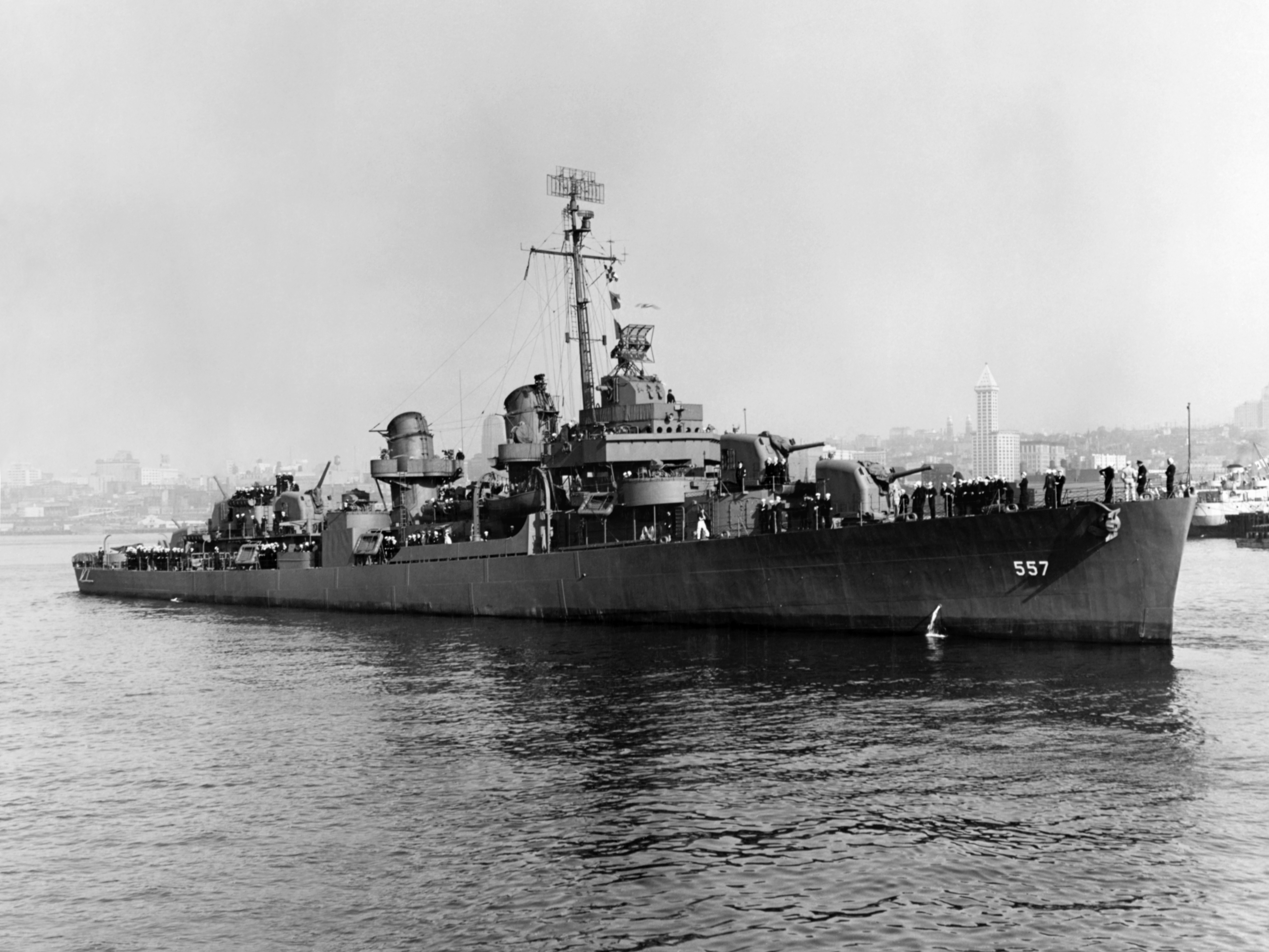
American Fletcher-class destroyer, commanded by Ernest E. Evans, part of Taffy 3's escort screen at the Battle off Samar. On the morning of 25 October 1944 she led the counterattack against Admiral Kurita's Centre Force, charging alone into a battle line that included the battleship Yamato. Fired every torpedo, expended every 5-inch round, and kept going until she was destroyed by the combined gunfire of four Japanese battleships and cruisers. 186 dead including Evans, who received a posthumous Medal of Honor. Located in 2019 at 6,469 metres, the deepest wreck of any ship then on record.
The Vessel
USS Johnston (DD-557) was a Fletcher-class destroyer of the United States Navy, commissioned at the Seattle-Tacoma Shipbuilding Corporation on 27 October 1943. She was 114 metres long, 2,050 tons standard displacement, armed with five 5-inch guns and ten 21-inch torpedo tubes, designed for 36 knots. The Fletcher class was the most numerous United States destroyer type of the Second World War, 175 ships built; Johnston was one of the first to be commissioned with the improved director-fire control system that would become the fleet standard.
Her first commanding officer, Commander Ernest Edwin Evans, was a Cherokee and Creek Native American from Pawnee, Oklahoma, a 1931 graduate of the United States Naval Academy and a veteran of a pre-war South Atlantic deployment. Evans took command of Johnston at her commissioning and held her through her subsequent 11 months of service. His first address to the crew, recorded in the ship's log of 27 October 1943, included the statement that would define his own fate and that of his ship: "This is going to be a fighting ship. I intend to go in harm's way. Anyone who does not want to go along had better get off right now."
She sailed to the Pacific in early 1944 and was assigned to Task Force 58 during the Marianas and Palau campaigns. Her combat record through 1944 included anti-aircraft fire support at Saipan, shore bombardment at Guam, and screening duties at Palau. By October 1944 she was assigned to Task Unit 77.4.3 (call sign "Taffy 3") under the command of Rear-Admiral Clifton A. F. Sprague, part of the escort carrier screen supporting the American landings at Leyte Gulf in the Philippines.
The Voyage
At dawn on 25 October 1944, Taffy 3 was operating in the waters off Samar, east of the Philippines. Her composition was six escort carriers (Fanshaw Bay, White Plains, Kalinin Bay, Kitkun Bay, Gambier Bay, St. Lo), three destroyers (Hoel, Heermann, Johnston), and four destroyer escorts (Dennis, John C. Butler, Raymond, Samuel B. Roberts). The escort carriers were the small, lightly-armed auxiliary carriers whose role was close-air support for the amphibious landings. Taffy 3's normal threat envelope had been Japanese aircraft, not surface ships.
At 06:45 on 25 October 1944, the Taffy 3 lookout sighted the masts of a Japanese surface force on the northern horizon. The force, designated Centre Force under Vice-Admiral Takeo Kurita, comprised the battleships Yamato, Nagato, Kongō, and Haruna, the heavy cruisers Haguro, Chōkai, Chikuma, Tone, and Kumano, the light cruisers Noshiro and Yahagi, and eleven destroyers. The combined surface gunfire of Centre Force was approximately twelve times the combined gunfire of Taffy 3. Kurita had, in the early morning of 25 October, broken through the San Bernardino Strait and was bearing down on what he believed were the American main fleet carriers. He had, instead, found the unprotected southern landings flank of the Philippine invasion.
Rear-Admiral Sprague ordered his escort carriers to turn east into the wind to begin launching aircraft and his screen to lay smoke. Commander Evans, aboard USS Johnston, did not wait for orders. He swung Johnston out of the screen formation and headed directly toward the Japanese battle line.
The Disaster
Johnston's charge toward Kurita's force commenced at 06:55 on 25 October 1944. Her objective, unstated but evident from Evans's manoeuvre, was to close the range and launch a torpedo attack at the nearest Japanese heavy cruiser. Evans pressed his ship through a wall of 16-inch Yamato shells without taking a hit; his crew, firing back with five 5-inch guns that were effectively pea-shooters against battleship armour, kept up an accurate rate of fire against the Japanese superstructures. At 07:10 Evans launched a full ten-torpedo spread at the Japanese heavy cruiser Kumano. The spread struck Kumano three times; she was forced to retire from the action.
Johnston was now out of torpedoes, her 5-inch guns still firing, and alone in front of the Japanese battle line. A 14-inch shell from the battleship Kongō struck her at 07:20 and destroyed her after engine room, reducing her speed to 17 knots and knocking out her after main battery. She continued firing her forward 5-inch guns at every Japanese ship that came within range. Evans, wounded by shrapnel and bleeding from multiple wounds, remained on his bridge, encouraging his crew over the ship's PA system.
Between 07:20 and 10:10, a period of nearly three hours, USS Johnston continued to attack Kurita's force alone. Her 5-inch guns fired at Japanese destroyers, Japanese cruisers, and even at the Yamato herself (though the 5-inch shells could not penetrate Yamato's armour). She drew fire away from the escort carriers; she maneuvered between the retreating American carriers and the pursuing Japanese ships; she refused to withdraw. By 10:00 she had been hit at least 40 times by Japanese gunfire of all calibres. Her 5-inch guns were firing semi-automatically by hand because her electrical power had been lost; her bridge had been destroyed by a direct hit that wounded Evans further; her engines were in emergency manual operation.
At 10:10 on 25 October 1944, surrounded by the Japanese destroyers of Kurita's screen and with all her ammunition exhausted, Johnston rolled onto her starboard side and sank. Commander Evans had been last seen on her bridge, still directing her action. Of her 327 crew, 186 died. Of the 141 survivors who reached the water, many would die over the following 50 hours of Japanese shark attacks and exposure before rescue arrived.
The Legacy
Commander Ernest Evans was posthumously awarded the Medal of Honor on 27 June 1945, the first Native American in the United States Navy to receive the award. The citation credits him specifically with the torpedo attack on Kumano and with the general conduct of Johnston through the 3-hour battle. He was the last American destroyer captain to receive the Medal of Honor in the Second World War.
The Battle off Samar, the engagement in which Johnston was lost, is considered by most American military historians as among the most heroic surface actions in American naval history. Kurita's Centre Force broke off its attack at 10:15 on 25 October 1944, approximately five minutes after Johnston sank, on the basis of Kurita's assessment that he was facing American main-fleet carriers rather than the light escort carrier force he had actually engaged. His decision was made without knowing that the massed torpedo and aerial attacks that had hit his ships through the morning had been launched by an escort force that was a small fraction of the strength he had assumed. USS Johnston was the single most important contributor to that misassessment.
The wreck of USS Johnston was located in 2019 by Victor Vescovo's submersible Limiting Factor at a depth of 6,468 metres off Samar, making her the deepest ship wreck ever located at the time. She lies upright, her hull broken into two sections, her foredeck and superstructure substantially intact for a ship of her depth. The discovery was confirmed on 30 October 2019 when Vescovo's dive team identified her hull number and read the name Johnston on her stern plates.
Her wreck remains a protected war grave under United States military law. The 186 dead are commemorated on the Manila American Cemetery and on the Tablets of the Missing at the United States Navy Memorial. USS Johnston herself has given her name to three subsequent American warships: USS Johnston (DD-821), which served from 1945 to 1981; USS Evans (FFG-31), named for Commander Evans; and the USS Ernest E. Evans (DDG-138), a Flight III Arleigh Burke-class destroyer commissioned in the mid-2020s. The name of Ernest Evans, the Cherokee who "went in harm's way," is at sea in the modern United States Navy.