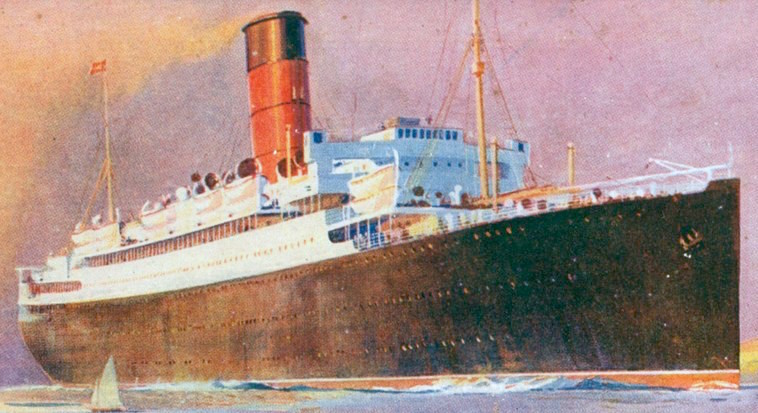
The Record
Cunard transatlantic liner, requisitioned as a troopship, evacuating British soldiers and civilians from Saint-Nazaire at the collapse of France. Bombed by a Luftwaffe Ju 88 at 15:50 on 17 June 1940; four bombs struck, one down a funnel into the engine room, and she sank in twenty minutes with thousands still aboard. Between 4,000 and 6,000 dead, the worst maritime disaster in British history. Churchill ordered the news suppressed; most Britons did not hear the story until the 1970s.
The Vessel
The RMS Lancastria was a Cunard Line transatlantic liner, 176 metres long, 16,243 gross tons, originally commissioned in 1922 as the Tyrrhenia for the Anchor Line's Canadian service and transferred to Cunard in 1924 under her new name. She was of moderate size compared to her Cunard fleetmates, designed for a service speed of 16 knots on twin screws, and was a passenger and cargo vessel rather than an express liner: tourist-class and cabin accommodations for 1,830 passengers on the Liverpool-Quebec route.
She passed to Cunard-White Star Line on the 1934 merger and was assigned to the company's cruise-ship market, repositioned as a 1930s winter cruise vessel to the West Indies and the Mediterranean. She carried Cunard's economy-class passengers through the last years of the pre-war transatlantic trade. At her requisition by the British Admiralty on 1 September 1939 she was at sea inbound from New York; she diverted to Liverpool on 3 September 1939 and was refitted as a troop transport over the following three weeks at Canada Dock, Liverpool.
Her wartime role between October 1939 and June 1940 was the movement of British Army and Royal Canadian Air Force personnel between Britain and France, Egypt, and Malta. She was one of some sixty British passenger liners requisitioned as troop transports for Operation Aerial, the emergency evacuation of remaining British military personnel and British civilians from French Atlantic ports after the collapse of France in May and June 1940. By 17 June 1940 she was at Quiberon Bay in the Loire-Atlantique, off Saint-Nazaire, under orders to embark as many troops and civilians as her decks could hold.
The Voyage
Her master, Captain Rudolph Sharp, had been pressed into Operation Aerial service from his normal Cunard career ten days earlier. He took on passengers at Saint-Nazaire through the morning of 17 June 1940 in conditions of near-total chaos: RAF ground crews, Royal Army Service Corps mechanics, Royal Engineers sappers, and British civilians fleeing the German advance came aboard from three Royal Navy tenders through the afternoon.
The loading continued until the Saint-Nazaire port authorities lost count. Cunard's peacetime certification for Lancastria was 2,200 passengers and crew; her wartime troop-transport certification was 4,200. By 15:00 on 17 June 1940 she had aboard, by the postwar reconstruction of her manifest, an estimated 6,000 to 9,000 people: approximately 5,300 RAF and Army personnel, 700 to 1,000 Cunard and Royal Navy crew, and between 2,000 and 3,500 British civilians. Her captain and her loading officers were shouting at incoming tenders to stop sending passengers. The tenders kept coming.
At 15:48 on 17 June 1940 she was still at anchor in the Charpentier Roads, four miles off Saint-Nazaire, preparing to depart for England. Her bridge was on the point of giving the engine order for departure when three German Luftwaffe Junkers Ju 88 bombers appeared over Saint-Nazaire at low altitude, identified her as the largest ship in the anchorage, and bombed her. Four bombs struck home in the attack. One penetrated her Number 2 hold, one passed down her Number 3 funnel and exploded in the engine room, and two struck her forward superstructure.
The Disaster
She took on water through the engine-room hit from the moment it struck. She listed to starboard within three minutes. Her port-side lifeboats could not be launched; her starboard-side lifeboats, swung out on a tilting deck, swamped as they reached the water. Between 4,000 and 6,000 people died in the Charpentier Roads between 15:48 and 16:12 on the evening of 17 June 1940.
The figure is uncertain because the British government of 1940 could not produce, and has never produced, a complete manifest. Captain Sharp estimated 5,000 dead; the French port authorities estimated 4,000 to 6,000; the British War Cabinet briefing paper of 21 June 1940 used the figure 4,000. The memorial at Saint-Nazaire uses the figure 4,000. The commonly-cited modern figure is 4,000, though the Lancastria Association has lobbied for a figure closer to 6,000. This is the worst single-ship loss of life in British maritime history. It is more than the Titanic and the Lusitania combined.
Winston Churchill, by that evening the Prime Minister for six weeks, was briefed on the sinking and ordered a D-notice on the press coverage. No British newspaper was to publish news of the Lancastria until "later news permits it". The specific reason Churchill gave to his War Cabinet on 18 June 1940 was that the country could not absorb another catastrophe on top of Dunkirk and the French collapse. The D-notice was never lifted. By the time British newspapers did begin, hesitantly, to carry the story in mid-July 1940, the Battle of Britain had begun and the Lancastria had been overtaken by newer disasters.
The Legacy
The cover-up of the Lancastria was one of the most successful wartime information-control operations undertaken by any British government. The families of the 4,000 to 6,000 dead received individual casualty notices from the War Office between late June and August 1940 but were instructed not to publicise the circumstances. Cunard's own commercial records of the sinking were sealed by the Admiralty. The survivors, mostly RAF and Army personnel, were reassigned within days and were bound by the Official Secrets Act from speaking about what had happened.
The first detailed British press coverage appeared in The New York Times on 26 July 1940 under a dateline from a neutral country. A partial account reached British newspapers that week. The full scale of the disaster did not enter British public consciousness until the survivors' published memoirs of the 1970s and 1980s. Most Britons did not hear the story of the Lancastria until thirty years after it happened.
The Lancastria Association, formed by survivors and descendants in 1981, has campaigned continuously for official British recognition. The British government finally issued a formal statement of commemoration in 2005; the 2015 unveiling of a national memorial at the Riverside Museum in Glasgow was the first occasion at which a British government minister participated. The French government commissioned its own memorial at Saint-Nazaire in 1988 and maintains the site to the present day. The official French death toll for the disaster is 4,213; the Lancastria Association uses 6,035.
Her wreck lies at 24 metres off Saint-Nazaire, intact enough for her name to be visible on her stern. The French Ministry of Culture declared her a Monument historique in 2007 and protected her from salvage under French cultural heritage law. She is the largest British maritime war grave in foreign waters. Her dead, most of whom were never named in any wartime newspaper, are now named on the Lancastria Memorial in Saint-Nazaire and in St Paul's Cathedral in London. The full history of her sinking has, at last, become publicly available; it took eighty years.