The Record
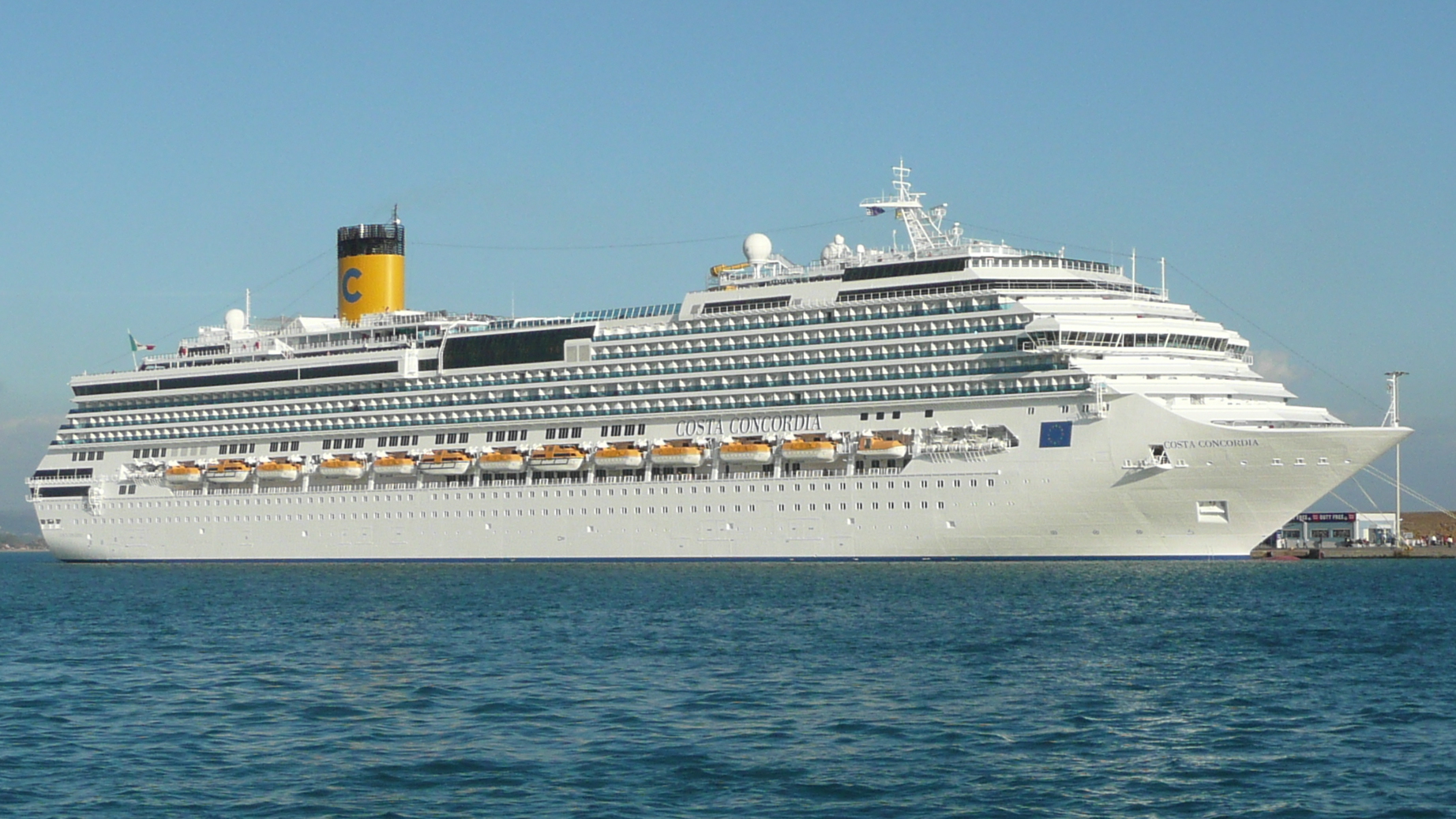
Italian cruise ship, 114,000 tons. On 13 January 2012 her captain, Francesco Schettino, steered a 'salute' too close to the island of Giglio and struck a submerged rock. 32 dead; Schettino abandoned ship before passengers were off, prompting the coast guard's famous order, vada a bordo, cazzo. Parbuckled upright in 2014 in the largest salvage operation ever attempted, scrapped in 2017.
The Vessel
The Costa Concordia was the first of the Concordia-class cruise ships, built at Fincantieri's Sestri Ponente yard in Genoa and entered into Costa Crociere service on 7 July 2006. She was 290 metres long, 114,147 gross tons, with 1,500 passenger cabins across thirteen decks and a certified capacity of 3,780 passengers and 1,100 crew. At the moment of her delivery she was the largest Italian-built passenger ship in history.
She was operated by Costa Crociere, the Italian cruise subsidiary of the American Carnival Corporation, on seven-day Tyrrhenian-Mediterranean itineraries departing from Civitavecchia and Savona. Her regular route called at Marseille, Barcelona, Palma de Mallorca, Tunis, Palermo, and Civitavecchia; the route was operated in both summer and winter seasons and had been essentially unchanged since her entry into service.
The practice of the "sail-by salute", in which a cruise ship would alter course to pass close to a specific coast for the benefit of passengers and of shore-side residents watching, was an established custom in Italian cruising. Costa Crociere had standardised a sail-by of the island of Giglio off the Tuscan coast in 2010 at the request of Mario Palombo, a retired Costa captain who lived on Giglio. The sail-by was nominally conducted at a minimum charted depth of 150 metres; Costa's fleet manuals specified a half-mile stand-off from the Giglio coastline.
The Voyage
She left the port of Civitavecchia at 19:18 on Friday 13 January 2012 at the start of a week-long cruise, carrying 3,206 passengers, 1,023 crew, and a fresh load of provisions. The passengers came from more than sixty countries, with the largest national contingents being Italian (989), German (569), French (462), and Spanish (177). Her master was Captain Francesco Schettino, a 51-year-old Neapolitan with twenty years of Costa service.
Her course was scheduled to pass Giglio at a distance of five nautical miles. Schettino altered the plan as she rounded the Argentario peninsula at about 21:30, setting a course for a closer sail-by in honour of her chief purser Antonello Tievoli, whose family lived on Giglio and who was to wave at them from the bridge wing. The Costa fleet dispatch in Genoa was notified; the duty officer there, as was customary for such changes, did not object. Schettino's specific intended course was for a pass at 0.5 nautical miles from the Giglio coastline.
His actual course was closer. At 21:42:15 GPS, with Schettino at the chart table and helmsman Jacob Rusli Bin at the wheel, the ship was in the act of a sharp port turn to clear a visible rock formation that had appeared closer than Schettino had expected it to be. The turn was ordered in a language the Indonesian helmsman did not fully understand. The helmsman's response was delayed, then executed in the wrong direction.
The Disaster
At 21:45 on 13 January 2012 the Costa Concordia struck Le Scole, a submerged rock formation 300 metres off Giglio's east coast, at 16 knots. The rock tore open 53 metres of her port side between frames 52 and 124, rupturing five watertight compartments against a design envelope of two. Two generators shorted almost immediately; the ship lost power, then emergency power, then partial emergency power as the generators came back on line. She drifted on her momentum for 30 minutes, turning through 120 degrees, and came to rest against the shore of Giglio at 22:17, listing to starboard at an angle that increased through the night.
Schettino's conduct in the following five hours became, in the subsequent Italian trial, the most documented failure of shipboard leadership on video in the history of commercial cruising. He delayed issuing the abandon-ship order for 62 minutes after the impact. When he did order abandonment, the ship's list had already exceeded the angle at which half of her lifeboats could be deployed. He then left the ship himself, boarding one of the last usable port-side boats, while several hundred passengers remained aboard.
The Livorno Coast Guard station commander Gregorio De Falco reached Schettino by ship-to-shore phone at 01:46 and ordered him repeatedly to return to the ship and coordinate the rescue. Schettino's refusal, and De Falco's increasingly furious demand (the phrase "Vada a bordo, cazzo" — "Get back on board, damn it") — became one of the most-heard Italian sentences of the twenty-first century when the transcript was released three days later. Schettino did not return. Thirty-two passengers died, five of them during or after Schettino's on-shore hours.
The Legacy
The Italian criminal trial of Francesco Schettino opened in Grosseto in July 2013 and ran for two years. In February 2015 he was convicted of multiple manslaughter, causing a maritime disaster, and abandoning ship, and sentenced to sixteen years and one month in prison. His appeals were exhausted by the Italian Supreme Court in 2017, when he began serving his sentence at the Rebibbia penitentiary in Rome. He is the first master of a major cruise ship in history to have been imprisoned for the loss of his vessel.
The Costa Concordia's salvage was one of the largest and most technically complex marine engineering operations ever undertaken. A consortium led by Titan Salvage and Micoperi installed a steel false-floor platform on the seabed beneath her hull, cabled 56 flotation sponsons to her sides, and on 16-17 September 2013 parbuckled the entire 290-metre hull upright through 65 degrees in a continuous 19-hour operation that the world watched in real time. She was refloated on 14 July 2014 and towed to Genoa in a four-day transit that was itself one of the slowest parade voyages in maritime history. She was scrapped at Pra', Genoa, between 2014 and 2017. The final piece of her hull was dismantled in July 2017.
Her loss catalysed the most substantial update to international cruise ship safety regulations since SOLAS 1974. The IMO's post-Concordia Cruise Ship Safety Review introduced mandatory mustering before sailing, revised bridge-resource management protocols, updated multi-language emergency communication requirements, and mandatory stability analysis for cruise ships operating near shore. All major cruise lines revised their "sail-by" policies; most eliminated them.
The thirty-two dead are memorialised on a bronze plaque on the quay at Isola del Giglio, placed facing the position where she came to rest. The rock that tore her hull is still there, unmarked. Schettino's own coast guard has declined to remove it from the charts, on the reasoning that leaving it visible is its own memorial.