The Record
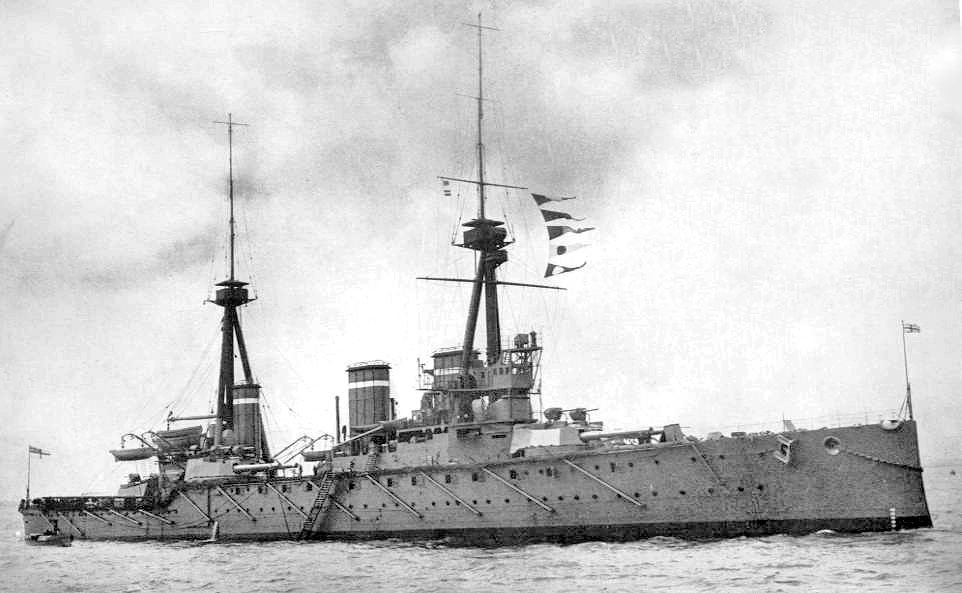
The first battlecruiser ever built and type-ship of a new class of warship. At the Battle of Jutland on the evening of 31 May 1916 a German salvo from SMS Derfflinger penetrated her Q turret and exploded the adjacent magazine; she broke in half inside ninety seconds. 1,026 dead, six survivors. Rear-Admiral Sir Horace Hood, Nelson's great-great-grandson, died on the bridge.
The Vessel
HMS Invincible was the lead ship of her class of battlecruisers, the first battlecruiser ever built, laid down on 2 April 1906 at Elswick on the Tyne and commissioned on 20 March 1909. She was 172 metres long, 17,250 tons, and carried eight 12-inch guns in four twin turrets, a main armament equal to contemporary battleships. Her design speed of 25 knots, produced by 41,000 shaft horsepower on four shafts, was approximately 4 knots faster than contemporary Dreadnought-class battleships.
She was Fisher's flagship of the battlecruiser concept: fast enough to catch and destroy armoured cruisers, heavily armed enough to engage any other ship of her class, and fast enough to outrun any battleship. The concept traded armour protection for speed; her belt armour of 6 inches was thinner than contemporary armoured cruisers and half the thickness of contemporary battleships. In Fisher's tactical vision, speed would compensate for the armour deficit: an Invincible class ship would engage at ranges beyond any battleship's accurate fire and would close only when the balance favoured her.
She entered service in 1909 as the Royal Navy's answer to the emerging German Scharnhorst-class armoured cruisers and to any future German ships of the battlecruiser type. By 1914 she had served in the North Sea and the Mediterranean; her one combat action before Jutland had been at the Battle of the Falkland Islands on 8 December 1914, where she and her sister HMS Inflexible, under Vice-Admiral Doveton Sturdee, had destroyed Admiral Graf Spee's German East Asia Squadron (including SMS Scharnhorst, SMS Gneisenau, SMS Leipzig, and SMS Nürnberg). The Falklands action had validated the battlecruiser concept in precisely the tactical role Fisher had designed it for.
The Voyage
At Jutland on 31 May 1916, HMS Invincible served as flagship of Rear-Admiral Horace Hood's 3rd Battlecruiser Squadron, part of Admiral Sir John Jellicoe's Grand Fleet. Hood's squadron (Invincible, Inflexible, Indomitable) had been detached to the Grand Fleet at Scapa Flow rather than serving with Beatty's 1st Battlecruiser Squadron at Rosyth; as a result, Invincible missed the opening "Run to the South" in which HMS Queen Mary and HMS Indefatigable were lost. She reached the action only in the late afternoon, at 17:55 on 31 May 1916, as the Grand Fleet was deploying from its cruising formation into its battle line.
Invincible's position in the battle was on the Grand Fleet's port bow, steaming south-southeast, directly into the closing German battlecruiser force under Vice-Admiral Hipper. At 18:21 she engaged SMS Derfflinger and SMS Lützow at a range of 9,000 metres, visibility poor in the North Sea summer haze. Her first salvos were effective: she scored four hits on Lützow and one on Derfflinger in the first eleven minutes of her action.
The Disaster
At 18:33 on 31 May 1916, a salvo from SMS Derfflinger struck Invincible's Q turret, forward of the bridge. The shell penetrated the turret roof and detonated in the cordite handling room. The resulting flash explosion propagated downward through the loading trunk into the forward magazine of Q turret.
The forward magazine of Q turret detonated. The fire-flash then propagated aft along the main flash path of her interconnected magazines; within two seconds of the first detonation, the adjacent P turret magazine had also detonated; within six seconds, the cross-magazine connections to her amidships A and X turret magazines had ignited. Invincible experienced essentially simultaneous detonation of three of her four main magazines.
She disintegrated. Observers on nearby ships saw her hull lifted bodily from the water and split into two pieces by the blast; the forward piece rose at the stern, the after piece at the bow, and the two ends momentarily stood almost vertical in the smoke before sinking in opposite directions. Photographs taken from HMS Indomitable show the smoke column reaching 300 metres into the North Sea evening, the highest single pillar of smoke recorded in the Battle of Jutland.
Invincible was gone inside fifteen seconds of the fatal salvo. Rear-Admiral Hood, Captain Edward Cay, 23 other officers, and 1,001 ratings went down with her. Six men survived, of whom five were from her foretop or masthead: one was the gunnery control officer who had been thrown clear by the blast. The survivors were picked up by the destroyer HMS Badger at 18:45.
The Legacy
Rear-Admiral Horace Hood was the great-great-grandson of Admiral Lord Samuel Hood, who had commanded the Royal Navy against the French during the Napoleonic Wars, and the direct descendant of Admiral Viscount Hood who had won the Battle of the Saintes in 1782. His death aboard Invincible ended the Hood naval dynasty in a line that had held flag rank in the Royal Navy for 150 years. The battlecruiser HMS Hood, commissioned in 1920, was named for him.
The destruction of three Royal Navy battlecruisers in the space of two hours (HMS Indefatigable at 16:02, HMS Queen Mary at 16:27, HMS Invincible at 18:33) represented the highest rate of capital-ship destruction in any single engagement in the history of naval warfare. The combined casualty count of 3,311 men in those two hours exceeded the entire Royal Navy combat dead of the Falklands Campaign of 1982 by a factor of ten.
The specific lesson of the magazine vulnerability was the central tactical question to emerge from Jutland. The Admiralty's secret report of October 1916 (the "Jellicoe Report") identified three separate mechanisms of magazine failure: the Q-turret roof penetration (the Queen Mary and Invincible failure mode); the open-cordite-stack turret practice that provided the flash path; and the cordite silk-bag packaging that burned faster than the modern German tubed propellant.
The Royal Navy's response was comprehensive. Every surviving British capital ship was retrofitted with flash-tight doors on her magazine trunks between July 1916 and April 1917. Open-cordite-stack turret practice was prohibited. Tubed cordite propellant was introduced across the fleet. No British capital ship was lost to magazine detonation for the rest of the First World War.
The wreck of HMS Invincible was located in 1991 by the same survey that located HMS Queen Mary, at 56°21.0′N 5°29.8′E, approximately 55 metres deep on the Jutland Bank. She lies broken into two distinct sections approximately 900 metres apart; the forward section is upright, the after section is inverted. Both sections have been extensively photographed and are protected war graves under the UK Protection of Military Remains Act 1986.
Her loss established the textbook case for the study of naval magazine protection. Every modern warship design addresses the flash path from turret to magazine in specific acknowledgement of the Invincible, Queen Mary, and Indefatigable failures. Rear-Admiral Hood, who went down with her, is commemorated on the Plymouth Naval Memorial alongside her other officers. Her 1,026 ratings are commemorated, by port of service, on the Portsmouth Naval Memorial, the Chatham Naval Memorial, and the Plymouth Naval Memorial. Six survived. She was Fisher's prototype, and her loss was the beginning of the end of the battlecruiser concept she had launched.