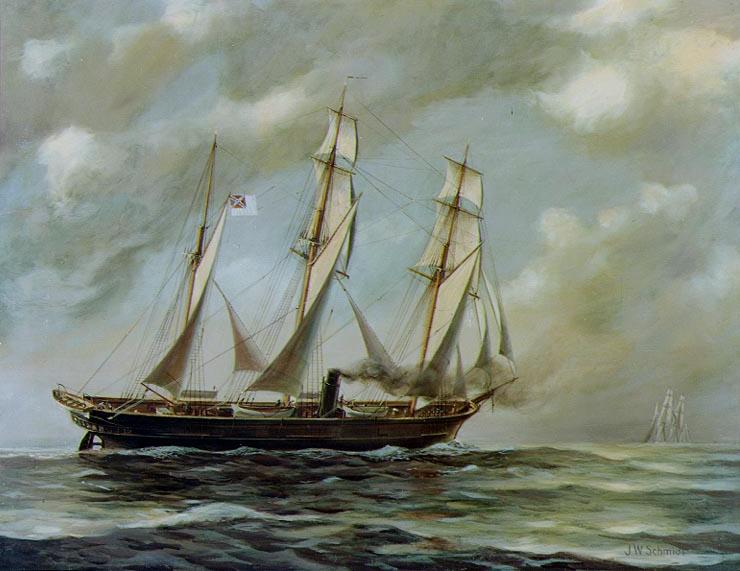
The Record
Confederate commerce raider, built clandestinely in Liverpool. Took or destroyed 65 Union merchant ships across two oceans in two years. Brought to battle by USS Kearsarge off Cherbourg on 19 June 1864 and sunk in an hour in the only major Civil War engagement fought in European waters. Édouard Manet painted the duel two weeks later from sketches made at the scene; the wreck was located by the French Navy in 1984.
The Vessel
CSS Alabama was a Confederate commerce raider of the Confederate States Navy, built secretly at the John Laird Sons & Company yard at Birkenhead, England, between 1861 and 1862 under the cover designation "Enrica". She was 67 metres long, 1,050 tons displacement, and powered by a combination of full sail rig (barque configuration) and a 300-horsepower single-cylinder steam engine driving a retractable screw propeller. Her armament comprised six 32-pounder smoothbore guns on the broadside, plus one 110-pounder Armstrong rifled pivot gun forward and one 68-pounder smoothbore pivot gun aft.
Her construction at a British shipyard was a sustained breach of British neutrality law during the American Civil War. The British Neutrality Laws of 1819 prohibited the construction in Britain of ships intended for the service of belligerents; the Confederate agents at Birkenhead had disguised the ship's intended purpose through the "Enrica" cover name and the use of a commercial contract with the fictitious Spanish merchant firm "Bravay & Co.". The British government, under sustained US diplomatic pressure, attempted to prevent her departure in July 1862; her departure on 29 July 1862 (for ostensible sea trials) was arranged to precede the formal British order to detain her by approximately 12 hours.
Her master from August 1862 onwards was Captain Raphael Semmes, 53, a career naval officer who had resigned from the United States Navy in February 1861 to accept Confederate commission. Her complement was 144 officers and ratings, predominantly British sailors recruited for commerce-raiding service in the Azores and subsequent ports of call.
The Voyage
CSS Alabama's operational deployment as a Confederate commerce raider lasted from August 1862 until June 1864, a period of approximately 22 months during which she conducted one of the most successful commerce-raiding campaigns in naval history. Her specific mission, established by the Confederate Navy Department, was the destruction of Union merchant shipping worldwide; her operational range was unconstrained by any specific theatre of operation.
Over her 22-month deployment, Alabama captured or destroyed 65 Union merchant vessels, representing a cumulative commercial value of approximately 6 million US dollars (equivalent to approximately 180 million US dollars in 2020 values). Her captures occurred in the North Atlantic (22 ships, primarily off the Azores and Newfoundland), the South Atlantic (18 ships, primarily off Brazil and South Africa), the Indian Ocean (11 ships, primarily in the Bay of Bengal), and the Gulf of Mexico (14 ships, primarily in the first months of her deployment). In addition to the merchant captures, she sank the Union warship USS Hatteras off Galveston, Texas, on 11 January 1863, the only Confederate naval sinking of a Union warship by another warship on the high seas during the Civil War.
By June 1864, Alabama had been at sea continuously for nearly two years without access to a proper dockyard. Her hull was substantially fouled with marine growth, her boilers required retubing, her copper sheathing was worn, and her crew was exhausted. Captain Semmes made the decision to seek dockyard repair at the French port of Cherbourg, the nearest European port of refuge from her position in the southern approaches to the English Channel. Alabama arrived at Cherbourg on 11 June 1864.
The Disaster
The appearance of Alabama at Cherbourg was reported by the US consular service within hours of her arrival. The Union Navy's sloop-of-war USS Kearsarge, commanded by Captain John A. Winslow and anchored at Flushing in the Netherlands, received the intelligence on 12 June 1864 and immediately sailed for Cherbourg. Kearsarge arrived off Cherbourg on 14 June 1864 and anchored in the outer harbour to await Alabama's emergence; under French neutrality law, the French authorities prohibited Kearsarge from entering the inner harbour or conducting any action within French territorial waters.
Captain Semmes's decision, made after three days of deliberation with his officers, was to accept the offered engagement. The tactical calculation was complex: Alabama was substantially worn and fouled, Kearsarge was a faster and slightly better-armed ship, and the engagement would be fought without any strategic necessity. But the alternative - an extended stay at Cherbourg - would have produced intolerable political pressure on the French government, which would have been forced eventually to intern Alabama under the French neutrality interpretation of Confederate naval status.
CSS Alabama departed Cherbourg at 10:30 on 19 June 1864 and engaged USS Kearsarge in international waters approximately 11 kilometres north of Cherbourg. The engagement lasted approximately one hour, from 10:57 to 12:05. Both ships manoeuvred in a tightening circle at a range of approximately 500-900 metres; both delivered continuous fire from their starboard batteries. Alabama's shells struck Kearsarge repeatedly but were unable to penetrate the chain-cable armour that Captain Winslow had rigged along Kearsarge's port and starboard sides. Kearsarge's fire, particularly from her two 11-inch Dahlgren pivot guns, progressively reduced Alabama's fighting capability.
At approximately 12:00 on 19 June 1864, an 11-inch shell from Kearsarge penetrated Alabama's hull below the waterline on the starboard quarter and burst in the engine room, destroying her boiler pumps and causing catastrophic flooding. Captain Semmes ordered the colours struck at 12:05; CSS Alabama sank at approximately 12:20 in approximately 70 metres of water at 49°45'N, 1°42'W. Of her 144 crew, 21 were killed in action and 70 were taken prisoner by Kearsarge; Captain Semmes and approximately 53 officers and ratings were rescued by the British yacht Deerhound, whose presence at the engagement enabled a portion of the Confederate officers to escape internment as prisoners of war.
The Legacy
The sinking of CSS Alabama ended the most successful Confederate commerce-raiding campaign of the Civil War. The cumulative damage inflicted by Alabama on Union merchant shipping had driven the US merchant marine onto foreign flags (primarily British); the long-term decline of the American merchant marine through the second half of the nineteenth century is conventionally dated from the Alabama raid of 1862-1864.
The specific legal consequences were substantial and unprecedented. The United States government filed a formal claim against the British government for damages sustained by US shipping as a result of the British violation of neutrality in constructing Alabama at Birkenhead. The "Alabama Claims" became one of the most significant Anglo-American diplomatic disputes of the post-Civil War period; the case was eventually submitted to international arbitration under the 1871 Treaty of Washington. The Alabama Claims Tribunal, convened at Geneva in 1871-1872, awarded the United States 15.5 million US dollars in damages, to be paid by Great Britain. The Geneva arbitration was the first successful application of international arbitration to resolve a major Anglo-American dispute and established the foundational precedent of modern international arbitration law.
The cultural memory of CSS Alabama has been extensive in both the American South and the British maritime community. Raphael Semmes's memoir Memoirs of Service Afloat During the War Between the States (1869) was widely read through the late nineteenth century and remains a primary source on commerce-raiding warfare. The engagement with Kearsarge was depicted by the French painter Édouard Manet in his 1864 painting The Battle of the Kearsarge and the Alabama, which was painted while the actual wreckage was still drifting in the Channel; the painting is now at the Philadelphia Museum of Art.
The wreck of CSS Alabama was located in 1984 by the French Navy minesweeper Circé at a depth of 60 metres off Cherbourg. The wreck site is jointly administered by France and the United States under a 1989 bilateral agreement; ongoing archaeological investigation has recovered over 400 artefacts including her ship's bell, several cannon balls, her cabin stove, and a significant quantity of personal possessions of her crew. The recovered artefacts are displayed at the Navy Museum in Washington DC and at the Cité de la Mer museum in Cherbourg. The 21 Confederate dead are commemorated by a memorial plaque at the Cherbourg naval cemetery, dedicated in 1995.