The Record
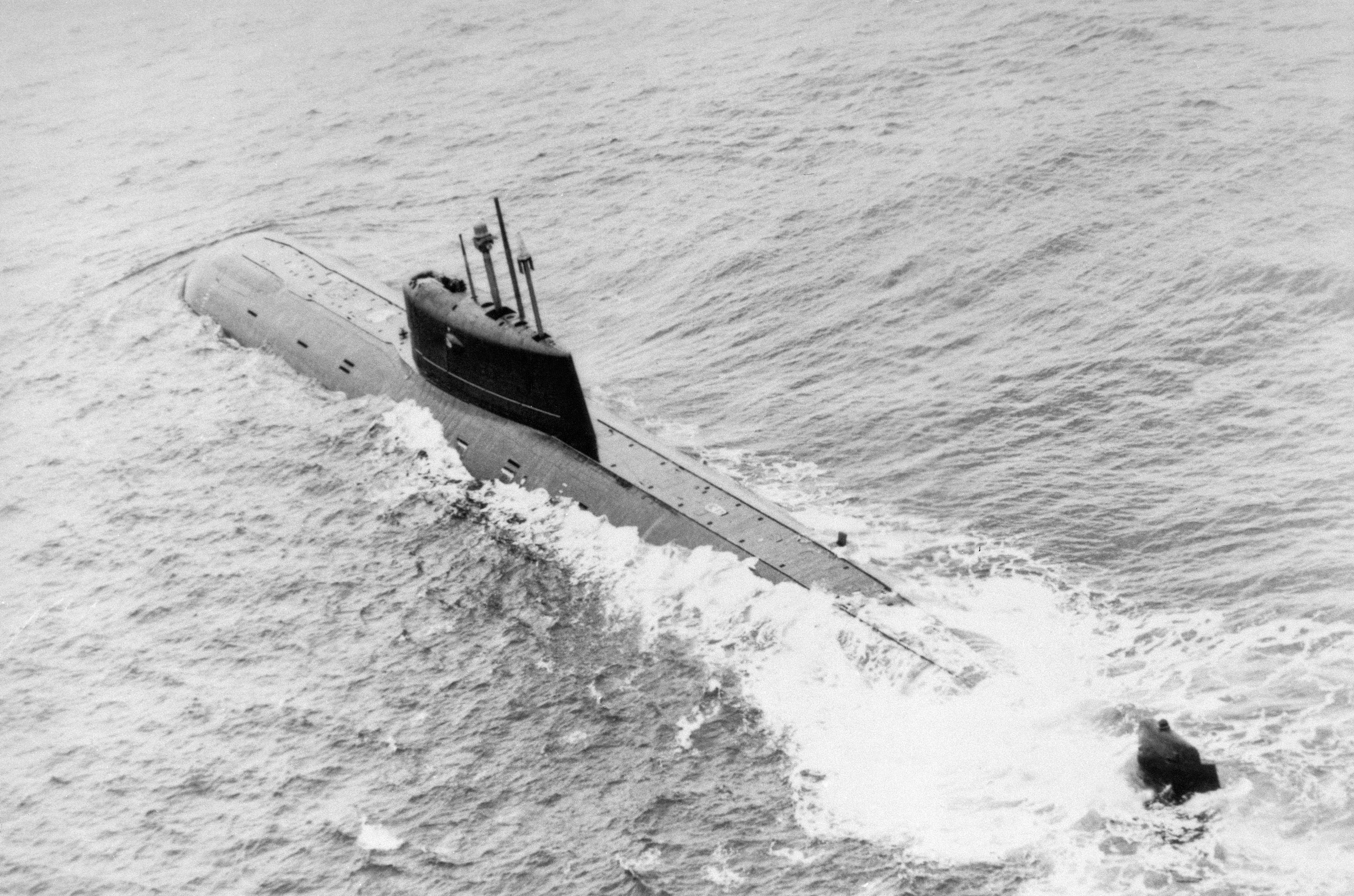
Soviet Mike-class experimental submarine, the only titanium-hulled attack submarine ever built, capable of diving beyond 1,000 metres. Fire in the aft engineering compartment on the morning of 7 April 1989 off Bear Island; surfaced but the fire spread through cable runs and she sank five hours later. 42 dead, mostly from exposure in the Barents Sea. Two plutonium-tipped torpedoes remain sealed inside the wreck at 1,680 metres; ongoing Russian surveys have detected no leakage so far.
The Vessel
The Soviet Navy submarine K-278 Komsomolets ("Young Communist") was a unique experimental submarine of the Mike class, commissioned at the Sevmash yard at Severodvinsk on 28 December 1983. She was 118 metres long, 8,000 tons submerged displacement, and was the only submarine ever built with a titanium pressure hull specifically rated for operations beyond 1,000 metres depth. Her operational depth specification was 1,000 metres (with a design maximum of 1,250 metres); the corresponding depth specification for contemporary Soviet and American SSNs was approximately 450-500 metres.
The Mike-class project was the Soviet Navy's most ambitious submarine experiment of the late Cold War. The titanium-hull construction had been possible only through the Soviet ability to source titanium in large quantities (from Kazakh mines) and through the Sevmash yard's specific experience in titanium welding (developed for the earlier Alfa-class titanium-hulled attack submarines). The titanium construction gave Komsomolets operational characteristics no Western submarine could match: she could operate at depths beyond the range of Western anti-submarine torpedoes; she could conduct evasive diving at rates of 100 metres per minute; and her hull-radiated noise at standard operating depth was reportedly lower than any other submarine in any fleet in the world.
Her commanding officer in April 1989 was Captain Second Rank Yevgeny Vanin, 39, a career Soviet Navy submarine officer. Her crew was 69 officers and ratings.
The Voyage
K-278 Komsomolets departed her base at Zapadnaya Litsa on the Kola Peninsula in February 1989 for her third operational patrol. Her patrol assignment was the experimental evaluation of the titanium-hull construction for extended deep operations. The submarine was transiting at a depth of approximately 386 metres on the morning of 7 April 1989 in the Norwegian Sea, approximately 180 kilometres southwest of Bear Island, on her return leg from the patrol area.
At 11:03 on 7 April 1989, a fire alarm sounded in the seventh (aft) compartment of K-278. The specific cause of the fire was subsequently determined to have been a spontaneous ignition of electrical insulation in the main electrical switchboard of the aft compartment, exacerbated by an oxygen leak from a cabin oxygen-regeneration unit. The fire spread rapidly through the seventh compartment and, within approximately 15 minutes, had breached the compartment's forward bulkhead and entered the sixth compartment.
Captain Vanin ordered an emergency surface manoeuvre. K-278 surfaced at 11:16 on 7 April 1989, having risen from 386 metres depth in approximately 8 minutes. Her surface-position emergency required immediate external assistance. The Soviet submarine rescue organisation had no deep-sea rescue submersible available in the Northern Fleet; the nearest available rescue ship was several hours away.
The Disaster
The fire in K-278 Komsomolets's sixth and seventh compartments could not be controlled. Over the following four hours, between 11:30 and 15:30 on 7 April 1989, her damage-control teams fought the fires, sealed affected compartments, and prepared for possible abandonment of the ship. Her electrical power progressively failed; her main hydraulic systems became inoperable; her compressed-air systems (used for blowing ballast for surface operation) progressively lost pressure.
At 17:08 on 7 April 1989 K-278 Komsomolets lost her surface stability. She began to sink stern-first. Captain Vanin ordered abandon-ship. The emergency lifeboats, designed for surface operations in calm conditions, were inadequate for the actual 7 April 1989 conditions in the Norwegian Sea: the water temperature was 4°C; waves were 1.5-2 metres; winds were from the west at 25 knots.
K-278 Komsomolets sank at 17:08 on 7 April 1989 at approximately 73°44′N 13°08′E in approximately 1,680 metres of water. Of her 69 crew, 42 died, mostly of exposure in the cold Norwegian Sea water before the Soviet Navy rescue ship Aleksey Khlobystov arrived at approximately 18:30. 27 were rescued, including 5 in the emergency rescue chamber that had detached from the submarine's sail during her sinking.
Captain Vanin went down with his ship. His body was not recovered. His last recorded message to the Northern Fleet, transmitted at 17:05 on 7 April 1989, read: 'Preparing for possible loss. All non-engineering personnel to life rafts. No further action possible.'
The Legacy
The sinking of K-278 Komsomolets was widely reported in Soviet and international press in April 1989 and was one of the major international naval events of the late Cold War. The Soviet Union's response to the sinking represented a significant policy shift compared to previous Soviet submarine disasters: the loss of K-278 was officially announced to the Soviet public within 24 hours, and subsequent international press access to the sinking's circumstances was substantial. The openness reflected the specific glasnost policies of the Mikhail Gorbachev government; the Komsomolets loss was one of the first Soviet military disasters to be openly discussed in the Soviet press.
The specific question of K-278's nuclear safety became an enduring concern. She had carried two Type 53-65K nuclear-tipped torpedoes (plutonium warheads of approximately 15 kilotons yield) and her single nuclear reactor contained approximately 100 kilograms of enriched uranium-235. The combined radioactive inventory on her wreck site remains one of the most concentrated nuclear-materials deposits on the ocean floor. The 1989 sinking location has been surveyed periodically by joint Russian and Norwegian research expeditions: 1989 (immediate post-sinking survey), 1993 (first comprehensive survey), 1994 (torpedo compartment sealing operation), 1998 (five-year follow-up), 2005, 2013, and 2020. The 2020 survey identified specific corrosion in the torpedo compartment and in the reactor compartment that may require active intervention in the 2040s.
The 42 dead of K-278 Komsomolets are commemorated at the Northern Fleet Memorial Cemetery at Severomorsk. Captain Vanin was posthumously awarded the Order of the Red Banner in 1989. The name K-278 Komsomolets has been retained in the Russian Navy records list as a war grave designation; no subsequent Russian Navy submarine has been given the number or the name.
The Mike-class titanium-hull concept, of which K-278 had been the only built example, was not pursued further by the Soviet or Russian Navy after her loss. The specific cost and complexity of titanium-hull construction, combined with the technical difficulties identified in the K-278 failure analysis, made the concept operationally unattractive even in the Soviet period when titanium was available in large quantities. K-278 Komsomolets remains, in 2025, the only titanium-hulled attack submarine ever operated by any navy.