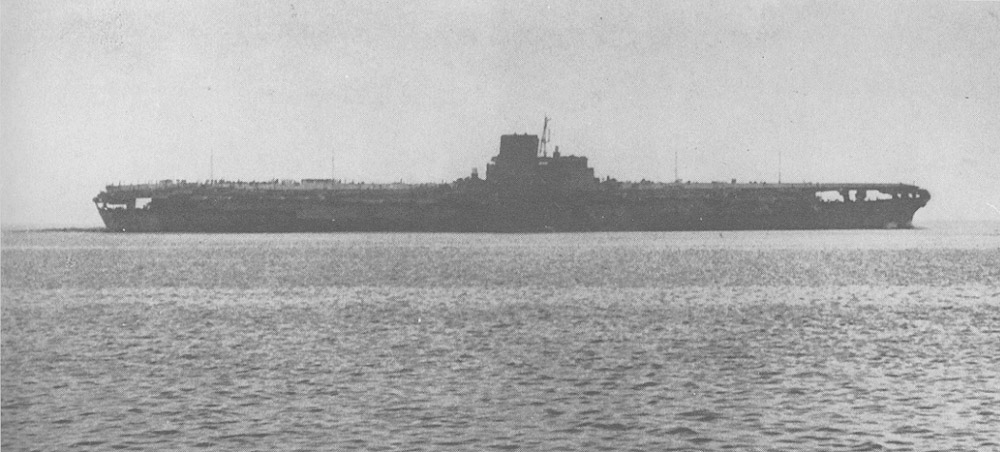
The Record
Originally laid down as the third Yamato-class battleship, converted mid-build to an armoured aircraft carrier, the largest warship ever built at the time. Sailed from Yokosuka on her maiden voyage only seventeen days commissioned; torpedoed four times by USS Archerfish on the morning of 29 November 1944. Poor damage control and unfinished watertight bulkheads doomed her. Sank seven hours after her first torpedo, on her first voyage. 1,435 dead.
The Vessel
The Imperial Japanese Navy aircraft carrier Shinano was the largest warship ever built until the commissioning of the American nuclear carrier USS Enterprise (CVN-65) in 1961. She was laid down as the third of the Yamato-class battleships on 4 May 1940 at the Yokosuka Naval Arsenal, but was converted during construction into an aircraft carrier following the destruction of the four Midway carriers in June 1942. She was commissioned on 19 November 1944.
The conversion from battleship to carrier had been approved in June 1942 and began in June 1943 under the immediate pressure of Japanese fleet carrier losses. The resulting ship displaced 72,000 tons, was 266 metres long, and had a flight deck capable of operating 47 aircraft. Her armour scheme was retained from her battleship design: she had the thickest flight-deck armour of any aircraft carrier ever built (190 mm), and her belt armour remained the 410 mm of the Yamato-class.
Her operational concept was unusual. The 1944 Imperial Japanese Navy carrier doctrine had, by that stage of the war, evolved toward the use of large carriers as support bases for land-based aircraft rather than as direct strike platforms. Shinano was intended to operate as a forward-deployed fleet carrier that would service, rearm, and refuel carrier aircraft and land-based bombers operating from bases in the Philippines, Formosa, and the Japanese home islands. Her large aviation fuel capacity (3,300 tons) and her ability to carry approximately 120 disassembled replacement aircraft in her hangars made her, by design, a carrier for the final defensive phase of the Japanese war.
The Voyage
Shinano was commissioned at Yokosuka on 19 November 1944 with her internal subdivision and fire-control systems incomplete. The decision to commission her before her construction was finished was driven by the Navy's anxiety about further American air attacks on Yokosuka; the plan was to move her to the Inland Sea for the remaining fitting-out, protected by the mountainous interior of Honshu.
Her first and only voyage, from Yokosuka to Kure, departed at 18:00 on 28 November 1944. Her commanding officer was Captain Toshio Abe, 52, a career Japanese naval officer. Her crew of 2,515 included approximately 1,200 regular naval ratings (many of whom were new recruits who had not been aboard during her trials) and approximately 300 Mitsubishi yard workers who had remained aboard to continue fitting-out work during the transit. Her escort was the three destroyers Isokaze, Hamakaze, and Yukikaze. The route was a direct passage through the Inland Sea approaches, expected to take approximately 36 hours.
The American submarine USS Archerfish (SS-311), commanded by Lieutenant-Commander Joseph F. Enright, was patrolling the waters east of Honshu on the same night. Enright had been moved to the area specifically in response to American intelligence reports of a new Japanese capital ship conducting trials in the area. At 20:48 on 28 November 1944 Enright sighted Shinano's superstructure on the horizon at approximately 10 nautical miles.
Archerfish shadowed the Japanese formation through the evening. Shinano's zigzag course ultimately brought her within 1,400 metres of Archerfish's firing position at 03:17 on 29 November 1944.
The Disaster
Enright fired a full six-torpedo bow spread at 03:17 on 29 November 1944. Four of the six torpedoes struck Shinano on her starboard side, in a cluster between her Frame 120 (the aft engine room) and Frame 180 (her after aviation fuel tanks). The four torpedo hits breached approximately 15 per cent of her hull side protection.
Shinano's damage control was catastrophic. Her internal subdivision was incomplete because of her rushed commissioning: the watertight door seals in her engineering spaces had not been fitted to the intended tightness, her counter-flooding pumps had not been fully tested, and her damage-control teams had not been drilled in her specific internal layout. The flooding of her engine rooms, which her design had been calculated to contain, instead propagated through adjacent compartments that should have been watertight but were not.
By 06:00 on 29 November 1944 Shinano had a 9-degree list to starboard. By 08:00 the list had increased to 13 degrees. By 09:00 her engine rooms were fully flooded and she was making 10 knots through the remaining engine; at 09:30 this speed dropped to 6 knots as her main boiler room flooded. Captain Abe ordered a course change toward Shiono-misaki, the nearest coast, in an attempt to beach her. The list continued to increase through the following hours.
At 10:55 on 29 November 1944, Shinano rolled onto her starboard side. She capsized at 11:00. She sank, stern-first, at 11:17 on 29 November 1944 at approximately 33°07′N 137°04′E in approximately 4,000 metres of water. Captain Abe went down with her. Of her 2,515 crew and yard workers aboard, 1,435 died; 1,080 were rescued by her three destroyer escorts.
The Legacy
The Shinano was the largest warship ever sunk by a submarine and the shortest-commissioned capital ship in naval history: 10 days from commissioning to sinking, 17 hours from departure to loss. Her sinking represented approximately 0.4 per cent of the entire annual steel production of the Imperial Japanese wartime economy, vaporised in seventeen hours of her first operational voyage.
The American Navy's initial assessment of the Enright attack underestimated its significance. Enright reported at his mission debriefing that he had sunk a large carrier; his identification was disputed by the U.S. Navy's submarine force intelligence, which maintained that no Japanese carrier of the reported size was known to be operating. Enright received a Submarine Combat Insignia for the mission but was not credited with sinking a capital-class target until the post-war Japanese surrender documents revealed the identity of his kill. The Japanese naval staff had classified Shinano as so secret that her existence had not been reliably reported in any Allied intelligence channel until after her sinking.
The wreck of Shinano lies at approximately 4,000 metres depth in the Philippine Sea, approximately 210 kilometres south-southeast of Shiono-misaki. Her specific position has never been located by modern deep-ocean survey; the Japanese government has not funded a Shinano expedition, and no commercial salvage has been attempted.
Shinano's story has been a point of continuing Japanese reflection in the post-war naval historiography. The rush to commission her under the pressure of 1944 circumstances, the inadequate damage control training of her crew, and the failure of her watertight subdivision have been cited by the Japan Maritime Self-Defense Force's training curriculum as examples of the specific organisational failures that the post-war Japanese navy was designed to avoid. The name Shinano has not been carried by any subsequent Japanese warship.
The 1,435 dead of Shinano are commemorated at the Yasukuni Shrine along with the Yokosuka yard workers who had remained aboard. Her existence was officially confirmed to the Japanese public only in 1946; her sinking had been classified, and most of the families of her crew had received only general casualty notices. The full story of her commissioning, her loss, and Enright's attack did not become widely known in Japan until the 1950s. She is, in modern Japanese naval memory, the ship that represents both the extraordinary engineering ambition of the late-war Imperial Japanese Navy and the organisational pressures that undid the fleet's final attempts at naval strength. She was the largest warship ever sunk; she was sunk on her first voyage, by one submarine, seventeen hours after leaving port.