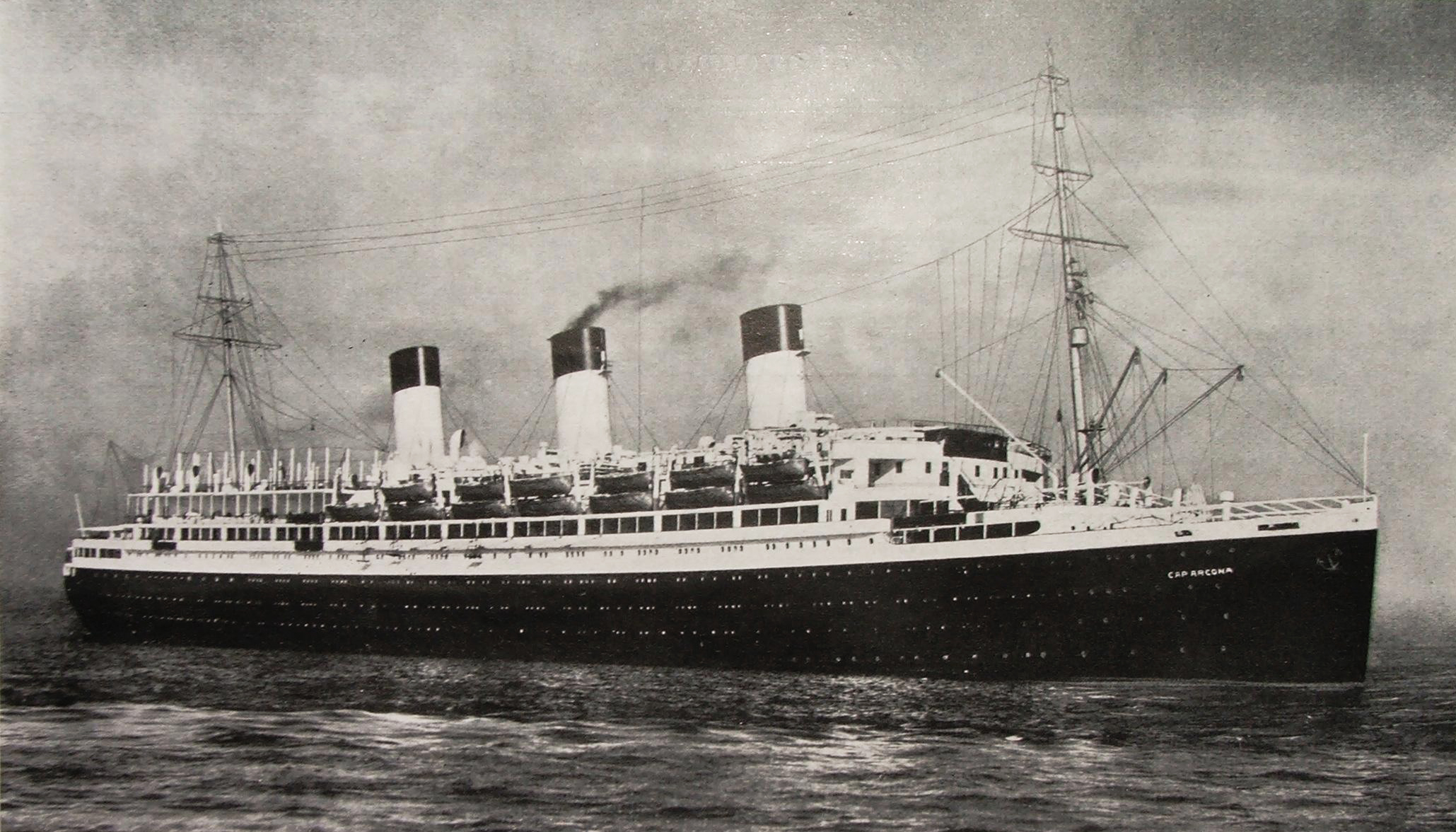
The Record
Former North German Lloyd liner, by May 1945 a floating prison for concentration camp inmates in the Bay of Lübeck. Bombed and strafed by RAF Typhoons of 83 Group on the afternoon of 3 May 1945, six days before the German surrender. Swedish Red Cross intelligence that the ship was carrying KZ prisoners had reached the RAF but not the squadrons in time. Approximately 5,000 dead, most of them Neuengamme inmates, many killed as they swam toward shore.
The Vessel
The Cap Arcona was a German passenger liner of the Hamburg Süd-Amerikanische Dampfschifffahrts-Gesellschaft (Hamburg South American Steamship Company), built at the Blohm & Voss yard at Hamburg between 1926 and 1927 and commissioned on 29 October 1927. She was 206 metres long, 27,561 gross tons, and powered by twin steam turbines producing approximately 24,000 horsepower. Her peacetime accommodation was approximately 575 first-class, 275 second-class, and 465 third-class passengers, plus a crew of 630.
Cap Arcona was designed specifically for the Hamburg to Buenos Aires passenger service, a premier transatlantic route of the late 1920s that carried predominantly affluent passengers between Germany and the substantial German-speaking communities in Brazil and Argentina. She was, at her commissioning, the largest and fastest of the German South American liners, and she was marketed as "the Queen of the South Atlantic" through the 1930s.
From 1940 she was requisitioned by the Kriegsmarine for wartime service as a troop transport. Her principal wartime role was the transport of German military personnel and civilian refugees from the eastern Baltic ports (Danzig, Gdynia, Königsberg) during the 1944-1945 German evacuation of East Prussia and Pomerania before the advancing Soviet forces. Through late 1944 and early 1945, she made multiple evacuation voyages between the eastern Baltic ports and the western Baltic (primarily Lübeck and Kiel).
By April 1945, the military situation had deteriorated dramatically. The German armed forces were in collapse; Soviet forces had reached the Baltic coast; the final phase of the European war was underway. Cap Arcona was at this point anchored in Lübeck Bay, awaiting her final evacuation assignment.
Her master on her final voyage was Captain Heinrich Bertram, 48, a career Hamburg Süd officer. Her complement on 3 May 1945 was approximately 5,800 persons: approximately 4,500 concentration camp prisoners from multiple subcamps of the Neuengamme concentration camp system; approximately 500 SS guards; approximately 600 German merchant marine crew; and approximately 200 Kriegsmarine personnel.
The Voyage
The specific operational context of 3 May 1945 was the final collapse of the German war effort and the transfer of concentration camp prisoners by the SS to various final destinations. The Nazi leadership's specific policy in the final weeks of the European war was to prevent the capture of concentration camp prisoners by Allied forces; prisoners were being progressively transported from inland camps to coastal locations for various planned final destinations that the Allied advance would subsequently prevent.
The prisoners aboard Cap Arcona on 3 May 1945 had been transported to the ship from the Neuengamme concentration camp and its subcamps over the preceding two weeks. The specific SS intent for these prisoners is contested in subsequent historical research: some historical sources suggest the prisoners were intended to be taken to Norway or Denmark for continued forced labour; other sources suggest that the SS intended to scuttle the ship with the prisoners aboard to prevent Allied capture of the prisoners; yet other sources identify the transport as simply a final disposition without specific plan.
The conditions aboard the ship were catastrophic. The approximately 4,500 concentration camp prisoners were held in below-deck spaces that had been temporarily fitted as prisoner accommodation; the density was extreme; ventilation was minimal; water and food were severely limited; sanitation facilities were inadequate. The prisoners had been progressively weakened by the concentration camp system; many were already in extreme physical distress before embarkation.
The Allied intelligence situation regarding Cap Arcona on 3 May 1945 was substantially confused. The British RAF Second Tactical Air Force was operating in the Lübeck area in support of the final British advance into northern Germany; specific intelligence reports indicated that Cap Arcona was a troop transport carrying German military personnel. The specific information that the ship was carrying concentration camp prisoners was not accurately conveyed to the British air forces; the prisoners were not identified as a specific category requiring protection from Allied attack.
The Disaster
At approximately 14:30 on 3 May 1945, British Royal Air Force aircraft of the 2nd Tactical Air Force began a series of coordinated attacks on shipping in Lübeck Bay. The attacking force comprised approximately 180 aircraft (Hawker Typhoon fighter-bombers and Short Stirling bombers) from multiple RAF squadrons, operating from bases in northern Germany and the Netherlands. The attack orders had been issued by Air Marshal Sir Trafford Leigh-Mallory, commander of the 2nd Tactical Air Force, based on the specific intelligence that Cap Arcona and her adjacent vessels were military transports carrying German troops.
The RAF attack on Cap Arcona began at approximately 14:45 on 3 May 1945. Multiple Typhoon fighter-bombers strafed the ship with cannon fire and rockets; subsequent aircraft delivered bomb hits to the ship's superstructure and upper decks. The attacks continued for approximately 60 minutes.
The specific tragedy was the impossibility of evacuating the 4,500 prisoners from the below-deck spaces. The prisoners were held in locked holds; the SS guards initially attempted to prevent evacuation; the ship's crew was paralysed by the attack; and the prisoners themselves were too weakened to successfully evacuate through the blocked passages and locked hatches.
Cap Arcona burned for approximately three hours before capsizing and sinking in Lübeck Bay at approximately 18:00 on 3 May 1945. The ship sank in approximately 20 metres of water, with her superstructure partially above the waterline.
Of the approximately 5,800 aboard, approximately 5,000 died: the overwhelming majority were concentration camp prisoners trapped below decks. Approximately 800 survived: predominantly SS guards, merchant marine crew, and Kriegsmarine personnel who had been on the upper decks at the time of the attack and who were able to jump into the water. Approximately 350 concentration camp prisoners survived - of the 4,500 originally aboard.
The adjacent ship Thielbek (carrying approximately 2,800 concentration camp prisoners) was also attacked and sunk on 3 May 1945 with approximately 2,700 dead. The cumulative casualty figure for the Lübeck Bay attacks on 3 May 1945 - approximately 7,700 dead - makes the attacks among the most catastrophic single-day casualty figures of any Allied military operation of the Second World War.
The Legacy
The Cap Arcona disaster of 3 May 1945 was one of the most specifically tragic incidents of the Allied campaign in the European theatre. The approximately 5,000 concentration camp prisoners killed represented approximately 70 per cent of the total Allied-attack casualties on that final day of the European war; the disaster occurred five days before the German surrender on 8 May 1945.
The specific operational and intelligence context of the disaster has been sustained the subject of historical research. The critical question - whether the British RAF attackers knew that the ship was carrying concentration camp prisoners - has been substantially resolved in the negative: specific British intelligence regarding the prisoner population had not been accurately conveyed to the 2nd Tactical Air Force. The International Red Cross had been attempting to contact Allied forces regarding the prisoner population of German Baltic shipping; these communications had not successfully reached the British air force command in time to prevent the attack.
The subsequent institutional response to the Cap Arcona disaster was complicated by the broader Cold War politics of the postwar period. The British government was reluctant to acknowledge specific responsibility for the attack; the Soviet Union and subsequent East German authorities used the disaster as a specific example of Western Allied war crimes; the West German federal government established the disaster in West German historical memory as a specific example of the chaos and tragedy of the war's final days.
The specific war-crimes prosecution related to the Cap Arcona case was complicated. The British military had no specific war-crimes prosecution interest (the attacking forces had not knowingly attacked prisoners; the specific responsibility was operational and intelligence failures rather than war crimes); the Soviet and East German authorities prosecuted specific German SS personnel related to the ship's guard forces (three senior SS guards were tried and executed in the East German trials of 1947-1951); the West German authorities conducted limited prosecutions.
The cultural memory of the Cap Arcona disaster has been substantial in German, British, and Jewish historical communities. The specific memorials include: the Cap Arcona Memorial at Neustadt in Holstein (dedicated 1959), featuring a central monument and multiple national-memorial sections for the different nationalities of the prisoners aboard; the Cap Arcona Memorial at Yad Vashem, Jerusalem (dedicated 1985); and the Cap Arcona Memorial at Lübeck Cathedral (dedicated 1955).
The wreck of Cap Arcona remained at approximately 20 metres depth in Lübeck Bay through the postwar period; she was gradually dismantled and her scrap value recovered during the 1950s and 1960s. The final remnants of the wreckage were removed in 1975. The approximately 5,000 concentration camp prisoners who died on Cap Arcona are specifically commemorated in the annual 3 May Memorial Service conducted at the Neustadt Memorial; the ceremony is attended by representatives of the prisoner national-memorial associations from multiple European countries.