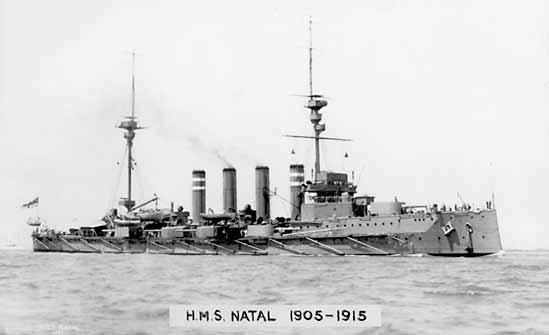
The Record
Royal Navy armoured cruiser, anchored at Cromarty Firth for the Christmas holiday in 1915. At 15:30 on 30 December, her after magazine detonated spontaneously during a film screening arranged for the crew's children. 421 dead, including the captain's wife and several civilian guests aboard for the afternoon. The cause was traced to deteriorated cordite propellant stored too close to the boiler room bulkheads, the same defect that had destroyed HMS Bulwark thirteen months earlier.
The Vessel
HMS Natal was a Warrior-class armoured cruiser of the Royal Navy, commissioned at the Vickers Barrow yard on 5 March 1907. She was 154 metres long, 13,550 tons standard displacement, armed with six 9.2-inch guns in single turrets, four 7.5-inch guns in twin turrets, and a secondary battery of twenty 3-inch guns. Her designed speed was 23 knots on four-shaft turbines.
The Warrior class of four ships (HMS Warrior, HMS Cochrane, HMS Achilles, HMS Natal) represented a specific phase of Edwardian armoured-cruiser design that attempted to combine heavy firepower with the speed needed to operate with battleships in the fleet scouting role. By 1914, like the contemporary Drake and Duke of Edinburgh classes, the Warriors had been largely overtaken by the emergence of the British battlecruiser and were assigned to secondary fleet roles.
Her service between 1907 and 1915 had included extensive Mediterranean and China Station deployments, participation in the 1911 Coronation Fleet Review, and the outbreak-of-war assignment to the 2nd Cruiser Squadron at Scapa Flow. By autumn 1915 she had been operating with the Grand Fleet for approximately a year on North Sea patrol and scouting duties.
The Voyage
On Thursday 30 December 1915 HMS Natal was anchored at Cromarty Firth, the Royal Navy's northern anchorage in northern Scotland. Her commanding officer was Captain Eric Back, 42, who had hosted a small Christmas party aboard his ship that evening. The specific arrangement for the party was in accordance with contemporary Royal Navy custom: senior officers could entertain their wives, their children, and invited civilian guests aboard warship at anchor for social occasions.
Captain Back's party on the evening of 30 December 1915 included approximately 10 civilian guests. His wife Lady Edith Back and their two children (aged 8 and 6) were aboard. The wives of three of the ship's other senior officers (Commander Smith, Engineer Lieutenant-Commander Morris, and Surgeon Baker) were aboard, as were the wives' children and several civilian nurses who had been invited to a motion-picture showing in the ward-room after dinner.
The motion-picture showing was in progress at approximately 15:20 on 30 December 1915 when the cordite magazine of HMS Natal detonated without warning.
The Disaster
HMS Natal's aft cordite magazine exploded at approximately 15:20 on 30 December 1915. The exact cause of the detonation was never conclusively determined; the subsequent Royal Navy Board of Inquiry identified two possible proximate causes (either unstable cordite propellant that had degraded into a self-igniting state, or a flash-fire from a carelessly-handled 4-inch shell being re-stowed in the ammunition passage). The Board's final finding attributed the cause to cordite degradation rather than to crew error.
The magazine explosion vented upward through the superstructure of HMS Natal and produced a pillar of flame and debris that rose approximately 300 metres above the Cromarty Firth. The explosion was heard across Ross-shire and was photographed by a civilian photographer on the Cromarty Firth shoreline. The photograph is one of the most widely-reproduced images of First World War Royal Navy disasters.
HMS Natal capsized and sank at 15:24 on 30 December 1915 at Cromarty Firth, in approximately 14 metres of water. 421 of her 704 aboard died in the explosion and the subsequent sinking. The dead included Captain Back, Lady Edith Back, the Back children, approximately 390 officers and ratings of the ship's complement, and approximately 10 civilian guests. The high percentage of civilian casualties among the dead (including seven women and three children) gave the Natal loss a particular public resonance.
The Legacy
The HMS Natal inquiry of January-March 1916 produced findings that fundamentally reshaped Royal Navy cordite-handling practice. The specific focus of the inquiry was the finding that cordite propellant stored in Royal Navy magazines was susceptible to thermal instability after periods of continuous storage in warm spaces; the specific failure mode was that the cordite's stabiliser compound could degrade over time and allow the propellant to reach self-ignition temperatures at approximately 65°C. The Royal Navy had been using cordite propellant with inadequate stabiliser for at least five years before the Natal loss.
The Board's recommendations, implemented across the Royal Navy fleet during 1916, included: mandatory replacement of all cordite propellant aged more than two years; mandatory temperature-control and ventilation of all capital-ship magazines; mandatory chemical testing of cordite samples at regular intervals; and revised procedures for cordite handling that eliminated the accumulation of cordite charges in ammunition passages.
The post-Natal reforms are credited, retrospectively, with preventing further Royal Navy cordite-magazine disasters of the type that had destroyed HMS Bulwark in November 1914 (about which see that folio) and HMS Vanguard in July 1917 (which would be lost to a similar failure). The German Kaiserliche Marine, which had been using better-stabilised cordite since 1913, had already learned the lesson that the Royal Navy only learned in 1916.
The broader public response to the Natal loss was shaped by the unusually high civilian casualty count. The British press coverage of the loss, published through January 1916, emphasised the specific tragedy of the 10 civilian dead (seven women and three children). The Admiralty's decision to permit civilian visitors aboard anchored warships for social occasions was progressively curtailed after 1916; by 1918 the practice had been substantially abandoned, and it was not reinstated after the end of the war.
The wreck of HMS Natal remained partially visible in Cromarty Firth from 1915 through 1967. She was progressively dismantled and salvaged through the 1920s and 1950s. By 1967 the remaining structure had been largely removed; a final wreck-clearance operation in 1968-1970 recovered the last major hull sections. The site is marked by a commemorative buoy and by a memorial plaque on the Cromarty Firth shore.
The 421 dead of HMS Natal are commemorated on the Chatham Naval Memorial (for her Chatham-port ratings) and on the Portsmouth Naval Memorial. Captain Back and Lady Edith Back are commemorated separately on the HMS Natal Memorial at the Royal Hospital Chelsea, along with the names of the civilian guests who died aboard. The name HMS Natal was not carried by any subsequent Royal Navy warship; the South African Navy's frigate SAS Natal (commissioned 1946) carried the South African equivalent name.