The Record
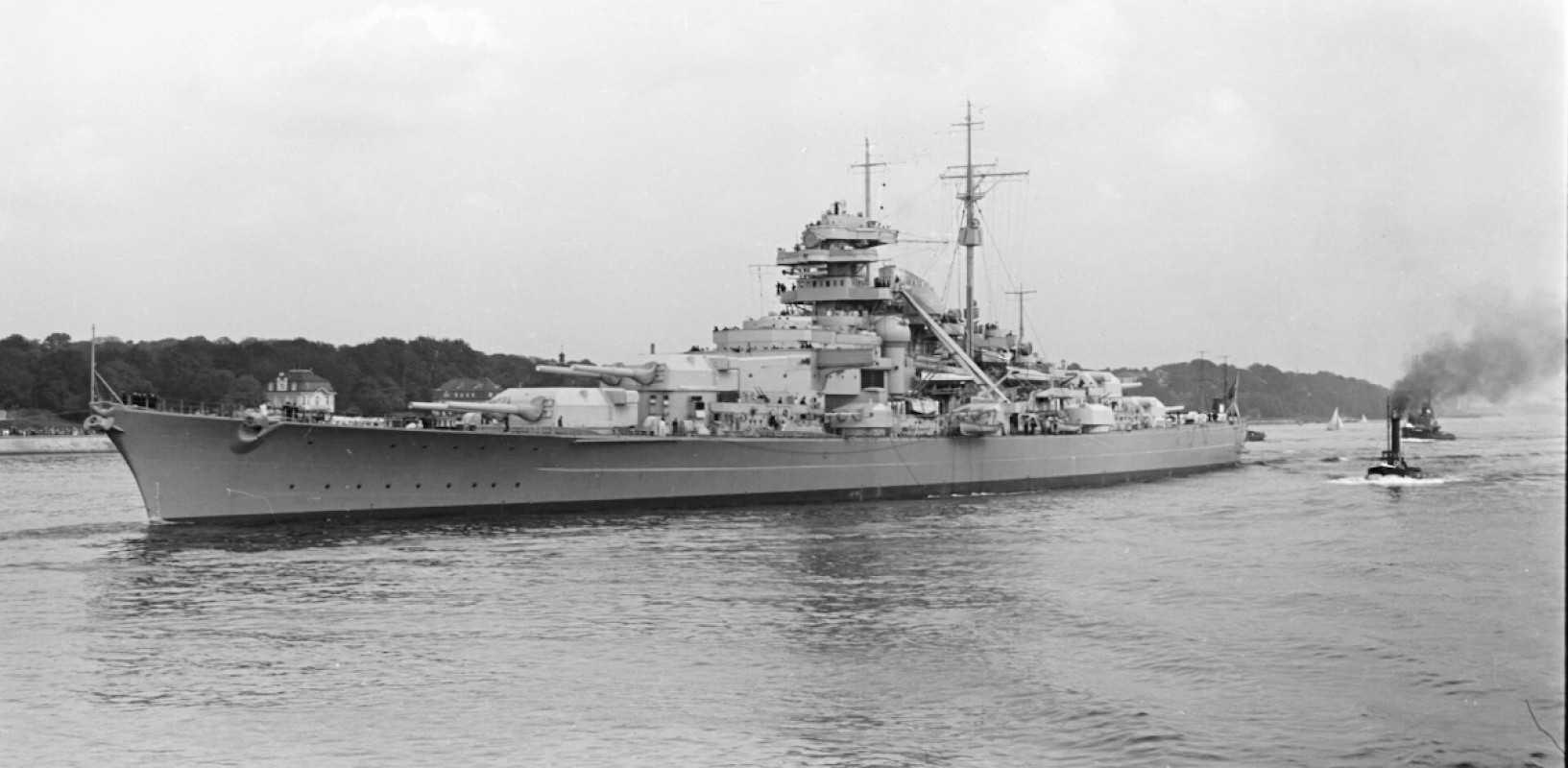
Germany's largest warship, flagship of the Kriegsmarine. Sank HMS Hood on 24 May 1941 in the Denmark Strait; three days later, crippled by a Fairey Swordfish torpedo to her rudder, she was pounded into scrap by the Royal Navy. ~2,100 dead, 114 rescued. Found by Robert Ballard in 1989, four and a half kilometres down, upright on the abyssal plain.
The Vessel
The Bismarck was a battleship of the new Kriegsmarine, the first of two ordered under the 1935 Anglo-German Naval Agreement and completed in Hamburg in August 1940. At 50,900 tons full load she was the largest warship Germany had ever built, 251 metres long, armed with eight 38 cm guns in four twin turrets, with a secondary battery of twelve 15 cm guns and an armour scheme that could shrug off most contemporary British fire at standard battle ranges. She carried a crew of 2,200.
Her design was the product of a German naval staff still working to the last generation's doctrine: a long-range commerce raider as much as a fleet battleship, built to survive single-ship engagements at range and to break out into the Atlantic convoy routes. Her armour was concentrated amidships against flat-trajectory fire, leaving her bow, stern, and steering gear relatively lightly protected. The weakness of her stern armour would be her undoing.
Admiral Erich Raeder intended her to sail in company with her sister Tirpitz and the two Scharnhorst-class battlecruisers as a four-ship squadron against the Atlantic convoy system. By the spring of 1941 only Bismarck and the heavy cruiser Prinz Eugen were available; Tirpitz was still working up, Scharnhorst was refitting from a broken boiler tube, Gneisenau had been hit by an RAF torpedo in Brest harbour. Operation Rheinübung, her sortie into the Atlantic, was ordered against the urging of both ship captains to wait for the heavier force.
The Voyage
She sailed from Gotenhafen on the evening of 19 May 1941 in company with Prinz Eugen, the heavy cruiser. British intelligence picked her up through Swedish reports, Ultra decrypts, and Coastal Command reconnaissance, and by 23 May the whole of the Home Fleet was converging to block her passage into the Atlantic. The British plan was to meet her in the Denmark Strait, the narrow water between Iceland and Greenland, with the battlecruiser Hood and the new battleship Prince of Wales.
The engagement came at 05:52 on 24 May 1941. Bismarck and Hood opened fire almost simultaneously at a range of 24,000 metres. Hood turned to bring her aft guns to bear and at 06:00, six minutes into the action, a German shell from Bismarck's fifth salvo found her aft magazine. She disintegrated. Prince of Wales, damaged and with her gunnery computers still working out the range, broke off and made smoke.
Bismarck had taken three hits during the five-minute action, one of which had opened a fuel tank and was trailing oil visible for miles. Admiral Günther Lütjens decided to make for Saint-Nazaire for repairs. Prinz Eugen was detached. The pursuit had begun.
The Disaster
For a day and a half she ran south-east at twenty-four knots with Force H steaming up from Gibraltar and the Home Fleet closing from the north. The RAF's Coastal Command lost her in heavy weather on the afternoon of 25 May; the Royal Navy lost her too. She had turned south earlier than the British had expected, and the Home Fleet spent that night chasing empty sea.
An American-built Catalina of 209 Squadron, flown by a Royal Air Force crew with an American naval officer as co-pilot, relocated her at 10:30 on 26 May, roughly 700 miles west of Brest. She was now within reach of Ark Royal's Swordfish torpedo bombers. The afternoon strike found the wrong target and attacked the British cruiser Sheffield instead; the torpedoes mercifully malfunctioned. The evening strike, launched into worsening weather at 19:10, put a Swordfish torpedo into Bismarck's rudder compartment. Her rudders were jammed twelve degrees to port. She could no longer steer.
Through the night she circled into the westerly gale, unable to make for the French coast and unable to turn into the wind. Rodney and King George V closed at dawn on 27 May. The gun duel that followed lasted eighty-eight minutes; the British ships fired 2,876 shells at point-blank ranges and Bismarck was battered to a floating hulk. Rodney's heavy shells penetrated her bridge, her turrets, her boiler rooms; fires burned from end to end. Her crew scuttled her, or so they later claimed, at around 10:35. Dorsetshire's torpedoes finished the scuttling. She rolled over and sank stern-first at 10:39.
2,100 men died, 114 were rescued. The rescue was broken off when a U-boat was reported; the Royal Navy abandoned four hundred men in the water to save the cruisers.
The Legacy
The loss of the Hood was the single greatest blow to British naval morale in the war and produced a political crisis that reached Churchill's cabinet inside the afternoon of the 24th; the pursuit and destruction of Bismarck three days later was the answer that allowed the British public and the Admiralty to believe the balance had been restored. The reputation of the Swordfish biplane as a weapon that could disable a modern battleship with a single torpedo was established by one aircrew over the North Atlantic in a gale that had grounded everything else.
The German naval staff drew the opposite lesson. Tirpitz was never allowed out into the Atlantic; she spent the rest of her war hidden in Norwegian fjords as a fleet-in-being until she was eventually destroyed at her moorings by RAF Lancasters in November 1944. The four-ship Atlantic squadron Raeder had imagined never sailed. Bismarck's loss was the end of German surface ambition in the war.
Her wreck was located in June 1989 by Robert Ballard, resting upright and largely intact on an underwater volcano at 4,790 metres, about 650 kilometres west of Brest. The ship had travelled on the seabed for roughly two kilometres after sinking, gouging a trail that Ballard's cameras followed to the hull. The damage photographed in 1989 and in subsequent expeditions has supported the German crew's claim that she was scuttled rather than sunk by gunfire; the belt armour is largely intact, the damage is above the waterline, and charges have been identified in the engine rooms.
She is classified as a war grave under international convention and visited only by scientific expeditions. The final broadcast from her radio room, at 09:40 on 27 May, was her last to reach Germany: Ship unmanoeuvrable. Will fight to the last shell. Long live the Führer. The message was sent by a Kriegsmarine radio operator whose name was not preserved and who did not survive.