The Record
Canada Steamship Lines Great Lakes cruise ship, calling Toronto in the middle of an Ontario-New York vacation circuit. Fire broke out in a linen locker at 02:30 on 17 September 1949 while docked overnight. Wooden panelling, an unattended fire watch, and non-functioning hoses let the flames consume her in under an hour. 139 dead, almost all of them American passengers asleep below. The disaster rewrote Canadian fire regulations and effectively ended wooden-superstructure passenger service on the Great Lakes.
The Vessel
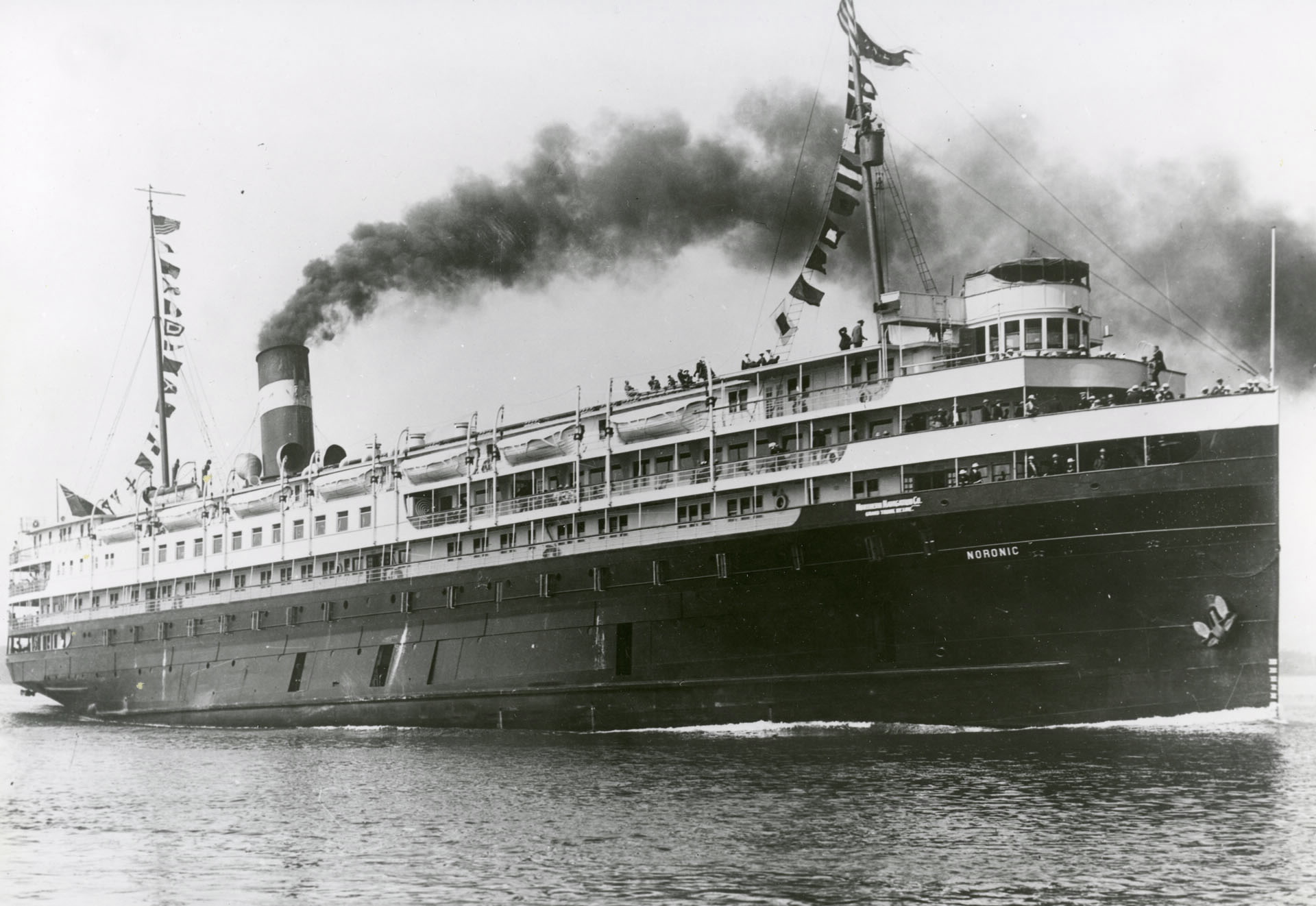
The SS Noronic was a Canadian Great Lakes passenger steamer, built at the Port Arthur Shipbuilding Company yard at Port Arthur, Ontario (now part of Thunder Bay) between 1911 and 1913 and commissioned on 10 September 1913. She was 110 metres long, 6,905 gross tons, and powered by triple-expansion steam engines producing approximately 2,500 horsepower. Her accommodation comprised approximately 600 first-class passengers (no second-class or steerage on Great Lakes cruise ships) plus a crew of 200.
She was owned and operated by the Canada Steamship Lines (CSL), one of the two dominant Great Lakes passenger shipping companies of the early twentieth century. Her operational deployment was the Great Lakes luxury cruise trade: week-long summer pleasure cruises between Toronto, Cleveland, Detroit, Windsor, Niagara Falls, and the Thousand Islands region. The Great Lakes cruise trade of the 1920s and 1930s had been a significant segment of North American tourism; Noronic and her sister-ships (Huronic, Hamonic) had been the principal vessels of CSL's luxury-cruise fleet.
By September 1949, Noronic was 36 years old and substantially representative of the pre-war Great Lakes passenger fleet. Her accommodation had been substantially modernised over the preceding decades (electric lighting, steam heating, modern bathrooms), but her specific safety features (fire-fighting equipment, evacuation procedures, emergency lighting) reflected the standards of the 1913-era Great Lakes passenger trade rather than the post-war international safety standards emerging in the late 1940s.
Her master on her final voyage was Captain William Taylor, 48, a career CSL officer. Her complement on 17 September 1949 was approximately 683 persons: approximately 524 passengers (predominantly American tourists on a one-week Great Lakes cruise) plus 171 crew.
The Voyage
The Noronic had departed Detroit on 11 September 1949 on a one-week "Tour of the Great Lakes" cruise: Detroit to Windsor, Detroit, Cleveland, Buffalo, the Thousand Islands, Toronto, and return to Detroit. Her passenger manifest was approximately 524 tourists, predominantly from Ohio, Pennsylvania, and New York; the cruise was a standard late-season tourist offering for the 1949 cruise season.
On the evening of 16 September 1949, Noronic had arrived at Toronto on her scheduled itinerary; she was moored at Pier 9 on the Toronto waterfront. The specific mooring was alongside the pier, with her starboard side to the pier and her port side facing the open harbour. The passengers had been granted shore leave in Toronto for the evening; many passengers had attended entertainment venues in downtown Toronto and returned to the ship at various times during the evening.
The ship's fire-watch arrangements on the evening of 16-17 September 1949 were substantially deficient by subsequent evaluation. The specific fire-watch personnel had been reduced from the standard complement of approximately 6 to approximately 2 for the overnight period; the specific fire-fighting equipment was substantially deteriorated (hose pipes were reported as being in poor condition; sprinkler systems had not been recently tested); and the specific emergency lighting and public-address systems had not been systematically exercised prior to departure from Detroit.
At approximately 02:30 on 17 September 1949, a fire was detected in a linen closet in the Eastern Women's Lounge on C-Deck (approximately amidships on the starboard side of the main passenger deck). The specific ignition source was never fully established; the subsequent Canadian Coast Guard investigation concluded that the most probable cause was a discarded cigarette in a linen-storage area, with the fire spreading through accumulated dust and linen material before detection.
The Disaster
The fire spread with catastrophic rapidity through Noronic. The specific material combinations in the passenger-deck spaces - varnished wood panelling (applied in multiple coats over decades), accumulated dust, flammable textile furnishings, and oil-based paints - produced an intense and rapidly-spreading fire that was not containable by the ship's standard fire-fighting equipment.
The specific failures of fire-control were systematic. The fire-alarm bell was not activated until approximately 02:38 on 17 September 1949, approximately eight minutes after detection; the ship's fire-fighting crew (reduced to two personnel overnight) was substantially inadequate for the rapidly-expanding fire; the fire-fighting hoses were found to be rotten and inoperative in multiple locations; and the specific spark-arrestor systems on the ship's air-conditioning had been partially disabled for maintenance.
By approximately 02:45 on 17 September 1949, the fire had spread through the C-Deck and D-Deck passenger corridors and was progressing toward the upper decks. The passengers were predominantly asleep in their cabins; the specific public-address system's failure to announce the fire meant that passenger awareness of the fire was delayed. Many passengers only became aware of the fire when they were awakened by smoke and heat in their cabins; by this point, the specific evacuation routes had been substantially compromised by the fire.
The specific evacuation patterns reflected the systematic failures. Passengers awakened by the fire attempted to evacuate through cabin doors into corridors already filled with smoke and flame; many passengers retreated to their cabins and attempted to escape through cabin windows; others attempted to evacuate through emergency exits that were substantially blocked by the fire's spread; still others jumped into Lake Ontario from upper decks and drowned.
SS Noronic burned for approximately four hours at the Toronto pier before the fire was progressively controlled by Toronto fire department responses. The ship sank at approximately 07:00 on 17 September 1949 in approximately 12 metres of water at Pier 9; her upper superstructure remained partially above the waterline.
Of the approximately 683 aboard, approximately 139 died: predominantly passengers who were trapped in their cabins by the fire's rapid spread or who drowned after jumping into the lake. Approximately 544 survived: predominantly crew members, passengers who were ashore at the time of the fire, and passengers who were able to evacuate through the ship's open-deck stairways before the fire's full spread. Captain Taylor survived.
The Legacy
The SS Noronic fire of 17 September 1949 was the worst peacetime maritime disaster in Canadian history and the worst Great Lakes passenger disaster of the twentieth century. The approximately 139 dead were predominantly American tourists; the specific casualties included multiple prominent Ohio and Pennsylvania families whose combined wealth and political connections produced substantial subsequent legal and regulatory activity in the United States.
The subsequent Canadian Coast Guard investigation, conducted through September and October 1949 under Captain John Kerr, identified a systematic catalogue of failures: (i) the inadequate fire-watch arrangements aboard Noronic on the night of 16-17 September 1949; (ii) the substantially deteriorated fire-fighting equipment; (iii) the delayed fire-alarm activation; (iv) the inadequate crew training for fire-emergency response; (v) the specific combustibility of the aged ship's interior materials; and (vi) the substantial departures from the emerging international standards for passenger-ship safety.
The specific regulatory response was the comprehensive revision of Canadian passenger-ship safety standards through 1950 and 1951. The new standards required: mandatory fire-detection systems on all passenger vessels; mandatory automatic sprinkler systems in public spaces; systematic crew training for fire emergencies; enhanced fire-fighting equipment inspection procedures; and updated interior-material specifications to reduce fire spread. The Canadian standards were substantially integrated with the subsequent International Safety of Life at Sea (SOLAS) Convention of 1960, which incorporated many of the specific fire-safety provisions developed in response to the Noronic disaster.
The specific impact on the Great Lakes passenger cruise trade was catastrophic. The Noronic loss, combined with the subsequent 1950 fire on the sister-ship SS Hamonic at Point Edward, Ontario (which killed no passengers but destroyed the ship), effectively ended the Great Lakes luxury-cruise trade. The 1950s saw the progressive retirement of the remaining Great Lakes passenger vessels; by 1960, the Great Lakes passenger-cruise trade had been substantially replaced by Great Lakes commercial bulk-carrier operations and limited excursion services.
The cultural memory of the Noronic fire has been substantial in Toronto and in the Canadian Great Lakes communities. The specific Noronic Memorial at Mount Pleasant Cemetery, Toronto, commemorates 118 of the 139 dead (primarily Canadian crew members and a portion of the American passenger victims). The subsequent 1965 film The Burning of the Noronic and the 1987 documentary The Noronic Disaster have sustained the memory of the event in Canadian popular culture.
The wreck of Noronic was substantially dismantled in 1950 and subsequent years; the hull was eventually scrapped and removed from Pier 9 by 1954. The approximately 139 dead are commemorated by the Noronic Memorial at Mount Pleasant Cemetery, Toronto (dedicated 1951); by the Great Lakes Shipwreck Memorial at the Great Lakes Shipwreck Historical Society, Whitefish Point, Michigan (dedicated 1986); and by individual memorials at the home communities of the American passenger victims across Ohio, Pennsylvania, and New York.