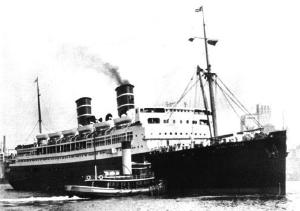
The Record
American Ward Line cruise ship, Havana to New York with Labor Day holiday passengers. Captain Robert Willmott died of a sudden heart attack on the evening of 7 September 1934; hours later a fire broke out in a storage locker off the Jersey coast. 137 dead of 549 aboard. The burning hulk drifted onto the beach directly in front of the Asbury Park Convention Hall, where it drew crowds for months and drove the first meaningful American shipboard fire regulations.
The Vessel
The SS Morro Castle was an American-flag cruise liner of the Ward Line, formally the New York and Cuba Mail Steamship Company. She was built at the Newport News Shipbuilding and Dry Dock Company in 1930 and entered service on the New York-Havana cruise route on 23 August 1930 as the principal vessel of the Ward Line's rapidly-expanding Cuban leisure trade. She was 155 metres long, 11,520 gross tons, certified for 489 cabin passengers and 240 crew, with a designed service speed of 20 knots on twin turbo-electric screws.
Her commercial premise was the Prohibition-era American demand for legal alcohol: Cuba, a Ward Line's primary Caribbean destination, was a short overnight cruise from New York and operated under laws that permitted the full consumption and sale of alcohol. The Ward Line's 1930 advertising campaign positioned the Morro Castle as the sophisticated American's way around the Volstead Act, and her 72-hour round-trip cruises (two nights in Havana, followed by a return to New York) became an established leisure pattern of the early 1930s.
Her master at the date of her final voyage was Captain Robert R. Willmott, 63, a career Ward Line officer who had commanded the Morro Castle since 1931. Her chief officer was William Warms, 46, also a career Ward Line officer. Her radio officer was George Rogers, 33, a recent Ward Line hire with a service record that the subsequent investigation would find suspicious in multiple respects.
The Voyage
She departed Havana at 13:15 on 7 September 1934 on the return leg of a four-day cruise, carrying 318 passengers and 240 crew. The weather through the afternoon and evening of 7 September 1934 was moderate; she proceeded north at her normal service speed of 18 knots.
At 19:45 on the evening of 7 September, Captain Willmott was found dead in his cabin by his steward. The cause was identified by the ship's surgeon as a sudden cardiac arrest. Chief Officer Warms, under the Ward Line's standing-order succession, assumed command. Warms was competent but unpracticed; he had never before held command of a Ward Line ship at sea.
In the early morning of 8 September 1934, at approximately 02:45, a fire was detected in a storage locker in B-deck's first-class writing room. The fire-alarm circuit, when triggered by the watchman, produced a response that the Morro Castle's subsequent investigation would find comprehensively inadequate: the fire-main pumps had never been drilled with the full night watch aboard, several of the fire hoses tested useless in the actual emergency, and Acting Captain Warms made a series of decisions in the following half-hour that accelerated the spread rather than contained it.
Warms's most consequential decision was to continue the ship on her course at 15 knots rather than reducing speed and turning into the wind. The 15-knot speed fed the fire with additional oxygen. By 03:20 the fire had spread from the first-class writing room through the A-deck public rooms and was visible from the bridge. By 03:45 it had reached the bridge itself; Warms evacuated the bridge and moved to the boat deck. By 04:15 the Morro Castle was on fire from stem to stern.
The Disaster
The lifeboat launches were conducted under conditions of severe disorder. Of her sixteen lifeboats, only six were successfully launched; several swung on davits that had been painted shut, and three of the six that launched were boarded mostly by crew rather than by passengers. The radio officer George Rogers delayed the SOS transmission for approximately forty minutes after the fire was first reported, an act that the subsequent investigation treated with significant suspicion.
137 of 558 aboard died. 421 survived. The dead were overwhelmingly passengers, many of them women and children who had been unable to find an operational lifeboat or who had been overcome by smoke in the cabin corridors. The ship burned through the night and the following morning. She grounded, blazing, on the beach at Asbury Park, New Jersey, shortly before 06:00 on 9 September 1934, where she became, by late morning, the largest tourist attraction on the United States Atlantic coast. An estimated 250,000 people visited the burning wreck at Asbury Park over the following week. Postcards of the smoking hull were sold in Asbury Park's boardwalk shops for a decade.
The investigation that followed had two tracks. The formal United States Department of Commerce marine board inquiry identified the fire's proximate cause as a lit cigarette in a stack of cleaning rags in the first-class writing room, and the distal causes as crew undertraining, insufficient fire-drill practice, and Warms's decision to maintain speed during the early fire response. Warms was convicted of manslaughter in January 1936 and sentenced to four years in federal prison; his conviction was reversed on appeal in 1937.
The criminal investigation of George Rogers, the radio officer, was more prolonged and more disturbing. Rogers was convicted in 1938 of an attempted bombing of his superior officer at the Bayonne Police Department; he was convicted in 1954 of the double murder of his landlord and the landlord's daughter in Bayonne, New Jersey. The New Jersey investigators who convicted him in 1954 subsequently concluded, based on Rogers's own private statements to cellmates and on circumstantial evidence of his movements on 7 September 1934, that Rogers had almost certainly set the Morro Castle fire. He had also almost certainly been involved in the death of Captain Willmott by poisoning, though the body was embalmed at sea and the evidence could not be recovered. This is the most widely-accepted modern explanation of the Morro Castle disaster; it has never been established to a criminal court's standard of proof.
The Legacy
The Morro Castle disaster is the direct cause of the modern American merchant marine fire-safety regime. The Ward Line, once one of the most profitable American passenger lines, collapsed commercially in 1935 under the weight of civil lawsuits and reputational damage; the line was dissolved in 1937. The 1936 Merchant Marine Act included specific provisions on crew training, fire-safety drills, and fire-resistance requirements for public spaces aboard passenger ships. The provisions were extended and tightened under SOLAS 1948 in direct response to the Morro Castle and the later Normandie fire.
Every passenger ship that has entered American registry since 1937 has been built to a fire-safety standard shaped by the Morro Castle investigation. Every passenger ship crew serving on American-flag vessels since 1937 has been required to participate in quarterly fire drills under rules the investigation wrote. The Morro Castle is, in this sense, one of the most consequential single ship disasters in the history of American regulation.
Her hull was scrapped at Baltimore in 1935 after six months as a tourist spectacle at Asbury Park. The ship's bell and name plate are displayed at the Smithsonian National Museum of American History. The commemorative plaque at Asbury Park that marked the grounding site was removed in 1990 during boardwalk renovations and has not been replaced. The site is now a parking lot behind the Asbury Park Convention Hall.
George Rogers died in New Jersey State Prison in 1958 at the age of 57, still formally serving time for the 1954 murders and never having been indicted for the Morro Castle fire. His cellmate's notes on Rogers's verbal confessions to the 1934 arson are preserved in the New Jersey state archives; the material has been reviewed by subsequent historians and remains the principal source for the modern attribution of responsibility. The Morro Castle remains the largest American peacetime maritime arson event, the fire that wrote modern American marine fire-safety regulation, and the only major American shipwreck whose proximate cause is now generally accepted to have been deliberate.