The Record
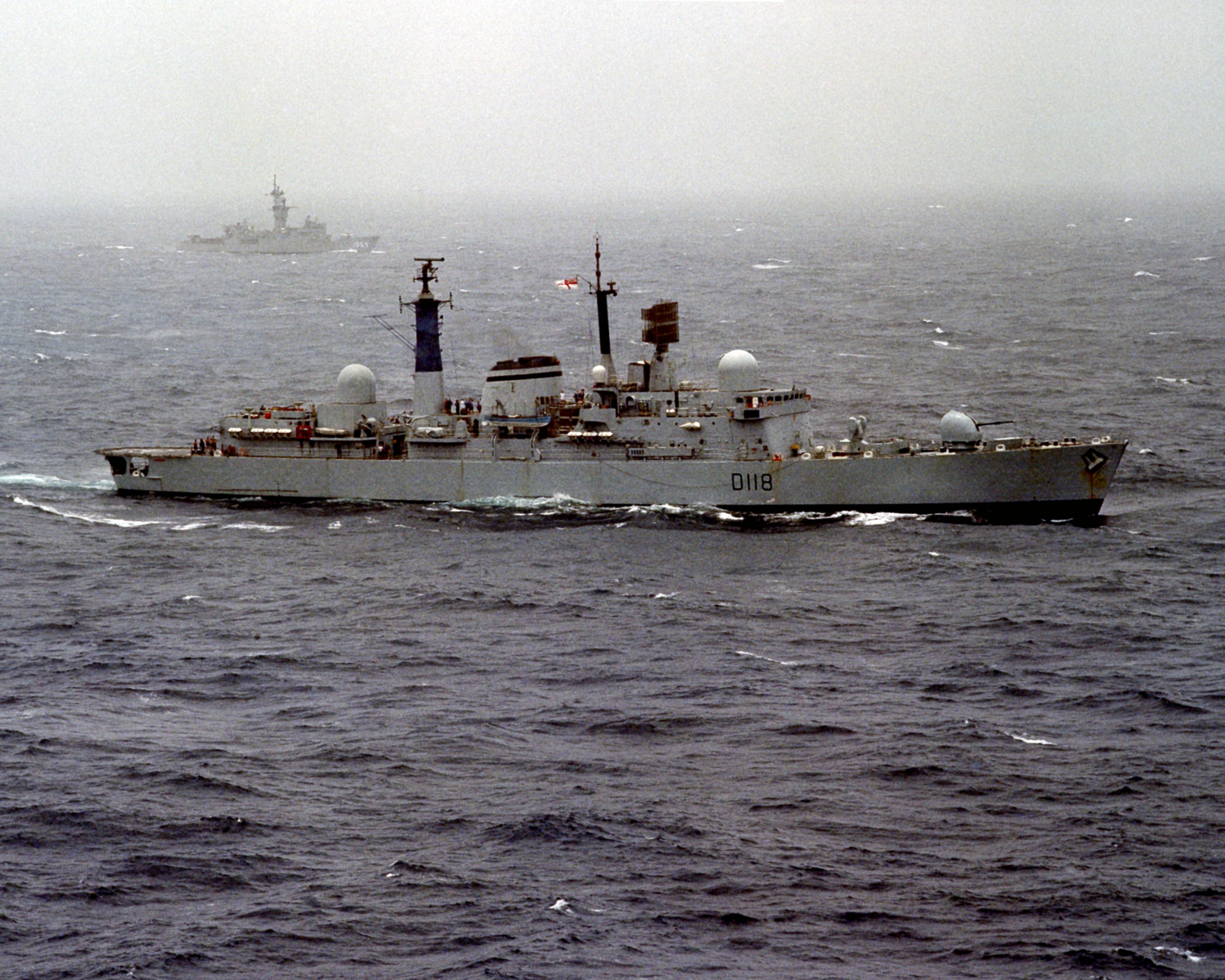
Royal Navy Type 42 destroyer, on radar picket duty north of Pebble Island. Bombed by two Argentine A-4 Skyhawks on the afternoon of 25 May 1982; three 1,000-pound bombs hit home in under a minute. She capsized in under twenty minutes. 19 dead, the same day as the Atlantic Conveyor. The Argentinians called 25 May 'the day of the two ships'; the Royal Navy later commissioned a new Coventry six years later.
The Vessel
HMS Coventry (D118) was a Type 42 guided-missile destroyer of the Royal Navy, commissioned at Cammell Laird at Birkenhead on 20 October 1978. She was a sister ship of HMS Sheffield, Birmingham, Cardiff, Glasgow, Newcastle, and other Type 42 destroyers. Her configuration, armament, and capabilities were essentially identical to Sheffield's: 125 metres, 4,100 tons full load, Sea Dart SAM system, single 4.5-inch gun, twin Rolls-Royce Olympus gas turbines, 30-knot design speed.
Her commanding officer in 1982 was Captain David Hart-Dyke, 44 years old, a career Royal Navy officer. Her crew was 281 officers and ratings. By the outbreak of the Falklands campaign in April 1982 she had been in Royal Navy service for three and a half years and had participated in multiple NATO Atlantic exercises and Persian Gulf deployments.
The Voyage
HMS Coventry sailed from Gibraltar with the Falklands task force in April 1982 and conducted escort and picket duties through the April-May campaign. Following the loss of HMS Sheffield on 4 May 1982, she was assigned with HMS Broadsword to a specific radar picket position north of Pebble Island, West Falkland, with the tactical mission of detecting and engaging Argentine aircraft attacking the British San Carlos beachhead from the west.
The pairing of a Type 42 destroyer (with Sea Dart area-defence missiles) and a Type 22 frigate (with Sea Wolf point-defence missiles) was the Royal Navy's preferred defensive configuration for radar picket duty in the 1982 campaign. The Type 42 was to provide long-range warning and area defence; the Type 22 was to provide close-in defence against any aircraft that penetrated the Sea Dart engagement envelope. The combination was intended to cover the range of Argentine air threats from standoff missile attack to low-level bombing runs.
By 25 May 1982 HMS Coventry and HMS Broadsword had been operating in the radar picket station for nine days. They had engaged and shot down multiple Argentine aircraft through that period. Their extended station-keeping had made them known to the Argentine air command as a "Coventry-Broadsword" defensive position, and had made them the priority target for the continuing Argentine air effort against the British.
The Disaster
At 14:20 on 25 May 1982 Argentine A-4 Skyhawk attack aircraft launched from the Argentine airfield at Río Gallegos were detected on HMS Coventry's radar at a range of 130 kilometres. Captain Hart-Dyke engaged with his Sea Dart missiles at 14:35; one Sea Dart shot down an Argentine Skyhawk at a range of approximately 40 kilometres. A second Argentine strike of four Skyhawks reached the Coventry-Broadsword position at 14:50.
The second strike was the critical one. The four Argentine Skyhawks, carrying four 500-kilogram bombs between them, approached the British ships at very low altitude to avoid the Sea Dart radar. The low-altitude approach placed the aircraft below the minimum engagement altitude for the Sea Dart system. Coventry's close-in defences (her 4.5-inch gun and her 20mm Oerlikon guns) and Broadsword's Sea Wolf point-defence system were engaged to intercept the low-altitude strike.
At 14:52 on 25 May 1982, the Argentine Skyhawks released their four bombs on the British ships. Three bombs struck HMS Coventry. The first entered her forward superstructure and detonated in the computer room, killing most of the officers and ratings in the combat information centre. The second entered her engineering spaces and detonated, flooding her forward engine room. The third entered amidships and detonated, breaking her fore-and-aft structural connection.
HMS Coventry capsized to port within 20 minutes of the bomb hits. Her speed of capsize reflected the three simultaneous bomb hits and the extensive internal damage that had exceeded her damage-control capability. She sank at 15:15 on 25 May 1982 at approximately 51°30′S 59°10′W in approximately 100 metres of water.
Of her 281 crew, 19 died. 262 survived, most of them rescued by HMS Broadsword (which had also been bomb-damaged in the same attack but had not been sunk) and by other British ships responding to the incident.
The Legacy
The loss of HMS Coventry on 25 May 1982 occurred within a few hours of the loss of the merchant conversion SS Atlantic Conveyor to Argentine Exocet attack. The combined British losses of 25 May (two ships sunk, one badly damaged) made the day the worst single day of British naval casualties in the entire Falklands campaign. 25 May 1982 is, in Argentine memory, the Argentine Navy's most successful operational day of the war; it is "the day of the two ships" in Argentine commemoration.
The tactical lesson of the Coventry loss was, like the Sheffield loss, the inadequacy of Type 42 anti-air defences against low-altitude attack. The Sea Dart missile had been designed for medium-altitude Cold War bomber threats; the specific low-altitude ground-attack scenarios of the Falklands campaign had not been a design specification. The subsequent Type 45 destroyer class, which entered Royal Navy service from 2009, was designed specifically to correct the Sheffield-Coventry vulnerabilities: the Type 45's Sea Viper (Aster 15 and 30) missile system is effective at significantly lower altitudes than the Sea Dart, and the ship's hull and superstructure incorporate steel construction throughout with improved damage-control provisions.
Captain Hart-Dyke was not court-martialled or formally criticised for the loss. His handling of HMS Coventry in the nine days leading up to the engagement, during which her Sea Dart missiles had shot down multiple Argentine aircraft, was credited with contributing to the continued effectiveness of the British task force defensive coverage. Hart-Dyke continued his Royal Navy career and retired in 1992 as a Rear-Admiral. His post-war account Four Weeks in May (2007) is one of the principal surviving first-hand accounts of the Falklands naval campaign.
The wreck of HMS Coventry lies at 100 metres depth in the South Atlantic, upside down on the sea floor, approximately 60 kilometres northwest of the Falkland Islands. She was surveyed by the Royal Navy in 1998 and declared a protected war grave under the UK Protection of Military Remains Act 1986. Her position is marked on modern nautical charts but diving on her is restricted to authorised personnel only.
The 19 dead of HMS Coventry are commemorated at the Falkland Islands Memorial Chapel at Pangbourne College, at the Portsmouth Naval Memorial, and at the Coventry Cathedral Memorial in Coventry, England. A fourth HMS Coventry (a Type 23 frigate, F98) was commissioned in 1988 and was decommissioned in 2002. As of 2025 the name is in reserve for a future Royal Navy vessel. The Coventry-Broadsword picket station of May 1982 is studied in every Royal Navy staff college course on air defence as the definitive case study of the Type 42's tactical limitations.