The Record
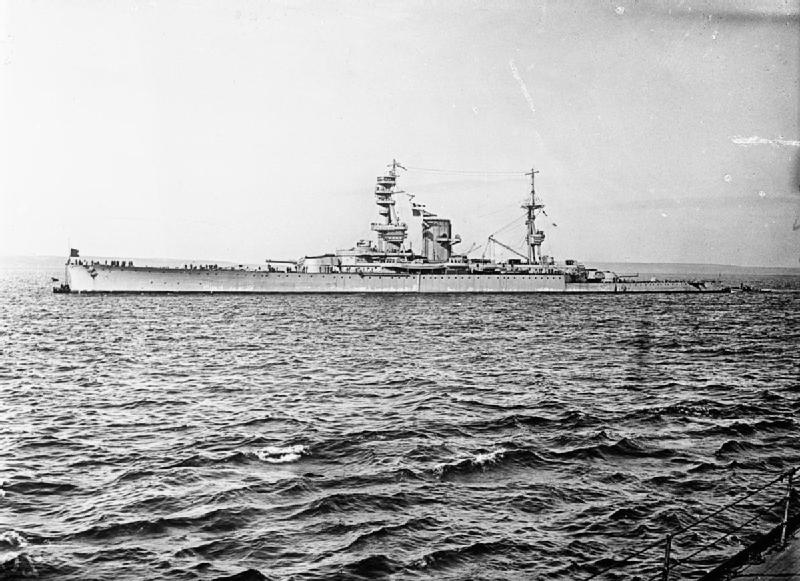
Royal Navy aircraft carrier, converted from a Great War battlecruiser. Torpedoed by U-29 southwest of Ireland at 19:50 on 17 September 1939, two weeks after the war began; she sank in fifteen minutes. 519 dead of 1,216 aboard, the first major Royal Navy loss of the Second World War. The pattern confirmed what the Admiralty feared: the aircraft carrier, without destroyer screens, was a torpedo's natural prey.
The Vessel
HMS Courageous was a Courageous-class aircraft carrier of the Royal Navy, converted in 1924-1928 from the cancelled "large light cruiser" of the same name. Like her sister Glorious, she had been one of Lord Fisher's 1915 "Baltic Project" vessels, designed for a war strategy that never materialised, completed after the First World War with a limited operational function, and eventually rebuilt as an aircraft carrier under the 1920s experimentation that converted several larger Royal Navy hulls to carrier service.
As reconstructed she was 238 metres long, 22,500 tons, and carried 48 aircraft (typically a mix of Fairey Swordfish torpedo bombers and Blackburn Skua fighter-bombers). Her design speed was 30 knots on four-shaft Parsons turbines. Her hangar and flight deck configuration was characteristic of British 1920s carrier conversions: the lower hangar was enclosed and armoured; the upper hangar was open to the weather; the flight deck was planked with narrow-laid Baltic fir.
Her interwar service had been predominantly in the Mediterranean Fleet and the Home Fleet, with periodic deployments to the Far East. Her commanding officer in September 1939 was Captain W. T. Makeig-Jones, 52 years old, a career Royal Navy officer with prior carrier service in the 1930s. Her air group was the 811 and 822 Naval Air Squadrons, a composite of Swordfish and Nimrod aircraft.
The Voyage
On 3 September 1939, the day Britain declared war on Germany, Courageous was at sea with the Home Fleet off the western approaches to the English Channel. Her specific operational assignment was anti-submarine patrol of the major north-Atlantic shipping lanes that led to Liverpool and Southampton. The Royal Navy's anti-submarine doctrine of September 1939 had placed primary emphasis on active hunting by aircraft carriers operating in the convoy approaches; four of the six Royal Navy fleet carriers (including Courageous, Hermes, Ark Royal, and Eagle) had been committed to this hunting role in the opening weeks of the war.
The doctrine assumed that carrier aircraft, operating from a mobile platform with adequate destroyer escort, could locate surfaced U-boats and sink them before they could engage merchant shipping. The specific tactical problem, not fully understood by the Royal Navy at the outbreak of war, was that carriers engaged in this hunting role were themselves high-value targets whose loss would be proportionally disastrous to the Royal Navy, and whose detection by submarines was made easier by the predictable patrol patterns the hunting role required.
At 19:00 on 17 September 1939, Courageous was operating in the southwestern approaches to the Bristol Channel, approximately 150 nautical miles southwest of Ireland. She was steaming into the wind to recover her returning air patrol when German submarine U-29, commanded by Kapitänleutnant Otto Schuhart, sighted her at a range of approximately 3,000 metres. Schuhart had been hunting the British convoy lanes on his first war patrol; his sighting of Courageous was accidental.
The Disaster
Schuhart manoeuvred U-29 to a firing position on Courageous's starboard side. At 19:50 on 17 September 1939 he fired a three-torpedo spread from his forward tubes at a range of 900 metres. Two of the three torpedoes struck Courageous on her starboard side: one at her forward boiler room, one amidships at her engine room.
The damage was immediately catastrophic. The two torpedo hits breached her main machinery spaces; her electrical power failed; her damage-control pumps were inoperable. She listed 10 degrees to starboard within 90 seconds and continued listing through the following 12 minutes.
Courageous capsized at approximately 20:02 on 17 September 1939, some twelve minutes after the torpedo strike. She sank at 20:07 at approximately 50°10′N 14°45′W in approximately 140 metres of water. Her speed of loss was extraordinary: a 22,500-ton aircraft carrier lost to a single submarine attack in fifteen minutes. Captain Makeig-Jones was on her bridge at the moment of the capsize; he remained aboard and drowned in the bridge as she went over.
Of her 1,216 crew, 519 died. 697 were rescued by the escorting destroyers HMS Ivanhoe and HMS Impulsive and by the Dutch merchant ship Veendam, which had been nearby. Courageous was the first Royal Navy fleet carrier lost in the Second World War and the first British capital ship lost to enemy action in the war.
The Legacy
The Admiralty's response to the Courageous loss was immediate and doctrinally consequential. Within 48 hours, the Royal Navy had withdrawn all four of its fleet carriers from the anti-submarine hunting role; the carrier role was redefined to fleet screening, strike operations, and long-range patrol of the approaches to fleet operating areas. The hunting role that Courageous had been conducting was transferred to surface destroyers and to the new RAF Coastal Command patrol squadrons that would become the principal Allied anti-submarine platform for the remainder of the war.
The doctrinal lesson was widely disseminated. The United States Navy's own carrier doctrine, under development in 1939-1940, explicitly incorporated the Royal Navy's Courageous lesson: American fleet carriers of the Second World War were never assigned to routine anti-submarine patrol in submarine-threatened waters; they were always deployed in fleet formations with heavy destroyer screens.
The sinking also had a specific German tactical consequence. Otto Schuhart, previously an unknown submarine commander, was promoted to Korvettenkapitän and awarded the Iron Cross First Class for the Courageous kill. His success, in the first two weeks of the war, confirmed to the German naval staff that unrestricted submarine warfare against British capital ships and merchant traffic was a viable strategic approach. Admiral Karl Dönitz's planning for the 1940-1941 U-boat campaign in the North Atlantic was shaped, in part, by the evidence Schuhart had provided.
The wreck of HMS Courageous was located in 1984 by the Royal Navy at approximately 140 metres depth in the Atlantic, approximately 150 nautical miles southwest of Land's End. She lies on her starboard side, her torpedo damage visible, her flight deck substantially intact. She is a protected war grave under the UK Protection of Military Remains Act 1986. The 519 dead are commemorated on the Portsmouth Naval Memorial, the Chatham Naval Memorial, and the Plymouth Naval Memorial depending on port of service. Her loss was the first Royal Navy capital ship casualty of the Second World War; her lesson reshaped Allied carrier doctrine for the remainder of the war.