The Record
Royal Navy first rate, 100 guns, Lord Keith's Mediterranean flagship (her admiral ashore). At anchor off Livorno on the morning of 17 March 1800, loose hay caught on a lit match tub in the cable tier and ignited; the crew could not contain it. She burned four hours before the magazine went up at eleven. 673 dead, nearly every man aboard. The flag captain, Andrew Todd, died with the ship.
The Vessel
HMS Queen Charlotte was a British first-rate ship of the line of the Royal Navy, built at Chatham Dockyard between 1785 and 1790 and named after Queen Charlotte, the consort of King George III. She was 57 metres long, 2,286 tons displacement, and armed with 100 guns on three full gun decks: thirty 32-pounders on the lower deck, twenty-eight 24-pounders on the middle deck, thirty 12-pounders on the upper deck, and twelve 6-pounder chase guns. She was, at her commissioning in 1790, the newest first-rate in the Royal Navy.
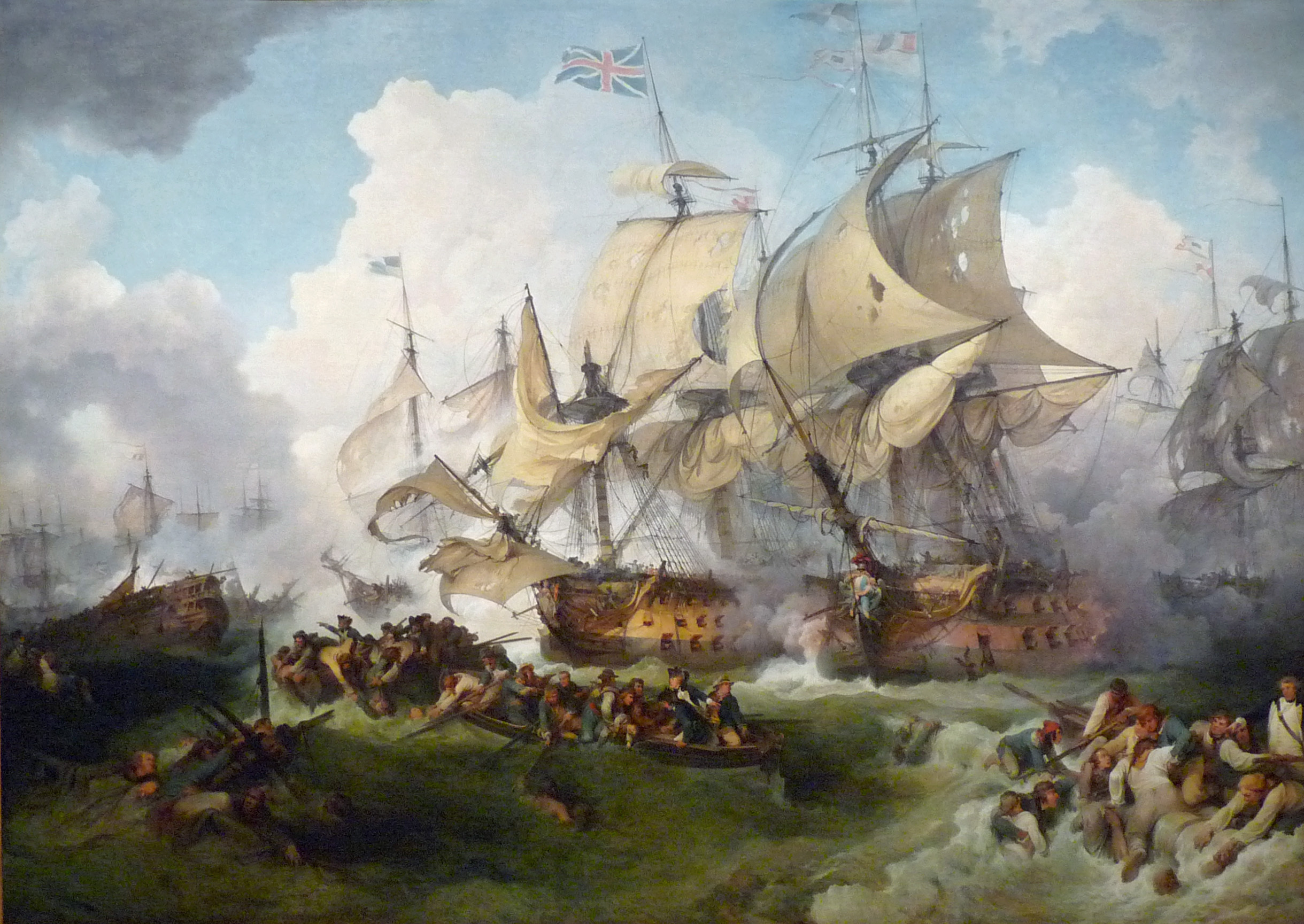
Her most celebrated service was as Admiral Lord Howe's flagship at the Battle of the Glorious First of June (1 June 1794), the first major naval battle of the French Revolutionary Wars. At that engagement, Queen Charlotte had led the British line through the French formation in the tactical manoeuvre that destroyed the French fleet's cohesion; Lord Howe's tactical innovation of "breaking the line" was conducted from Queen Charlotte's quarterdeck. The battle produced British casualties of approximately 290 killed and 858 wounded; Queen Charlotte herself had suffered approximately 35 dead and 100 wounded during the engagement.
Her subsequent service through 1800 had been continuous through the French Revolutionary Wars. Her master in March 1800 was Rear-Admiral George Keith Elphinstone, Lord Keith, commander-in-chief of the British Mediterranean fleet. Her captain was Andrew Todd, 42, a career officer of long Mediterranean service. Her complement in March 1800 was 829 officers, marines, and ratings.
The Voyage
In March 1800, the British Mediterranean fleet under Lord Keith was engaged in the blockade of French forces occupying Italy and the Levant. Queen Charlotte, as Keith's flagship, was stationed at Livorno (Leghorn) on the west coast of Italy, coordinating the British blockade of the French-occupied Mediterranean coast.
On 16 March 1800, Lord Keith departed Queen Charlotte for a reconnaissance patrol aboard a smaller frigate, leaving Captain Todd in operational command of the flagship. Queen Charlotte was anchored approximately 19 kilometres off Livorno, in the standard station for a flagship maintaining communication with both the Italian coast and the British naval forces offshore.
The ship was engaged in routine flagship duties. On the upper deck, hay was being stowed from recent provisioning operations; the hay was intended for the stabling of horses used by officers ashore. The hay was stowed in bales on the upper deck near the forecastle, adjacent to the galley firebox chimney.
The specific initiating event of the disaster, established by the subsequent British Admiralty inquiry, was that a spark from the galley chimney ignited the hay on the upper deck at approximately 06:00 on 17 March 1800. The ignition was initially small and was detected by the watch on deck within approximately two minutes. Standard fire-fighting procedures were immediately implemented: the upper-deck fire hoses were deployed, crew members attempted to contain the spreading hay fire, and the adjacent ship's boats were prepared for evacuation.
The Disaster
The fire-fighting efforts failed to contain the fire. The specific failure mechanism was the continuous supply of oxygen to the fire from the ship's natural ventilation arrangements, combined with the tarred rope and rigging near the upper deck, which ignited within approximately 15 minutes of the initial fire. By 06:30 on 17 March 1800, Queen Charlotte's upper deck was substantially engulfed in flame.
The fire spread rapidly down through the ship's hatches to the middle gun deck and the lower gun deck. By 07:00, the middle deck was in flame; the lower gun deck, where her 32-pounder guns were stationed along with approximately 200 barrels of salted provisions, was compromised. The ship's gunpowder magazine, located below the lower gun deck, was now at imminent risk of igniting.
Captain Todd's response was immediate: he ordered the gunpowder magazine flooded with seawater at approximately 07:15, which prevented the magazine detonating but did not arrest the main fire. The ship's boats were launched, and evacuation of the crew commenced; however, the fire had spread so rapidly that substantial portions of the ship's company were trapped below decks by the burning upper deck and the collapsing companion ladders.
HMS Queen Charlotte burned for approximately 11 hours before the fire reached her powder magazines despite the flooding attempt. The magazine detonation occurred at approximately 17:00 on 17 March 1800, destroying the forward third of the ship. The remaining aft section burned until approximately midnight on 17 March; the ship's hulk sank in approximately 90 metres of water approximately 19 kilometres off Livorno.
Of the 829 aboard, approximately 673 died: burned below decks, trapped by the collapsing structure, or drowned after the magazine explosion. Approximately 156 survived, predominantly those who had been able to reach the ship's boats in the initial evacuation. Captain Andrew Todd died aboard the ship; Lord Keith, who was not aboard at the time, subsequently commanded the British Mediterranean fleet through 1801.
The Legacy
The loss of HMS Queen Charlotte was the single worst Royal Navy peacetime loss of life of the Napoleonic Wars era, substantially exceeding the losses at all but the largest fleet engagements of the period. The approximately 673 dead represented approximately 0.5 per cent of the Royal Navy's total personnel strength of 1800; the specific loss of a first-rate flagship was a substantial operational setback for the British Mediterranean fleet.
The subsequent Admiralty inquiry, convened at Livorno in April 1800 under Lord Keith's supervision, identified the specific cause as spark ignition from the galley chimney combined with inadequate management of the upper-deck hay stowage. The inquiry's broader findings produced a specific Admiralty Standing Order (May 1800) prohibiting the stowage of combustible materials (hay, straw, dry provisions barrels) within 10 metres of galley chimneys on Royal Navy ships; the standing order was incorporated into subsequent editions of the Admiralty Regulations.
The cultural response was limited, in part because the Queen Charlotte loss occurred in the early months of the Napoleonic Wars when British naval attention was focused on the French and Spanish fleets. No substantial literary or artistic treatment of the disaster appeared until the nineteenth century; the ship is primarily remembered through the connection to the Battle of the Glorious First of June rather than through her loss.
The wreck of Queen Charlotte has never been located. She lies in approximately 90 metres of water in the Ligurian Sea off Livorno; her specific position has been lost to time and her location is currently known only to the level of a search area of approximately 15 square kilometres. Two separate Italian archaeological surveys (1994, 2012) have attempted to locate the wreck; neither has been successful. The ship's bell of HMS Queen Charlotte was not recovered. The 673 dead are commemorated by a memorial plaque at the Church of Saint George, Livorno, dedicated in 1802 by the British community of the port.
A subsequent HMS Queen Charlotte (1810), an 100-gun first-rate, was built to replace the lost ship and served with the Royal Navy through 1892, maintaining the name's association with Royal Navy first-rates through the Victorian period. The name is currently held by a shore establishment at Plymouth.