The Record
Greek Epirotiki Line cruise ship, on a routine run up the South African coast. Took on water through a faulty engine-room valve in a Wild Coast storm on the night of 3 August 1991. Captain Avranas and most of the crew abandoned ship before the passengers were organised; guitarist Moss Hills and the ship's entertainers took over the bridge, broadcast the Mayday, and ran the evacuation. All 571 aboard survived; the South African Navy airlifted every passenger and crew off by helicopter the next day. A cruise-line disaster with no deaths but permanent reputational damage to the profession of sea captain.
The Vessel
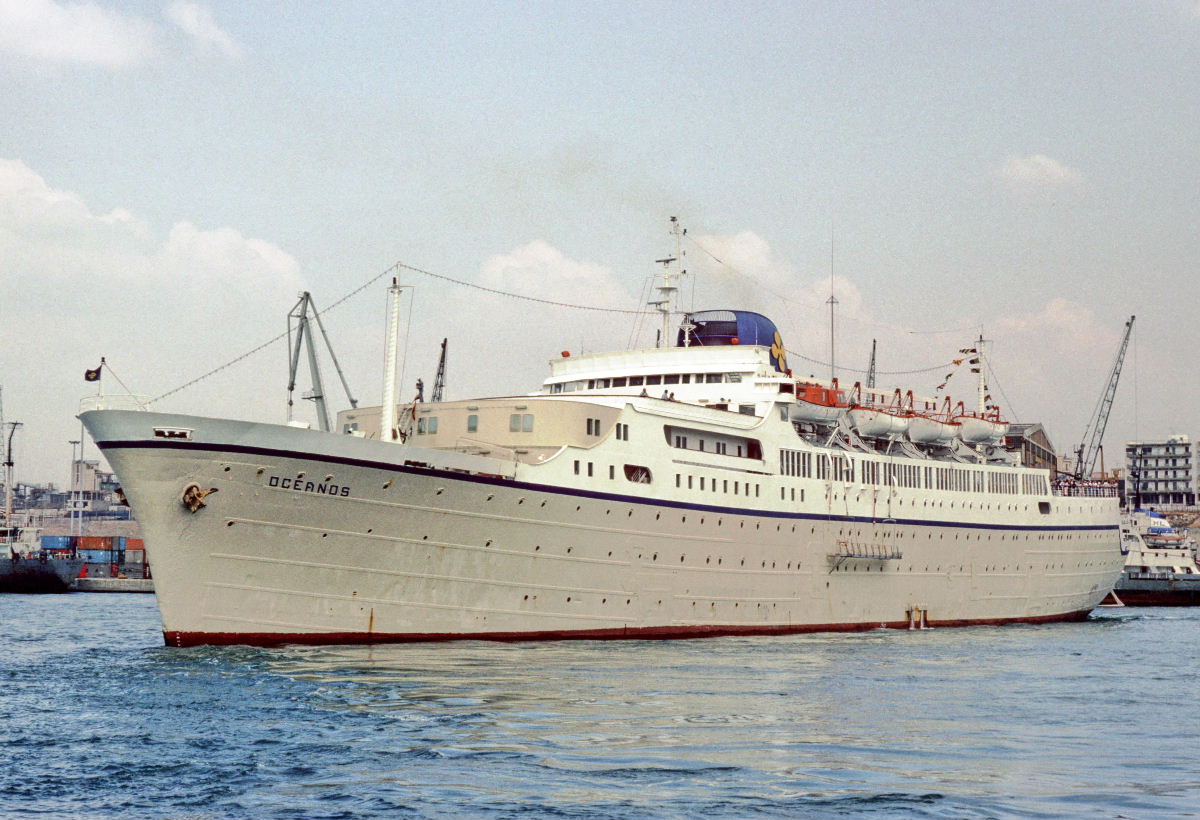
The MTS Oceanos was a Greek-flagged cruise passenger ship, originally built as the SS Jean Laborde for the French Messageries Maritimes line at the Forges et Chantiers de la Méditerranée yard at La Seyne, France between 1952 and 1953 and launched on 4 June 1952. She was 153 metres long, 13,335 gross tons, and powered by twin steam turbines producing approximately 9,400 horsepower. Her original accommodation for the East Africa passenger service was approximately 100 first-class, 110 tourist-class, and 460 third-class passengers, plus a crew of 220.
She had served on the France to Madagascar route through the 1950s and 1960s; she was sold to various subsequent operators through the 1970s and was eventually purchased by the Greek Epirotiki Lines in 1976 and renamed Oceanos. Her post-1976 service was as a Mediterranean and Caribbean cruise ship, operating under Greek flag and Epirotiki management.
By 1991, she had been operating as a cruise ship for 15 years and was substantially aged. The specific maintenance condition of the ship had been the subject of various concerns; she had been the subject of multiple minor incidents and had required substantial operational accommodations to continue service.
Her master on her final voyage was Captain Yiannis Avranas, 45, a career Greek merchant marine officer. Her complement on 3 August 1991 was 581 persons: 361 passengers (predominantly South African tourists on a Durban-East London coastal cruise) plus 220 crew.
The Voyage
On 3 August 1991, the Oceanos was conducting a four-day cruise under charter to the South African travel company TFC Tours. The specific cruise itinerary was a winter-season cruise (the southern-hemisphere winter) along the South African coast: Durban (departure) → East London → Port Elizabeth → Cape Town → return to Durban. The specific voyage was a standard TFC Tours summer offering that had been successfully operated in previous years.
The specific operational issue relevant to the disaster was the weather conditions off the South African Wild Coast. The Wild Coast (the section of South African coast between East London and Port St Johns) is notoriously rough during the southern-hemisphere winter: the Agulhas Current combined with prevailing southwesterly winds produces substantial wave conditions and occasional rogue waves.
At approximately 21:30 on 3 August 1991, the Oceanos was approximately 27 kilometres off the Wild Coast, approximately 50 kilometres southeast of Coffee Bay. The weather had been deteriorating through the afternoon: wind had risen from force 7 to force 9; sea state was building with waves of approximately 8-10 metres; visibility was reduced by heavy rain.
At approximately 21:40 on 3 August 1991, Oceanos experienced what was subsequently identified as a catastrophic hull failure. The specific failure occurred at the ship's bow: a substantial wave impact combined with the specific deteriorated condition of her forward hull plating produced a hull breach approximately 3-4 metres below the waterline. The specific flooding began immediately through the hull breach; the ship's pumps were activated but could not address the flooding rate.
The Disaster
The specific progression of flooding aboard Oceanos was rapid and catastrophic. Within approximately 10 minutes of the initial hull breach, water had entered the ship's engine room; the main engines were progressively shut down to prevent electrical fire; the ship's wireless equipment was disconnected from main power. The specific emergency power supplies were activated but were substantially inadequate for the continued operation of critical systems.
The specific operational issue was the substantial failure of the ship's officers and crew to initiate systematic evacuation procedures. The ship's captain (Yiannis Avranas) and his senior officers abandoned the ship on the first lifeboat to launch, at approximately 22:30 on 3 August 1991. The specific abandonment was conducted without informing the ship's passengers or the remaining crew; the passengers and non-officer crew were left aboard the sinking ship with no effective leadership.
The specific role of the Moss Hills (British cabaret entertainers Robin and Moss Hills, who were performing aboard the ship) and other passengers in the evacuation became the specific subject of subsequent international media coverage. The Moss Hills and other passengers recognised that the ship's officers had abandoned them; they took responsibility for organising the evacuation of the remaining passengers and crew; they transmitted distress signals using the ship's wireless equipment (before it failed due to flooding); and they coordinated the launching of remaining lifeboats and the transfer of passengers to rescue vessels.
The specific rescue operation was substantial. Multiple South African Navy and coast guard helicopters and vessels responded to the Oceanos's distress calls over the following approximately 8 hours. The specific rescue was substantially coordinated by the Moss Hills and other passengers; approximately 225 of the 581 aboard were evacuated by the South African Navy helicopters (South African Air Force Puma helicopters); approximately 356 were evacuated by the lifeboats and rescue vessels.
MTS Oceanos sank at approximately 15:30 on 4 August 1991 in approximately 90 metres of water off the Wild Coast of South Africa. The sinking took approximately 18 hours from the initial hull breach - an extraordinarily long duration that permitted the effective evacuation of the ship.
Of the 581 aboard, all 581 survived - the only major passenger liner sinking of the modern era (post-1980) without casualties. The specific combination of: (i) the slow progressive sinking over approximately 18 hours; (ii) the effective evacuation coordination by passengers (not the ship's officers); (iii) the specific proximity to South African rescue resources; (iv) the specific warm water temperature (approximately 20 degrees Celsius); and (v) the specific calm conditions during most of the rescue operation produced the no-casualty outcome.
The Legacy
The MTS Oceanos disaster of 3-4 August 1991 was one of the most publicly scandalous maritime incidents of the late twentieth century, not because of its casualty figure (zero dead) but because of the specific failure of the ship's officers to fulfill their fundamental duty to their passengers. The specific abandonment of the passengers and crew by the captain and senior officers - who used the first available lifeboats to save themselves - became an international symbol of professional dereliction.
The subsequent South African Department of Transport investigation, conducted through 1991 and 1992, identified a complex pattern of failures: (i) the specific structural failure of the ship's hull (attributed to progressive deterioration over 38 years); (ii) the specific failure of the Epirotiki Lines maintenance and inspection programmes; (iii) the specific failure of the ship's officers to fulfill their duty during the emergency; (iv) the specific inadequacies of the ship's emergency communications and evacuation systems; and (v) the specific operational decisions that had kept the ship in service despite known maintenance issues.
The specific prosecution of Captain Avranas and the senior officers was substantially complicated by Greek jurisdictional issues. The specific Greek maritime authorities conducted their own investigation and initially declined to prosecute; under sustained international pressure, the specific Greek courts eventually convicted Avranas and two senior officers of negligence in 1992; the specific sentences were substantially limited.
The specific broader cultural response to the Oceanos incident has been substantial. The specific case became a principal reference point in modern maritime law and ethics courses; the specific "captain goes down with his ship" principle was substantially reinforced by the Oceanos case as a continuing expectation of merchant marine conduct.
The specific regulatory response in international maritime operations was substantial. The subsequent 1994 International Maritime Organization amendments to the SOLAS Convention incorporated specific requirements influenced by the Oceanos case: enhanced captain-and-crew responsibilities during emergency operations; enhanced passenger-evacuation coordination requirements; enhanced inspection and maintenance standards for aging cruise vessels; and enhanced monitoring of cruise-operator compliance with safety standards.
The specific impact on the Epirotiki Lines and the broader Greek cruise industry was substantial. The Oceanos was the last major Epirotiki Lines cruise ship loss; the specific company's subsequent operations were substantially affected by reputation damage; the specific Epirotiki company was eventually absorbed into Louis Cruise Lines in 1996.
The specific cultural memory of the Oceanos disaster has been substantial through media coverage. The specific 1992 BBC documentary The Sinking of the Oceanos and the specific 1993 book Abandon Ship by Ronnie McGuinness (a British passenger on the ship) provided detailed accounts. The Moss Hills's specific heroic role was subsequently recognised; Robin and Moss Hills have continued to work in international entertainment and maritime safety advocacy.
The wreck of Oceanos lies at approximately 90 metres depth off the Wild Coast of South Africa. The wreck has been documented by multiple South African diving expeditions; it is substantially accessible to technical divers. The specific wreck is protected under South African cultural heritage legislation. The incident is commemorated by the Oceanos Memorial at the Port Shepstone Maritime Museum (dedicated 1993).