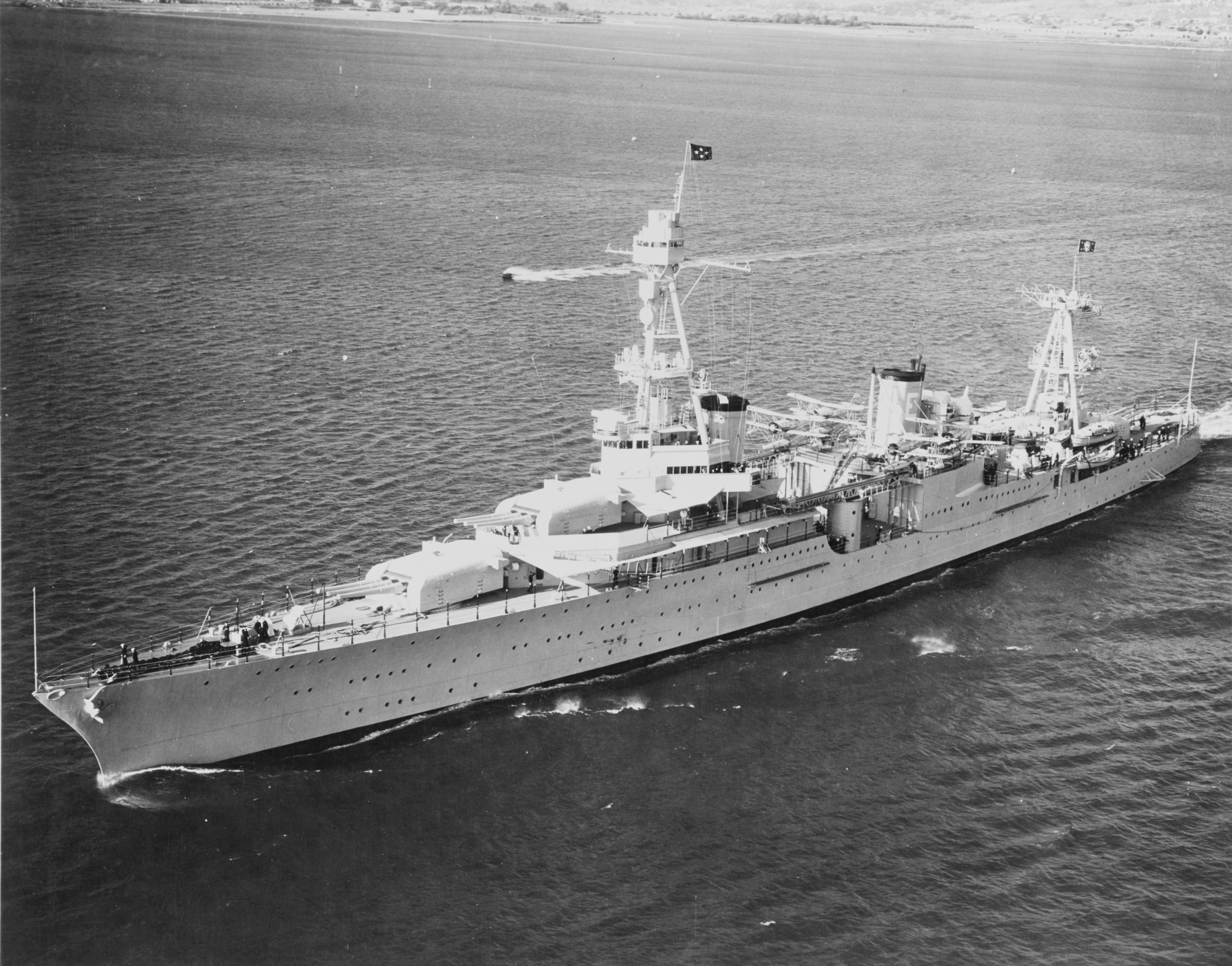
The Record
American Northampton-class heavy cruiser, nicknamed 'The Ghost of the Java Coast' by the Japanese who kept reporting her sunk. Caught with HMAS Perth at the Sunda Strait on the night of 28 February-1 March 1942 blundering into a Japanese amphibious force. 693 dead of 1,061 aboard; Captain Albert Rooks was awarded a posthumous Medal of Honor. 368 of the survivors were captured and 266 of those died as prisoners of war, many on the Sumatra railway.
The Vessel
USS Houston (CA-30) was a Northampton-class heavy cruiser of the United States Navy, commissioned at the Newport News Shipbuilding Company on 17 June 1930. She was 183 metres long, 9,200 tons standard displacement, with nine 8-inch guns in three triple turrets. She was one of the six Northampton-class heavy cruisers, the first American heavy cruiser class built to the Washington Naval Treaty's displacement limit.
Her interwar service had been largely ceremonial. She had served as President Franklin Roosevelt's "Presidential yacht" on multiple occasions, carrying him on fishing trips to the Bahamas in 1934 and 1935 and on the 1938 voyage to Pearl Harbor. The association with Roosevelt had made her the best-known American warship of the 1930s; her crew enjoyed considerable prestige within the service.
In the Pacific from 1940 she was assigned to the Asiatic Fleet under Admiral Thomas Hart, based at Cavite in the Philippines. The Asiatic Fleet, smaller than the Pacific Fleet, was the American forward deployment in the western Pacific against Japanese expansion. Her captain from September 1940 was Captain Albert H. Rooks, 50 years old, a 1914 Naval Academy graduate with a 27-year career.
The Voyage
When Japan attacked American, British, and Dutch territories on 7-8 December 1941, the Asiatic Fleet was badly placed: many of its assets were damaged or destroyed in the opening Japanese attacks on the Philippines. Houston herself, anchored at Cavite, was near-missed by Japanese bombers on 8 December and took shrapnel damage from several bomb bursts. By late December 1941 the Asiatic Fleet had retreated south toward the Netherlands East Indies, operating from bases at Surabaya, Java.
The ABDA (American, British, Dutch, Australian) Command was formed in January 1942 to coordinate Allied naval operations against the Japanese advance through the Netherlands East Indies. Houston was assigned to ABDA's surface striking force under the Dutch Rear-Admiral Karel Doorman, who commanded the principal remaining Allied cruiser force in the theatre. Through January and February 1942, Doorman's force conducted a series of attempts to intercept Japanese amphibious invasion forces moving south through the Java Sea; the operations were largely unsuccessful.
The Battle of the Java Sea on 27 February 1942 was Doorman's final major engagement. His force of five cruisers (De Ruyter (flag), Houston, HMS Exeter, HMAS Perth, HMNS Java) and nine destroyers engaged two Japanese heavy cruisers, two light cruisers, and fourteen destroyers under Rear-Admiral Takeo Takagi. The Japanese force's superiority in torpedo armament and radar-equipped fire control proved decisive. Doorman was killed when De Ruyter was sunk; Java was also lost; HMS Exeter was damaged and withdrew.
Houston and HMAS Perth, now the only Allied cruisers still in the theatre, withdrew to Tanjung Priok (the port of Batavia, modern Jakarta) on 28 February 1942. On the night of 28 February, under the command of Captain Rooks and Captain Hec Waller of HMAS Perth, the two cruisers departed Tanjung Priok in an attempt to reach the Indian Ocean through the Sunda Strait. They did not know that the Japanese Western Attack Force was at that moment conducting its amphibious landing at Merak Bay on the Java side of the Sunda Strait.
The Disaster
The two Allied cruisers entered the Sunda Strait at approximately 22:30 on 28 February 1942 at 28 knots. At approximately 23:10, lookouts aboard Houston sighted the Japanese landing force at anchor at Bantam Bay, approximately 1 nautical mile to port. The Allied cruisers had blundered into the Japanese Western Attack Force: four heavy cruisers (Mogami, Mikuma, Kumano, Suzuya), one light cruiser (Natori), and fourteen destroyers, protecting a large invasion convoy.
Captain Rooks and Captain Waller turned their two cruisers to engage. The subsequent Battle of Sunda Strait, fought between 23:10 on 28 February and approximately 00:45 on 1 March 1942, was the most desperate naval engagement of the Asiatic Fleet's war. Houston and Perth fired their 8-inch and 6-inch guns at every Japanese target in range, engaging simultaneously multiple heavy cruisers and destroyer squadrons.
HMAS Perth was struck by four Japanese torpedoes and sunk at approximately 00:25 on 1 March 1942. Her loss did not stop Houston; Captain Rooks continued to fight his ship alone against the Japanese force. Over the following 20 minutes Houston was struck by an estimated eight torpedoes and numerous 8-inch shell hits. Captain Rooks was killed on the bridge at approximately 00:30. Houston, under the command of her executive officer Commander David W. Roberts, continued to engage until her 8-inch guns ran out of ammunition; she then fired her 5-inch secondary guns until those also ran dry.
USS Houston sank at approximately 00:45 on 1 March 1942, rolling onto her starboard side and disappearing bow-first. Of her 1,061 officers and crew, 693 died in the engagement or in the water. 368 survived to reach Java shore, where they were captured by Japanese forces.
The Legacy
The captured Houston crew and the surviving Perth sailors were distributed across the Japanese prisoner-of-war system through 1942-45. The majority of the Houston prisoners were transported to Thailand and Burma, where they were assigned as forced labour on the Burma-Thailand Railway (the "Death Railway" of Pierre Boulle's The Bridge on the River Kwai). Approximately 266 of the 368 Houston survivors of the sinking subsequently died in Japanese captivity, most from cholera, dysentery, starvation, and beriberi on the railway. When the war ended in August 1945, only 102 of Houston's original crew were still alive. The combined Houston casualty count of 959 dead, between the sinking and subsequent captivity, made her the heaviest American shipboard casualty rate of the Pacific War.
Captain Albert H. Rooks was posthumously awarded the Medal of Honor on 4 June 1942 for the Battle of Sunda Strait; the citation credited him with bringing Houston into a hopeless engagement knowing the likely outcome. Houston, Texas (the ship's namesake city) conducted a memorial campaign through 1942 that raised over 6,000 voluntary enlistments for the United States Navy at the recruiting desk erected in Sam Houston Park; the USS Houston (CL-81), a Cleveland-class light cruiser, was launched on 19 June 1943 with 1,000 men already volunteered to man her, and was the only U.S. Navy ship in history commissioned with her full wartime complement before her completion.
The wreck of Houston was located on 29 June 2014 by a joint United States Navy and Indonesian Navy expedition, at a depth of 40 metres in the Sunda Strait. She lies in shallow tropical water and has been subject to ongoing illegal scrap-metal salvage since the 1970s. The U.S. Navy's 2017 formal survey of the site found that the wreck had been partially dismantled: approximately 60 per cent of her hull had been stripped by Indonesian scrap divers using explosives. The U.S. State Department has filed formal protests with the Indonesian government; the salvage reportedly continues.
The 959 dead of the USS Houston (including the Java Sea engagement dead and the post-capture dead) are commemorated at the Manila American Cemetery and on the USS Houston Memorial in Sam Houston Park, Houston, Texas. She was called, in the Japanese press of 1942, "the Ghost of the Java Coast," because Japanese spotters kept reporting her sunk and she kept appearing in subsequent engagements. When she was finally destroyed in the Sunda Strait she had acquired one of the most distinguished combat records of any Pacific War cruiser. Her dead include the largest single contingent of Texas-born war dead in American history.