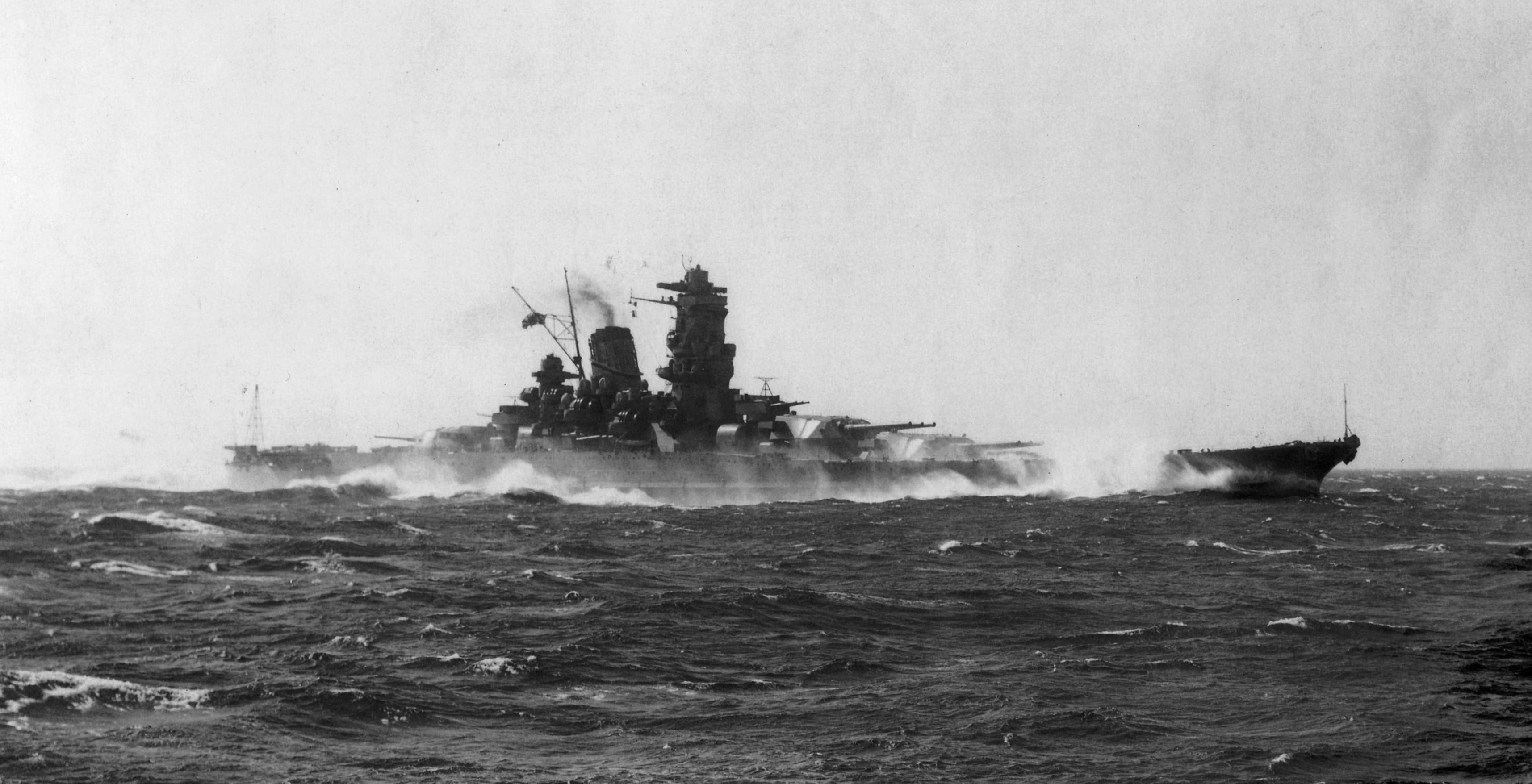
The Record
Flagship of the Imperial Japanese Navy, the largest battleship ever built alongside her sister Musashi. Sent on a one-way mission to Okinawa in Operation Ten-Go on 6 April 1945 with fuel for only half the voyage, intercepted by 386 American carrier aircraft the next afternoon. Her forward magazine detonated after ten torpedoes and nine bombs; the mushroom cloud was visible from Kyushu, 200 kilometres away. 3,055 dead of 3,332 aboard; the Imperial Japanese Navy never sortied again.
The Vessel
The Yamato was the lead ship of her class, the largest and most heavily armed battleships ever built by any navy. She was laid down at the Kure Naval Arsenal on 4 November 1937 under the strictest secrecy in the history of Japanese warship construction: even the senior naval officers who oversaw her construction did not have complete drawings, and the Kure construction docks had been covered with roofs to prevent aerial reconnaissance by foreign powers. She was commissioned on 16 December 1941, nine days after Pearl Harbor, displacing 72,800 tons at full load, with a principal armament of nine 46-cm (18.1-inch) guns in three triple turrets, each gun firing a 1.46-tonne shell to 42,000 metres.
Her displacement, her gunnery, and her armour were all records that have never since been exceeded. Her sister Musashi was her equal; a third sister Shinano was converted mid-construction into an aircraft carrier; a fourth, projected as Warship Number 111, was never laid down. The three Yamato-class battleships represented the Imperial Japanese Navy's central bet on the dreadnought concept at a moment when the rest of the world's principal navies were moving decisively toward aircraft carriers. Yamato was the largest capital-ship commitment the Japanese naval staff ever made, and she was commissioned into a war in which her primary theoretical opponents were aircraft.
She served as the flagship of the Combined Fleet under Admiral Isoroku Yamamoto from February 1942 until his death in April 1943, and under Admiral Mineichi Koga from mid-1943 until the shift of fleet command ashore in mid-1944. Her principal contemporary, Musashi, was sunk on 24 October 1944 at the Battle of the Sibuyan Sea by American carrier aircraft; her sister-once-carrier Shinano was torpedoed and sunk on 29 November 1944 on her maiden voyage. By the spring of 1945, Yamato was the last Yamato-class warship still operational.
The Voyage
In March 1945, the American amphibious assault on Okinawa was beginning. The Imperial Japanese Navy, under the overall command of Admiral Soemu Toyoda and operationally commanded by Vice-Admiral Seiichi Ito of the Second Fleet, determined that Yamato should sortie on a one-way mission to attack the American amphibious shipping at Okinawa. The mission was titled Ten-Go (Operation Heaven One); the naval staff's written orders called for Yamato to beach herself on the Okinawa shore if she could reach the anchorage and to fight as a coastal artillery battery until her ammunition was exhausted.
Ito's fleet comprised Yamato, the light cruiser Yahagi, and eight destroyers. The fleet's fuel allocation was 2,500 tonnes of oil, sufficient for one-way travel to Okinawa at economical speed but not sufficient for the return voyage. This was intentional. The operational plan was for Yamato to beach at Okinawa and her escorts to fight to destruction. Ito himself, in a conversation with Toyoda in early April, had expressed reservations about the strategic purpose of the sortie; Toyoda had confirmed the orders.
Yamato departed the Inland Sea on the afternoon of 6 April 1945, her crew of 3,332 ratings and officers aware of the mission's one-way character. She proceeded south-southwest through the East China Sea at 12-15 knots through the night of 6-7 April. Her course was detected by the American submarine USS Threadfin at 20:00 on 6 April; the submarine's report reached U.S. Pacific Fleet headquarters the following morning. Admiral Raymond Spruance ordered Task Force 58, the principal carrier striking force under Vice-Admiral Marc Mitscher, to intercept and destroy her.
The Disaster
The first American carrier strike reached Yamato at 12:32 on 7 April 1945. Mitscher's Task Force 58 deployed 386 aircraft from eight carriers (Hornet, Bennington, Belleau Wood, San Jacinto, Essex, Bunker Hill, Hancock, Bataan): 280 torpedo, dive, and fighter aircraft, supported by 106 additional fighter escorts. Yamato's defensive armament consisted of 150 anti-aircraft guns of six calibres, her fire controllers directed by four radar sets, a formidable defensive battery against any contemporary attacker. Against 386 aircraft operating from horizons in three directions, it was insufficient.
The American strike developed in waves over two hours. The first wave (12:32-12:50) concentrated on her starboard side and delivered five torpedo hits, jamming her starboard steering and starting a 5-degree list. The second wave (13:35-14:00) delivered a further five torpedo hits on her port side and three 500-pound bomb hits on her amidships superstructure. The third wave (14:00-14:15) attacked through the smoke of the first two and added three more torpedo hits. Yamato was, by the end of the third wave, listing 28 degrees to port with her deck edge under water, her main fire control disabled, and her torpedo-protection systems exhausted.
At 14:23 on 7 April 1945, the combined hydrostatic pressure on her already-shattered forward magazine bulkhead exceeded the structural limit. Her forward magazine detonated. The explosion generated a mushroom cloud approximately 6 kilometres high that was photographed by American aircraft at a distance of 200 kilometres from the position. The column of smoke was visible from Kyushu, 200 kilometres to the north.
Yamato sank at 14:23 on 7 April 1945 at 30°43′N 128°04′E. Of her 3,332 crew, 269 survived, all rescued by the escorting destroyers Fuyutsuki and Yukikaze. Admiral Ito went down with her. Captain Kosaku Aruga, her commanding officer, lashed himself to the compass binnacle rather than abandon ship; he did not survive. Her escort force lost the cruiser Yahagi and four of her eight destroyers. Total Japanese losses on 7 April: 3,055 dead, five ships sunk. American losses: ten aircraft shot down, twelve aircrew killed.
The Legacy
The Imperial Japanese Navy did not sortie again. The surviving units of the Combined Fleet were dispersed to various home ports through April and May 1945, where they were gradually destroyed or made inoperable by American air attack. Admiral Toyoda was relieved in late May. The Japanese government's surrender on 15 August 1945 came four months after Yamato's loss; she is, in the conventional Japanese military history, the last fully-crewed Imperial Japanese Navy combat operation of the war.
The mushroom cloud of 7 April 1945, photographed at various ranges by American carrier aircraft, is one of the most widely-reproduced images of the Pacific War. The image has been used repeatedly in Japanese public discourse since 1945 as a symbol of both militarist futility and what the Japanese post-war left has called "beautiful pointlessness"; it has also been used in Japanese right-wing discourse as a symbol of noble sacrifice. The interpretation has never been fully settled.
Her wreck was located on 1 August 1985 by Paul Allen's 1985-1986 Yamato Expedition, in 340 metres of water, broken into two large sections some 300 metres apart on the East China Sea floor. The wreck has been surveyed five times since by the Kaikō deep-sea submersible (2000), the Kairei research vessel (2004), the Yokosuka/Shinkai 6500 missions of 2010 and 2012, and the Paul Allen-funded Research Vessel Petrel expedition of 2016. The wreck is the subject of a perpetual dispute: Japanese war-grave status competes with American military-archaeology interest and with the commercial interests of the East China Sea resource-extraction industries. The Japanese Ministry of Defense requests foreign governments respect the site as a war grave but has declined to formally designate it as such.
The Yamato Museum at Kure in Hiroshima Prefecture, opened in 2005 on the site of the Kure Naval Arsenal where she was built, maintains a 1:10 scale model 26.3 metres long at the centre of its main exhibition hall. The museum also contains recovered artefacts from the wreck including a 46-cm shell fragment, a rangefinder, and personal effects of several of her officers. The annual memorial service on 7 April at the Yamato Memorial in Kure Municipal Cemetery is attended by survivors of the crew (none remain), their families, Japan Maritime Self-Defense Force representatives, and civilian military historians. The service is broadcast on NHK. The dead of the Yamato are treated in contemporary Japan as the last of the Imperial military dead; their memory is political in ways the memory of no other single ship is political. She remains the largest battleship ever built, the largest single-ship loss of life in Imperial Japanese Navy history, and the final object lesson of the battleship age.