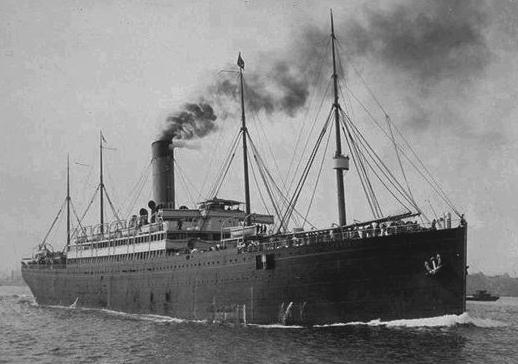
The Record
White Star Line transatlantic liner, New York to Mediterranean, rammed in fog off Nantucket by the Italian liner Florida at 05:40 on 23 January 1909. Wireless operator Jack Binns tapped out the first CQD distress call ever sent at sea; the signal was received at Siasconset and relayed to rescue ships hours before the Republic finally went down. Six dead. The incident turned the wireless into the indispensable safety instrument of the twentieth century.
The Vessel
The RMS Republic was a White Star Line transatlantic passenger liner, built at the Harland & Wolff yard at Belfast between 1902 and 1903 and launched on 26 February 1903. She was 175 metres long, 15,378 gross tons, and powered by twin quadruple-expansion steam engines developing a combined 14,000 horsepower. Her design was a White Star Line "intermediate" liner: a step between the smaller Atlantic steamers of the 1890s and the subsequent Olympic-class superliners of 1911-1914.
She was, at her commissioning in 1903, among the most technologically advanced passenger liners on the North Atlantic. Her accommodation configuration was approximately 225 first-class, 250 second-class, and 2,000 third-class (steerage) passengers, plus a crew of 300. Her commercial operation was the New York to Boston to Mediterranean run: a combination service carrying North American emigrant returns to southern Europe and affluent American tourists to Mediterranean port visits.
Her specific claim to technological distinction was the installation of Marconi wireless telegraphy equipment, among the first passenger liners to carry this then-novel communication technology. In January 1909, Republic's Marconi operator was Jack Binns, 25, a trained Marconi wireless officer. Binns's specific technical competence would prove to be decisive in the subsequent disaster.
Her master on her final voyage was Captain Inman Sealby, 50, an experienced career officer of the White Star Line. Her complement on 23 January 1909 was approximately 742 passengers (primarily first-class and second-class for the Mediterranean cruise itinerary) plus 300 crew; the total was approximately 1,042 aboard.
The Voyage
The RMS Republic departed New York at 15:00 on 22 January 1909 bound for Gibraltar and subsequent Mediterranean ports (Naples, Alexandria, Genoa), with approximately 742 passengers and 300 crew. Her voyage was a winter Mediterranean cruise itinerary, carrying predominantly first-class and second-class passengers for six-week European holidays.
The navigational environment of the North Atlantic approaches to New York in January is notoriously hazardous. Dense fog banks, formed by the meeting of the warm Gulf Stream with the cold Labrador Current, produce visibility conditions of less than 100 metres for extended periods; the southern approaches to New York harbour, specifically the area around Nantucket lightship, are among the busiest transatlantic shipping lanes in the world and have been the location of repeated collisions throughout the age of steam navigation.
At approximately 05:30 on 23 January 1909, Republic was sailing eastward approximately 90 kilometres south of the Nantucket lightship in heavy fog with visibility of less than 50 metres. Her speed had been reduced from her normal cruising speed of 17 knots to 4 knots in accordance with Captain Sealby's standing orders for fog navigation. Her whistle was being sounded at one-minute intervals; her lookouts were at enhanced stations; her compass course was 84 degrees true, heading towards Gibraltar.
Simultaneously, the Italian liner SS Florida of the Lloyd Italiano company was sailing westward in the same sector, approaching New York from Naples with approximately 830 Italian emigrants aboard. Florida's compass course was 266 degrees true, which, had it been accurately steered, would have put her south of Republic's eastward course. However, Florida's navigation had been substantially compromised by a compass malfunction: her helmsman was steering an actual course of approximately 272 degrees, which placed her on a converging track with Republic.
The Disaster
At approximately 05:42 on 23 January 1909, Florida emerged from the fog approximately 400 metres to the starboard bow of Republic, sailing at approximately 15 knots on a converging course. The two ships were on a collision bearing; the closing rate was approximately 35 kilometres per hour.
Captain Sealby of Republic ordered full reverse to the engines and hard left rudder; Captain Angelo Ruspini of Florida similarly ordered emergency engine and rudder manoeuvres. Neither captain had sufficient reaction time to avoid the collision.
At approximately 05:45 on 23 January 1909, SS Florida struck RMS Republic on the port quarter at approximately 4 knots relative impact speed. Florida's reinforced bow penetrated approximately 8 metres into Republic's hull, opening a breach approximately 12 metres long through Republic's port side amidships. The impact location was immediately below the first-class dining saloon; three passengers and three crew members were killed in the collision itself.
The two ships separated after the collision. Florida was substantially damaged at her bow but was not in immediate sinking danger; her bow bulkhead had held, and her forward watertight compartments were flooding but containable. Republic, however, was holed below the waterline and taking on water at a rate that her pumps could not possibly address. The flooding extended through her port-side double-bottom into her engine-room, which began to flood progressively.
The specific and historically-significant response was the Marconi wireless transmission by Jack Binns. Within approximately 15 minutes of the collision, Binns had activated Republic's Marconi equipment and was transmitting the emergency distress call "CQD" (the pre-SOS distress signal). The CQD transmission reached the Marconi shore station at Siasconset, Massachusetts, at approximately 06:00 on 23 January 1909, and from there was relayed to multiple ships in the region including the White Star liner RMS Baltic and the US Revenue Service cutter USS Gresham.
The multi-ship response was coordinated via wireless throughout the subsequent hours. Republic and Florida maintained position in the fog; Baltic and Gresham converged on their location; at approximately 19:30 on 23 January 1909 (approximately 14 hours after the collision), the transfer of 742 passengers from Republic to Florida and thence to Baltic was completed without further loss of life. Republic sank at approximately 20:40 on 24 January 1909 in approximately 65 metres of water, approximately 36 hours after the collision.
The Legacy
The RMS Republic collision of January 1909 was the first major maritime disaster in which wireless telegraphy played a decisive role in preventing catastrophic loss of life. The specific sequence - the CQD distress call from Jack Binns, the reception by the Siasconset shore station, the relay to multiple rescue ships, the coordination of the multi-ship response, and the successful evacuation of the 742 passengers in the 14 hours following the collision - established the operational template that would subsequently be applied (though not always successfully) at every subsequent major maritime disaster of the twentieth century.
The immediate technological consequences were substantial. The US Congress held hearings on wireless telegraphy in ship safety during the spring of 1909; Jack Binns testified before Congress in April 1909. The subsequent Wireless Ship Act of 1910 required all US passenger ships carrying more than 50 passengers on voyages exceeding 200 miles to be equipped with Marconi wireless telegraphy. The international response was the 1912 International Convention for the Safety of Life at Sea (SOLAS), drafted initially in response to the Republic case but adopted in its final form only after the subsequent 1912 Titanic disaster, which established 24-hour wireless watch standards and mandatory distress-signal protocols.
The cultural response was extensive. Jack Binns became an international celebrity; his wireless key from the Republic transmission was preserved as a Marconi Company artefact and is displayed at the American Museum of Natural History, New York. Binns himself emigrated to the United States, wrote an account of the incident (CQD: The Account of the Rescue, 1909), and remained a public advocate for wireless safety standards through the 1920s.
The wreck of RMS Republic was located in 1981 by the American ocean search expedition of Captain Martin Bayerle. The wreck lies at approximately 80 metres depth south of Nantucket lightship. Subsequent salvage operations through the 1980s and 1990s recovered a substantial portion of the ship's fittings and a quantity of gold specie that had allegedly been aboard (the so-called "Republic gold" story is substantially disputed by archaeological researchers). The wreck is protected under the US Abandoned Shipwreck Act of 1987. The six dead from the initial collision are commemorated by a memorial plaque at the Marconi Wireless Historical Site, Siasconset, Massachusetts.