The Record
Philippine ferry, certified for 1,518, carrying at least 4,400 passengers home for Christmas. Collided with the oil tanker MT Vector in the Tablas Strait on 20 December 1987. Both vessels burst into flames. 24 survivors. Three times the Titanic's death toll, almost entirely unknown in the West. Most of the dead were never counted by name.
The Vessel
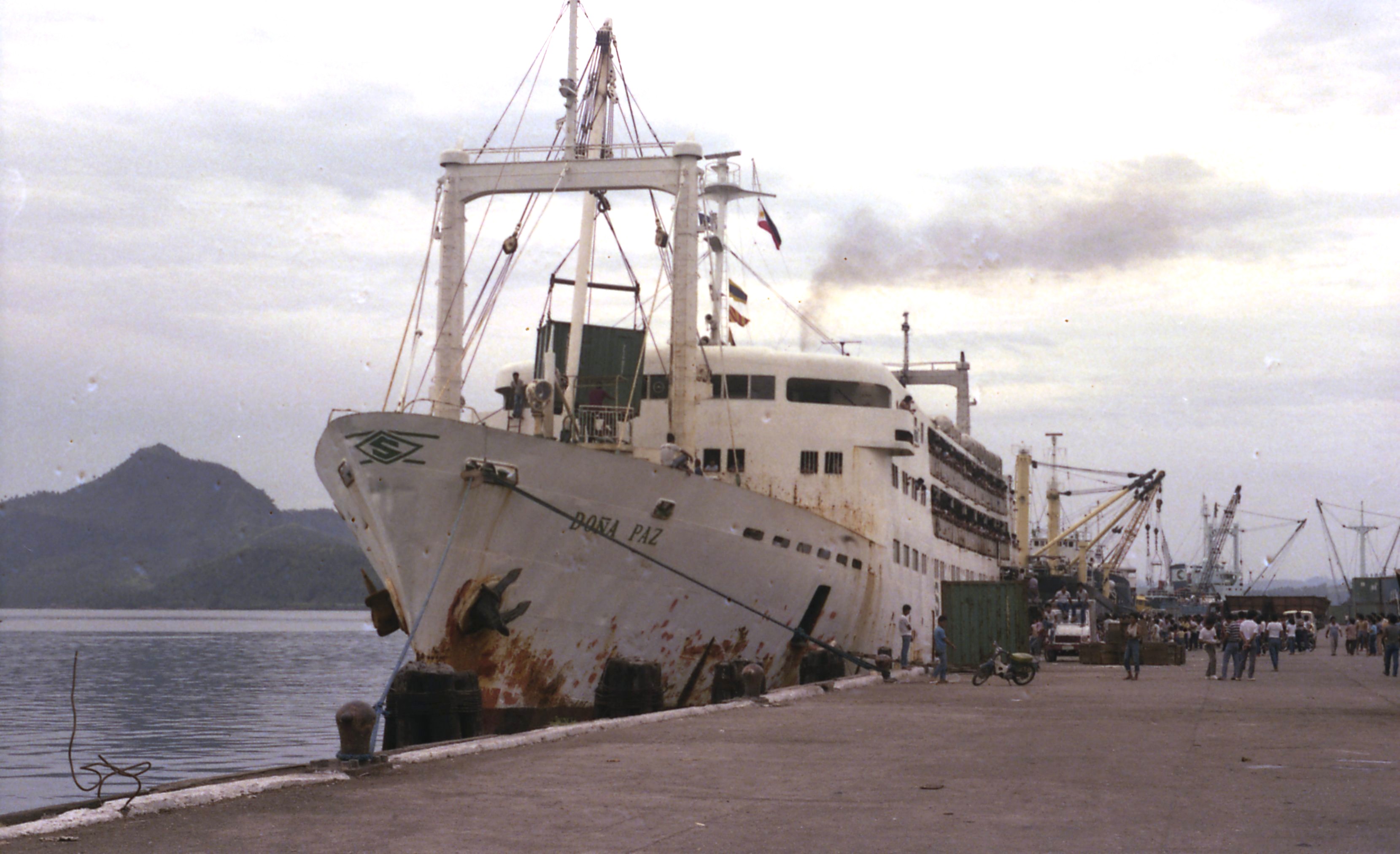
The MV Doña Paz was a Japanese-built passenger ferry, 2,215 gross tons, 93 metres long, originally launched in 1963 as the Himeyuri Maru for the Japanese domestic ferry trade between Kagoshima and Okinawa. She was sold in 1975 to the Philippine interisland operator Sulpicio Lines, renamed Don Sulpicio, and worked the Manila-Cebu route until a fire damaged her in a port incident in 1979. She was rebuilt and returned to service in 1981 under the name Doña Paz.
Her certified passenger capacity after the 1981 rebuild was 1,518, a figure agreed with the Philippine Coast Guard and published on her bridge ticket. Her actual carrying capacity at any given voyage was larger, because Philippine interisland practice allowed tickets to be sold on deck and in passageway space, and because infant passengers did not count toward the manifest limit. She was typically operated at between 1,800 and 2,500 aboard, depending on the season.
The Sulpicio Lines fleet of which she was the flagship had a long record of regulatory violations, fires, and strandings; the Philippine Coast Guard had cited the line for manning, lifeboat, and certification failures in every year since 1979. None of these citations had resulted in the cancellation of her certificate. The Philippine ferry industry in the 1980s was the most lightly regulated major passenger-carrying maritime sector in the world.
The Voyage
She left Tacloban, Leyte, at 06:30 on 20 December 1987 on her regular overnight Christmas run to Manila, carrying workers returning home for the holidays. Her published manifest listed 1,518 passengers and 58 crew. Her actual complement, reconstructed by the subsequent inquiry from survivor testimony, family petitions, and Sulpicio Lines' post-disaster list of claimants, was between 4,000 and 4,500, the overwhelming majority of them deck and passageway passengers without assigned berths.
Passing her in the opposite direction, outbound from Bataan to Masbate in the Tablas Strait, was the MT Vector, a Filipino-owned chartered oil tanker carrying 8,800 barrels of kerosene, gasoline, and diesel fuel for the Caltex distribution depot at Masbate. The Vector had no valid certificate of inspection, her license had expired in October, her master had no valid license, and she was carrying a crew of thirteen none of whom had the qualifications for a tanker of her size. She was also, the subsequent inquiry established, unseaworthy: her rudder and steering gear were partially inoperative.
At approximately 22:30 on 20 December 1987, in the Tablas Strait roughly 180 nautical miles south of Manila, the two ships collided. The Vector's cargo ignited on impact. Both ships were enveloped in flaming petroleum within seconds.
The Disaster
The Doña Paz burned and sank within two hours. The Vector burned longer and sank at around 02:30 on 21 December. The sea surface around both ships burned for most of the night on a sheet of flaming kerosene and gasoline, fed by the Vector's ruptured cargo tanks. The water of the Tablas Strait that night was shark-infested, as the area has long been known to be; the survivors who jumped from the ferry's rails into water that was already on fire had first to clear the burning layer and then to swim in water where survivors were being taken.
24 of the Doña Paz's passengers and two of the Vector's crew were rescued by the passing Philippine ship Don Claudio at dawn on 21 December. No other survivors were recovered. 4,386 people died, by the final count accepted by the Philippine Board of Marine Inquiry; this is the figure preserved on the official marker. Outside analysts, survivor advocacy groups, and independent researchers have argued that the true toll was between 4,500 and 5,000, based on the fact that the Sulpicio Lines manifest was known to exclude at least 700 non-ticketed passengers and that no complete manifest of deck passengers was ever produced.
The Doña Paz herself came to rest at 545 metres, in deep abyssal water, and has never been located.
The Legacy
The Doña Paz is the deadliest peacetime maritime disaster in history, three times the death toll of the Titanic, exceeded only in wartime by the Wilhelm Gustloff, Goya, Cap Arcona, and Junyo Maru. Her toll alone exceeds the combined civilian maritime dead of every North Atlantic sinking of the twentieth century.
The Philippine Board of Marine Inquiry placed primary fault on the Vector for sailing without valid certificates and for her unseaworthy condition; the Sulpicio Lines was faulted for overloading and for inadequate lifeboat provisioning. The Philippine Supreme Court ruled in 1990 that the Vector's owner was jointly liable with Sulpicio for damages. Neither company had insurance adequate to cover the claims. Sulpicio Lines continued to operate and would lose two more ferries to mass-casualty events (Doña Marilyn 1988, Princess of the Orient 1998, Princess of the Stars 2008) before being stripped of its passenger license in 2011.
International press coverage at the time was almost nonexistent. The New York Times gave the story 180 words on page A-6 in the 24 December 1987 edition; The Washington Post did not run the story at all. The deadliest peacetime maritime disaster in human history was, in the Western press, a minor Christmas-week wire item. Filipino historians have argued that the Western silence reflects a broader pattern of Southeast Asian maritime disasters treated as unworthy of attention by the international news cycle; this is not a disputed characterisation.
The Doña Paz has no national monument in the Philippines. There is no marker at her wreck site because her wreck site has never been pinned. The Sulpicio Lines maintained a private memorial at its Manila terminal until the line ceased operations. The passengers' families continue to press for an accurate final count. Most of the 4,386 confirmed dead were never counted by name; that is the most persistent fact of her history.