The Record
Sir John Franklin's expedition to find the Northwest Passage vanished with all hands. Inuit testimony of cannibalism among the final survivors was dismissed by Victorian society and vindicated by 20th-century forensic archaeology. The ships themselves were not found until the 2010s, exactly where the Inuit had always said they were.
The Vessel
HMS Erebus and HMS Terror were Hecla-class bomb vessels of the Royal Navy, small three-masted ships built originally in the Napoleonic era to carry mortars for shore bombardment. Terror was laid down at Topsham in 1813; Erebus at Pembroke Dockyard in 1826. Their mortars had been removed in the 1830s and their hulls strengthened for polar work: their bows were reinforced with iron plating, their internal frames doubled, their keels braced against ice pressure. They had been built thickly enough in the first place to absorb the recoil of twelve-inch mortars, which made them some of the strongest small ships the Royal Navy had ever built.
Both ships had circumnavigated Antarctica under James Clark Ross between 1839 and 1843 and had proved their ice-worthiness in conditions harder than any they were likely to see in the Arctic. On their refit for the 1845 Arctic expedition, they were fitted with 20-horsepower steam engines adapted from London and Greenwich Railway locomotives, coupled to screw propellers that could be lifted clear of the ice. Each ship carried three years of provisions, tinned meat from the contractor Stephan Goldner, and the finest ice-capable hulls the Royal Navy had produced.
The expedition was to be commanded by Sir John Franklin, 59 years old, a veteran of Trafalgar and of two previous Arctic expeditions, recently returned from a six-year governorship of Van Diemen's Land. His second-in-command was Francis Crozier in Terror; his first officer in Erebus was James Fitzjames. The expedition's purpose, as the Admiralty defined it in a secret sailing order of 5 May 1845, was the completion of the Northwest Passage: the remaining 480 kilometres of unsurveyed Arctic channel between the eastern entrance at Lancaster Sound and the western mouth of the Bering Strait.
The Voyage
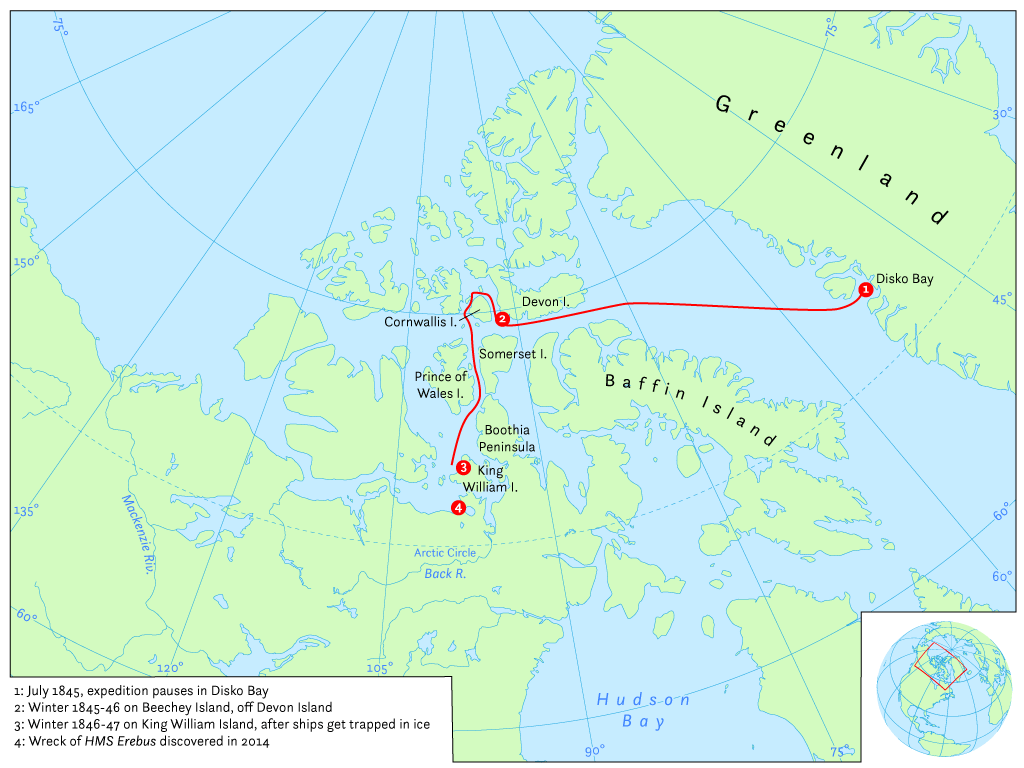
Erebus and Terror left Greenhithe on 19 May 1845 with 129 men aboard. They provisioned at Stromness in the Orkneys, called at the Whalefish Islands off western Greenland in July, and were last seen by European eyes on 26 July 1845 by the whaling captains Robert Martin and Henry Dannett, who encountered them moored to an iceberg in Baffin Bay waiting for pack ice to clear from Lancaster Sound.
They entered Lancaster Sound that August. They wintered 1845-46 at Beechey Island, where a stone cairn over three graves (John Torrington, John Hartnell, and Private William Braine, all dead by January 1846) would be found by search expeditions in 1850. In August 1846 they passed through Peel Sound and into Victoria Strait, and became beset by heavy multi-year ice off the northwest coast of King William Island on about 12 September 1846. They did not move again.
Franklin died on 11 June 1847, aged 61, probably of tuberculosis; his death was recorded in a note left in a cairn at Point Victory by the survivors in April 1848. By that date, 23 men had died. The remaining 105, under Crozier and Fitzjames, abandoned the two ships and began a march south across King William Island with boats on sledges, intending to reach the Back River and from there the Hudson's Bay Company posts at Great Slave Lake. None of them survived the march.
The Disaster
The details of the march and deaths of Franklin's 105 were reconstructed piecewise across 150 years from Inuit oral testimony, scattered skeletal remains, the 1854 report of the Hudson's Bay surveyor John Rae, and the forensic archaeology of the late twentieth century. The party walked south for perhaps 300 kilometres before it broke apart, leaving small groups to die on the island and on the mainland opposite. Lead poisoning from the solder of Goldner's tinned provisions, scurvy from insufficient vitamin C, tuberculosis, pneumonia, and exposure were the principal causes. Inuit witnesses reported to Rae in 1854 that the final survivors had been reduced to cannibalism. Rae's report was attacked by Dickens and the Royal Navy establishment as slander; modern forensic analysis of cut marks on recovered bones has vindicated Rae.
Lady Franklin, her husband's widow, funded a decade of search expeditions between 1847 and 1857 that mapped most of the Canadian Arctic in the process of failing to recover her husband's body. Her 1857 Fox expedition under Leopold McClintock found the Point Victory cairn with its 1848 note, Franklin's death record, and the tracks of the southward march. The expedition became the model and the recruiting device for most of the great polar explorations of the next half-century.
The ships themselves, abandoned on the ice, drifted south with the pack. Inuit witnesses reported to McClintock, Charles Francis Hall, and Frederick Schwatka between 1857 and 1880 that one of the ships had been reboarded by some of Crozier's men and sailed south into Queen Maud Gulf before finally sinking; the other had been crushed in the ice off the Royal Geographical Society Islands. Where either ship actually came to rest remained unknown for 166 years.
The Legacy
The Canadian Arctic search for the wrecks of the Franklin expedition became, across the late twentieth century, one of the most widely publicised archaeological quests in the world. The Canadian government placed the remaining 1845-48 search area under the legal protection of the Department of Fisheries and Oceans in 1992. Parks Canada formally took over the search in 2008 under the leadership of Ryan Harris and the inter-agency Partnership Working Group, which included the Government of Nunavut and Inuit heritage groups.
On 2 September 2014 a Parks Canada team led by Harris located HMS Erebus in eleven metres of water off Wilmot and Crampton Bay, Queen Maud Gulf, exactly where the Inuit witness Puhtoorak had told Hall she sank in 1867. On 3 September 2016 a survey team from the Arctic Research Foundation, acting on a tip from Inuit ranger Sammy Kogvik, located HMS Terror in 24 metres of water in Terror Bay, King William Island. Both sites are now protected national historic sites of Canada, co-managed by Parks Canada and the Inuit Heritage Trust.
The Franklin expedition is the most thoroughly examined failed polar expedition in history. The lead-poisoning theory, the Goldner-tin hypothesis, the scurvy reconstruction, and the Inuit oral-history corroboration have all been supported by forensic work on recovered remains and on the wrecks themselves. The bodies of Torrington, Hartnell, and Braine at Beechey Island were exhumed in 1984 and 1986; their analyses gave the lead-poisoning evidence its forensic basis.
The Inuit of King William Island and the adjacent mainland had been reporting the wreck locations continuously since 1854. None of their testimony had been believed by the Royal Navy or the British press of the nineteenth century. The two discoveries of 2014 and 2016 were, in Canadian Inuit heritage terms, simply the vindication of what Inuit witnesses had always said. This is now the official Canadian historical account: the Inuit had been right.