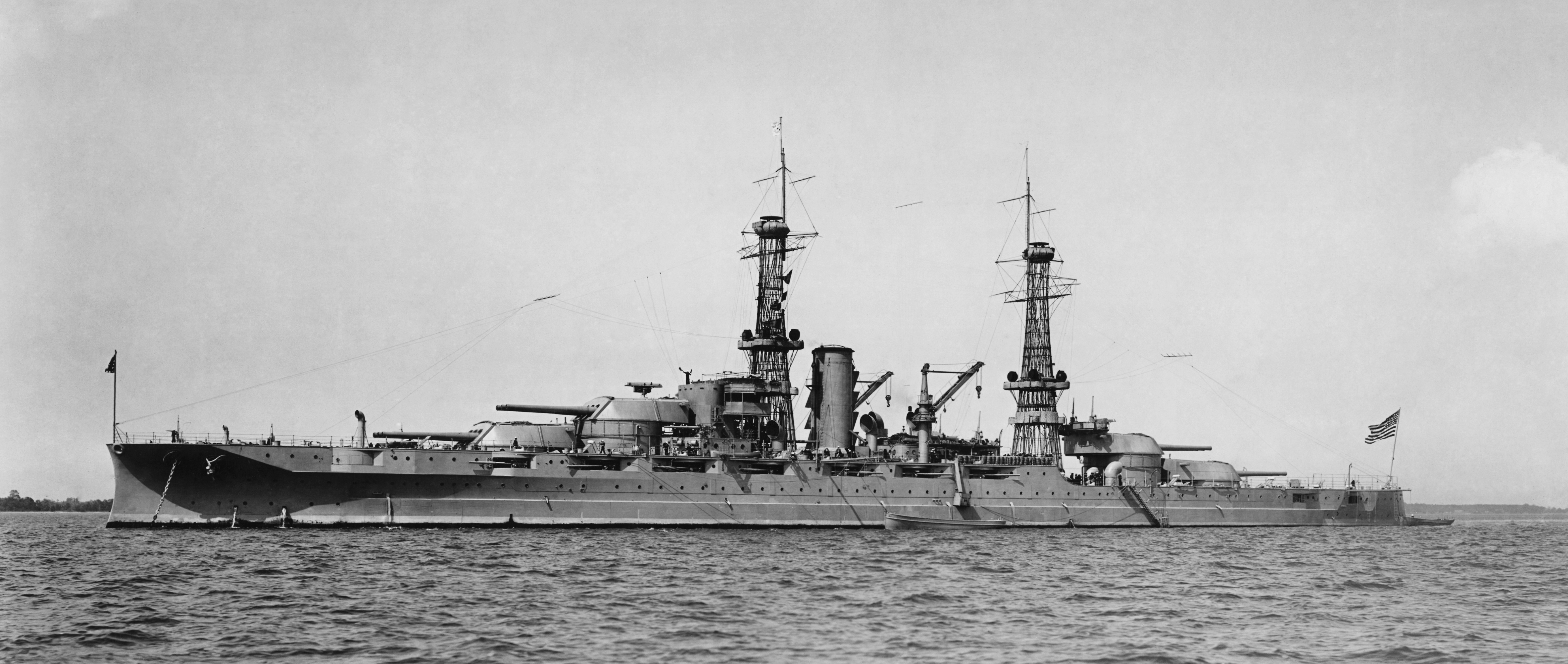
The Record
Pennsylvania-class battleship, moored on Battleship Row alongside Ford Island. A Japanese armor-piercing bomb detonated her forward magazine at 08:06 on 7 December 1941; she sank in under nine minutes. 1,177 dead, nearly half the American casualties of the day. Still seeping oil into the harbor eight decades on, beneath the white memorial that spans her submerged hull.
The Vessel
The USS Arizona was a Pennsylvania-class super-dreadnought of the United States Navy, commissioned at the New York Navy Yard on 17 October 1916. At 31,400 tons and 185 metres long she carried twelve 14-inch guns in four triple turrets, a main battery characteristic of the generation of American battleships that followed Oklahoma and preceded Colorado. She served for a quarter-century in the Atlantic and Pacific fleets and was the flagship of Battleship Division 1 in the Pacific from 1940.
By late 1941 she had been in Pearl Harbor for the better part of the year. Her captain was Franklin van Valkenburgh; her admiral was Isaac C. Kidd, commanding Battleship Division 1 from her flag bridge. Her crew numbered 1,511, including a brass band of twenty-one musicians who had placed second in the annual Battle of Music tournament the previous evening and were scheduled to play again on the morning of 7 December. Most of the crew had returned to the ship on Saturday evening; the morning watch was drinking coffee on the forecastle when the Japanese aircraft came over the Waianae range at 07:55 on the 7th.
She was moored on the inboard side of Berth F-7, on Battleship Row, with the repair ship Vestal alongside her outboard side and the battleships Nevada, Oklahoma, Maryland, Tennessee, West Virginia, and California arrayed along the rest of the row. She was among the first ships hit.
The Voyage
The attack on Pearl Harbor was launched from six Japanese aircraft carriers positioned 380 kilometres north of Oahu. The first wave of 183 aircraft crossed the coast at 07:48 and reached Battleship Row at 07:55. The torpedo bombers attacked the outboard battleships and the dive bombers and level bombers attacked the inboard ones. The Arizona, protected from torpedo runs by Vestal, became a target for the Nakajima B5N high-altitude level bombers carrying 800-kilo armour-piercing bombs converted from 356 mm naval shells.
At 08:06 on 7 December 1941, one of these bombs struck the forward deck between Turret II and the forward magazine. It penetrated the armoured deck at an angle consistent with a drop from 3,000 metres and detonated either inside or immediately adjacent to the forward magazine.
The resulting explosion was catastrophic by any measure. A million pounds of smokeless powder ignited in a thousandth of a second. Turret I was lifted clear of the ship. The forward superstructure and bridge collapsed forward into the crater. The bow broke free. A fireball rose 150 metres. Admiral Kidd was in the conning tower; Captain van Valkenburgh was on the bridge; both died instantly.
The Disaster
She sank in nine minutes. Her forward magazines had consumed the bow; her after boilers flooded within minutes as she settled onto the shallow harbour bottom. The fires burned for two and a half days, fed by fuel oil from her own tanks and from West Virginia's nearby. The shock of her magazine detonation had battered the repair ship Vestal alongside and set the inboard side of the Tennessee on fire.
1,177 men died aboard her, nearly half of the American dead of the entire Pearl Harbor attack. 335 survived. Whole gun crews, the band, the ship's marines, the officers at breakfast in the wardroom, the deck divisions at colours, the engine rooms that never knew what had happened: the Arizona's losses were the worst single-ship loss of life in the history of the United States Navy to that date, and remain so to this day.
Of the 1,177 dead, 337 were recovered in the days and weeks following the attack. The remaining 900 or so are still aboard her, sealed in the compartments that flooded and never drained. In the decades since, survivors of the ship have requested on their deaths to be interred with their shipmates; the Navy has accommodated this, placing the cremated remains of dozens of survivors inside the wreck at dive-accessible compartments.
The Legacy
The President's address to Congress on the following afternoon, 8 December 1941, named the date as one that "will live in infamy" and secured the unanimous vote for war with Japan that brought the United States fully into the Second World War. The Arizona never fired a shot in that war; she was, from the first hour of American participation, already on the bottom.
She was not salvaged. The Navy considered raising her through 1942 and concluded that her damage was beyond economical repair and that her removal would delay the rest of the harbour's work. Her guns, fuel, ammunition, and several superstructure sections were removed and used elsewhere; her mainmast went to the Arizona state capitol in Phoenix. The rest of her has remained on the harbour floor at Berth F-7 for over eight decades.
The USS Arizona Memorial, designed by the Austrian-American architect Alfred Preis and completed in 1962, is a 57-metre concrete and steel structure suspended above her wreck at right angles to her hull, without touching it. A marble wall at the far end bears the names of the 1,177 dead. Visitors reach the memorial by Navy launch from a visitor centre on the shore of Ford Island.
She still seeps oil. Between two and nine litres a day rise through her plating from the fuel bunkers that had been topped up on the Friday morning before the attack: visible as an iridescent sheen on the water directly beneath the memorial. Park rangers call them the "black tears". She is expected to leak for at least another seventy years. The Navy's 1983 structural study of her hull concluded that she would hold together for longer than that, and that any attempt to drain her remaining fuel would risk her collapse.
She is the most-visited war grave in the world, approximately 1.8 million visitors annually. Of the surviving crew, the last living USS Arizona sailor, Lou Conter, died in 2024 at the age of 102. The ship now belongs entirely to her own dead and to the visitors who come, in silence, to stand above them.