The Record
Torpedoed by U-20 off the Old Head of Kinsale. A secondary explosion sank her in 18 minutes. 128 of the dead were American civilians. The sinking hardened U.S. opinion against Germany and pushed Washington toward intervention two years later. The secondary-explosion cause remains disputed to this day.
The Vessel
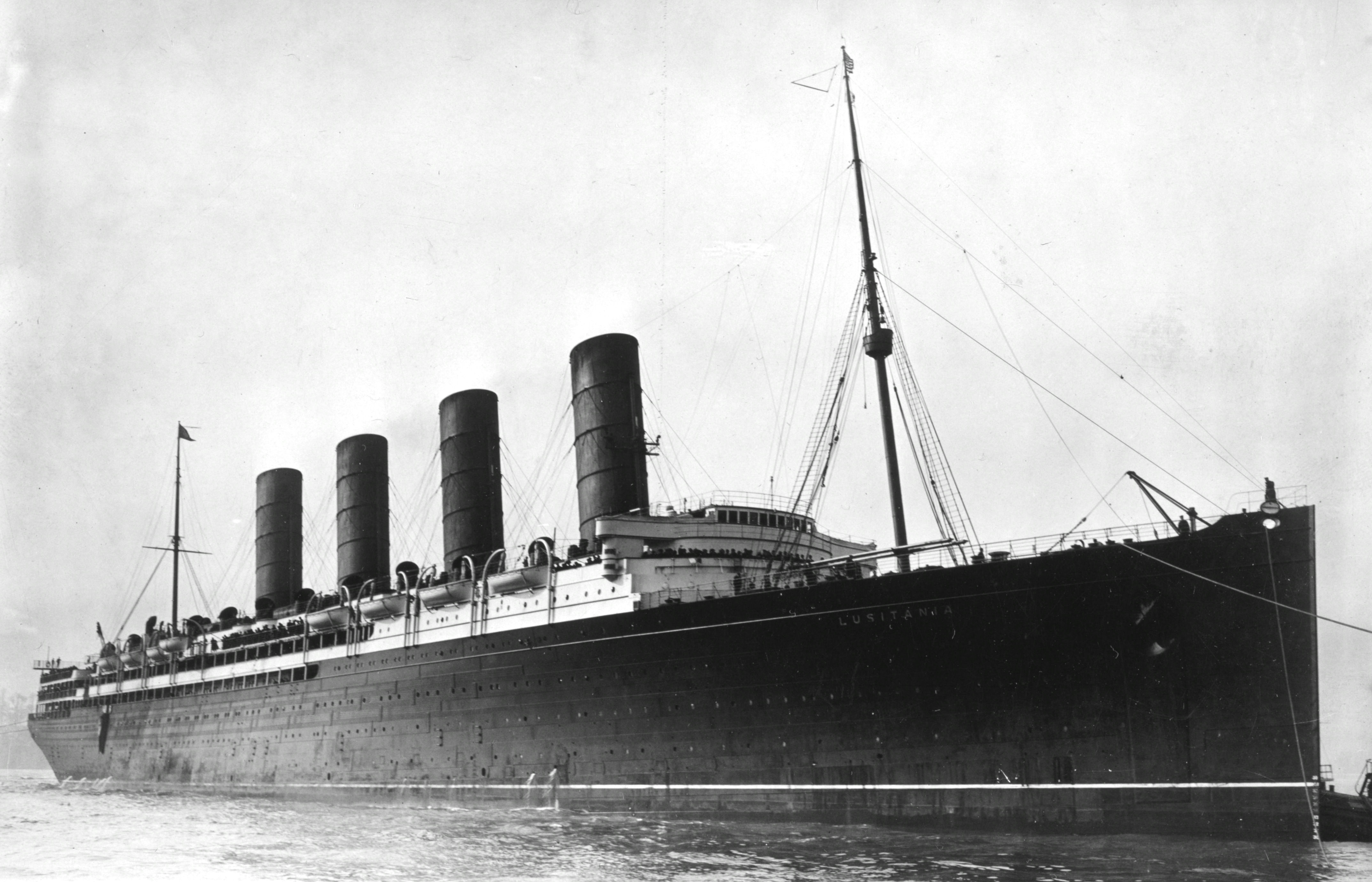
The RMS Lusitania was a Cunard Line transatlantic liner, 239 metres long and 31,550 tons, built by John Brown and Company at Clydebank and entered into service in September 1907. She and her sister Mauretania were the response to North German Lloyd's challenge for the Atlantic speed record; both were subsidised by the British Admiralty under a 1903 agreement that allowed her requisition as an auxiliary cruiser in wartime.
She was the first quadruple-screw liner of her size and the first to use Parsons direct-drive steam turbines at transatlantic scale, producing a service speed of 25 knots with reserve to 27. She took the Blue Riband on her second westbound voyage in October 1907 and held it against all challengers for five years. Her design was publicly Cunard's commercial flagship; her design drawings, held at the Admiralty, also identified her as a vessel whose hold subdivision and coaling arrangements permitted rapid conversion to a warship.
By 1915 she was the only major transatlantic liner still maintaining her Liverpool-New York schedule. The Cunard board had kept her in service over the protest of her master, Captain William Turner, who had argued through 1914 that the speed advantage that had justified her subsidy no longer compensated for the U-boat risk. Her last voyage out of New York was announced for 1 May 1915 in the same newspaper page that carried the Imperial German Embassy's notice warning that any vessel flying the British flag in the declared war zone around the British Isles was liable to destruction.
The Voyage
She left Pier 54 in New York at 12:30 on 1 May 1915 with 1,959 aboard: 1,265 passengers and 694 crew. 189 of the passengers were American citizens, a statistic the German embassy warning had calculated into its text and a statistic the Cunard agents had calculated against it. Among them were the theatrical producer Charles Frohman, the millionaire Alfred Vanderbilt, the American fashion designer Carrie Kennedy, the wine merchant George Kessler, and the philosopher and writer Elbert Hubbard.
Her cargo manifest, the subject of a century of litigation and research, listed 4.2 million rounds of .303 small-arms ammunition, 1,250 cases of three-inch shrapnel shells (unfuzed), and some 3,000 percussion fuses, all declared to American port authorities and all permitted under the neutrality laws then in force. She also carried several thousand cases of butter, cheese, copper ingots, and aluminium powder bound for the Liverpool markets. None of this was officially contraband under Cunard's prevailing interpretation of the law, and all of it was listed on her public shipping papers.
Turner had received Admiralty instructions before sailing to zigzag in the war zone, to maintain full speed, and to avoid the headlands. On the afternoon of 7 May 1915 he elected to reduce speed to 18 knots in an Irish Sea fog and to steer a straight course toward the Old Head of Kinsale. His reasoning, given in evidence to the subsequent inquiry, was that the fog made the Celtic Sea lighthouse unreliable and that he wished to fix his position by sighting the headland. The U-boat he did not know was there was also preparing for the same afternoon.
The Disaster
U-20 under Kapitänleutnant Walther Schwieger had been working the western approaches for ten days and had sunk three ships already. At 14:10 on 7 May she fired a single G6 torpedo from 700 metres. It struck the Lusitania's starboard bow just abaft the bridge.
A second, much larger explosion followed perhaps fifteen seconds later. The nature of the second explosion has been the central controversy of the sinking ever since. Contemporary theories have ranged from a coal-dust explosion in her partly-empty starboard bunkers (the explanation favoured by the 1993 Ballard expedition), to a boiler rupture (favoured by the original British inquiry), to a detonation of the small-arms ammunition in her forward hold (favoured by German propaganda and, in subsequent decades, by several independent researchers).
The effect of the second explosion was catastrophic. The list to starboard was immediate and increased through the eighteen minutes she remained afloat. The port lifeboats could not be launched because they swung inboard against the hull; the starboard boats swung so far out that loading them from the deck was impossible for most passengers. Of 48 boats aboard, six launched successfully. She sank bow-first in 18 minutes, a list so sharp that her masts were underwater before her stern left the surface. 1,198 of the 1,959 aboard died, 128 of them Americans. Turner survived; Frohman, Vanderbilt, Hubbard, and Kessler did not.
The Legacy
The Wilson administration's response was three diplomatic notes over three weeks; the third was sharp enough that Secretary of State William Jennings Bryan resigned in protest rather than sign it. Wilhelm II ordered his U-boats to avoid sinking passenger liners without warning for the rest of 1915 and through most of 1916. The decision to resume unrestricted submarine warfare in February 1917, taken against the Kaiser's civilian advisers, was the proximate cause of the American declaration of war against Germany two months later. The Lusitania's loss is widely taught as the event that pushed the United States into the First World War, though the actual mechanism was more circuitous: she was remembered in April 1917 because her dead had not been forgotten.
The British Mersey inquiry of 1915 exonerated Turner, criticised German submarine doctrine, and sealed its most sensitive evidence for a century. The American Mayer inquiry of 1918, which heard from survivors, reached similar conclusions. Neither inquiry satisfied the conspiracy theorists who have continued to argue that the Admiralty deliberately exposed the Lusitania to attack in hopes of provoking American entry, a charge for which no contemporary documentary evidence has ever emerged and which the 2014 release of the sealed Mersey papers did not substantiate.
The wreck was located by Commander Frank Herald of the Royal Navy in 1935 and repeatedly photographed since. Robert Ballard's 1993 expedition documented her condition at 93 metres: lying on her starboard side, the hull plates torn open forward of the bridge where the torpedo struck, the coal bunkers vented. The site is a protected grave under Irish law, owned since 1968 by the American entrepreneur Gregg Bemis, who fought for decades in Irish courts for salvage rights and died in 2020 without succeeding. She remains where she went down. The secondary explosion has never been definitively explained, and at this distance of time almost certainly never will be.