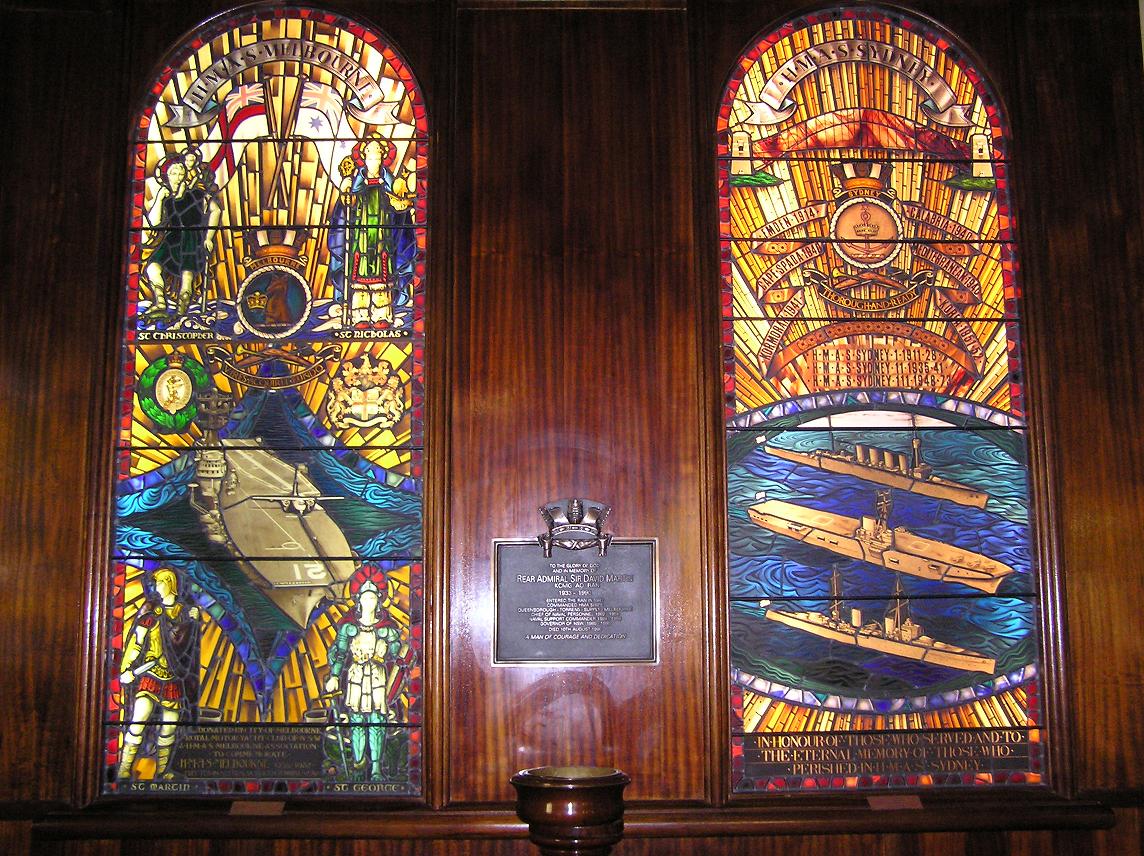
The Record
Royal Australian Navy light cruiser, intercepting what she took to be a Dutch merchantman off Western Australia on the afternoon of 19 November 1941. The 'merchantman' was the disguised German auxiliary cruiser Kormoran. Both ships opened fire at close range; Sydney's bridge and turret magazines were destroyed in seconds. Both ships were mortally damaged; Sydney was not seen again, lost with all 645 aboard. Her wreck was located in 2008 by David Mearns at 2,468 metres, 22 kilometres from the Kormoran.
The Vessel
HMAS Sydney (D48) was a modified Leander-class light cruiser of the Royal Australian Navy, commissioned at Portsmouth on 24 September 1935 and transferred to Australia on 4 August 1936. She was 170 metres long, 6,830 tons standard displacement, armed with eight 6-inch guns in four twin turrets, four 4-inch anti-aircraft guns, and eight 21-inch torpedo tubes in two quadruple mountings. Her designed speed was 32.5 knots on four-shaft Parsons geared turbines.
The modified Leander-class differed from her British sisters principally in propulsion machinery arrangement: her boiler rooms and engine rooms were separated by fore-and-aft subdivision to improve damage survivability, an Australian improvement that would prove critical to her war service. She was the second ship of her name in the Royal Australian Navy, her predecessor having been the light cruiser HMAS Sydney (II) that had sunk the German raider SMS Emden at the Cocos Islands in 1914.
Her Second World War service was distinguished. Under Captain John Collins she had engaged and sunk the Italian light cruiser Bartolomeo Colleoni at the Battle of Cape Spada on 19 July 1940 in one of the opening Royal Navy victories of the Mediterranean campaign. She had escorted the Australian Second Division to North Africa, had participated in the Syrian campaign, and had returned to Australian waters in February 1941 as the most celebrated warship in the Royal Australian Navy. Her new commanding officer from May 1941 was Captain Joseph Burnett, a 42-year-old Naval College graduate.
The Voyage
On 11 November 1941 Sydney departed Fremantle on a routine escort of the troop transport Zealandia to the Sunda Strait; she parted company with Zealandia on 17 November and turned south to return to Fremantle. She was approximately 200 kilometres southwest of Carnarvon, Western Australia, on the afternoon of 19 November 1941, steaming south at 14 knots on a calm sea.
At 16:00 on 19 November Sydney's lookout sighted a single merchant ship on the horizon steering a course that would cross hers at a range of approximately 11 kilometres. The merchant ship, which appeared to be a Dutch freighter, flew the Netherlands flag and hoisted international signals identifying herself as the MV Straat Malakka. Sydney closed the range to investigate, in accordance with Royal Australian Navy standing orders for unidentified merchant vessels in Australian coastal waters.
The ship was not the Straat Malakka. She was the German auxiliary cruiser Kormoran, commanded by Fregattenkapitän Theodor Detmers, 39 years old, a veteran German naval officer and the most successful commerce raider of the Kriegsmarine. Kormoran had been operating under the Straat Malakka disguise for three months; she carried 150 mines, 400 torpedoes, six 5.9-inch guns (concealed in false cargo hatches), and a crew of 393 including a Luftwaffe aircraft and pilot. She had already sunk 11 Allied merchant ships since leaving Germany in December 1940.
The Disaster
Captain Burnett closed Sydney to 1,300 metres from the supposed Straat Malakka in an attempt to positively identify her through the international signal code. At this range, the two ships were within point-blank gunnery range of each other. Detmers, now unable to maintain his disguise at such short range, unmasked Kormoran's armament at 17:30 and opened fire simultaneously.
Kormoran's concealed 5.9-inch guns and her torpedo tubes were fired essentially at the same moment as Sydney's main battery. The first two Kormoran salvos struck Sydney's bridge, director control tower, and main signal-flag arrangement; Captain Burnett was killed on the bridge, and the senior gunnery officers were killed in the director tower. Sydney was, within the first thirty seconds of the engagement, effectively decapitated.
The subsequent action lasted approximately 30 minutes. Sydney fought back from her surviving turrets and hit Kormoran repeatedly with 6-inch shells that ignited the German raider's oil tanks and her torpedo magazine. Kormoran was burning and was mortally damaged by approximately 18:00. Sydney, listing heavily to port from the torpedo hits and with uncontrolled fires forward, turned away southeast at 18:05 and disappeared into the gathering dusk with a visible fire still burning.
Both ships sank on the night of 19-20 November 1941. Kormoran was scuttled by Detmers at approximately 00:30 on 20 November after her crew abandoned her in her intact lifeboats. 318 of Kormoran's 393 crew survived; they were rescued over the following five days by British and Australian vessels alerted by their reports of the engagement.
Sydney was never seen again. All 645 of her crew perished.
The Legacy
The Australian inquiry into the loss of Sydney, conducted in November 1941 and December 1941 through sworn examination of the Kormoran survivors held in Australian POW camps, was the only source of information about the engagement for the following 66 years. The German survivors' testimony was consistent across multiple separate examinations: Sydney had been surprised by the short-range ambush, had been decapitated by the first minutes of gunfire, and had limped away on fire toward the southeast. The German testimony was controversial in Australia through the 1940s and 1950s, partly on the grounds that the Sydney had been a more capable warship than Kormoran and should have been able to destroy the raider more decisively; the alternative theory, that Kormoran had been aided by a Japanese submarine, circulated in Australian public discourse for decades without ever being substantiated.
The mystery of Sydney's exact location was resolved on 17 March 2008 by the Finding Sydney Foundation, an Australian private-public partnership led by the David Mearns expedition team. Using records from the 1941 Kormoran survivor testimony and modern ocean-floor modelling, Mearns's survey located the Kormoran wreck at 2,560 metres depth, 180 nautical miles west of Carnarvon. Five days later, on 22 March 2008, the same expedition located the Sydney wreck at 2,468 metres depth, 22 kilometres east-southeast of the Kormoran wreck. The relative positions confirmed the German testimony of 1941: Sydney had fought Kormoran and had then proceeded east-southeast before sinking.
The 2008 visual survey of the Sydney wreck confirmed the damage pattern described by the Kormoran survivors. The forward superstructure and bridge were destroyed; the after deck was largely intact; the cruiser's hull below the waterline showed two torpedo impacts on her port side. The wreck is intact and upright, resting on her keel on a sandy bottom, with her forward turrets still trained in the direction of Kormoran's wreck.
The 645 dead of HMAS Sydney are commemorated at the HMAS Sydney II Memorial in Geraldton, Western Australia, a 30-metre concrete dome of 645 stainless-steel seagulls arranged above a black granite wall bearing their names. The memorial, designed by Charles Smith and Joan Walsh-Smith, was unveiled on 18 November 2001, sixty years after the ship's loss. HMAS Sydney (II) remains the worst single-ship loss of life in Australian military history. The successor ship HMAS Sydney (III) served in the Pacific War, the Korean War, and Vietnam; HMAS Sydney (IV) is currently in Royal Australian Navy service.