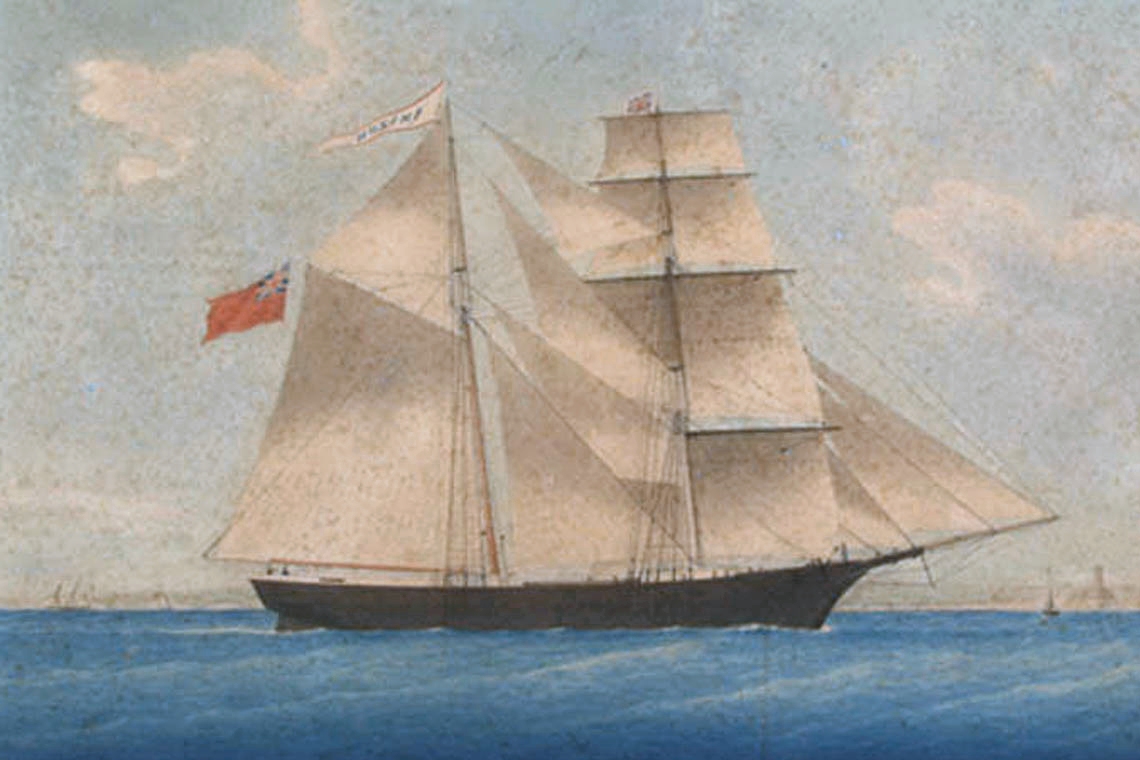
The Record
American brigantine, Staten Island to Genoa with 1,701 barrels of denatured alcohol. Discovered 600 miles west of Portugal on 4 December 1872, sailing under reduced canvas with nobody aboard. The captain, his wife, their two-year-old daughter, and seven crew had vanished from the ship with her boat; no trace of them was ever found. The most durable theory is a feared alcohol-vapour explosion that drove them into the lifeboat, which was then lost in tow.
The Vessel
The Mary Celeste was a hermaphrodite brig (brigantine) built at Spencer's Island, Nova Scotia, in 1861, originally named Amazon. She was 30 metres long, 282 gross tons, with a pine-planked hull on oak frames and a small deckhouse forward of the mizzen mast. She was a middling vessel of the type and size that characterised the Maritime Canadian trade of the 1860s and 1870s: one principal cargo hold, a crew of eight, a master's cabin aft, a deckhouse forward for the mate and crew.
Her early career was unlucky. Her first master died on her maiden voyage. She ran aground twice, was salvaged, was sold through five successive owners between 1867 and 1869, and was bought at a U.S. admiralty auction in October 1872 by a consortium of New York merchants who had her renamed and registered as an American-flag vessel. Her new master was Captain Benjamin Spooner Briggs, 37 years old, a fifth-generation New England mariner from Marion, Massachusetts, with a reputation for a careful approach to weather and a teetotal ship.
Briggs held a partial ownership stake in her. In November 1872 he loaded her at the Hunter's Point terminal in Brooklyn with 1,701 barrels of denatured industrial alcohol consigned to H. Mascaranhas and Sons of Genoa. The alcohol was for the fortification of vermouth and for the Italian perfume industry; it was a commercial cargo of moderate value but was highly volatile. She sailed on 7 November 1872 with Captain Briggs; his wife Sarah; their two-year-old daughter Sophia; and a crew of seven consisting of first mate Albert Richardson, second mate Andrew Gilling, cook Edward Head, and four German seamen. There were ten people aboard.
The Voyage
The weather out of New York Harbor was foul; the Mary Celeste sheltered at Staten Island for two days before taking her departure on 7 November. She reached the outer reaches of the Gulf Stream by 15 November and entered the open Atlantic on the track toward Gibraltar and then Genoa. The subsequent research has established from her daily entries in the ship's log that she had an uneventful passage through the first nineteen days of her voyage.
On 25 November 1872, the last entry in her log was made at 08:00: her position was then 37°01′N 25°01′W, approximately 150 nautical miles west of the Azores, under light northerly winds, with all sails set on her course of 090 degrees. The weather was clear. She was making 8 knots. Everything aboard, as Albert Richardson noted that morning, was "as it should be".
Approximately twenty-four hours later, on the morning of 26 November, something changed aboard the Mary Celeste. What that something was has been debated for 150 years without resolution.
The Disaster
Mary Celeste was sighted by the Canadian brigantine Dei Gratia, commanded by Captain David Reed Morehouse and first mate Oliver Deveau, at 13:00 on 4 December 1872. Her position was 38°20′N 17°15′W, approximately 600 kilometres west of Portugal. She was moving under reduced sail, with her main staysail and forestaysail set, in a fresh breeze. She appeared to be abandoned. Morehouse took the Dei Gratia in a cautious approach; after an hour of signalling, Oliver Deveau and two sailors went aboard.
What they found was a ship in largely ordered condition. Her sails were partly set and partly furled. Her chronometer, sextant, and navigation books were missing. Her ship's boat was missing from its davits. Her forward hatch and lazarette were both open, which was unusual at sea. Approximately 0.9 metres of water stood in her hold, which was within the normal bilge range for a ship of her size. Nine of the 1,701 barrels of alcohol in her hold were empty, later determined to have been made of a different wood (red oak) which was more porous than the other 1,692 barrels (white oak); the nine had leaked in the passage. Her last galley meal showed signs of having been in the process of preparation.
There was no sign of violence aboard. There was no sign of any voluntary flight preparation. There were no bodies. There was no captain's daughter.
Deveau spent the afternoon of 4 December and the following three days sailing the Mary Celeste to Gibraltar, arriving on 13 December 1872 with Morehouse as prize salvor. The ten souls who had been aboard her on 25 November were never seen again.
The Legacy
The Gibraltar salvage hearing of December 1872-March 1873 conducted an exhaustive investigation. The presiding Attorney General, Frederick Solly Flood, suspected foul play: that Morehouse and Briggs had colluded in an insurance fraud, that the Dei Gratia crew had murdered the Mary Celeste crew, that something criminal had happened. His investigation produced no evidence for any of these theories. The admiralty court awarded Morehouse a salvage fee of approximately one-sixth of the combined value of ship and cargo (£1,700 of £11,550), a fee low enough to suggest the court suspected something without being able to prove it.
The most durable explanation, synthesised by subsequent investigators and summarised in David Williams's 2016 book Fate of the Mary Celeste, is that Captain Briggs, realising that nine of his 1,701 alcohol barrels had been leaking into the hold and that the alcohol vapours could not be safely vented through the closed forward hatch, ordered the opening of the hatch and an emergency evacuation to the ship's boat on a long painter astern. The ten souls aboard abandoned the ship for the expected 30-60 minutes of ventilation. The painter parted in the rising wind. The boat was lost in sight of the Mary Celeste, which continued under her reduced sail while her lifeboat drifted away.
This reconstruction is consistent with all the observed evidence. The disordered forward hatch, the open lazarette, the reduced but still-set sails, the missing navigation instruments (which Briggs would have taken into the boat for dead reckoning), the missing ship's boat, the continued survival of the main cargo: all are consistent with a panicked but non-violent evacuation that was undone by a broken painter.
The Mary Celeste herself continued sailing under successive owners for twelve years after her rediscovery. She was deliberately wrecked off Rochelais Reef in Haiti on 3 January 1885 by her then-master Gilman C. Parker in an insurance-fraud conspiracy that Parker and his partners confessed under interrogation; the wreck was found to be real and was investigated on-site. Parker and his accomplices were tried for insurance fraud but acquitted on a hung jury. The ghost ship of the Atlantic was destroyed on her second wreck, in a criminal act. Her timbers remain on the Rochelais Reef. The ten dead of 1872 remain lost.
Arthur Conan Doyle's 1884 short story "J. Habakuk Jephson's Statement", published in the Cornhill Magazine twelve years after the event, fictionalised the Mary Celeste's abandonment as a racially motivated massacre, and invented many of the enduring fictional details (the warm teacups, the half-eaten breakfast, the still-burning stove) that have become part of the modern mythology of the ship. None of them are in the actual record.