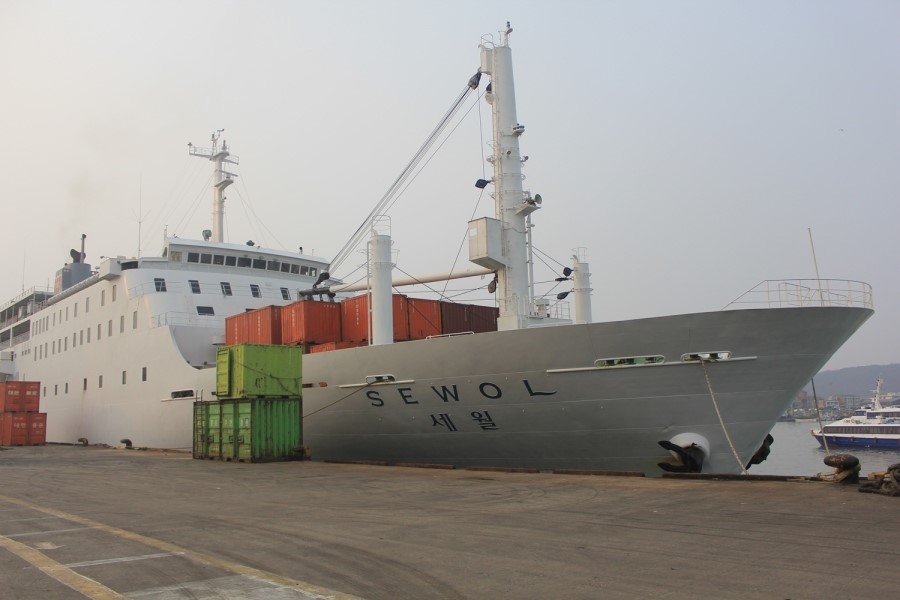
The Record
South Korean ro-ro ferry, Incheon to Jeju, 16 April 2014. Overloaded and improperly ballasted, she heeled in a routine turn and could not recover; the captain and crew abandoned ship while ordering passengers to stay in their cabins. Of the 304 dead, 250 were high school students on a field trip. Broadcast live on national television for hours, the disaster became a political rupture that eventually reached the presidency and ended it.
The Vessel
The MV Sewol was a Japanese-built passenger ferry, 6,835 gross tons and 146 metres long, originally commissioned in 1994 as the Marine-Express Ferry Naminoue on Japan's Kagoshima-Naha route. She was acquired by South Korea's Chonghaejin Marine Company in October 2012 for a price of 10.8 billion won ($9.5 million). She was then modified substantially in a Korean yard: her upper superstructure was extended upward by two decks, the deck area was expanded by 11.9 square metres, and her certified passenger capacity was increased from 804 to 956.
The modifications were approved by the Korean Register of Shipping on 25 January 2013 on condition that she carry, at all times, a minimum of 1,077 metric tons of ballast water and a maximum of 987 metric tons of cargo. These limits had been calculated to compensate for the raised centre of gravity from the new superstructure. Her modified stability was theoretically within Korean regulatory limits, but only just, and only under the specified ballast and cargo conditions.
In commercial service on the Incheon-Jeju route between March 2013 and April 2014, Sewol routinely operated with less than the required ballast and more than the allowed cargo. The subsequent inquiry established that she sailed in this condition on every voyage for which records were kept. The Korean Register of Shipping had conducted annual surveys without identifying the pattern. Her operator, Chonghaejin Marine, was a family-controlled business whose chairman Yoo Byung-eun and his wife and sons had been indicted in the 1990s on fraud charges. The Korean Coast Guard had conducted routine pre-sailing inspections that did not check ballast levels.
The Voyage
She left Incheon at 21:00 on 15 April 2014 on her regular overnight run to Jeju, 12 hours late due to fog. She was carrying 476 passengers, including 325 second-year students of Danwon High School in Ansan on a two-day school trip to Jeju, and a crew of 33 under Captain Lee Joon-seok. Her cargo holds contained 2,142 metric tons of cargo, slightly more than double her permitted limit, and her ballast tanks held 580 metric tons of water, approximately half her required minimum.
She proceeded through the night at normal service speed of 18 knots. The third mate Park Han-gyeol, 25 years old and holding her bridge watch through the early morning of 16 April, was on her first voyage in this role. At about 08:49, in the Maenggol Channel between Jeju and the mainland, she was ordered by Park to change course from 135 degrees to 140 degrees. The helmsman, Cho Joon-ki, applied the rudder. The actual course change that resulted was far larger than ordered, a matter of contested testimony at the subsequent trial. The ship began to heel to port.
Her understated stability margin, established by the modifications and further compromised by under-ballasting and over-cargoing, could not correct the developing list. Within 90 seconds she was listing at 35 degrees. Her cargo, inadequately lashed, shifted to port and pinned the list. By 08:55 she was lying on her port side. By 09:00 she was listing at 45 degrees and filling.
The Disaster
Captain Lee Joon-seok made a ship-to-shore distress call to the Korean Coast Guard's Jeju VTS at 08:55 and received direction to the Mokpo VTS at 08:58. The Mokpo VTS ordered him to sound the general alarm and prepare the passengers for evacuation. This order was not executed. The bridge crew instead broadcast to passengers throughout the ferry that they should remain in their cabins, stay in place, and await further instruction. This broadcast was repeated at least seven times over the ship's PA system between 08:52 and 09:37.
The first Korean Coast Guard patrol craft, CG-123, reached the scene at 09:30. It moved along the starboard side of the heeled ferry, rescuing first the crew members who had emerged onto the external decks. At 09:46 Captain Lee and 14 of his 33 crew left the ship by the starboard-side rescue boats. The overwhelming majority of the students were still in their cabins, still following the broadcast instructions, still alive at this point.
She capsized fully at 10:31 and her stern sank at 12:45. The Coast Guard, Korean Navy, and civilian vessels that arrived through the morning rescued 172 people, all of whom had either made their own way out of the ferry against the crew's instructions or had been outside her cabins at the moment of heeling. 304 aboard died in cabins and corridors below decks, including 250 of the 325 Danwon High School students. The sinking was broadcast live on Korean national television.
The Legacy
The arrest and prosecution of Chonghaejin Marine's corporate officers, the ship's officers, and inspectors across three Korean state regulators was the most extensive corporate and regulatory prosecution in modern Korean history. Captain Lee Joon-seok was convicted of murder (by omission) on 11 November 2014 and sentenced to 36 years; the sentence was increased on appeal in April 2015 to life imprisonment. Thirteen other crew members were convicted of negligent manslaughter. Chonghaejin Marine's chairman Yoo Byung-eun was found dead in an orchard outside Suncheon on 22 July 2014, some weeks after going on the run; the official finding was natural causes in a state of extreme malnutrition, a finding the public did not generally accept.
The political consequences reached the Korean presidency. President Park Geun-hye's response to the disaster, including her seven-hour absence from the public record on the morning of the sinking during the critical rescue window, became one of the central charges in her December 2016 impeachment and March 2017 removal from office. The Sewol is directly implicated in the fall of a South Korean president.
She was raised on 23 March 2017 by a Shanghai Salvage Company consortium under a 2015 contract with the Korean government, in one of the most complex lift operations in modern maritime engineering. She was towed upright and inspected at Mokpo. The bodies of nine missing passengers who had remained trapped in her since the sinking were recovered during the search of her hull in 2017. Three remained unaccounted for.
The wreck is preserved intact at a dedicated memorial site in Mokpo. The yellow ribbon, worn as the national memorial symbol for the Sewol dead, remains one of the most visible political symbols in contemporary Korean civil society. The Sewol Memorial and the Danwon High School memorial garden in Ansan are among the most-visited contemporary memorials in the country. The sinking is the defining civil-society event of twenty-first-century South Korea; the country's subsequent political trajectory is inseparable from it.