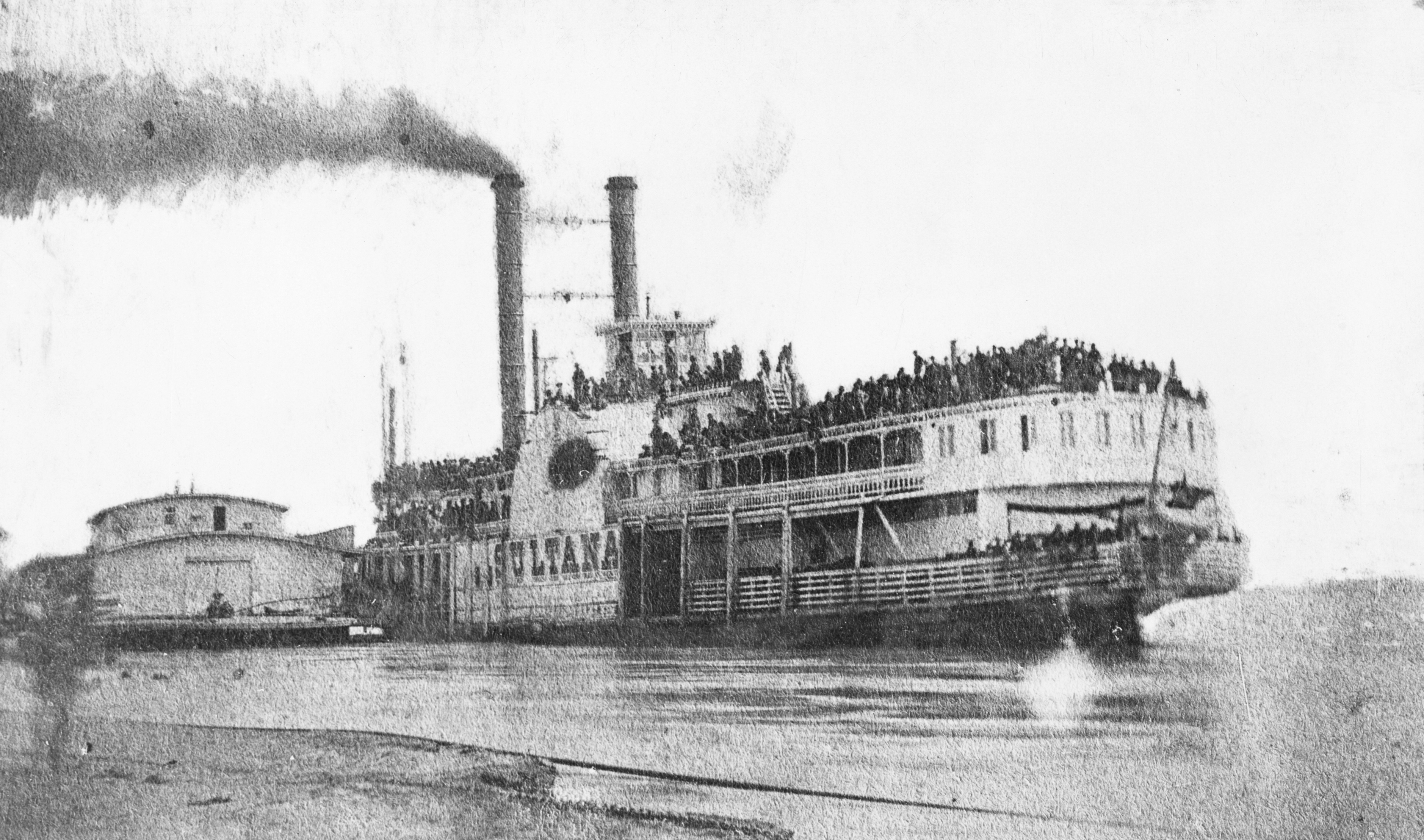
The Record
Mississippi steamboat carrying Union POWs home from Confederate prison camps. Designed to carry 376; 2,100 were aboard. Three of four boilers exploded at 2 a.m. north of Memphis. More Americans died than on the Titanic. Lost beneath news of John Wilkes Booth's death the same week.
The Vessel
The SS Sultana was a Mississippi River sidewheel steamboat, 79 metres long, 1,719 tons gross, built in Cincinnati in 1863 by the John Litherbury yard and owned by a syndicate of St Louis merchants. She was classified as a cabin steamer of the second class, with first-class accommodations on her upper decks, a capacity of perhaps 380 passengers and crew, and a boiler installation consisting of four tubular high-pressure boilers on her lower deck.
Her commercial role in 1864-65 was the cotton and general-freight trade between New Orleans and St Louis, with scheduled stops at Memphis, Vicksburg, and Cairo. She was one of some 200 commercial steamers working the Lower Mississippi during the Civil War years under the military transport system overseen by the United States Quartermaster Department, which requisitioned civilian steamers for troop movements at a per-head contract rate.
In March 1865 one of her four boilers developed a bulging seam from overheating; the ship's engineer R. G. Taylor had her put into a repair yard at Vicksburg for a proper rebuild, which would have taken three weeks. Her master, Captain J. Cass Mason, under commercial pressure to maintain his schedule, accepted a patch repair of the single boiler: a rivet-mounted steel plate over the weakened seam. The repair took 24 hours. The boiler inspector who certified the patch was under contract from the owners.
The Voyage
She departed New Orleans on 21 April 1865 carrying 70 fare-paying passengers, a small stern cargo of sugar and livestock, and Captain Mason's contract to embark Union prisoners of war at Vicksburg for transport north. The Confederacy had surrendered ten days earlier; the Union Quartermaster at Vicksburg, Lt Col Reuben Hatch, was under urgent orders from Washington to repatriate as quickly as possible the approximately 5,000 Union POWs recently released from the Cahaba and Andersonville prison camps, most of whom had arrived at the Vicksburg transit camp in May already starving, diseased, and unable to walk without support.
Hatch had discretion to assign POWs to any available transport. He negotiated a contract with Captain Mason for a head rate of $5.00 per enlisted man and $10.00 per officer for the Sultana's onward trip. The financial incentive for overloading was the structural problem of Hatch's position. The Sultana's certified passenger capacity was 376. The number of Union POWs loaded at Vicksburg on 24 April 1865, plus the existing 70 civilian passengers, plus the 85 crew, plus some cattle on the stern deck, exceeded 2,100 people. The overloading was so visible that her hurricane deck sagged under the concentrated weight and had to be shored up with extra stanchions between Vicksburg and Memphis.
She departed Vicksburg at 09:00 on 25 April 1865 against the spring flood current and at roughly six knots. She made Helena, Arkansas, that evening; Memphis at 18:00 on 26 April; and was steaming seven miles north of Memphis in the small hours of 27 April 1865, her overloaded decks quiet with POWs sleeping.
The Disaster
At 02:00 on 27 April 1865, three of her four boilers exploded almost simultaneously. The inquiry afterward determined that the starboard middle boiler, the same one that had been patched in Vicksburg, was the point of initial failure; the shock of its rupture propagated through the adjacent boilers in the same brick setting within milliseconds. The explosion destroyed the centre of the ship and collapsed the three upper decks into the firebox. The Sultana's wooden superstructure caught fire from the exposed coals immediately.
The ship had no lifeboats that could serve her actual passenger load; she carried a skiff and a yawl sufficient for perhaps 80 people. The Mississippi current at that season was running at 6 knots in flood, and the water temperature was 12 degrees Celsius. POWs too weak to swim from Andersonville died in minutes in the current. Those who could swim were pulled under by those who could not. The burning hulk drifted downstream for four kilometres before grounding against a wooded bank near the mouth of Second Chickasaw Bayou at 06:30.
Rescue steamers from Memphis arrived within an hour of the first alarm. The Bostonia II pulled 100 survivors out of the water on the way downstream. The Silver Spray, the Pocahontas, and the small gunboats Essex and Tyler worked the river bank through the morning. Survivors were taken to Memphis hospitals; many of the POWs, already at the edge of starvation, died in the following days from exposure and exhaustion on top of the immediate injuries of the explosion.
The confirmed death toll was approximately 1,167, though it has been revised by different historians between 1,100 and 1,800 depending on how missing POWs are counted. The final figure accepted by the Park Service is 1,167. This exceeds the Titanic's 1,517 passenger deaths in 1912 and makes the Sultana disaster the deadliest maritime accident in United States history.
The Legacy
The sinking received almost no national press coverage. She exploded two days after the death of President Lincoln's assassin John Wilkes Booth in a Virginia tobacco barn; the press of the week was saturated with Booth coverage, with President Johnson's first week in office, and with the continuing end of the Civil War. The Chicago Tribune carried the Sultana story on page four. The New York Times buried it on page five. Within a week it was no longer national news.
Two contemporary inquiries were conducted: a military Board of Inquiry under Major General Cadwallader Washburn at Memphis, and a Congressional investigation under Senator Lane of Kansas. Both concluded that the proximate cause was the bulging starboard middle boiler, the ineffective repair at Vicksburg, and the gross overloading by a factor of five. The court-martial of Lt Col Hatch on charges of corruption was dismissed for lack of evidence; Hatch retired from the Army in 1866. Captain Mason had died in the explosion.
No one was ever held criminally responsible. The Sultana herself settled on a sandbar which the river migrated away from over the following decades; the wreck is now buried under perhaps eight metres of Arkansas farmland some distance from the current bed of the Mississippi, and has been located by ground-penetrating radar surveys though never fully excavated.
Her memory has been preserved almost entirely by the descendants of her dead. The Sultana Disaster Museum in Marion, Arkansas, maintains the memorial roll. The Sultana Association of Descendants and Friends conducts an annual memorial service. She is a deliberate countermonument to the way the American Civil War is usually remembered: 1,167 Union soldiers, half of them already dying of Andersonville-camp malnutrition, killed not in combat but in a commercial overloading scheme, two weeks after the war had ended, and forgotten beneath Lincoln's funeral train.