The Record
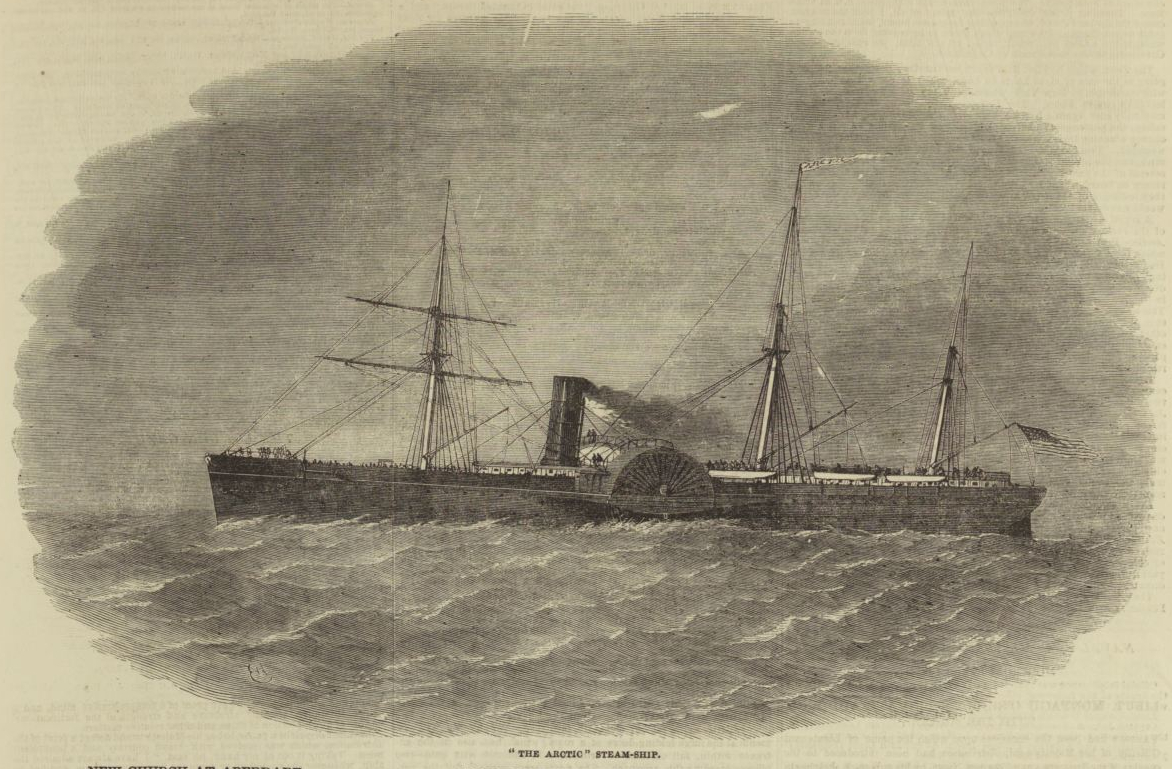
Flagship of the American Collins Line, transatlantic paddle steamer. Rammed by the French steamer SS Vesta in fog off the Grand Banks on 27 September 1854, she sank slowly over five hours. The crew seized the lifeboats first; not a single woman or child among the passengers survived, including Captain Luce's twelve-year-old son. The scandal ruined Collins Line within five years.
The Vessel
The SS Arctic was a paddle steamer of the American Collins Line, one of the four sister ships (with Atlantic, Baltic, and Pacific) built between 1850 and 1851 to compete with the Cunard Line for the transatlantic mail and passenger trade. She was 86 metres long, 2,856 tons, with a wooden hull and a pair of side-mounted paddle wheels driven by Oscillating Steam Engine Works of New York. She entered service on 27 October 1850 and won the transatlantic speed record from Pacific the following year with a 9-day 17-hour Liverpool-New York passage.
The Collins Line, officially the United States Mail Steamship Company, was the first American transatlantic line to be competitive with the British Cunard service. It operated under a $858,000 annual U.S. Post Office mail contract and was the visible commitment of the American government to contesting British maritime supremacy on the Atlantic. The four Collins ships were the largest, fastest, and most luxuriously appointed American passenger ships of their generation. Arctic was widely considered the fleet flagship.
Her master from 1851 was Captain James C. Luce, a 53-year-old Massachusetts mariner of forty years' deep-sea experience. Luce had commanded Arctic on her eastbound record voyage and was the most respected American ship's captain of his generation.
The Voyage
She departed Liverpool on 20 September 1854 on her return voyage to New York with 233 passengers, 150 crew, and the American diplomatic mail. Her passenger list included the wife and daughter of the Collins Line's president Edward K. Collins, the wife and two children of the Collins Line's treasurer, and a number of other Collins family members. The ship was, in contemporary terms, overloaded with the families of her own company's directors.
She made her usual rapid westbound passage across the Atlantic through 25 September. On the morning of 27 September 1854 she was approximately 90 kilometres southeast of Cape Race, Newfoundland, running west in dense fog at approximately 13 knots. At 12:10 she collided with the French iron screw steamer SS Vesta, an emigrant ship of 250 tons, outbound from Saint-Pierre and Miquelon to France.
The Vesta struck Arctic's starboard bow with her reinforced iron stem. The damage to Vesta was severe but above her waterline; the damage to Arctic was three separate holes in her wooden hull below her waterline. Captain Luce believed Arctic to be more seriously damaged than Vesta; he directed Arctic's pumps and closed her watertight compartments while the two ships remained alongside. Arctic began to settle. Luce ordered her to return to St John's, Newfoundland, at full speed.
The Disaster
The rapid westbound movement increased the rate of water entering Arctic's hull. By 15:00 on 27 September 1854 she was taking on water faster than her pumps could expel it. Captain Luce gave the order to lower her six lifeboats and evacuate the passengers. What followed was the single most shameful episode in American maritime history before the Lusitania.
The lifeboats were seized almost immediately by Arctic's crew. The engineers and stokers, who had been ordered to remain at their stations to keep the pumps running, left their positions and rushed for the boats. The firemen fought with the passengers. Captain Luce attempted to maintain order on the deck and, by several surviving accounts, personally ensured that at least two lifeboats were launched with passengers aboard; he could not control the general chaos.
The crew's commandeering of the boats was the proximate cause of the disaster's particular shape. Of the 85 survivors eventually rescued, 61 were crew members and 24 were passengers. Not one of the 81 women and children among the passengers survived. Among the dead were Mrs Edward Collins, her daughter Mary Ann, her son Henry Collins, and the wife and two children of the company treasurer. Arctic sank at 17:00 on 27 September 1854. Captain Luce was one of the survivors; he had gone over the side as the ship went down and had been picked up by one of her boats.
The specific details of the crew's behaviour became public when the surviving passengers reached New York in early October. The American press coverage was extensive, detailed, and brutal. Luce was never personally accused of cowardice, but he never commanded another ship.
The Legacy
The Arctic disaster broke the Collins Line. The loss of Arctic herself cost the company approximately $700,000 in 1854 dollars; the loss of the families of her own directors was a private catastrophe that paralleled the public disaster. Her sister ship Pacific vanished without trace in the North Atlantic in January 1856 (the first transatlantic steamer to disappear without any survivors), and the combined blow destroyed the line's commercial viability. Congress declined to renew the mail contract in 1857. The Collins Line ceased operations on 1 April 1858.
The broader consequences of the disaster were twofold. First, the exposure of crew cowardice in the Arctic sinking produced the first serious American public discussion of merchant marine crew discipline, and led, eventually, to the 1871 Seaman's Act that began the systematic federal licensing of American deep-sea crewmen. Second, the Arctic disaster demonstrated the fatal inadequacy of the lifeboat provisioning of mid-century transatlantic liners. The six lifeboats aboard Arctic could accommodate approximately 180 people; 383 had been aboard. The lesson was not learned: the Titanic sailed 58 years later with lifeboat capacity for 1,178 of her 2,240.
The question of why not a single woman or child survived the Arctic was debated in the American press for a full decade after 1854. The consensus explanation was that the crew had physically overpowered the women and children at the lifeboat launches; the alternative explanation, supported by Captain Luce's own testimony, was that women and children had been placed in the boats that had subsequently capsized in the Atlantic swell. Both explanations appear to be partly true.
Captain Luce continued to live in Massachusetts until his death in 1880, never returning to sea. His personal account of the disaster, submitted to the Collins Line's board of directors in November 1854, is preserved in the Mystic Seaport archives and is the principal surviving first-hand document of the sinking.
The wreck of the Arctic has never been located. Her position is known approximately from the 1854 records, at approximately 46°45′N 53°00′W, in water depths between 3,000 and 4,000 metres. She lies on the Atlantic abyssal plain, unvisited. No physical memorial exists to her dead; her 285 names are preserved in the 1854 New York newspaper obituaries and in the Collins Line archive at the Smithsonian. The lesson of the Arctic, that a disorganised crew will seize the lifeboats from the passengers, was learned by the Collins Line, was forgotten by the White Star Line, and was forgotten again by every line thereafter. Its reappearance in subsequent disasters has, each time, produced the same shocked reaction; the Arctic was simply the first.