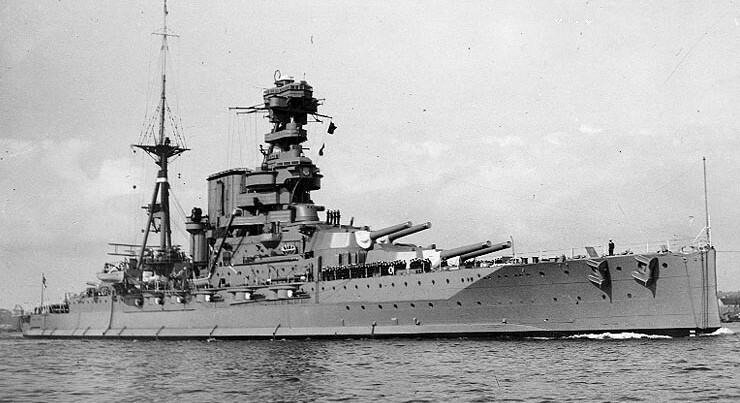
The Record
Royal Navy Queen Elizabeth-class battleship, operating off Sidi Barrani with the Mediterranean Fleet. Torpedoed by U-331 at 16:25 on 25 November 1941; three torpedoes found her port side, her magazines ignited, and she capsized and exploded in under five minutes. 862 dead of 1,184 aboard. The entire sinking was filmed from HMS Valiant; the Admiralty suppressed the footage for three months to prevent German confirmation of the kill.
The Vessel
HMS Barham was a Queen Elizabeth-class battleship of the Royal Navy, commissioned at the John Brown & Company yard at Clydebank on 19 October 1915. She was 197 metres long, 27,500 tons standard displacement, armed with eight 15-inch guns in four twin turrets, a main armament equal to any battleship then in service. She was the fourth ship of her class, the five-ship Queen Elizabeth class that had been the Royal Navy's principal late-First World War fast battleship design.
Her First World War service had included the Battle of Jutland on 31 May 1916, where she had served with the 5th Battle Squadron and had been hit by six German shells without serious damage, firing 337 rounds of 15-inch ammunition in return. Her interwar service had been primarily in the Mediterranean Fleet. She had undergone major modernisation refits in 1930 and 1937; by 1939 her propulsion machinery had been completely replaced, her anti-aircraft armament upgraded, and her deck armour strengthened. She was, at the outbreak of the Second World War, the most up-to-date Queen Elizabeth-class battleship in service.
Her commanding officer from October 1941 was Captain Geoffrey Cooke, 42, a career Royal Navy officer and graduate of the Royal Naval Staff College. Her Admiralty assignment was to the Mediterranean Fleet under Admiral Sir Andrew Cunningham, flagship of the battle squadron operating from Alexandria.
The Voyage
On 25 November 1941 Barham was operating with the Mediterranean Fleet in the eastern Mediterranean under the command of Vice-Admiral Sir Henry Pridham-Wippell. The specific operation was a cover for a planned interception of a suspected Italian convoy bound for Benghazi; the fleet was proceeding westward across the eastern Mediterranean at 17 knots in a formation of three battleships (Queen Elizabeth, Barham, Valiant), the cruiser Euryalus, and eight destroyers. Weather was calm; visibility was good.
The German Type VIIC submarine U-331, commanded by Oberleutnant zur See Hans-Diedrich von Tiesenhausen, 28 years old, had been operating in the eastern Mediterranean for six weeks. U-331 had sunk a British destroyer and two small merchant vessels on the same patrol; von Tiesenhausen was an experienced submariner on his second command patrol. At approximately 16:00 on 25 November 1941, von Tiesenhausen sighted the British battle squadron through his periscope at a range of 4,500 metres.
He closed to attack position at 16:25 and fired a full four-torpedo bow salvo at Barham at 16:30 from a range of 370 metres. The close firing range was extraordinary for a submarine attack on a screened battleship; von Tiesenhausen had brought U-331 inside the anti-submarine screen of the British destroyers, an approach that was tactically remarkable and carried enormous risk.
The four torpedoes struck Barham on her port side below the waterline, all in a cluster between frames 50 and 68, amidships.
The Disaster
The torpedo impacts occurred at 16:25 on 25 November 1941. Barham began to list immediately to port, the list increasing at approximately 2 degrees per minute. Her watertight subdivision had been compromised across four compartments, and her damage-control teams had only limited time to respond before the list crossed the critical threshold.
At 16:29, four minutes after the torpedo strikes, Barham's main 15-inch magazine detonated. The detonation was recorded on a cinefilm camera aboard the nearby battleship HMS Valiant, operated by a British Pathé News cameraman who happened to be filming a routine Mediterranean Fleet exercise. The resulting footage (approximately 47 seconds of continuous film, released to the British public in 1942 after initial classification) is the only extant moving-picture record of a battleship's magazine explosion in the Second World War; it has become, through repeated use in documentaries and in training films, one of the most widely-seen single pieces of film ever taken of a naval disaster.
The explosion destroyed approximately half of the ship's hull and superstructure. The resulting mushroom cloud rose to an estimated 300 metres. Her bow and stern, no longer held together by the ship's midship structure, rose from the water momentarily and then sank in opposite directions. Between the first torpedo strike and her complete disappearance, approximately 4 minutes and 30 seconds elapsed.
Of her 1,184 crew, 862 died. 320 were rescued by the accompanying British destroyers. Captain Cooke went down with the ship; Rear-Admiral Hugh Binney, embarked aboard as the 1st Battle Squadron commander, also died.
The Legacy
The Admiralty's immediate response was a three-month news blackout on the Barham loss. The British government was concerned that public knowledge of the loss would damage Mediterranean morale at a difficult moment in the North African campaign (Operation Crusader was then in progress). The specific mechanism of the blackout was notification of the next-of-kin of the dead by private telegram, with a request for family silence on the grounds of national security. The censorship lasted until 27 January 1942, when the Admiralty finally released the news after the Barham loss had begun to be reported in neutral foreign press.
The delayed announcement had a psychological effect that the Admiralty had not fully anticipated. Because the news was withheld for over two months, the British public received the news in a form that seemed to suggest the Admiralty was concealing other losses. Churchill personally addressed the Commons on 27 January 1942 to explain the decision and to confirm the loss of Barham.
The tactical lesson of the Barham loss was the vulnerability of a battleship screened only by conventional destroyers to a determined submarine penetration. The Royal Navy's subsequent Mediterranean operations placed increased emphasis on aircraft patrol of the battle force's operating area, on sonar-equipped destroyers in the screen, and on regular zigzag practice.
The wreck of HMS Barham was located in 1993 by a Royal Navy survey team at approximately 470 metres depth in the eastern Mediterranean. She lies inverted and broken into two main sections at 32°34′N 26°24′E, approximately 200 nautical miles north-northwest of Sollum, Egypt. She is a protected war grave under the UK Protection of Military Remains Act 1986.
The cinefilm footage of the Barham explosion became, through the post-war period, one of the most frequently-used illustrations of naval power and its limits. The 47 seconds between the appearance of flame at Barham's amidships and the final disappearance of her stern has been used in virtually every documentary treatment of the European naval war, in most United States Navy damage-control training films, and in the opening sequence of the 1980 film The Final Countdown. The 862 dead are commemorated on the Portsmouth Naval Memorial; their names are read at the annual Royal Navy remembrance service on 25 November. Oberleutnant von Tiesenhausen was awarded the Knight's Cross for the attack and survived the war; he emigrated to Canada in the 1950s and died in Vancouver in 2018, aged 105, the last surviving German submarine commander to have sunk a British battleship.