The Record
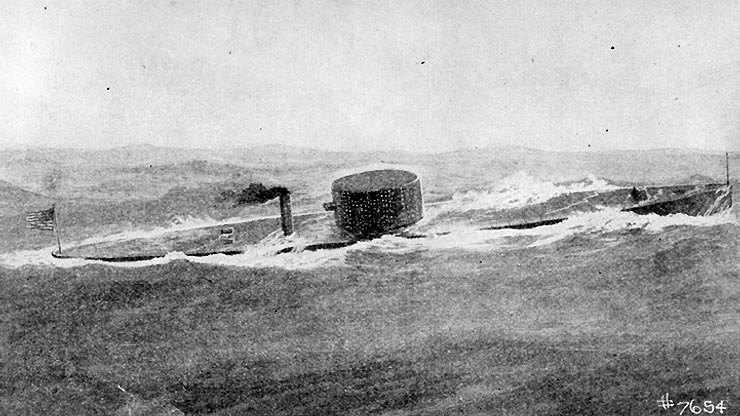
Union Navy ironclad, revolutionary low-freeboard turret ship (a cheesebox on a raft, as her detractors called her). Fought CSS Virginia to a draw at Hampton Roads in March 1862 and ended the age of wooden-hulled naval warfare in a single afternoon. Foundered in a storm off Cape Hatteras on New Year's Eve 1862: 16 dead, 47 rescued by USS Rhode Island. Discovered in 1973 and her turret raised in 2002, now on display at the Mariners' Museum in Virginia.
The Vessel
USS Monitor was the first ironclad warship commissioned by the United States Navy, designed by the Swedish-American engineer John Ericsson and built by the Continental Iron Works at Greenpoint, Brooklyn, between October 1861 and February 1862. She was 53 metres long, 987 tons displacement, with a low-freeboard armoured hull protecting an 18-inch iron-plated cylindrical revolving gun turret mounting two 11-inch Dahlgren smoothbore guns.
Her design was the most radical warship concept of the nineteenth century. Ericsson's hull sat so low in the water that her main deck was only 45 centimetres above the waterline; her superstructure consisted of the turret and a small armoured pilothouse forward. She had no masts, no sails, no sides above the waterline to speak of. Her critics called her "a cheesebox on a raft". Her construction was funded under a Congressional emergency appropriation with the specific mission of countering the Confederate ironclad CSS Virginia (formerly USS Merrimack), which was known to be under conversion at Portsmouth, Virginia.
She was commissioned under Lieutenant John Lorimer Worden on 25 February 1862, crewed by 58 Union Navy volunteers, and despatched south to Hampton Roads under tow by the steam tug Seth Low on 6 March 1862. She had not been sea trialled. Her crew had not trained in her turret mechanism. She was, as Worden described her in his letter to his wife, "the oddest ship in creation, and likely to go down in any weather at all".
The Voyage
She reached Hampton Roads on the evening of 8 March 1862, twelve hours after CSS Virginia had sortied from Norfolk and had destroyed two Union wooden warships, Cumberland and Congress, killing 261 Union sailors in a single afternoon. The surviving Union warships in the Roads were pinned against the shore; the Union blockade of Hampton Roads had collapsed in a single action. The Monitor came into the Roads at 21:00 and anchored under the shelter of the USS Minnesota, which was aground and likely to be Virginia's target at dawn.
At 07:45 on 9 March 1862, CSS Virginia steamed out of Norfolk to finish the Minnesota. The Monitor interposed. The two ironclads engaged at close range from 08:45 to 12:15, firing at each other for three and a half hours at distances sometimes closing to 50 metres. Virginia's 7- and 9-inch guns could not penetrate Monitor's turret armour. Monitor's 11-inch guns, firing under-strength 5.5-kg charges because the Navy had not yet approved the heavier charges Ericsson had designed the guns for, did not penetrate Virginia's 10 cm iron plating.
Neither ship sank the other. Both retired in the afternoon, damaged but operational. The engagement ended the age of wooden-hulled naval warfare in a single afternoon. Every European navy that was watching the Hampton Roads action, and all of them were watching, began rewriting its warship specifications within weeks. Monitor and Virginia would never meet again; Virginia was scuttled by her own crew on 11 May 1862 when the Confederacy abandoned Norfolk, and Monitor continued operating in Virginia waters through the spring and summer.
The Disaster
Her end came in the winter. On 29 December 1862 she was ordered south from Hampton Roads to Beaufort, North Carolina, to support a Union amphibious operation against Wilmington. She was taken in tow by the sidewheel steamer USS Rhode Island and departed Fort Monroe that morning. The weather forecast was clear; the meteorology of 1862 did not yet identify rapidly-developing southeastern storms.
By the afternoon of 30 December the weather had developed into a severe Cape Hatteras storm. Monitor was pitching heavily in 5-metre head seas; her ventilator caps were being periodically overtopped, and her pump belt failed in the early evening. Worden's successor as her commanding officer, Commander John P. Bankhead, ordered the signal rockets fired from her turret to request assistance from the Rhode Island. Rhode Island launched her boats.
The Monitor foundered at approximately 01:30 on 31 December 1862, twenty nautical miles southeast of Cape Hatteras, North Carolina. Her low-freeboard hull had been unable to maintain the seakeeping margin required by Hatteras's weather; she filled through the ventilators, the engine-room hatch, and eventually the turret itself, and settled in 70 metres of water. Sixteen of her 63-man crew went down with her; the Rhode Island's boats pulled forty-seven out of the storm.
The Legacy
The wreck was located on 27 August 1973 by a joint Duke University, National Geographic Society, and NOAA expedition led by the oceanographer John Newton. She rested upside down, approximately 26 kilometres off Cape Hatteras at a depth of 73 metres, with her revolving turret lying detached nearby, apparently fallen free as she rolled during the sinking. The site was declared the first United States National Marine Sanctuary on 30 January 1975, a legal category created specifically to protect her.
A multi-year recovery operation was conducted by NOAA, the United States Navy, and the Mariners' Museum of Newport News between 1998 and 2002. Her four-bladed propeller was raised in 1998, her innovative steam engine in 2000, her turret with its two Dahlgren guns in 2002. The turret recovery on 5 August 2002 was conducted with a spider-lift rig designed by the U.S. Navy Mobile Diving and Salvage Unit Two; the 270-ton assembly was lifted to the barge Wotan and transported to Newport News, where the subsequent electrolytic conservation of the turret continues to the present day at the Monitor Center of the Mariners' Museum.
The recovered artefacts include Monitor's pilothouse plate, her anchor, her silver service, personal possessions of her crew, and the skeletons of two of her sixteen dead. The skeletons were buried with military honours at Arlington National Cemetery on 8 March 2013, exactly 151 years after her engagement at Hampton Roads.
She was the first modern warship of the industrial era, the model against which every subsequent iron-hulled warship was compared. Her turret is the direct ancestor of every warship turret since. She outlived her Confederate counterpart by seven months and launched the iron-warship era that would culminate in HMS Dreadnought half a century later. The Mariners' Museum maintains her as the central exhibit of American Civil War naval history; her surviving structure is the most complete Civil War-era iron hull in existence.