The Record
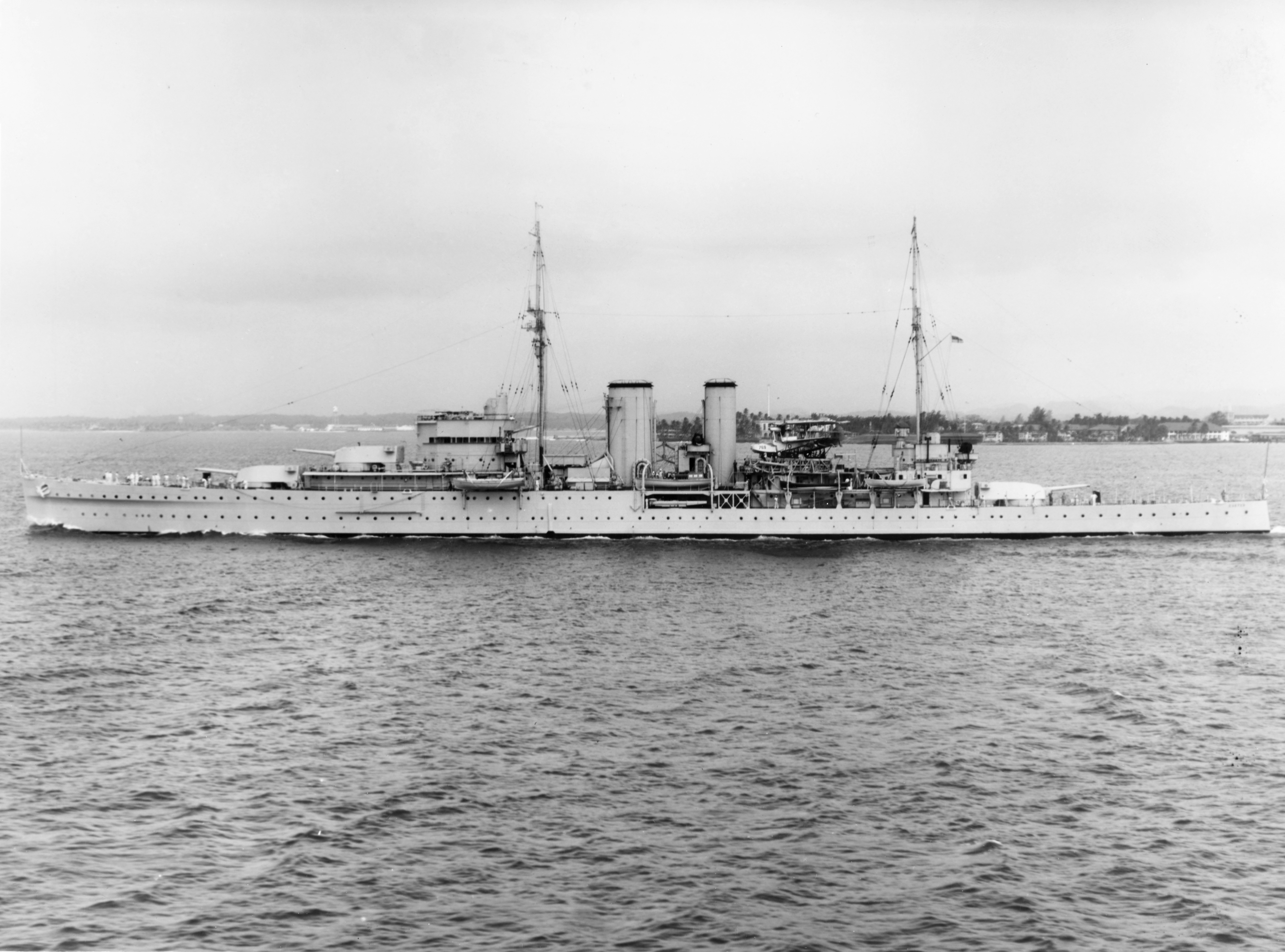
Royal Navy York-class heavy cruiser, veteran of the 1939 Battle of the River Plate where she had helped run the Graf Spee to ground. Intercepted by four Japanese heavy cruisers on 1 March 1942 at the Second Battle of the Java Sea while attempting to escape to Ceylon. Struck in the engine room by a 20.3 cm shell; scuttled by her crew after sustained torpedo and gunfire attack. 54 dead. Her wreck was located in 2007 and then, shockingly, illegally salvaged for scrap metal in 2016 by Indonesian scrap divers, along with HMS Electra and HMS Encounter.
The Vessel
HMS Exeter was a British heavy cruiser of the Royal Navy's York class, built at the Devonport Royal Dockyard between 1928 and 1931 and commissioned on 27 July 1931. She was 176 metres long, 8,520 tons displacement, and armed with six 8-inch primary guns in three twin-gun turrets (two forward, one aft), eight 4-inch anti-aircraft guns, and six 21-inch torpedo tubes. Her armour protection included a 76-millimetre main belt, 76-millimetre turret armour, and 38-millimetre deck armour.
Exeter was the second ship of the York class, a two-ship class built under the specific armament constraints of the 1922 Washington Naval Treaty (which limited cruiser primary-gun armament to 8 inches). Her specific claim to historical significance was her prior participation in the Battle of the River Plate (13 December 1939): as a member of Commodore Henry Harwood's Force G, Exeter had engaged the German pocket battleship Admiral Graf Spee off the estuary of the River Plate. Exeter had sustained substantial damage in the engagement (including a major hit to her bridge that killed approximately 60 officers and crew), but had contributed substantially to the tactical pressure that led to Graf Spee's scuttling at Montevideo four days later.
By February 1942, Exeter had been repaired from her River Plate damage and had been assigned to the Allied ABDA (American-British-Dutch-Australian) Command in the Southwest Pacific. Her operational role was cruiser operations in defence of the Dutch East Indies and Malaya against the Japanese Imperial Navy's advance through Southeast Asia.
Her master on her final voyage was Captain Oliver Gordon, 47, a career Royal Navy officer. Her complement was approximately 800 officers and ratings.
The Voyage
The Japanese invasion of the Dutch East Indies had commenced on 10 January 1942 and by the end of February 1942 was in its final phase: the Japanese Imperial Navy was conducting amphibious landing operations on Java. The Allied ABDA Command's naval forces, under Rear Admiral Karel Doorman of the Royal Netherlands Navy, attempted to intercept the Japanese invasion fleet.
On 27 February 1942, Doorman's ABDA striking force comprised: the Dutch cruisers De Ruyter (flagship) and Java; the British heavy cruiser Exeter and the light cruiser HMS Perth (actually Australian, attached to British command); the American heavy cruiser USS Houston; and nine destroyers (three Dutch, three British, three American). The force was engaged by the Japanese covering force, comprising: the Japanese heavy cruisers Nachi and Haguro; the Japanese light cruiser Jintsū; and approximately 14 Japanese destroyers.
The subsequent Battle of the Java Sea (27 February 1942) was the largest surface engagement of the Pacific War to that point. The battle continued from approximately 16:00 on 27 February 1942 to approximately 00:30 on 28 February 1942. The engagement produced catastrophic Allied losses: De Ruyter, Java, and three Allied destroyers were sunk; Rear Admiral Doorman was killed aboard De Ruyter.
Exeter sustained an 8-inch shell hit in her forward boiler room at approximately 17:15 on 27 February 1942. The specific damage reduced her speed to 11 knots and forced her to withdraw from the main engagement. She successfully retreated to Surabaya, arriving on 28 February 1942. At Surabaya, emergency repairs were conducted to restore her to approximately 23 knots maximum speed; the ship was ordered to evacuate to the British Ceylonese naval base at Colombo (modern Sri Lanka) for comprehensive repair.
Exeter departed Surabaya on the evening of 28 February 1942, accompanied by the destroyer HMS Encounter and the American destroyer USS Pope, on the attempted escape voyage westward through the Java Sea and southward into the Indian Ocean.
The Disaster
At approximately 07:30 on 1 March 1942, Exeter and her escorts were detected by Japanese reconnaissance aircraft approximately 170 kilometres northwest of Bawean Island in the central Java Sea. The Japanese Navy's covering force - the heavy cruisers Nachi, Haguro, Myōkō, and Ashigara, along with multiple destroyers - had been specifically deployed to intercept Allied escape traffic from Surabaya.
The Japanese force was substantially superior to Exeter's three-ship group. The four Japanese heavy cruisers carried a combined primary armament of 40 8-inch guns; Exeter carried only six 8-inch guns (and her forward boiler room damage had reduced her speed to approximately 23 knots, below the 25 knots of the Japanese cruisers). The tactical situation was clear: Exeter could not outrun the Japanese force and could not defeat them in a running engagement.
The engagement commenced at approximately 10:20 on 1 March 1942, with the Japanese cruisers opening fire at approximately 22,000 metres range. The engagement continued for approximately four hours, with the Japanese force gradually closing range and delivering sustained heavy-gun fire. Exeter returned fire but her rate of fire was progressively degraded by shell hits and by the continuing deterioration of her boiler-room damage.
At approximately 11:20 on 1 March 1942, Exeter sustained her critical hit: an 8-inch shell struck her after boiler room, penetrating to the boiler systems and causing catastrophic steam loss. Her speed dropped to approximately 6 knots within minutes. She was subsequently unable to manoeuvre effectively and was progressively destroyed by the continuing Japanese fire.
Captain Gordon ordered abandon ship at approximately 11:40 on 1 March 1942. The surviving crew abandoned ship using the ship's boats and floats. HMS Exeter sank at approximately 11:55 on 1 March 1942 in approximately 90 metres of water in the Java Sea. HMS Encounter and USS Pope were also sunk in the same engagement (HMS Encounter within minutes of Exeter; USS Pope at approximately 14:00 on 1 March 1942 by air attack from Japanese carrier aircraft).
Of Exeter's 800 complement, 152 died: approximately 100 killed in the shell engagement and approximately 52 in the sinking or subsequent survival period. Approximately 648 survived: rescued from the water by Japanese destroyers. The survivors were taken to Japanese prisoner-of-war camps in Java and subsequently in Makassar (Sulawesi), Singapore, and Japan itself. Captain Gordon survived and was imprisoned through the remainder of the war, dying in 1947 of complications from his captivity.
The Legacy
The loss of HMS Exeter on 1 March 1942 was among the most specifically tragic Royal Navy losses of the Pacific War, given the ship's prior heroic service at the Battle of the River Plate in December 1939. The specific narrative trajectory - from the River Plate victory to the Java Sea defeat, in just over two years - has been extensively documented in British naval historical literature.
The specific circumstances of her loss reflected the broader operational catastrophe of the Allied ABDA Command in February-March 1942. The ABDA force had been substantially outnumbered, outgunned, and outfought by the Japanese Imperial Navy throughout the Dutch East Indies campaign. The loss of Exeter was one of approximately 18 major Allied warship losses during the campaign; the combined ABDA casualty figures exceeded approximately 4,500 dead across the two-month Java campaign.
The 648 Exeter survivors subsequently endured particularly harsh Japanese captivity conditions. The survivors were predominantly held at the Makassar prison camp on Sulawesi, the Cycle Camp at Batavia (Jakarta), and the Funken Maru prison camp in Japan itself. The subsequent mortality rate among Exeter survivors during captivity was approximately 35 per cent (approximately 225 of the 648 survivors died in captivity), among the highest mortality rates of any British prisoner-of-war cohort of the Second World War.
The specific cultural memory of HMS Exeter has been extensive in Royal Navy commemorative practice. The ship's name was subsequently assigned to two successor Royal Navy vessels: HMS Exeter (D89), a Type 42 destroyer commissioned in 1980 and decommissioned in 2009 (which had served in the 1982 Falklands War, the 1990-91 Gulf War, and multiple subsequent operations); and HMS Exeter (the proposed name for a future Type 26 frigate, currently under construction). The name thus represents an active continuity in Royal Navy commemorative practice.
The wreck of HMS Exeter was located in 2007 by an Indonesian fishing expedition at approximately 90 metres depth in the Java Sea. The wreck site was subsequently documented by multiple diving expeditions through the 2000s and 2010s. In 2016, a controversy emerged regarding illegal commercial salvage of the wreck: Indonesian fishermen and commercial salvage operators had been systematically extracting ferrous materials from the wreck site, substantially compromising the wreck's archaeological integrity. The British Ministry of Defence and the Indonesian government reached an agreement in 2017 to protect the wreck site; the wreck is now protected under Indonesian maritime heritage legislation.
The 152 dead and the approximately 225 who died in subsequent captivity are commemorated by the Exeter Memorial at Exeter Cathedral, Devon, and by a separate memorial at Portsmouth Royal Naval Cemetery. The annual Exeter Memorial Service is conducted at Exeter Cathedral on the first Sunday of March.