The Record
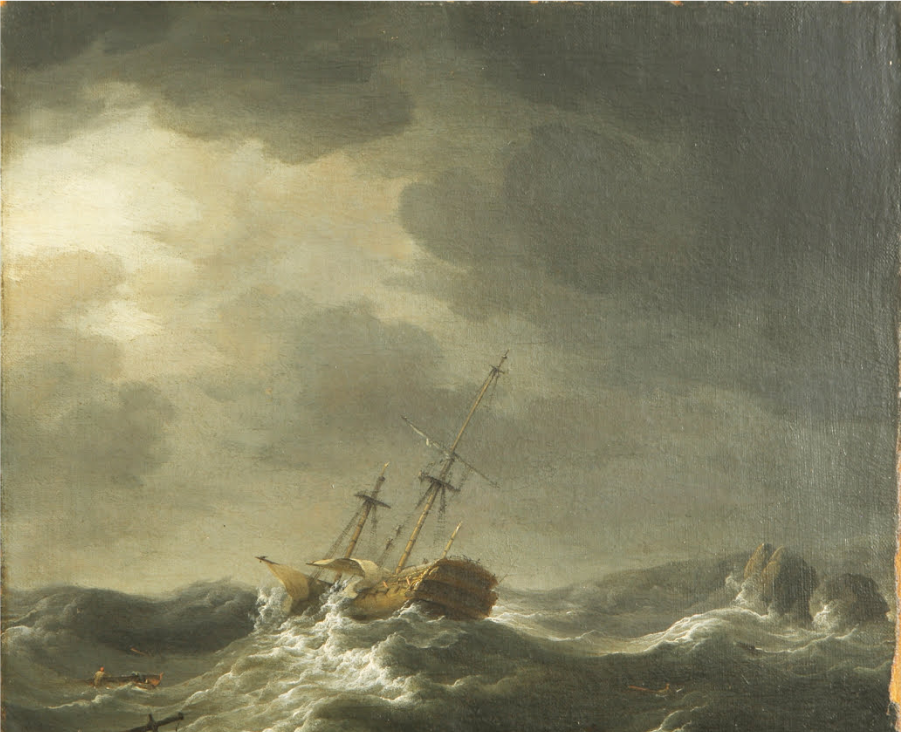
Royal Navy sixth-rate, detached from Commodore Anson's Pacific squadron in a gale at Cape Horn. Wrecked on the uncharted rocks of the Gulf of Penas, Patagonia, on 14 May 1741. ~120 men went ashore; around 36 came home, two years and a mutiny later. The survivors' rival accounts of the island ordeal, including Captain Cheap's authority and the shooting that split the crew, became the first naval court-martial conducted in print in the English language, and were fixed for the modern reader by David Grann's 2023 book.
The Vessel
HMS Wager was a British sixth-rate frigate of the Royal Navy, originally constructed in 1734 as an East Indiaman for the British East India Company and converted to naval service in 1739. She was 37 metres long, 500 tons displacement, and armed with 28 guns of mixed 9- and 6-pounder calibre. She was, for a converted East Indiaman, a lightly-built ship: her hull timbers were thinner than a purpose-built naval frigate of her rate, and her accommodation arrangements, designed for a Company trading voyage, were indifferently suited to long naval deployment.
She was purchased by the Royal Navy in 1739 at the outbreak of the War of Jenkins' Ear between Britain and Spain. Her conversion to naval service at Deptford Dockyard included the installation of her 28 guns, the reorganisation of her accommodation for a naval crew of 160 officers and ratings, and the strengthening of her deck planking for the weight of her armament. The conversion was completed in April 1740.
Her master on her final voyage was Captain Dandy Kidd, who was appointed to her on her commissioning into naval service. Kidd died of fever in November 1740 during the South Atlantic crossing; command then passed to Captain David Cheap, a 40-year-old Scottish officer who had previously served under Admiral George Anson in the Mediterranean.
The Voyage
HMS Wager was assigned to Commodore (later Admiral) George Anson's South Seas expedition of 1740-1744, a Royal Navy squadron of six ships tasked with circumnavigating the globe via Cape Horn, attacking Spanish shipping and settlements on the Pacific coast of South America, and intercepting the annual Spanish treasure galleon from Manila to Acapulco. Wager was assigned to the squadron as a supply ship, carrying ammunition, provisions, and specie for the expedition's operations in the Pacific.
The Anson squadron sailed from Portsmouth on 18 September 1740. The transit of the South Atlantic to the Strait of Magellan was plagued by scurvy and typhus; by the time the squadron reached the approaches to Cape Horn in March 1741, the combined crews had lost approximately 40 per cent of their original complement to disease.
The squadron's transit around Cape Horn in April and May 1741 was catastrophic. A series of severe southwesterly gales, the characteristic "Cape Horn snorter" of the southern autumn, scattered the six ships over hundreds of kilometres of the southeast Pacific. Wager became separated from the flagship Centurion in late April 1741 and was unable to rejoin the squadron. Captain Cheap, now commanding Wager alone, attempted to continue north along the Chilean coast to the planned squadron rendezvous at Juan Fernández Island.
By 13 May 1741, Wager had rounded Cape Horn but her crew was exhausted, her rigging damaged, and her hull leaking substantially. Cheap's navigational position was uncertain: the continuous overcast of the southern autumn had prevented any celestial observations for approximately three weeks, and his dead-reckoning position was progressively diverging from his actual position.
The Disaster
On the morning of 14 May 1741, Wager was sailing northwest along what her officers believed was the open Chilean coast, at approximately 100 kilometres offshore. In reality, due to the accumulated dead-reckoning error, she was within 15 kilometres of the coastal archipelago of the Guayaneco Islands, at approximately 47 degrees south latitude.
At approximately 04:30 on 14 May 1741, Wager struck a submerged rock off the western coast of what is now Wager Island, in the Guayaneco archipelago. The impact holed her bow below the waterline; she began to flood immediately and drove onto the coastal rocks. Within approximately two hours, HMS Wager was wedged on the rocks with her hull broken amidships and her masts collapsed across her foredeck.
Of the 160 aboard, 140 survived the initial grounding and made it to the desolate shore of Wager Island: a cold, mountainous, and almost uninhabited piece of land on the western Patagonian coast. The survival situation was among the worst documented in eighteenth-century naval history. The island was effectively uninhabited apart from occasional Kawésqar indigenous fishing parties; the climate was continuously cold, wet, and stormy; the food resources were limited to shellfish, seabirds, and seaweed.
Over the subsequent 14 months, the Wager survivors divided into factions, mutinied against Captain Cheap, separated into smaller parties attempting independent escape, and suffered progressive attrition from starvation, exposure, drowning in attempted coastal passages, and one documented killing of a crewman by Captain Cheap for insubordination. Of the 140 initial survivors, only 36 eventually returned to Britain: approximately 20 under Cheap via the Chilean coast in 1746, and 16 under the gunner John Bulkeley via a makeshift longboat voyage to Rio de Janeiro and thence Britain in 1743.
The Legacy
The subsequent Royal Navy court-martial, convened at Portsmouth in April 1746, was substantially complicated by the conflicting testimony of the three rival survivor groups. Captain Cheap (who had eventually reached Britain via Chile in 1746) was charged with the shipwreck itself and with the killing of Midshipman Henry Cozens; he was acquitted on both charges, primarily because the alternative authority structures established during the 14-month survival period on Wager Island had so thoroughly complicated the legal question of command. The gunner Bulkeley and his faction, who had returned to Britain in 1743 and published a widely-read narrative of their escape, were not formally charged with mutiny on the grounds that the dissolution of command authority after the shipwreck had rendered the concept of mutiny legally problematic.
The Wager case had significant consequences for Royal Navy legal doctrine concerning authority after shipwreck. The 1748 Articles of War, revised in direct response to the Wager case, included a specific clause maintaining naval discipline and officer authority "so long as a crew remains on His Majesty's service, whether aboard a ship or not", removing the legal ambiguity that Bulkeley and his supporters had exploited.
The cultural afterlife of the Wager case has been disproportionate to the number of people involved. Three competing first-person narratives were published in the 1740s (Bulkeley and Cummins 1743, Alexander Campbell 1747, John Byron 1768); the narratives have been mined by subsequent historians and novelists as one of the richest case studies of extremity and authority in eighteenth-century maritime history. John Byron (the grandfather of the poet Lord Byron) was a midshipman on Wager who survived the full 14 months on the island; his 1768 memoir The Narrative of the Honourable John Byron became a foundational source.
The wreck of HMS Wager was located in 2006 by a joint Chilean-British archaeological expedition at a depth of approximately 15 metres off the coast of what is now designated Wager Island in the Chilean Magallanes region. The site is protected under Chilean cultural heritage legislation. David Grann's 2023 book The Wager: A Tale of Shipwreck, Mutiny and Murder became a major international bestseller and was optioned by Martin Scorsese and Leonardo DiCaprio for a 2026 film adaptation.