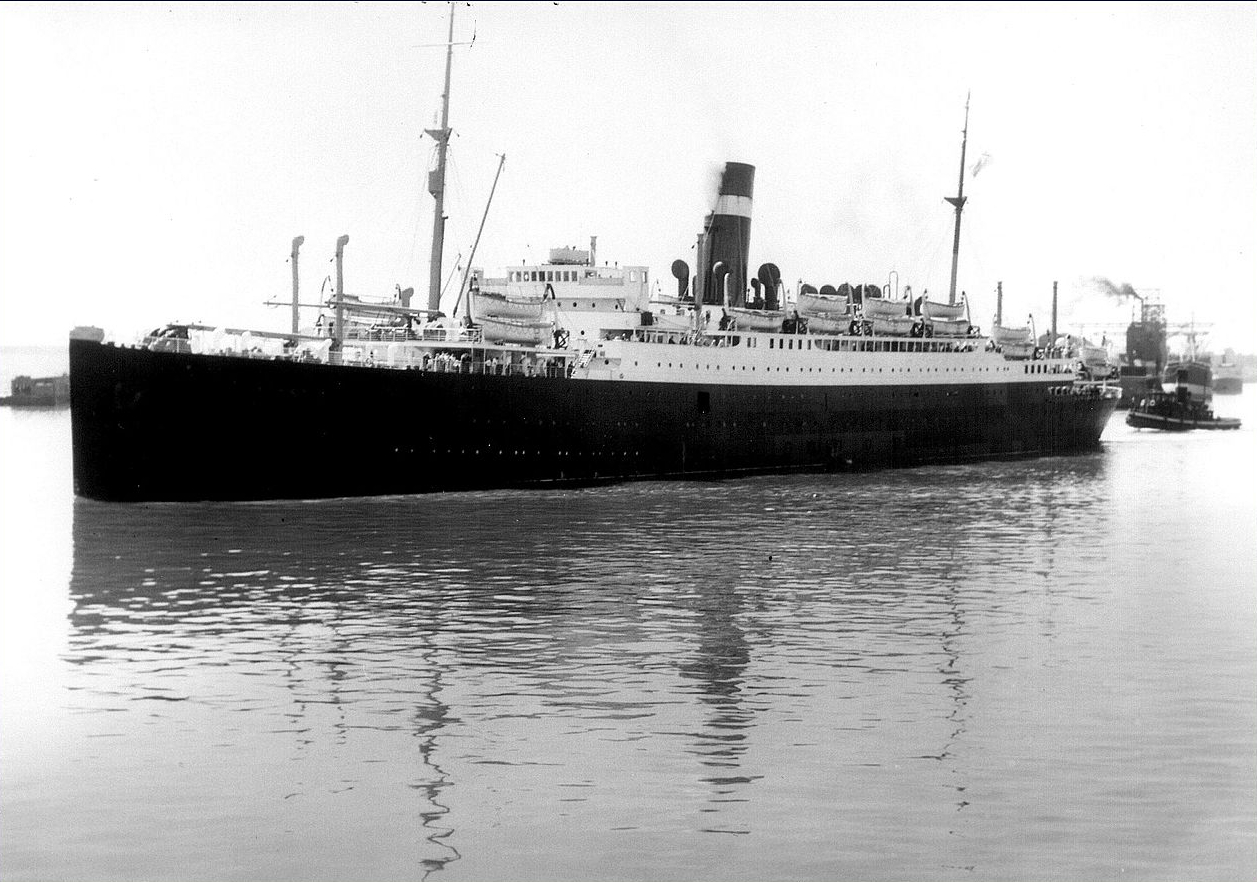
The Record
Donaldson Atlantic Line passenger liner, Glasgow to Montreal, crowded with refugees and tourists caught in the war's opening days. Torpedoed by U-30 west of Rockall at 19:40 on 3 September 1939, nine hours after Chamberlain's declaration of war. The first British merchant vessel sunk in the Second World War. 117 dead of 1,418 aboard, including 28 Americans; Germany denied responsibility until 1946.
The Vessel
The SS Athenia was a British passenger liner of the Donaldson Atlantic Line, built at the Fairfield Shipbuilding yard in Govan, Scotland, and launched on 28 January 1922. She was 160 metres long, 13,465 gross tons, and designed for the Glasgow-Montreal immigrant and general-passenger trade. She carried cabin-class and tourist-class accommodations for 1,550 passengers, with a service speed of 15 knots. She was the second Donaldson ship of her name, the first Athenia (launched 1904) having been torpedoed and sunk by U-53 on 16 August 1917, eight nautical miles south of Inishtrahull.
Her interwar service was unremarkable: routine Atlantic passages between the west coast of Scotland and Canadian ports through two decades, with occasional cruises to the Mediterranean and the West Indies. By the summer of 1939 she was one of the oldest passenger liners still in first-line Donaldson service; the company had placed her on a heavily-booked late-August Glasgow-Montreal run carrying American and Canadian nationals, British emigrants to Canada, and European refugees fleeing the deteriorating political situation on the Continent.
Her commanding officer for the September 1939 voyage was Captain James Cook, 63 years old, a career Donaldson mariner on his final pre-retirement Atlantic command. Her crew and passenger list, assembled on 1 September 1939 as Germany invaded Poland, included 1,103 passengers and 315 crew, a total complement of 1,418.
The Voyage
Athenia left Glasgow at 13:45 on 1 September 1939, the day that Germany invaded Poland. She called at Belfast and Liverpool through the afternoon of 1-2 September and departed Liverpool at 17:00 on 2 September 1939 on the open-Atlantic leg of her voyage to Quebec and Montreal. Her passenger list at the Liverpool departure had grown to 1,103 as additional refugees and American nationals boarded; the total complement was 1,418.
The specific political context was critical. British Prime Minister Neville Chamberlain's ultimatum to Germany had been delivered on the morning of 2 September; the German response was expected shortly. Chamberlain's declaration of war was made on the morning of 3 September 1939. Athenia was, at that moment, approximately 250 nautical miles north-west of Ireland on the Atlantic passage. She was now, under international law, a British merchant vessel of war, though she was a passenger liner carrying non-combatants and was not an armed merchant cruiser.
German submarine U-30, commanded by Oberleutnant zur See Fritz-Julius Lemp, had departed Kiel on 22 August 1939 and had been patrolling the western approaches to Britain since 28 August. At approximately 19:30 on 3 September 1939, nine hours after Chamberlain's declaration of war had reached U-30 by wireless, Lemp sighted Athenia at a range of approximately 2,000 metres. He misidentified her silhouette as that of an armed merchant cruiser, a category of British warship that had been briefed at the German naval staff as a legitimate submarine target at the outbreak of war.
The Disaster
Lemp fired a single G7 torpedo at Athenia at 19:40 on 3 September 1939. The torpedo struck her port side at the engine room. U-30's second torpedo, fired immediately, malfunctioned and circled back toward the submarine itself, forcing Lemp to dive to avoid his own weapon; it eventually ran its course without striking anything.
Athenia's engine room was breached by the initial torpedo strike. Her power failed; her pumps could not operate; her watertight doors, partially closed at the moment of attack, could not contain the flooding. She developed an immediate list to port. Captain Cook ordered abandon-ship at 20:10, 30 minutes after the torpedo strike. The evacuation proceeded in relatively good order because the sea was calm and the 26 lifeboats were adequately provisioned for the ship's actual complement.
Athenia remained afloat through the night of 3-4 September 1939. Rescue ships reached her position in the early morning of 4 September: the Norwegian merchant ship Knute Nelson, the British destroyer HMS Electra, and the American freighter City of Flint. The three ships worked the scene through the morning, picking up survivors from the lifeboats and from debris in the water. Athenia finally sank at 10:50 on 4 September 1939 at approximately 56°30′N 14°10′W in approximately 250 metres of water.
Of her 1,418 passengers and crew, 117 died: 50 were killed in the initial torpedo strike or in the engine room flooding, 10 died on the listing deck or in lifeboat launching accidents, and 57 died of exposure in the cold Atlantic water before the rescue ships arrived. The dead included 28 American citizens, among them Mrs Ruby Mitchell of Chicago (who became the first American citizen killed by German military action in the Second World War).
The Legacy
The political consequences of the Athenia sinking were immediate and extensive. The German government, through Propaganda Minister Joseph Goebbels, officially denied that any German submarine had been in the area; Lemp had violated the Kriegsmarine's own 31 August 1939 prize regulations (which required submarine attacks on unescorted merchant vessels to be conducted under the prize-warning protocol, not by torpedo from submerged position), and the German staff recognised that the sinking would be used by British and American propaganda as the moral basis for the opening weeks of the war.
Lemp's log entries for 3 September 1939 were subsequently altered, on Dönitz's direct order, to remove the reference to Athenia and to substitute a fictitious attack on a different British vessel that night. Lemp himself was informally disciplined (not formally court-martialled) and was returned to operational command of U-30. The fraudulent log alterations were discovered by the Allies after the war from original Kriegsmarine files recovered from the Royal Navy's capture of U-110 on 9 May 1941 (Lemp's subsequent command, where he drowned in the attempt to prevent the British from capturing his Enigma machine).
The American response to the Athenia sinking was significant but ultimately constrained. President Roosevelt's specific rhetorical response, delivered in a national address on 3 September 1939 and repeated on 5 September, stopped short of declaring American support for the Allied cause; but his reference to "the sinking of the Athenia, an unarmed civilian passenger liner" became the first of the sequence of rhetorical landmarks that would eventually produce the Lend-Lease Act of March 1941.
The Athenia is the first British merchant vessel sunk in the Second World War, the first civilian passenger vessel lost in the European naval war, and the first vessel sunk by a German submarine in violation of international humanitarian protocols. Her wreck was located in 2017 by a Finnish-Scottish marine archaeology survey at approximately 250 metres depth, 250 nautical miles north-west of Inishtrahull. She lies on her port side, intact from the engine room forward, the torpedo damage visible on her exposed starboard plating. She is a protected war grave under UK protection-of-military-remains legislation. The 117 dead are commemorated on the Tower Hill Memorial in London; Ruby Mitchell's name is recorded at the U.S. Merchant Marine Memorial at Marine Park in Brooklyn, New York.