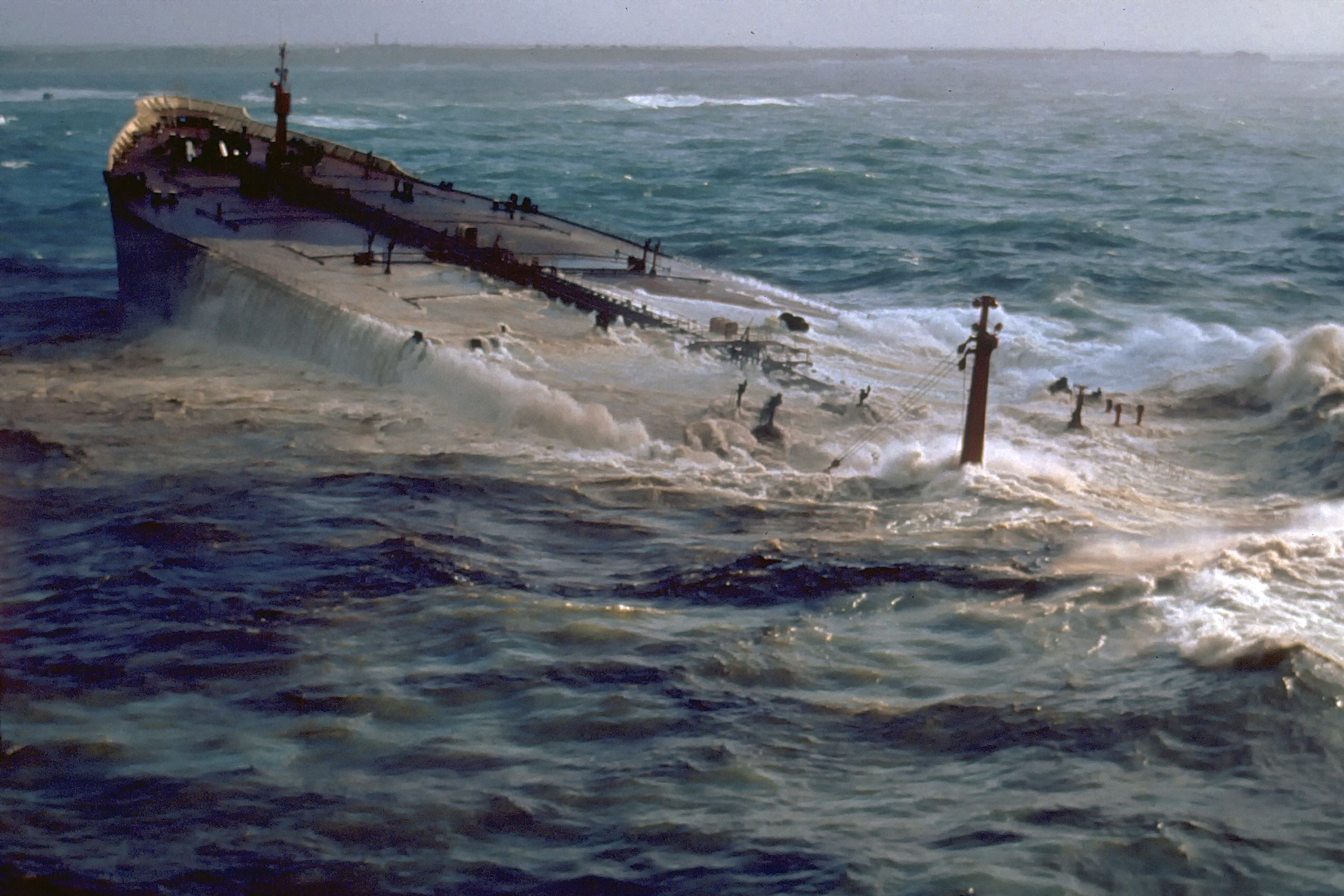
The Record
Liberian-flagged Very Large Crude Carrier, returning 220,000 tonnes of Iranian light from the Persian Gulf to Rotterdam. Her rudder failed off Ushant in a March gale on the morning of 16 March 1978; a West German tug refused to take her in tow without an agreed fee, and by the time negotiations ended the tide had driven her onto Portsall Rocks. She broke in half and spilled 227,000 tonnes of crude across 300 kilometres of Breton coast. The largest oil spill of its kind to that date; the subsequent French civil suit ran for 14 years and produced the most detailed environmental-damage judgement in European legal history.
The Vessel
The Amoco Cadiz was a Very Large Crude Carrier (VLCC) of 233,690 deadweight tons, 334 metres long, built at the Astilleros Españoles yard at Cádiz, Spain, and delivered in May 1974 to the Amoco International Oil Company of Chicago. Her sister ships Amoco Singapore and Amoco Milford Haven operated the same Middle East-to-Europe route; the Amoco Cadiz was, at her commissioning, one of the largest commercial vessels afloat.
She was registered under the Liberian flag, as the overwhelming majority of VLCCs of her era were; Liberian registration afforded the owner tax advantages and less onerous crewing requirements than American or European flag states. Her crew of 44 was predominantly Italian; her master, Captain Pasquale Bardari, was a 43-year-old career Italian merchant mariner whose career had included ten years of VLCC command in Greek and Cypriot flag vessels before his hire by Amoco in 1977.
Her cargo on the voyage of 16 March 1978 was 121,157 tonnes of light Arabian and Iranian crude oil, loaded at Ras Tanura and Kharg Island between 30 January and 6 February 1978, destined for the Amoco refinery at Rotterdam via the English Channel. She had departed the Persian Gulf on 7 February 1978. She was, on the morning of 16 March 1978, approximately five hours from Ushant, the French cape that marks the northwest corner of the Brittany coast.
The Voyage
At approximately 09:45 on 16 March 1978, in heavy weather west of Ushant, the Amoco Cadiz's steering gear failed. The specific failure was in the hydraulic ram of the primary steering system; the failure isolated the rudder in a 10-degree starboard position and removed the ability of the bridge to steer. Her master, Captain Bardari, responded with a sequence of emergency measures (stopping the main engines, dropping the port anchor) that would have been appropriate in calm water and were substantially less appropriate in the force-10 weather then prevailing.
Bardari radioed for tug assistance at approximately 11:00. The nearest ocean-going tug was the West German salvage tug Pacific, 45 minutes away. Pacific under Captain Hartmut Weinert reached the Amoco Cadiz at 11:45 and began negotiating terms of the tow with Bardari under the standard Lloyd's Open Form "No Cure, No Pay" salvage contract. The negotiation was conducted by radio between Bardari and Weinert, with additional radio traffic between Weinert and his employer Bugsier Reederei in Hamburg, and between Bardari and the Amoco Oil Marine Department in Chicago. The negotiation lasted approximately three and a half hours.
In the course of this negotiation, the Amoco Cadiz drifted toward the French coast at approximately 2.5 knots, driven by the westerly gale. By 15:00 she was some 10 miles off the Brittany coast, a distance that was closing faster than the tug could secure a workable tow in the weather. At approximately 16:00 Pacific finally had a tow line aboard and began attempting to manoeuvre the tanker out to sea. The first tow line parted at 17:15 under the combined strain of the swell and the tanker's inertia. A second line was made fast by 18:00 and also parted within an hour. At 21:04 on 16 March 1978 the Amoco Cadiz grounded on the Portsall Rocks off the Finistère coast.
The Disaster
The grounding opened her forward cargo tanks on the first impact. The tide was falling; she settled onto the rocks as the tide ran out overnight, opening further tanks. By the morning of 17 March she had broken her back on the rocks; by 28 March she had broken in two; by 30 March she was three separate sections on the Portsall bar. The entire 223,000 tonnes of her crude oil cargo was released into the sea between 16 March and 30 March 1978.
The spill was, at its release, the largest marine oil spill in history. Its contamination of the Brittany coast was worsened by the specific circumstances of the French tidal regime: the Portsall Rocks are on the edge of a very high-energy tidal stream area where the Atlantic tide ranges 8 metres or more, and the oil was distributed by tidal pumping across approximately 400 kilometres of Breton coast. 76 coastal communes were directly affected; the Breton oyster, scallop, and kelp industries collapsed in 1978 and had not recovered fully by 1985.
The French government's response, coordinated by the Prefect of the Finistère department, was the largest oil-spill cleanup France had ever mounted. Approximately 6,000 French military personnel, 300 Royal Navy personnel seconded under NATO arrangements, and 20,000 civilian volunteers participated in the beach-cleaning operation over the following ten months. The cost of the French national response was approximately $75 million in 1978 dollars.
The Legacy
The litigation that followed was, at the time of its 1992 settlement, the longest international commercial lawsuit in modern history. The French state, 90 Breton coastal communes, and several thousand individual Breton claimants sued Amoco International in the United States Federal District Court for the Northern District of Illinois, Chicago, where Amoco's corporate headquarters were located. The case, In re Oil Spill by the Amoco Cadiz off the Coast of France, ran from its filing in 1978 through trial in 1982-1986, the initial judgement in 1988, the appellate process through 1990, and the final settlement in 1992.
The court's 1988 finding, upheld on appeal, was that Amoco International was liable for the full cost of the spill and could not disclaim liability through its Liberian-flag corporate structure. The court specifically found that Amoco's maintenance of the Amoco Cadiz's steering gear had been inadequate, that the steering system's hydraulic ram had been a known reliability problem across the class since 1976, and that Amoco had not communicated this known defect to its masters. The total judgement against Amoco was approximately $250 million in 1988 dollars, the largest marine pollution liability judgement in history to that date.
The more important legacy was regulatory. The International Maritime Organization's 1978 Protocol to the International Convention for the Prevention of Pollution from Ships (MARPOL 73/78), which had already been in negotiation at the time of the grounding, was substantially strengthened in its final 1983 form under the direct influence of the Amoco Cadiz spill. The 1983 MARPOL required segregated ballast tanks in all new tankers above 20,000 tons deadweight, a measure that reduced the pollution risk of ballast operations by approximately 30 per cent across the global tanker fleet. The Amoco Cadiz spill is, directly, the reason that all modern oil tankers carry segregated ballast in dedicated compartments rather than in their cargo tanks.
The wreck of the Amoco Cadiz lies scattered across the Portsall Rocks, where most of the hull has broken up and been dispersed by tidal action over the subsequent decades. Her remaining identifiable sections are protected as a marine archaeology site under French law. A memorial to the spill stands on the quay at Portsall; the anchor of the Amoco Cadiz, recovered during the salvage operations of 1978-79, is mounted at the centre of the memorial with a plaque listing the 76 affected communes. The Breton tourism office continues to cite 1978 as the year of the Marée Noire, the Black Tide, the most significant event of recent regional history.