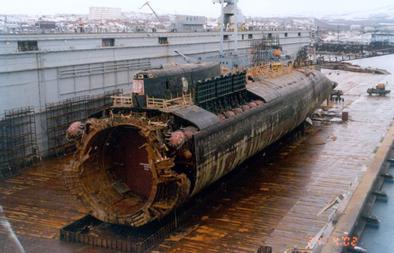
The Record
Russian Oscar II-class nuclear-powered submarine, on a naval exercise in the Barents Sea. A hydrogen peroxide leak in a practice torpedo ignited at 11:28 on 12 August 2000; two minutes later the detonation breached the forward magazine and a larger blast destroyed the bow. Twenty-three men survived in the stern and lived for hours, tapping on the hull. The Russian Navy refused foreign rescue help for 36 hours while Putin remained on his Black Sea holiday. 118 dead, the defining political failure of the early Putin government.
The Vessel
The Kursk (K-141) was a Project 949A Antey-class cruise-missile submarine of the Russian Northern Fleet, the second-to-last Oscar II-class boat built by the Soviet and then Russian shipbuilding industry. She was launched at Severodvinsk on 16 May 1994 and commissioned on 30 December 1994 at the very end of the boats that Soviet shipbuilding had begun laying down in the 1980s. She was 154 metres long, displaced 19,400 tons submerged, and was designed around twenty-four SS-N-19 Shipwreck (P-700 Granit) anti-ship cruise missiles carried in external launch tubes angled at 40 degrees forward of her sail.
Her mission was the destruction of American aircraft carrier battle groups. The Oscar II class had been designed in the 1970s as the Soviet Navy's principal weapon against the post-Vietnam American naval order, specifically against the battle groups built around the Nimitz-class carriers; her 24 missiles, fired in a coordinated salvo, were calculated to saturate the Aegis defences of a full American carrier group. She was a fighting submarine of the Cold War, commissioned three years into the post-Cold War era.
Her post-Cold War Northern Fleet service had been constrained by the general financial collapse of the Russian military establishment through the 1990s. She had spent 1995 through 1999 mostly alongside at Vidyayevo on the Kola Peninsula, conducting only short training patrols because the fleet could not afford the fuel or the maintenance for full deployments. Her August 2000 exercise, Summer-X 2000, was her first participation in a major Northern Fleet exercise since her commissioning six years earlier. It was to be observed by the Russian president Vladimir Putin, six months into his first term, as part of the Northern Fleet's public demonstration that its capabilities had been restored.
The Voyage
She sailed from Vidyayevo on the morning of 10 August 2000 under the command of Captain First Rank Gennady Lyachin, 45 years old, a 23-year submarine veteran promoted to her command in 1999. Her crew of 118 was an unusually strong complement for a Russian boat of her era: many were senior specialists posted to Kursk for the duration of the exercise, including two engineering officers from the Kola Peninsula submarine command who had been drafted aboard specifically to oversee the torpedo tests planned for 12 August.
The Summer-X 2000 exercise required Kursk to fire two practice torpedoes on 12 August: a Type 65-76A practice weapon with a hydrogen peroxide (high-test peroxide, HTP) oxidiser, at a surface target in the Barents Sea north of Severomorsk. The Type 65-76A was a Soviet-era heavyweight torpedo design of the 1970s whose hydrogen peroxide propulsion system had a known history of accidental ignition; the Royal Navy had abandoned the identical British Mark 12 torpedo in 1955 after the loss of HMS Sidon in the same way. Russian and Soviet naval safety assessments had classified the Type 65-76A's HTP system as acceptable with proper handling; the torpedo was still in inventory and routinely loaded for exercises.
At 11:28 on 12 August 2000, with Kursk at periscope depth and preparing to fire her first practice torpedo, a leak developed in the HTP oxidiser tank of the Type 65-76A loaded in her Number 4 torpedo tube. The leak accelerated; the HTP came into contact with the kerosene propellant; the chemical reaction became a fire inside the sealed tube.
The Disaster
Two minutes and fifteen seconds after the initial leak began, at 11:30 and 42 seconds on 12 August 2000, the Type 65-76A torpedo detonated inside the torpedo tube. The detonation was recorded on the seismograph at Kongsberg in Norway as a 1.5-magnitude event. The blast breached the forward bulkhead between the torpedo room and the first compartment, venting flame and debris into the control room.
One hundred and thirty-five seconds after the first detonation, at 11:32 and 54 seconds, a second and much larger explosion destroyed the forward third of the Kursk. This detonation was recorded as a 3.5-magnitude event and corresponded to the ignition of approximately seven of the remaining torpedoes and shells stored in the forward weapons compartment. The blast destroyed the control room, the first compartment, the second compartment, and the forward edge of the third. Captain Lyachin and the forty-odd crew members in the forward sections died instantly. The force of the second explosion drove the remainder of the hull down and into the Barents Sea floor at 108 metres.
Twenty-three men survived the blast, sealed by the closed watertight doors in the aft compartments. They gathered in the ninth and tenth compartments over the following hours. Captain-Lieutenant Dmitri Kolesnikov, 27 years old and newly married, led the survival party; his body, recovered with the ship in October 2001, carried a handwritten note dated 13:15 on 12 August 2000 listing the names of the twenty-three survivors and describing the darkness of the flooded compartment and the falling oxygen level.
The Russian Navy's initial response was dysfunctional. The first rescue submarine reached the wreck on the evening of 12 August but failed to mate with the escape hatch because of misalignment damage to the hull. Subsequent rescue attempts over 14, 15, and 16 August all failed. For thirty-six hours the Russian Northern Fleet refused foreign rescue assistance, despite specific offers from the British and Norwegian navies whose deep-sea rescue vehicles were better equipped for the specific conditions of the Barents seabed. Putin, on holiday at his Black Sea dacha, did not return to Moscow until the fifth day of the crisis.
By the time Norwegian and British divers reached the aft escape hatch on 21 August, all twenty-three surviving crew had been dead for perhaps a day. The oxygen candles the survivors had been burning to maintain the atmosphere had set the eighth compartment on fire; the fire had consumed the remaining oxygen. 118 men died.
The Legacy
The political consequences in Russia reached into the Putin government's first political crisis. Putin's holiday absence during the rescue, his deflection of responsibility toward the previous (Yeltsin-era) defence establishment, and his dismissive televised response to the mother of a dead sailor on 22 August ("it sank") produced the first significant drop in his approval ratings. The Russian liberal press, which still existed in 2000, covered the Kursk story critically; the subsequent closure of NTV television under state pressure in April 2001 is widely connected by Russian media historians to the Kursk coverage.
The Kursk was raised from the Barents Sea floor in October 2001 in one of the most complex marine engineering operations ever undertaken. A consortium of Dutch salvage companies (Smit Tak and Mammoet) contracted by the Russian Navy cut the shattered bow section from the rest of the hull underwater, lifted the remaining ten compartments onto a submersible barge, and towed her to the Roslyakovo dry dock near Murmansk. 115 of the 118 bodies were recovered and buried at the Serafimovskoye Cemetery in St. Petersburg and at Vidyayevo.
The official Russian investigation, published in 2002, identified the Type 65-76A torpedo HTP leak as the proximate cause. The secondary cause, the disorganised initial rescue response, was not officially addressed; the investigation did not name any senior officer for disciplinary action. Captain First Rank Vyacheslav Popov, the Northern Fleet commander, was retired from active service in 2001. No one was prosecuted.
The Type 65-76A torpedo was withdrawn from the Russian Navy inventory following the Kursk investigation. The Oscar II-class boats were progressively retired or converted to the modernised Project 949AM configuration with different torpedo armament. The Kursk disaster ended the Russian Navy's use of HTP-propelled heavyweight torpedoes, a forty-year Soviet weapons programme that the original British lesson of HMS Sidon in 1955 had been, for the Soviet Navy, insufficient to terminate.
Dmitri Kolesnikov's note, recovered from the ninth compartment, has been displayed at the Central Naval Museum in St Petersburg since 2003. It reads: "It is dark here to write, but I'll try by feel. It seems like there are no chances, 10-20 percent. Let's hope that at least someone will read this. Here are the lists of the personnel of the other sections that are now in the 9th and will try to get out. Hello to everyone, no need to despair. Kolesnikov."