The Record
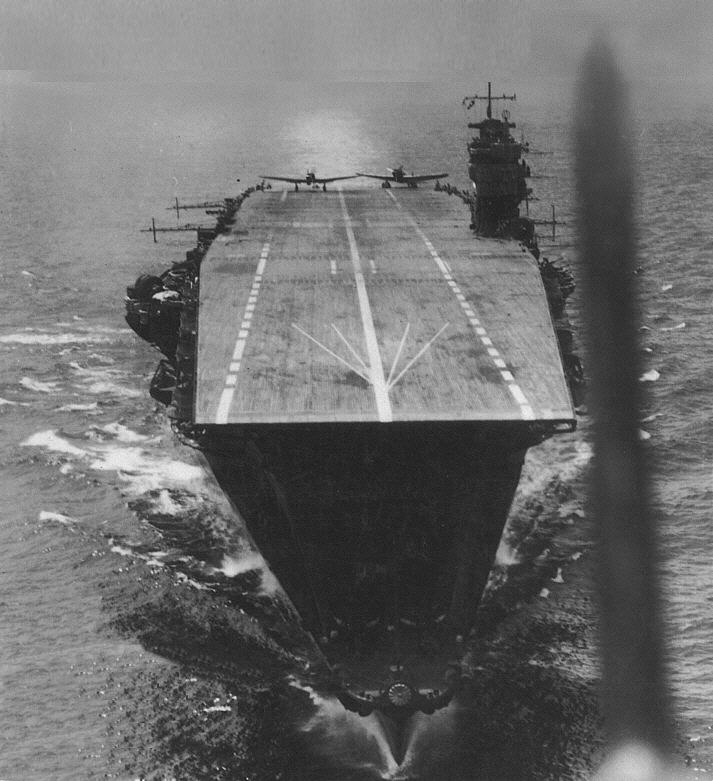
Flagship of the Kidō Butai, the Japanese fast carrier strike force that attacked Pearl Harbor. At the Battle of Midway on the morning of 4 June 1942, a single American Dauntless dive bomber planted a 1,000-pound bomb among her fuelled and armed aircraft; she burned all day and was scuttled the next morning. 267 dead; 1,630 survived. Located in 2019 by Paul Allen's RV Petrel at 5,490 metres.
The Vessel
The Imperial Japanese Navy aircraft carrier Akagi was the flagship of the Kidō Butai, the First Air Fleet that was the principal strategic striking force of the Imperial Japanese Navy through the first six months of the Pacific War. She had been originally laid down in 1920 as the second of the Amagi-class battlecruisers but was converted during construction into an aircraft carrier under the terms of the Washington Naval Treaty. She was commissioned on 25 March 1927 at the Kure Naval Arsenal.
As commissioned Akagi displaced 36,500 tons, was 260 metres long, and carried an unusual three-deck flight arrangement derived from early British carrier practice. The 1935-1938 modernisation rebuilt her with a conventional single continuous flight deck, a starboard-side island superstructure, and improved protection. As rebuilt she carried 66 aircraft (18 fighters, 18 dive bombers, 27 torpedo bombers, plus reserves) and could operate them at 31.5 knots, a standard comparable to the American Lexington-class.
She served as the flagship of the First Air Fleet under Vice-Admiral Chūichi Nagumo from April 1941. Her air group led the 7 December 1941 attack on Pearl Harbor as the lead ship of the Kidō Butai's six-carrier strike force. She subsequently participated in the January 1942 raids on Rabaul, the February 1942 attack on Darwin, the March 1942 operations in the Indian Ocean (sinking HMS Hermes, HMS Dorsetshire, and HMS Cornwall), and the May 1942 support of Operation MO. By June 1942 she had compiled the most successful operational record of any carrier in history up to that date.
The Voyage
On the morning of 4 June 1942 Akagi was the flagship of the Kidō Butai operating 240 nautical miles north-northwest of Midway Atoll. Admiral Nagumo's force comprised four fleet carriers (Akagi, Kaga, Sōryū, Hiryū), two fast battleships (Haruna, Kirishima), three cruisers, and a screen of eleven destroyers. The specific operational plan of 4 June was to destroy Midway's defending aircraft and shore installations in a dawn strike, then to deal with any American carrier force that might appear.
The opening Midway strike was launched at 04:30 on 4 June 1942. Akagi's air group commander Captain Minoru Genda, observing from Nagumo's bridge, directed the first wave of 108 aircraft against Midway. The strike reached Midway at 06:30 and caused considerable damage to installations; however, American forces had had sufficient warning (through the Magic intelligence intercepts that had broken the Japanese naval code) to launch a counter-strike of their own. The American carriers Enterprise, Hornet, and Yorktown were at that moment some 250 nautical miles east of the Kidō Butai, preparing their own strike against Nagumo's carriers.
Through the early morning of 4 June 1942 the two carrier forces searched for each other across the Pacific. American PBY Catalina aircraft located the Japanese force at 07:00. The American carrier air groups were launched against the Japanese position over the following three hours. The American aircraft, however, reached the Japanese force in uncoordinated waves rather than in a single strike. The American torpedo bomber squadrons reached the Kidō Butai first, between 09:20 and 10:00; all were shot down with negligible damage to the Japanese carriers. The American dive bomber squadrons reached the Japanese force at 10:22, exactly as Akagi's flight deck was being re-armed for a strike against the American carriers.
The Disaster
At 10:22 on 4 June 1942, Lieutenant-Commander Richard Best of USS Enterprise's dive bomber squadron VB-6, piloting a Douglas SBD Dauntless dive bomber at 6,000 metres altitude, identified Akagi as his target. Akagi's flight deck at that moment held 18 torpedo-armed Nakajima B5N Kate torpedo bombers being prepared for launch, along with fully-fuelled aircraft of her combat air patrol. Best's dive attack produced a single bomb hit directly amidships.
The single 1,000-pound bomb, striking at a relatively gentle angle of 45 degrees, penetrated Akagi's wooden flight deck and detonated on her upper hangar deck. The detonation occurred among the torpedo-armed, fully-fuelled aircraft being prepared for launch. The resulting chain reaction was catastrophic: aviation fuel from ruptured lines ignited; the aerial torpedoes detonated in succession; the 250-kilogram bombs on the armed aircraft detonated; the fire spread through the hangar deck and downward into the main deck. By 10:30, Akagi was on fire from end to end and was unable to manoeuvre.
Admiral Nagumo transferred his flag to the light cruiser Nagara at 10:46 and was evacuated from the burning flagship. Captain Taijirō Aoki remained aboard Akagi with a damage-control party; through the afternoon and evening of 4 June the party attempted to save the ship. The fires could not be contained. At 18:00 on 4 June Akagi's starboard engine compartment exploded. Captain Aoki ordered the ship's company to abandon ship at 19:20. The surviving destroyers took off approximately 1,630 of her 1,897 crew; 267 died in the fires and the subsequent abandonment.
Akagi was scuttled at 04:55 on 5 June 1942 by four Type 93 torpedoes fired by the destroyer Arashi at a range of 700 metres. She sank at 05:20 at approximately 30°30′N 179°8′W in approximately 5,490 metres of water. Vice-Admiral Nagumo had, by that morning, lost three of his four fleet carriers (Akagi, Kaga, Sōryū) in the space of approximately two hours.
The Legacy
The Battle of Midway, of which Akagi's loss was the central event, has been universally identified by subsequent American and Japanese military historians as the strategic turning point of the Pacific War. Before Midway, the Imperial Japanese Navy had conducted offensive operations throughout the Pacific basin with substantial freedom of action; after Midway, the Japanese fleet did not conduct a major offensive operation until the October 1944 Leyte Gulf campaign, and did so with vastly reduced resources. The four Japanese carrier losses (Akagi, Kaga, Sōryū, Hiryū) at Midway could not be replaced in a Japanese economy that could not match the American industrial base; the Imperial Japanese Navy never recovered the offensive capability it lost between 10:22 and 10:30 on the morning of 4 June 1942.
The specific tactical lesson of Akagi's destruction, and of the parallel destruction of Kaga and Sōryū in the same 60-minute window, was the catastrophic vulnerability of a fleet carrier caught with armed and fuelled aircraft on her hangar deck during a re-arming cycle. The Japanese carrier doctrine of 1942 had not fully appreciated this vulnerability; the American carrier doctrine, after 4 June 1942, institutionalised strict protocols for aircraft de-fuelling, fuel-line purging, and bomb-handling that would reduce the risk of analogous losses in subsequent engagements.
The wreck of Akagi was located in October 2019 by an expedition from the Research Vessel Petrel (operating under the sponsorship of the late Paul Allen's foundation). She lies at 5,490 metres depth, upright on the abyssal plain, with the bomb-impact crater visible on her flight deck. The Petrel survey also located Kaga 11 kilometres to the east; subsequent surveys in 2023-2024 located Hiryū and Sōryū. All four Midway carriers are now located; their relative positions, consistent with the known sinking locations of 4-5 June 1942, have clarified several historical questions about the battle's sequence.
All four wrecks are protected under the Sunken Military Craft Act 2004 as foreign military vessels in United States waters (the positions are in the international waters claimed by the United States as part of the Papahānaumokuākea Marine National Monument). The Japanese government has not made a formal statement on the wrecks' status but has participated in commemorative events at the discovery locations. The 267 dead of Akagi are commemorated at the Yasukuni Shrine in Tokyo, along with the combined dead of the four Midway carriers. The name Akagi is not currently carried by any JMSDF vessel, though a future Izumo-class helicopter destroyer has been rumoured for the name. The four flight decks of 4 June 1942 were the turning point of the Pacific War.