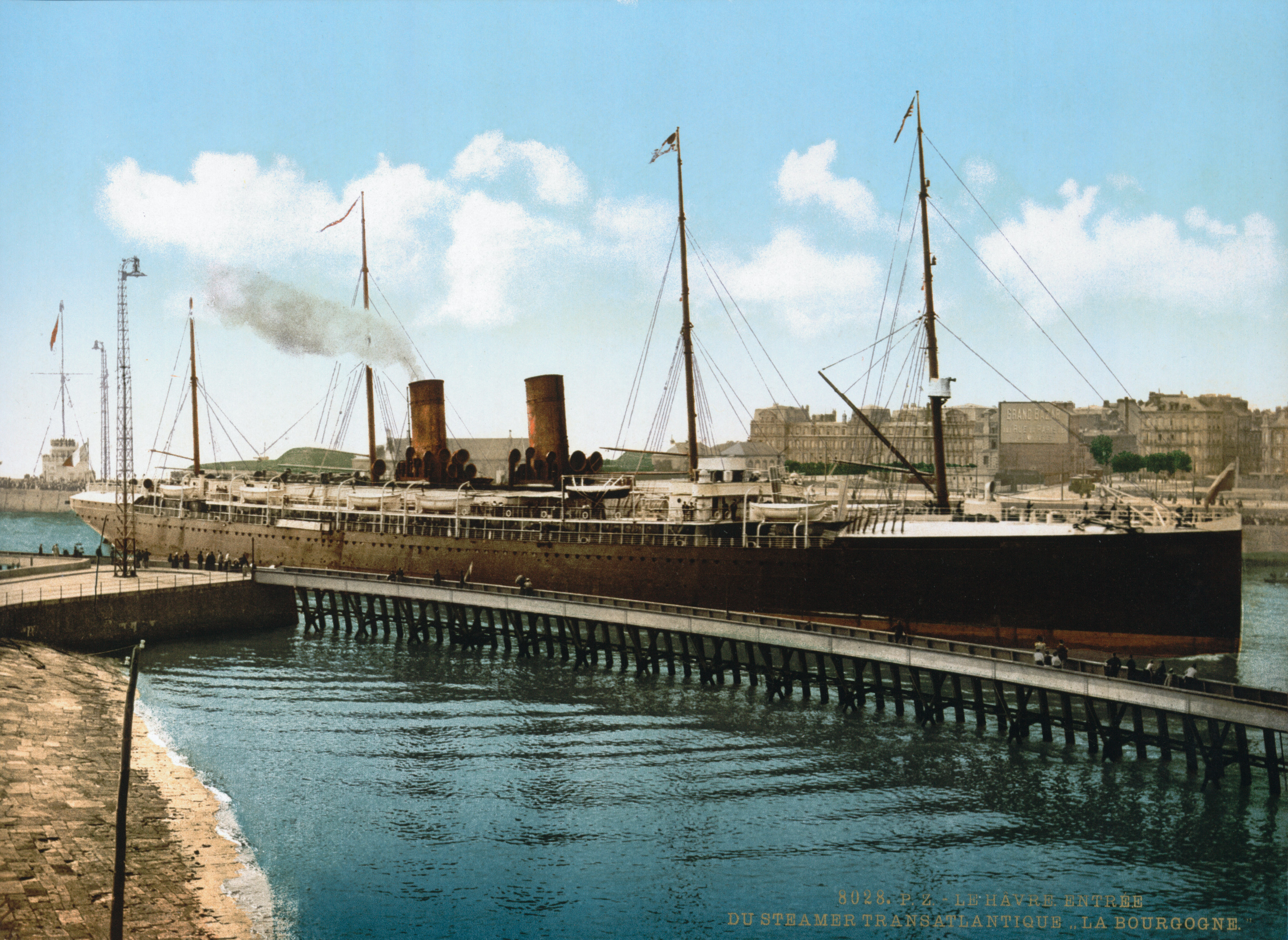
The Record
French Line transatlantic liner, New York to Le Havre. Rammed in dense fog by the British sailing ship Cromartyshire off Sable Island on 4 July 1898 and sank in thirty minutes. 549 dead, including every child and all but one woman aboard; the French crew seized the lifeboats, beating passengers back with oars, and were widely reviled in the press of two continents. The disaster was a scar on the French merchant marine for decades.
The Vessel
The SS La Bourgogne was a French Compagnie Générale Transatlantique (CGT, "French Line") passenger steamer, commissioned at the Forges et Chantiers de la Méditerranée yard at La Seyne-sur-Mer on 10 April 1885. She was 152 metres long, 7,395 gross tons, with compound-expansion steam propulsion on twin screws and a service speed of 17 knots. Her specific role was the Le Havre-New York passenger and mail trade, on the principal French route across the North Atlantic.
The CGT's Le Havre-New York route was the principal French competitor against the British Cunard and White Star transatlantic services; the La Bourgogne and her three sister ships (La Gascogne, La Champagne, La Normandie) were the core of the CGT's express-service fleet. By the late 1890s the class had been in continuous service for approximately 15 years; La Bourgogne had completed approximately 140 Atlantic round-trips.
Her master in July 1898 was Captain Louis Deloncle, 49, a career CGT officer.
The Voyage
On 2 July 1898 La Bourgogne departed Le Havre on her regular eastbound Atlantic voyage, bound for New York. Her complement for the voyage was 725 aboard: 506 passengers (a mix of French, American, and European travellers) and 219 ship's crew. The weather in the North Atlantic through 2-4 July 1898 was fair; the voyage proceeded routinely through the first three days.
At approximately 05:00 on 4 July 1898, La Bourgogne was approximately 60 kilometres south of Sable Island, Nova Scotia, in heavy fog that had developed overnight. Visibility was approximately 100 metres; La Bourgogne was proceeding at approximately 13 knots, which (by the contemporary maritime regulation and by the CGT's own operating standards) was substantially above the safe speed for the prevailing fog conditions.
Approaching La Bourgogne from the opposite direction, proceeding eastward at approximately 10 knots, was the British iron sailing ship Cromartyshire, a 1,554-ton four-masted iron sailing barque of the British merchant marine. The Cromartyshire was running before the wind under reduced canvas because of the fog.
At approximately 05:00 on 4 July 1898, the Cromartyshire's reinforced iron bow struck La Bourgogne's port side amidships. The collision was severe: the Cromartyshire's bow penetrated La Bourgogne's hull below the waterline at Frame 55, producing a hull breach approximately 8 metres wide and 3 metres deep.
The Disaster
The damage to La Bourgogne was immediately fatal. Her main engine room and adjacent compartments flooded within 15 minutes of the strike; her electrical power was lost; her list to port progressed to approximately 25 degrees within 20 minutes.
The specific horror of the La Bourgogne sinking, which produced the subsequent international scandal, was the conduct of the CGT crew during the evacuation. The ship's crew (approximately 219 in number) systematically seized the lifeboats at the expense of the passengers, using physical force to drive the passengers away from the lifeboat-launching stations. The specific reports of the surviving passengers, published in the American and European press through July and August 1898, described crew members using oars, revolvers, and knives to prevent passengers from boarding the lifeboats.
The casualty pattern of the La Bourgogne disaster reflected the specific conduct of the crew. Of the 725 aboard, 549 died: 502 passengers, 47 crew. 176 survivors were recovered by the Cromartyshire (which had remained on scene despite having been damaged in the collision) and by three passing steamers that arrived over the following 24 hours. Of the 167 women aboard La Bourgogne, 166 died; 1 survived. Of the 47 children aboard, all 47 died. Of the 219 ship's crew, 47 died.
SS La Bourgogne sank at approximately 07:00 on 4 July 1898 at approximately 43°50′N 60°15′W, in approximately 800 metres of water south of Sable Island.
The Legacy
The SS La Bourgogne disaster was one of the worst civilian maritime disasters of the pre-Titanic era in terms of casualty count; its specific cultural resonance, however, was produced less by the casualty count than by the conduct of the French crew during the evacuation. The specific ethical failure of the crew became, in contemporary North American and European press coverage, the emblematic case of "maritime cowardice" of the late nineteenth century.
The subsequent French investigation, conducted by the French Ministry of Marine through autumn 1898, was substantially defensive of the CGT and of the surviving crew. The French Board of Inquiry's findings (published in March 1899) attributed the primary responsibility for the disaster to Captain Deloncle (who had died in the sinking) for his excessive speed in fog conditions; the Board's secondary findings criticised the crew's conduct during evacuation but did not recommend criminal prosecution of any surviving crew member. The specific leniency of the French Board's findings was the subject of substantial international criticism.
The American and British response was significantly sharper. The American press coverage through 1898-1899 systematically identified specific CGT crew members whose conduct had been particularly reprehensible; the British press coverage was similarly critical. The specific comparison with the 1854 SS Arctic disaster (44 years earlier, also involving Atlantic steamer crew cowardice) became a common frame of reference: the Arctic and La Bourgogne were compared as the two canonical cases of crew-cowardice maritime disasters of the nineteenth century.
The specific regulatory consequences of the La Bourgogne disaster included significant reforms in CGT operational doctrine and in French maritime regulation generally. The CGT's subsequent operational procedures (implemented through 1899-1900) included mandatory crew-restraint protocols during evacuation, mandatory passenger-priority enforcement by ship's officers, and specific disciplinary protocols for crew members engaged in lifeboat-commandeering conduct. The French Merchant Marine Act of 1902 (enacted partially in response to the La Bourgogne case) established the first French regulatory framework for passenger-vessel emergency evacuation protocols.
The La Bourgogne case was specifically referenced, 14 years after her sinking, in the 1912 Titanic inquiry as an historical precedent for passenger-ship evacuation failures. The specific comparison favoured the Titanic's crew: despite the catastrophic casualty count of the Titanic, the Titanic crew had not engaged in the systematic passenger-exclusion conduct that had characterised the La Bourgogne evacuation.
The wreck of La Bourgogne lies at approximately 800 metres depth off Sable Island, Nova Scotia. She has not been located by modern deep-ocean survey expeditions. The 549 dead are commemorated at the La Bourgogne Memorial at Le Havre, at the specific Compagnie Générale Transatlantique memorial at the Louvre, and at individual memorials in the French and American families of the dead. The La Bourgogne case remains, in French and American maritime historiography, the canonical example of late-Victorian passenger-ship crew cowardice.