The Record
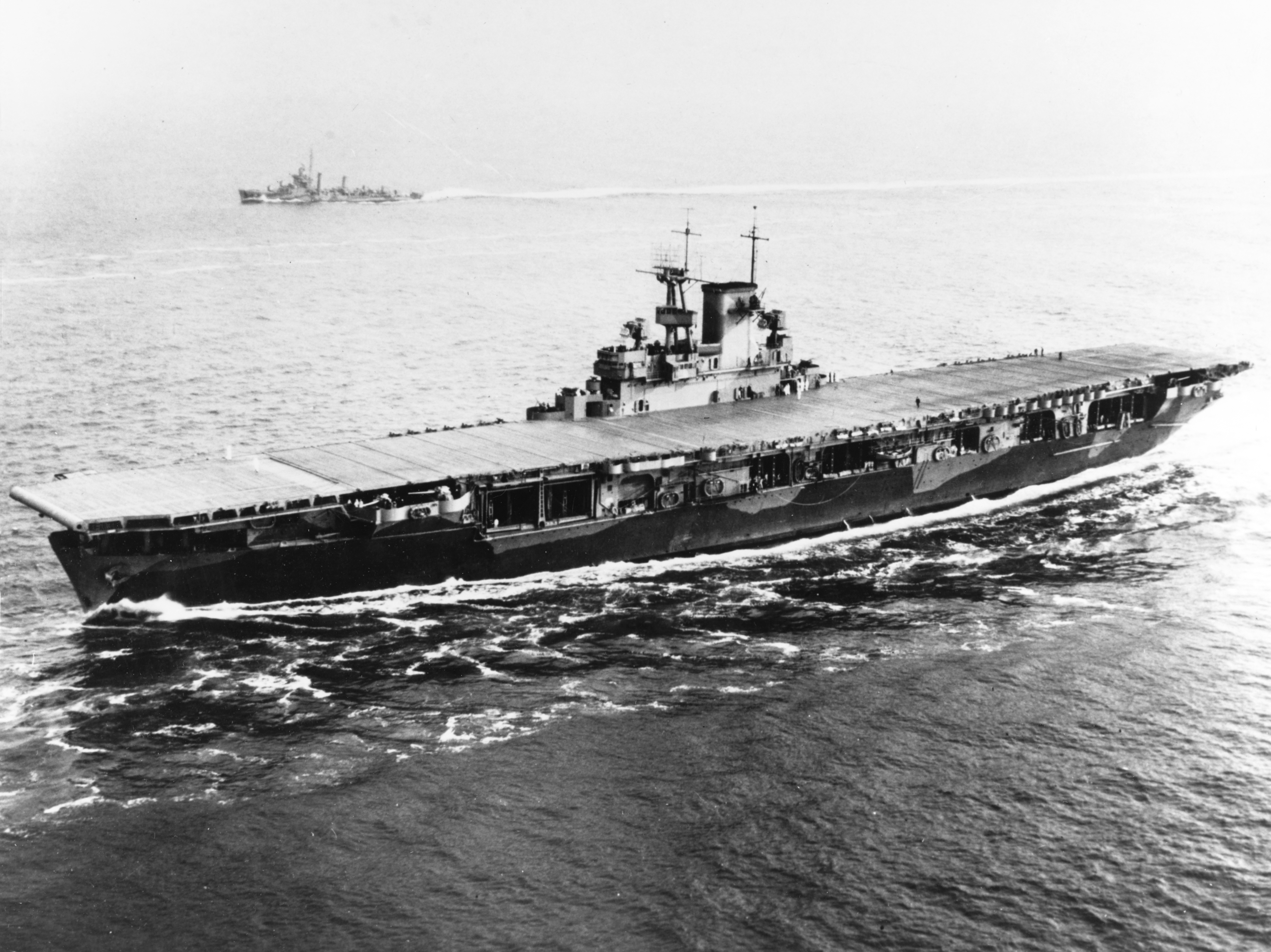
American Wasp-class aircraft carrier, covering the Guadalcanal reinforcement convoy. Struck by three torpedoes from the Japanese submarine I-19 at 14:44 on 15 September 1942: part of the most damaging single salvo of torpedoes in submarine history, three of six also hit USS O'Brien and USS North Carolina. 193 dead. Aviation fuel lines ruptured and damage-control pumps failed; scuttled by USS Lansdowne that evening. Found in 2019 by Paul Allen's team in 4,500 metres.
The Vessel
USS Wasp (CV-7) was a reduced-displacement fleet aircraft carrier of the United States Navy, commissioned at the Fore River Shipyard in Quincy, Massachusetts, on 25 April 1940. She was 226 metres long, 14,700 tons standard displacement, approximately 60 per cent the size of the contemporary Yorktown-class carriers. Her reduced size was a specific consequence of the 1936 London Naval Treaty's carrier tonnage limits: the United States had 15,000 tons of remaining carrier tonnage available under the treaty and had built Wasp to fit the allocation precisely.
Her smaller size imposed significant compromises. Her air group was 76 aircraft (smaller than a Yorktown's 90); her bunkerage was sufficient for approximately 9,000 nautical miles at 15 knots (shorter-legged than her full-sized sisters); and her armour protection was limited to splinter-proofing against bomb fragments. She was, at her commissioning, the most austere American fleet carrier in service.
Her first eighteen months of service were in the Atlantic. She participated in the North African convoy runs of late 1940, the Malta relief operations of April and May 1942 (ferrying 47 British Spitfires to the besieged island), and the 1941 Allied occupation of Iceland. She transferred to the Pacific in June 1942 after the loss of USS Lexington and the damage to USS Yorktown. Her commanding officer was Captain Forrest Sherman, 45, a career naval aviator who had commanded a destroyer squadron before his carrier assignment.
The Voyage
By September 1942 USS Wasp was operating with Task Force 18 in the Solomons campaign, providing air support for the Marine ground operations at Guadalcanal. The Japanese counteroffensive on Guadalcanal had been continuous since the August landings; American reinforcements were being moved through the Solomon Sea in a running campaign against Japanese submarines, aircraft, and surface forces operating from Rabaul and Truk.
On 15 September 1942, Wasp was steaming south in the Solomon Sea at approximately 11°S 164°E, some 240 kilometres southeast of San Cristobal Island, with the American battleship USS North Carolina, the light cruiser USS O'Brien, and an escort of destroyers. The formation was covering the movement of the Marine 7th Regiment to Guadalcanal aboard the transport USS Fuller.
The Japanese fleet submarine I-19 under Commander Takakazu Kinashi, 36 years old, had been patrolling the same water for three days. I-19 was one of Japan's Type B1 cruiser submarines, 2,198 tons submerged, carrying six 533 mm torpedo tubes (five forward, one aft) and a magazine of 17 Type 95 torpedoes with 400-kilogram warheads. The Type 95 was the submarine-launched variant of the Imperial Japanese Navy's remarkable Type 93 Long Lance torpedo: oxygen-fuelled, extremely fast, and with exceptional range (11,000 metres at 49 knots).
Kinashi sighted the American task force at 14:20 on 15 September 1942 at a range of approximately 5,000 metres. He closed to a firing position on Wasp's starboard bow and, at 14:44, fired six torpedoes from his forward tubes in a full salvo.
The Disaster
The six-torpedo salvo fired by I-19 at 14:44 on 15 September 1942 is the most damaging single torpedo salvo in the history of submarine warfare. Three of the six torpedoes struck USS Wasp. Two others continued through the American formation past Wasp and struck the battleship USS North Carolina (one torpedo hit; moderate damage) and the destroyer USS O'Brien (one torpedo hit; eventually fatal damage). The sixth torpedo missed and continued to the horizon. No single submarine in any war has ever inflicted more damage with a single salvo.
The three torpedo hits on Wasp struck in quick succession on her starboard side between 14:45 and 14:46: one forward, one amidships, one aft. The hits ignited her forward aircraft-fuel storage, ruptured her damage-control water mains, and produced a series of secondary explosions as the compartments flooded. Wasp's damage control response was comprehensive but her scale had made her vulnerable: with less redundancy than her Yorktown sisters, she had fewer options when multiple systems failed simultaneously.
Captain Sherman ordered abandon-ship at 15:20 on 15 September 1942, 35 minutes after the first torpedo strike. The evacuation proceeded in relatively good order because the weather was calm and the escorting destroyers were able to come alongside. 193 of her 2,167 crew died, most in the initial torpedo strikes. 1,974 survived. Wasp burned through the afternoon, steadily flooding; at 21:00 on 15 September the destroyer USS Lansdowne fired five torpedoes into her to scuttle her. She sank at 21:00 on 15 September 1942 at approximately 12°25′S 164°8′E, in approximately 4,500 metres of water.
The Legacy
The loss of USS Wasp was, like the loss of USS Hornet six weeks later, part of the sequence of American carrier losses that reduced the U.S. Pacific Fleet to only USS Enterprise and USS Saratoga by late October 1942. The Wasp-Hornet interval of September-October 1942 was the lowest point of American carrier strength in the Pacific War.
The specific submarine warfare lesson of the Wasp loss was the revelation of the Japanese Type 93 Long Lance torpedo's range, speed, and warhead. American submarine doctrine up to September 1942 had assumed that Japanese torpedoes were roughly equivalent to American Mark 14s. The demonstration that Japanese submarines could effectively engage a screened American carrier force from 5,000 metres away, and that a single salvo could damage three American capital ships across a 4,000-metre spread, caused a significant reassessment of American anti-submarine doctrine. The U.S. Navy's subsequent emphasis on sonar-integrated escort patterns, hunter-killer anti-submarine forces, and longer-range air patrols was directly informed by the Wasp case.
The Japanese submarine captain Kinashi's attack on Wasp was the single most successful war patrol of the Pacific War by tonnage sunk per torpedo fired. Kinashi himself was lost in October 1944 when I-19 was destroyed by an American destroyer in the Philippine Sea campaign.
The wreck of USS Wasp (CV-7) was located on 13 January 2019 by Paul Allen's research vessel Petrel, at a depth of 4,540 metres in the Solomon Sea. She lies upright on her keel, her forward torpedo damage visible, her hull otherwise largely intact. The Petrel survey cameras identified her hull number and confirmed her identity by matching deck features to her 1942 configuration.
The name USS Wasp has been carried by four subsequent American warships: CV-18 (an Essex-class fleet carrier, active 1943-1972); LHD-1 (the Wasp-class amphibious assault ship, commissioned 1989, still in service); and the new USS Wasp (CVN-83), a planned Gerald R. Ford-class carrier with projected commissioning in the late 2030s. The USS Wasp Memorial at Arlington National Cemetery commemorates the 193 dead of CV-7; separate memorial rolls exist for CV-18 and for the current LHD-1. USS Wasp was the smallest American fleet carrier; her loss was the most lopsided submarine-to-carrier kill in Pacific War history; and her name has been maintained through successive American fleet carriers continuously since 1940.