The Record
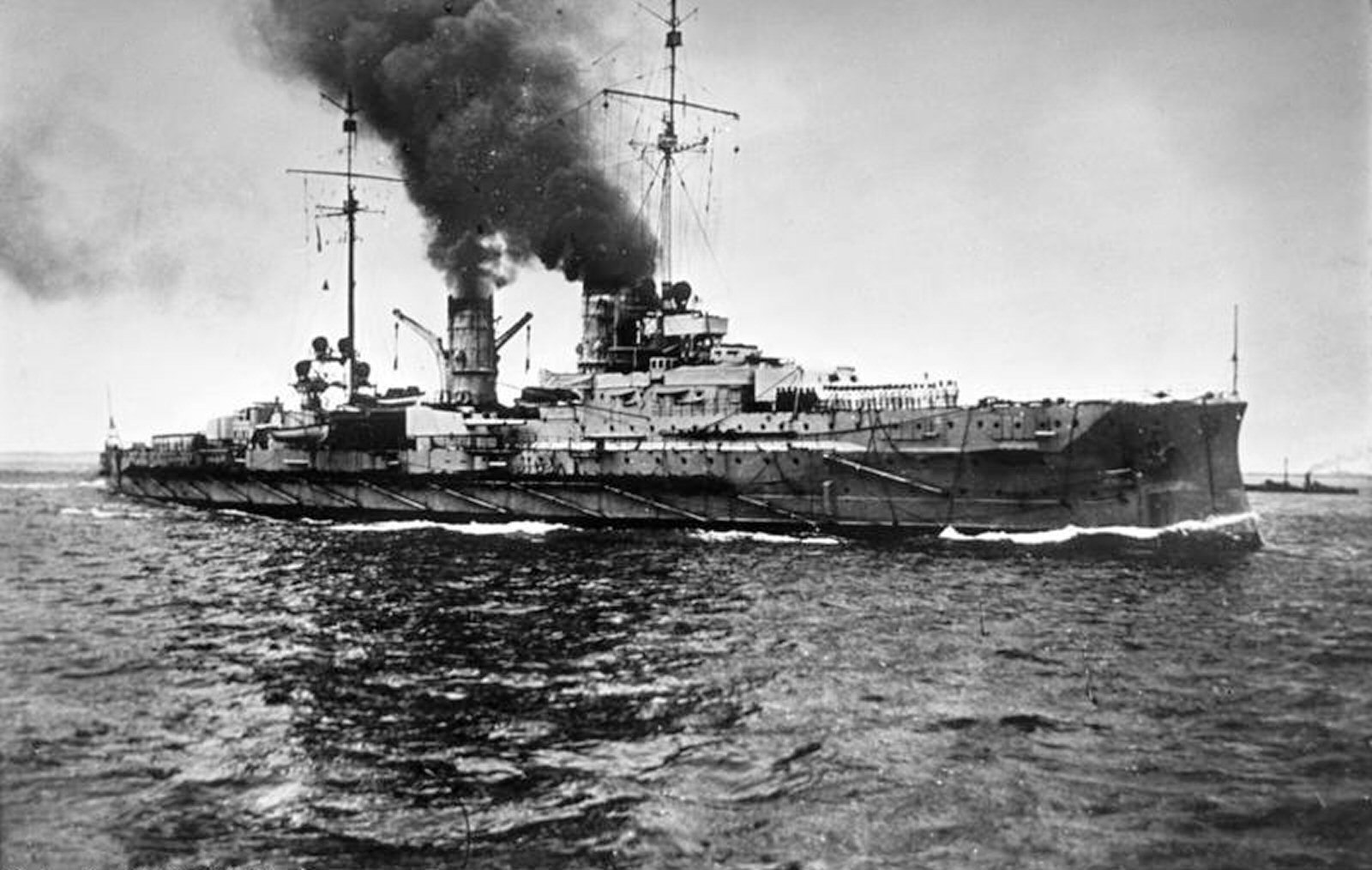
German armoured cruiser, the fastest of her class, caught by the British battlecruiser force at the Battle of Dogger Bank on 24 January 1915. Struck by over seventy British shells across three hours, she listed progressively, burning, but kept firing. She capsized at 12:07 while still shooting; the photograph of her rolling belly-up with her crew scrambling along her keel became the iconic image of naval firepower in the Great War. 792 dead; the British rescue effort was abandoned when a Zeppelin was mis-identified as a bombing attack.
The Vessel
SMS Blücher was a German armoured cruiser of the Imperial German Navy, built at the Kaiserliche Werft Kiel between 1906 and 1909 and commissioned on 1 October 1909. She was 162 metres long, 17,500 tons displacement, and armed with twelve 21-centimetre primary guns in six twin-gun turrets (one forward, one aft, and four in wing positions), eight 15-centimetre secondary guns in casemate positions, and four 45-centimetre torpedo tubes. Her armour protection included a 180-millimetre main belt of Krupp cemented armour, 180-millimetre turret face armour, and 70-millimetre deck armour.
Blücher was a unique design representing a specific historical transition in capital-ship naval architecture. She had been designed in 1905-1906 in response to German naval intelligence reports that the Royal Navy was designing an armoured cruiser armed with 23.4-centimetre primary guns; her 21-centimetre armament was specifically sized to match this assumed British armament. In fact, the Royal Navy's new design was the battlecruiser HMS Invincible armed with 30.5-centimetre primary guns; the German intelligence assessment had been substantially incorrect, and Blücher was built as a substantially underarmed ship relative to the actual British battlecruiser class.
The specific consequence was that SMS Blücher, at her commissioning in 1909, was an operationally marginal capital ship: substantially more heavily armed than the older German armoured cruisers (which she was intended to replace) but substantially inferior to the new British battlecruisers. Her subsequent deployment in the First World War reflected this marginal status: she was assigned to supporting roles rather than to frontline battlecruiser duties.
By January 1915, Blücher had been assigned to the German 1st Scouting Group under Vice Admiral Franz Hipper, based at Wilhelmshaven. Her operational role was the supporting-battlecruiser function in the High Seas Fleet's battlecruiser force. Her master was Captain Erdmann, 45, an experienced career officer. Her complement was 1,026 officers and ratings.
The Voyage
On 23 January 1915, Vice Admiral Hipper's 1st Scouting Group received orders to conduct a surprise bombardment of British East Coast ports (specifically Hartlepool, Scarborough, and Whitby had been previously raided on 16 December 1914; the January 1915 raid was intended to extend the East Coast raid pattern). The force comprised four battlecruisers (Seydlitz, Moltke, Derfflinger, Blücher) and four light cruisers with torpedo-boat screens.
The raiding force departed Wilhelmshaven on the afternoon of 23 January 1915. The planned operation was an overnight transit of the central North Sea, a dawn bombardment of the British East Coast on the morning of 24 January 1915, and an immediate retreat to German waters.
British naval intelligence, through the Royal Navy's Room 40 signal-intelligence section at the Admiralty, had decoded the German operational orders for the raid within hours of their transmission. Admiral Sir David Beatty's 1st Battle Cruiser Squadron (four battlecruisers: Lion, Tiger, Princess Royal, New Zealand) departed Rosyth on the evening of 23 January 1915 to intercept the German raiding force; Admiral Sir George Goodenough's 1st Light Cruiser Squadron provided the accompanying light-cruiser screen.
At approximately 07:15 on 24 January 1915, the British and German forces made contact in the central North Sea at approximately 54 degrees 50 minutes north, 3 degrees 20 minutes east, approximately 160 kilometres east of Dogger Bank. The German force was sailing west-northwest towards the British coast; the British force was approaching from the southwest. The two forces recognized each other as superior naval forces, and both withdrew: the German force turning back eastward towards Wilhelmshaven, and the British force pursuing.
The Disaster
The pursuing engagement - subsequently designated the Battle of Dogger Bank - lasted approximately four hours, from 08:00 to 12:00 on 24 January 1915. The tactical configuration was a classic stern-chase: the faster British battlecruiser squadron (27 knots maximum speed) was pursuing the retreating German force (25 knots maximum speed). The critical tactical consideration was the position of SMS Blücher, the slowest ship in the German formation.
Blücher's maximum speed of 25 knots was slower than the other three German battlecruisers (Seydlitz, Moltke, Derfflinger all capable of 27-28 knots). As the pursuing British squadron closed the range, Blücher progressively fell behind the main German formation and became the British squadron's primary target. By 09:00, Blücher was approximately 2 kilometres behind the nearest other German ship; by 10:00, the separation had widened to approximately 4 kilometres.
The British battlecruisers concentrated their fire on Blücher from approximately 09:30. The progressive shell damage to the Austro-trailing German ship was substantial: British 34-centimetre and 30.5-centimetre shells progressively destroyed Blücher's gun turrets, compromised her steering, and initiated multiple internal fires. By 11:00, Blücher was effectively disabled: her primary armament was substantially inoperative, her speed was reduced to approximately 17 knots, and she was taking on water through multiple hull breaches.
Admiral Beatty's subsequent tactical decision was to continue the pursuit of the main German battlecruiser formation rather than to finish off Blücher. The decision was controversial: the main German formation subsequently escaped to Wilhelmshaven, while Blücher was finished by the trailing British destroyers. SMS Blücher was hit by a torpedo from the British destroyer HMS Meteor at approximately 12:00 on 24 January 1915 and capsized at approximately 12:10.
The sinking was catastrophic but substantially survivable. Of her 1,026 complement, 792 died: primarily killed in the sustained shell engagement during the preceding four hours, or drowned in the capsize. Approximately 234 survived: rescued from the water by British destroyers and the light cruiser HMS Arethusa. Captain Erdmann died aboard the ship.
The Legacy
The Battle of Dogger Bank of 24 January 1915 was the first major surface engagement of the First World War and the first engagement between dreadnought-era capital ships. The battle's specific outcome - the loss of SMS Blücher as the only major capital-ship casualty - was substantially the result of the intelligence advantage that the Royal Navy had established through the Room 40 cryptographic section; the German force had been anticipated and intercepted in circumstances that favoured the British.
The specific operational consequence for the German Navy was the comprehensive re-evaluation of the High Seas Fleet's raid strategy. The 1915 raids had been premised on the assumption that the German raiders could successfully strike the British East Coast and withdraw before the Royal Navy's heavy forces could intercept; the January 1915 interception at Dogger Bank demonstrated that this assumption was substantially incorrect. The subsequent German raid strategy was substantially more conservative: major raids on the British coast were discontinued; German capital-ship operations in the North Sea focused on submarine warfare and mine-laying rather than on surface raids.
The specific operational consequence for the British Navy was also substantial. The admirals' performance at Dogger Bank was subsequently criticised by the Royal Navy's Fleet Tactical Board: Beatty's decision to continue the pursuit of the main German formation (and thus to allow Blücher to be finished by destroyers rather than by the heavier British battlecruisers) had been tactically efficient but had produced the consequential decision that the main German formation escaped to Wilhelmshaven. The subsequent Royal Navy battlecruiser tactical doctrine incorporated specific guidance about concentrating fire on high-value disabled enemy ships; the subsequent Battle of Jutland (1916) reflected these modified tactical principles.
The cultural response to the Blücher sinking was muted in both Britain and Germany. In Britain, the engagement was presented as a tactical success but not as a strategic triumph; the main German formation's escape was understood as the operationally significant outcome. In Germany, the loss of Blücher was presented as a unit sacrifice rather than as a defeat; the narrative emphasis was on the successful escape of the main German formation and the demonstration of German battlecruiser survivability.
The wreck of SMS Blücher was located in 1993 by Norwegian hydrographic surveys at approximately 75 metres depth at Dogger Bank. Subsequent technical-diving expeditions have documented the wreck. The wreck is protected under German and international maritime heritage legislation. The 792 dead are commemorated by a memorial at the German Naval Memorial, Laboe, Kiel, Germany, and by a separate memorial at the Imperial German Navy Section of the Central Cemetery, Berlin.