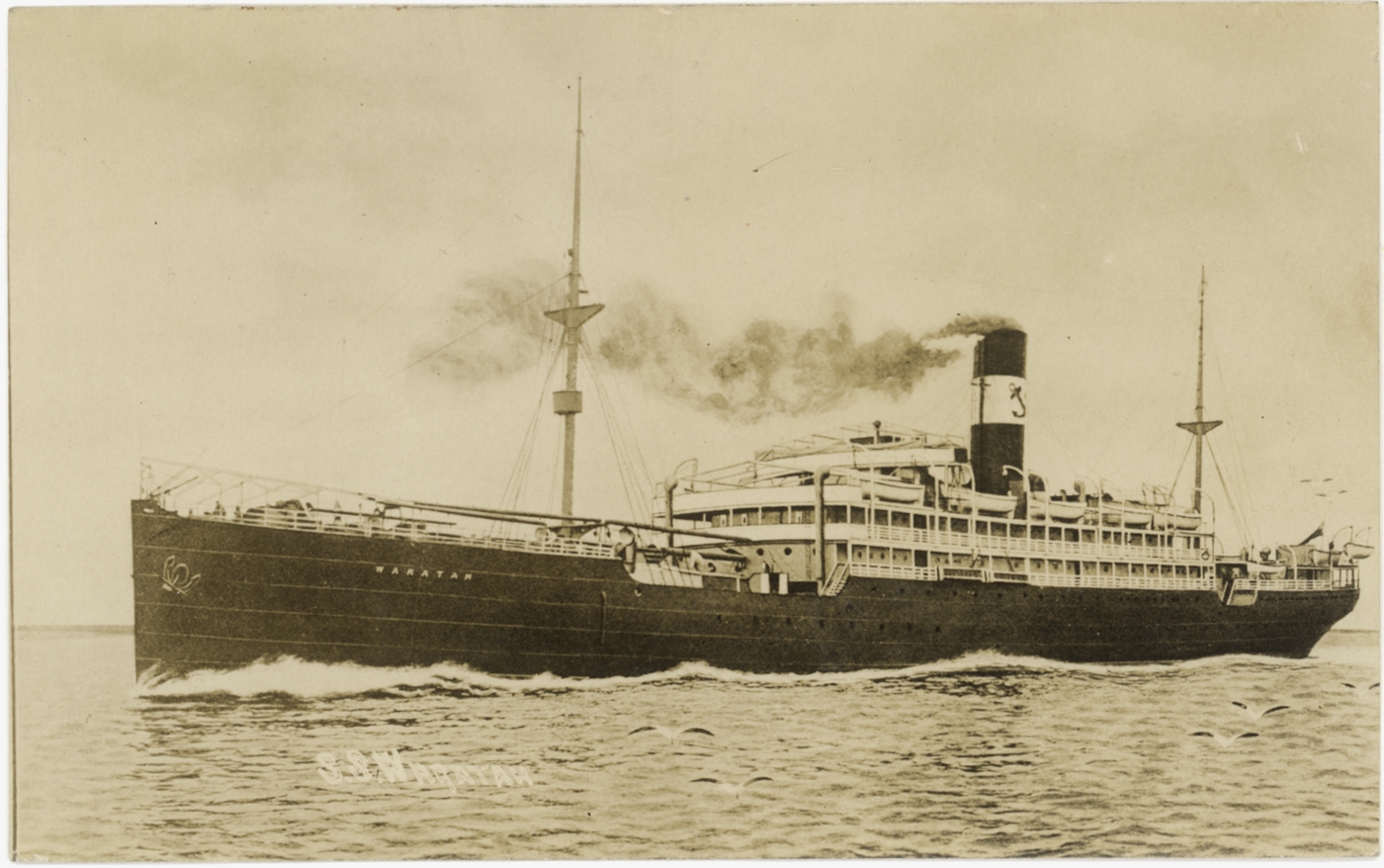
The Record
Blue Anchor Line passenger-cargo ship, Durban to Cape Town. Sailed into heavy weather on the night of 27 July 1909 and was never seen again. 211 aboard vanished without trace. Suspicion has centred on a top-heavy design and excessive metacentric height, but no wreck has ever been confirmed; known in Australia as 'Australia's Titanic', the disappearance remains one of the great unsolved maritime mysteries of the twentieth century.
The Vessel
The SS Waratah was an Australian steam passenger liner, built at the Barclay Curle shipyard at Glasgow between 1907 and 1908 for the Blue Anchor Line and launched on 12 September 1908. She was 141 metres long, 9,339 gross tons, and powered by twin quadruple-expansion steam engines. Her design was specifically configured for the Blue Anchor Line's London to Australia and return emigrant service: accommodation for approximately 100 first-class passengers, 250 third-class passengers, and substantial cargo capacity for the return voyage's wool and general freight.
She was, by the standards of the 1908 British mercantile marine, a relatively modern ship: triple-expansion engines, electric lighting throughout, electric wireless telegraphy equipment, and steel hull construction with substantial subdivision into watertight compartments. Her maiden voyage had been successful: she departed London on 5 November 1908 on her first voyage to Australia and had returned to London on 27 June 1909 without substantial incident, having delivered her full complement of emigrant passengers and returned with a cargo of Australian wool.
Her master on her second voyage was Captain Joshua Ilberry, 60, a career Blue Anchor Line officer who had commanded Waratah from her commissioning. Her complement on the second voyage was 211 passengers plus 119 crew, a total of 330 aboard.
Her specific design issue, subsequently the subject of extensive investigation, was her potential instability in certain loading configurations. During her maiden voyage, a passenger had reported to the captain that the ship had listed for extended periods and had rolled slowly at sea in a manner suggesting marginal metacentric height (the measure of a ship's stability). The specific concern had been reported to the Blue Anchor Line's engineering staff but had not been the subject of any formal investigation prior to her second voyage.
The Voyage
SS Waratah departed London on 27 April 1909 on her second voyage to Australia, carrying 211 passengers and 119 crew. The outward passage via the Suez Canal and the Indian Ocean proceeded without substantial incident. She arrived at Sydney on 6 June 1909, discharged her passenger and commercial cargo, loaded a return cargo of Australian wool, and departed Sydney on 7 July 1909 on her return voyage to London.
The return passage called at Melbourne, Adelaide, Durban, Cape Town, St Helena, and Las Palmas. At Durban on 26 July 1909, Waratah took aboard 92 additional passengers and 17 crew from the Durban station, bringing her complement on the Durban-to-Cape Town leg to approximately 211 passengers and 119 crew.
She departed Durban at approximately 20:00 on 26 July 1909 bound for Cape Town, a standard 48-hour coastal passage that was expected to be completed by approximately 26 July the subsequent evening. Her captain's log indicated fair weather, moderate southwesterly swell, and standard operational conditions.
At approximately 06:00 on 27 July 1909, Waratah exchanged signal flags with the British cargo ship SS Clan MacIntyre off Cape Hermes, approximately 240 kilometres north of East London, South Africa. The Clan MacIntyre was eastbound; Waratah was southwestbound; the two ships passed at a distance of approximately 1.5 kilometres in daylight and fair weather. The Clan MacIntyre's officers reported Waratah as sailing normally and showing no signs of distress.
This encounter, at approximately 06:00 on 27 July 1909 off Cape Hermes, was the last confirmed sighting of SS Waratah.
The Disaster
SS Waratah and her 330 passengers and crew disappeared entirely in the approximately 48 hours following her 06:00 passage of SS Clan MacIntyre on 27 July 1909. The specific events of her disappearance are entirely unknown: no distress signal was received, no wreckage was identified at the time, no body was ever recovered, and no survivors ever emerged. The ship, the 330 people aboard, and her return cargo of Australian wool simply ceased to exist on the open ocean of the southeast African coast.
Weather conditions in the region on 27-28 July 1909 were, according to subsequent meteorological reconstruction, substantially more severe than any assessment based on the surrounding coastal weather observations had indicated. A substantial southerly gale developed in the Natal coastal waters on the afternoon of 27 July 1909; the Agulhas Current in the region produced, during the gale, the specific phenomenon of "rogue waves" (isolated waves of exceptional height, typically 1.5 to 2 times the surrounding significant wave height) that have been subsequently identified as a major hazard on the southeast African coast.
The specific theories of Waratah's loss, as advanced by subsequent maritime investigators, are: (i) capsize due to marginal metacentric stability under the combined loading of return cargo and gale conditions, (ii) foundering due to a rogue wave of exceptional height, (iii) failure of her cargo stowage during the gale, producing a shifting-cargo capsize, or (iv) some combination of all three factors. The specific mechanism cannot be determined without access to the wreck site.
Extensive search operations were conducted through August, September, and October 1909 by multiple Royal Navy, South African Navy, and private vessels. The search covered approximately 700,000 square kilometres of ocean between Durban and Cape Town. No wreckage, no bodies, no oil slick, and no survivors were identified. The SS Waratah and her 330 aboard disappeared without a single physical trace.
The Legacy
The SS Waratah disappearance was, and remains, the largest unexplained maritime disappearance in the history of the mercantile marine. The absence of wreckage, the absence of bodies, and the absence of any distress signal produced a sustained mystery that has been actively investigated by maritime historians, marine archaeologists, and commercial salvage expeditions for over a century.
The immediate commercial consequence was the bankruptcy of the Blue Anchor Line, which was unable to sustain its London to Australia service in the absence of its flagship vessel. The Blue Anchor Line's fleet was purchased by P&O (Peninsular and Oriental Steam Navigation Company) in 1910; the London to Australia route continued under P&O operation.
The subsequent Board of Trade inquiry, conducted in London in 1910, was substantially handicapped by the absence of any physical evidence. The inquiry concluded that Waratah had been lost "by perils of the seas" but was unable to identify the specific mechanism. The Blue Anchor Line's stability-calculation records for the ship were examined; specific criticisms were made of the margin of safety in her design, but no finding of negligence against the ship's officers or the shipping company was made.
The subsequent cultural memory of SS Waratah has been substantial. The ship has been referred to in various Australian and South African cultural contexts as "the Australian Titanic" - though the comparison is imperfect (Titanic sank visibly; Waratah disappeared without trace). Joseph Conrad, who had personal knowledge of the South African coastal trade, referred to the Waratah case in his 1912 essay The Rescue as an example of the unknowable hazards of modern commercial navigation.
Extensive commercial salvage searches for the wreck have been conducted, including major expeditions in 1977 (led by Emlyn Brown and David Davies), 1999-2001 (Emlyn Brown's second major search), and 2004 (the NOAA expedition Emma). All searches have been unsuccessful. The 1999 Brown search identified a promising wreck signature off the Xora River estuary, which was initially reported as the Waratah but was subsequently determined in 2004 to be a different vessel (identified as an early twentieth-century ore carrier of different dimensions).
The wreck of SS Waratah remains officially missing. She lies, presumably, somewhere in the approximately 700,000 square kilometres of ocean between Durban and Cape Town, at depths that likely exceed 4,000 metres in the Agulhas Basin. The 330 dead are commemorated by a memorial plaque at the Merchant Navy Memorial, Tower Hill, London, and by a separate memorial at the Waratah Hotel, Sydney, Australia (dedicated 1910).