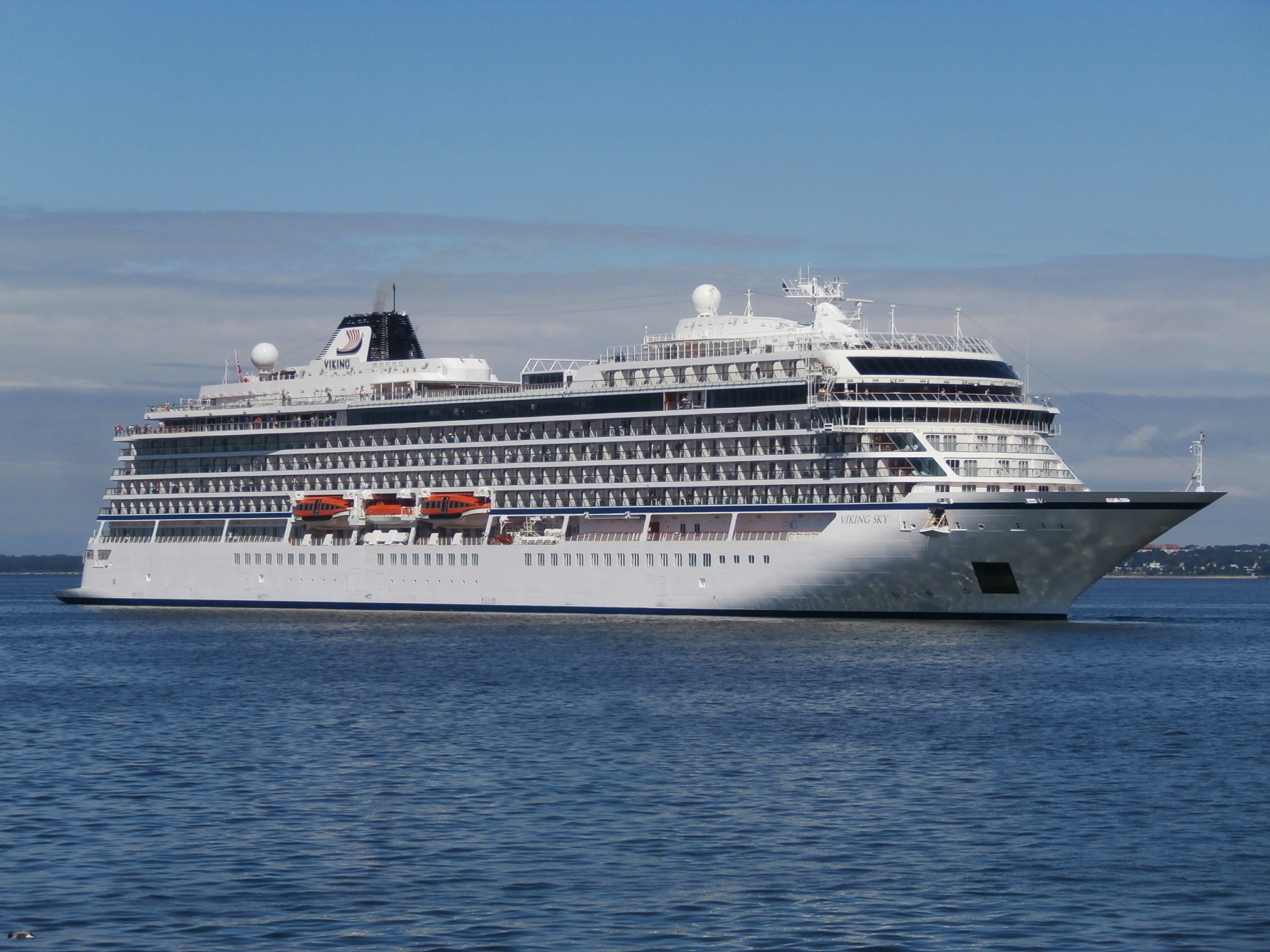
The Record
Norwegian cruise ship, on the passage from Tromsø to Stavanger with 915 passengers. All four engines lost power in succession off Hustadvika on the afternoon of 23 March 2019 in a severe storm. She drifted toward the rocky coast as her anchors dragged. 479 passengers were airlifted off by five SAR helicopters before the engines were restarted. No deaths; the cause was traced to low lubricating oil levels that had tripped automatic shutdowns.
The Vessel
The MV Viking Sky was a Norwegian-flagged luxury expedition cruise ship of the Viking Ocean Cruises company, built at the Fincantieri yard at Ancona, Italy in 2017 and commissioned on 13 January 2017. She was 228 metres long, 47,800 gross tons, and powered by twin diesel engines producing approximately 27,000 horsepower. Her accommodation comprised approximately 930 passengers plus approximately 470 crew.
She was one of the new generation of Viking Ocean Cruises luxury expedition cruise ships, specifically designed for premium-market cruise tourism with an emphasis on small-ship intimacy and destination-focused cruising. Her operational role in 2019 was the Scandinavian fjord and Arctic cruise circuit.
Her master on her final voyage was Captain Bengt-Ove Nilsen, 53, a career Norwegian merchant marine officer. Her complement on 23 March 2019 was approximately 1,373 persons: 915 passengers (predominantly American, British, Australian, and Canadian tourists) plus 458 crew.
The Voyage
On 23 March 2019, the MV Viking Sky was conducting a 14-night "Into the Midnight Sun" cruise between Bergen, Norway and Tilbury, England. The specific itinerary included multiple Norwegian port calls; on 23 March 2019, the ship was transiting the Norwegian coast between Tromsø and Stavanger.
The specific weather conditions on 23 March 2019 were substantially unfavourable. A major Norwegian Sea storm was affecting the Norwegian coast; wind velocities had risen to force 9-10 (approximately 90-100 kilometres per hour); sea state was approximately 6-8 metre waves; the specific conditions were near the operational limits for cruise ship operations.
At approximately 14:00 on 23 March 2019, Viking Sky was approximately 4 kilometres off the Norwegian coast at Hustadvika, a notoriously dangerous stretch of coast characterised by numerous submerged reefs and complex coastal geography.
At approximately 14:00 on 23 March 2019, Viking Sky experienced sudden engine failure. All four main engines stopped almost simultaneously; the specific cause was subsequently identified as engine lubrication failure caused by low lubricating oil levels (approximately 28 per cent below required levels) combined with the specific ship motion in the severe weather conditions.
The Disaster
The specific loss of engine power in the severe weather and the specific proximity to the hazardous Hustadvika coast produced an immediate critical situation. Without engine power, the ship was unable to maintain her position or heading; she began drifting toward the reef-strewn coast at approximately 3-4 knots.
Captain Nilsen's immediate response was to drop both anchors to prevent the ship from being driven onto the reefs. The specific anchoring was successful; the specific ship's position was stabilised approximately 4 kilometres offshore, but the extreme weather conditions continued to substantially affect the anchored ship.
The specific immediate concern was the possibility of the anchors dragging or the specific ship being swept closer to the reefs by the extreme wave action. The specific Norwegian Coast Guard and rescue authorities immediately initiated a major emergency response.
The specific rescue operation was one of the largest helicopter rescue operations in Norwegian history. The specific operation involved: (i) approximately 10 Norwegian Air Force rescue helicopters operating in rotation; (ii) multiple Norwegian Coast Guard vessels providing support; (iii) approximately 19 hours of continuous helicopter evacuation.
Over the period from 15:00 on 23 March 2019 through 10:00 on 24 March 2019, the specific helicopters evacuated approximately 479 passengers from the Viking Sky to the mainland. The specific remaining passengers (approximately 436) and the crew remained aboard the anchored ship.
At approximately 06:00 on 24 March 2019, the ship's crew was able to restart one of the main engines; the ship was subsequently able to proceed under her own power to the nearby port of Molde, Norway. The specific Viking Sky did not sink; she was successfully recovered from the emergency situation.
The specific injuries from the incident were substantial: approximately 20 passengers were injured during the ship's severe rolling in the storm conditions and during the helicopter evacuation. Some specific serious injuries occurred, but no fatalities resulted from the incident.
The Legacy
The MV Viking Sky incident of 23-24 March 2019 was one of the most dramatic cruise ship emergencies of the modern era. The specific near-catastrophe of a major luxury cruise ship drifting toward a hazardous coast in a severe storm, combined with the specific successful emergency response, produced substantial international media attention and subsequent regulatory review.
The subsequent Norwegian Maritime Authority investigation, conducted through 2019-2020, identified the specific causes: (i) the specific low lubricating oil levels in the ship's engines; (ii) the specific inadequate monitoring of oil levels by the ship's crew; (iii) the specific operational decisions to maintain the ship's schedule despite the severe weather warnings; (iv) the specific design considerations for the engine lubrication system at severe ship angles.
The specific institutional response by Viking Ocean Cruises was substantial. The specific company implemented enhanced operational procedures; enhanced engine-monitoring protocols; enhanced weather-delay policies; enhanced crew training for emergency situations.
The specific regulatory response was substantial in both Norwegian and international maritime operations. The International Maritime Organization's subsequent policy discussions on cruise-ship emergency response; the specific engine-lubrication requirements for cruise ships; the specific enhanced port-state inspection protocols - all were substantially informed by the Viking Sky case.
The specific cultural memory of the Viking Sky has been substantial in the cruise industry. The specific 2019 incident was extensively documented in video footage by passengers aboard the ship (which was subsequently distributed via social media); the specific dramatic imagery of passengers clinging to furniture during severe ship rolls became an iconic representation of cruise ship emergencies.
The specific ship Viking Sky was subsequently repaired and returned to active service. She has continued to operate as a Viking Ocean Cruises expedition cruise ship; the specific 2019 incident has been incorporated into her subsequent marketing as an example of the ship's successful emergency response capabilities.
No casualties occurred in the specific Viking Sky incident. The specific dramatic near-disaster is commemorated through the specific Norwegian Coast Guard's annual commemoration of the rescue operation and through the specific cruise-industry training materials that reference the incident.