The Record
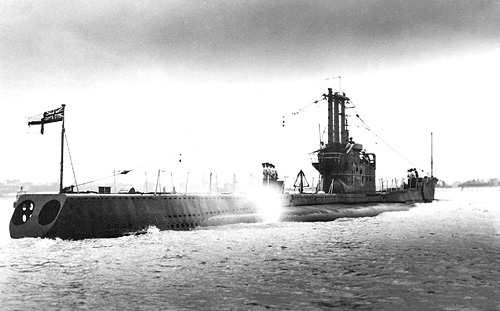
Royal Navy A-class submarine, on a training exercise out of Portsmouth. Failed to surface from a dive on the night of 16 April 1951 somewhere between Start Point and the Channel Islands. Seventy-five dead, no survivors. Located two months later on the continental shelf at 85 metres; the probable cause was a structural failure of the snort mast that flooded her while submerged.
The Vessel
HMS Affray (P421) was a British A-class submarine of the Royal Navy, commissioned at the Cammell Laird yard at Birkenhead on 25 November 1945. She was 87 metres long, 1,120 tons surfaced displacement, 1,620 tons submerged, armed with ten 21-inch torpedo tubes (six forward, four aft) and a single 4-inch gun. Her designed operational depth was 150 metres; her test depth was 180 metres.
The A-class was the Royal Navy's last generation of conventional diesel-electric submarine built during the Second World War, commissioned between 1945 and 1948. Sixteen A-class submarines were built at various British yards; Affray was the eighth of the class. Her peacetime service had been primarily in the Mediterranean Fleet and the Home Fleet, with periodic operational deployments through the late 1940s.
By 1951 she had been in Royal Navy service for five and a half years. She had recently completed a refit at HM Dockyard Portsmouth that had modernised her electrical switchboard, replaced some of her older Vickers electrical components, and upgraded her snorkel system (an equipment that allowed her to run her diesel engines at periscope depth rather than on the surface). Her commanding officer from January 1951 was Lieutenant John Blackburn, 27 years old, a career Royal Navy submarine officer on his first submarine command.
The Voyage
On 16 April 1951 HMS Affray departed Portsmouth on a training exercise, Operation Training Class Fourteen, for which she was carrying a mixed complement of officer and NCO trainees in addition to her regular crew. Her embarked complement included 50 regular crew members and 25 training personnel (Royal Navy and Royal Marine officers and senior ratings undergoing submarine warfare training), making her total complement 75. This was significantly above her normal crew complement of 55.
Her specific mission was a routine submerged training exercise in the waters of the English Channel, approximately 30 nautical miles south of Start Point, Devon. The exercise schedule called for Affray to submerge at approximately 21:00 on 16 April 1951, to conduct a 15-hour submerged training cycle (including simulated torpedo attacks, depth-control exercises, and periscope-watch training), and to resurface at approximately 12:00 on 17 April 1951.
At approximately 21:15 on 16 April 1951, HMS Affray transmitted a routine submerging signal to the Portsmouth submarine command. The signal indicated her intended dive time (21:00) and her intended surface time (12:00 on 17 April 1951). She then disappeared from radio contact, as was normal for a submerged submarine operating on exercise.
The Disaster
At 12:00 on 17 April 1951 HMS Affray did not surface as scheduled. The Portsmouth submarine command initiated the standard overdue-submarine alert at 12:30 on 17 April. The Royal Navy's subsequent search operation was one of the most extensive peacetime submarine searches ever mounted. Over 50 surface ships, 4 submarines, and continuous RAF Coastal Command maritime patrol aircraft operations searched the Affray's expected operating area for 60 days between 17 April and 14 June 1951.
HMS Affray was located on 14 June 1951 by the submarine search vessel HMS Loch Fada using an experimental Type 193 sonar that the Royal Navy had been developing specifically for submarine-location operations. Her wreck was found in 86 metres of water at approximately 50°17′N 2°17′W, on the continental shelf south of Dorset, on a relatively smooth sandy bottom.
Subsequent investigation of the wreck, conducted by the recovery vessel HMS Reclaim using both surface-supplied diving and the newly-developed tethered remotely-operated underwater vehicle, identified the immediate cause of Affray's loss. Her snorkel mast, a 6-metre vertical pipe that allowed air intake when she operated at periscope depth, had failed structurally at the base. The failure had admitted the sea into the submarine's upper ventilation system, which then flooded through the open ventilation valve of the control room. The flooding had occurred rapidly; the crew had no time to reach their escape positions.
75 of Affray's 75 crew and training personnel died. The death toll was the worst peacetime submarine disaster in Royal Navy history at that date, and remained so for the remainder of the twentieth century.
The Legacy
The Royal Navy's formal investigation of the Affray loss, conducted by the Admiralty Board of Inquiry from September through December 1951, produced a detailed mechanical analysis of the snorkel mast failure. The specific root cause was identified as a metallurgical defect in the snorkel mast's base-plate weld, where the mast attached to the pressure hull. The weld had been subject to stress corrosion over approximately six years of service; the specific conditions of the 16 April 1951 exercise (repeated periscope-depth snorkelling at moderate sea state) had caused the stressed weld to fail at an approximately 90-degree angle from the vertical.
The subsequent Admiralty Board action was far-reaching. All Royal Navy A-class submarines were ordered into HM Dockyard Portsmouth for inspection and refit of their snorkel masts; the inspection programme, conducted from January 1952, identified similar stress-corrosion cracks in eight of the sixteen A-class boats. The refit programme replaced the original snorkel mast bases with reinforced designs using improved metallurgy and with additional structural supports to prevent failure modes of the Affray type. The refit programme was completed by December 1953.
The broader Royal Navy submarine safety reforms that followed the Affray investigation included: mandatory periodic structural inspection of all submarine external hull penetrations (implemented 1952); revised safety procedures for Royal Navy training cruises involving non-regular crew personnel (implemented 1952); and the establishment of the Submarine Rescue Service within the Royal Navy (implemented 1953), which for the first time created a dedicated deep-sea submarine rescue capability for the Royal Navy.
The wreck of HMS Affray has remained in her 1951 position at 86 metres depth in the English Channel. She has been periodically surveyed by the Royal Navy, most recently in 1998. She is a protected war grave under the UK Protection of Military Remains Act 1986. Her position is marked on modern nautical charts, but diving on her is prohibited without Ministry of Defence authorisation.
The 75 dead of HMS Affray are commemorated at the Royal Navy Submarine Memorial at HMNB Portsmouth, and at the HMS Affray Memorial at HMS Alliance at Gosport (the Royal Navy's submarine museum). The 17 April 1951 anniversary is marked each year by the Royal Navy Submarine Service with a memorial service at HMS Dolphin in Gosport. The name HMS Affray has not been carried by any subsequent Royal Navy warship. HMS Affray remains the worst peacetime submarine disaster in Royal Navy history, and the catalyst for the modern Royal Navy submarine safety regime.